Joshua States

pollinator
+ Follow
since Feb 19, 2021
Merit badge: bb list bbv list
Biography
I spent most of my life on one adventure after another. I've studied classical ballet, music, and driven truck OTR. Rock & ice climbing, mountaineering, and bow hunting have been my primary outdoors pursuits. I have spent most of my professional life in the building trades and recently retired from my job as a building code guru. My wife and I have a metal working business where we do a lot of forging, welding, and creating. I also do a bit of woodworking. My primary focus in metal work is knives and other bladed tools.
For More
6a Alpine Southwest USA
Apples and Likes
Apples
Total received
In last 30 days
4
Forums and Threads

Recent posts by Joshua States

I'm very interested to see how you finished out the interior. This is what we call a "Tiny Home" here in the US.
I guess you have to clean the snow off the solar panels in the winter?
2 weeks ago
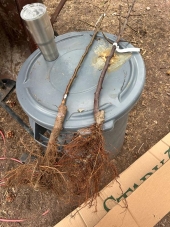
I managed to get the invaders out with some amount of root ball still attached. I planted them in between the mush room beds.

2 weeks ago
Update:
The Pioneer Mac died. I got a replacement, but they sent the wrong variety, (red delicious, which I don't like at all), so I complained and got a Gala instead. I just planted both of them.
All three survived the winter and are now starting to leaf out. The Braeburn is much larger than the other two, which are little more than twigs with some buds.
Sorry about the rotten phone pics.


2 weeks ago
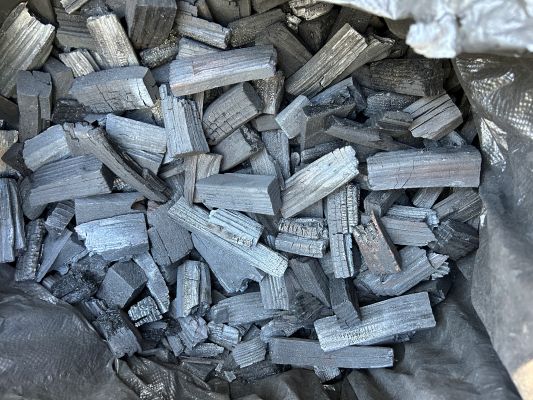
I was outside today crunching some charcoal I made and stored for a few years. I crush it and use it periodically. I started with 160 pounds of it, so it will last me a while.
Yeah, I know what you are thinking, where did you get 160 pounds of charcoal? (my system is down at the bottom herewebpage.)
Anyway, I decided to chuck it into my little SunJoe woodchipper to see how that worked.
I started with these pieces that are anywhere from 1-1/2" square and 4" long to pieces 1/2" thick and just as long, down to pieces that were about 1" square.


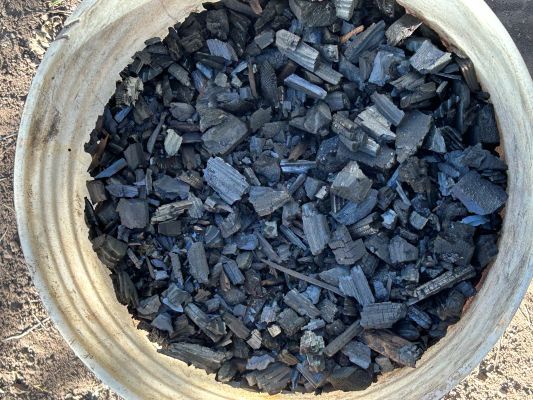
After about 10 minutes or so, I had about 4-gallons of this and a lot of powder at the bottom of the pail.


2 weeks ago

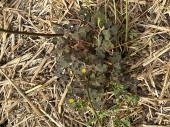
Nancy Reading wrote:It looks like you have two different plants there -

I'm wondering if the brighter green one is chickweed (Stella media)?

It is a common annual - quite nice as a salad leaf. I can't really tell from the photo though.

The other looks like some sort of Oxalis - maybe oxalis corniculata:
That can be invasive I gather depending on your climate. Again edible leaves, although tend to be a bit tough in my experience.


I think @Nancy Reading is right, there are two different volunteers in there. I also think @Samantha Lewis is right that these came with the nursery plants.

I need some pollinator attraction, so I might try to dislodge them and transplant. They are terribly close to the crown, so that might be impossible without damaging the blueberry.
I'll get some better pics tomorrow.
2 weeks ago
I started a few blueberry plants last year in containers and moved them into the greenhouse to over winter. They have started to come back around, and I noticed one of them has some new companions.
What the heck are they and should I get rid of them?
2 weeks ago
I finally found time to watch the video. It was worth it.
Even though it focuses on large scale farms and is just the beginning of research into using biochar as a soil amendment, it has relevant information for much smaller growers and even the home garden. You would just need to create a system suited to the size of your operation.

A couple of points I noticed:
One of the farmers was mixing his biochar with composted material at a 90/10 ratio of compost to biochar. Another farmer was mixing it with non-composted organic matter at a 20/80 ratio of organic matter to biochar and letting the composting process continue. Very different ratios and very different methods. I think the only results we heard about at the end of the video were from the farmer who mixed at the 90/10 ratio.

I remember reading about the discovery of Amazonian soils and realizing that the ancients mixed charcoal with their soil. What strikes me is the apparent dichotomy between the expectations between what the Amazonians did vs. what we Westerners want. The Amazonians were looking at soil health from a generational perspective. They were aware that this process took years, if not centuries, to come to full fruition. We expect to see results after a year or two and that's probably not a reasonable expectation. I am willing to accept small, incremental changes, so I will continue to use charcoal/biochar as a soil amendment in my garden. As this is only my first season in a new climate zone, it's going to take some time.

I have already mixed biochar into my compost pile. Now I have a load of organic matter that is just starting the composting process. I think I will add some biochar to that compost bin and see what happens.
2 weeks ago

Eric Hanson wrote:Joshua,
Very Nice!
You have a nice wood chip bed for your mushroom spawn.  If you want to encourage them a little more, maybe find some straw and cover with 1-2 inches of light, fluffy straw--don't overdo it.  This is just enough to keep the wood chips damp.
But again, these look very good.
Good Luck,
Eric


Thanks Eric,
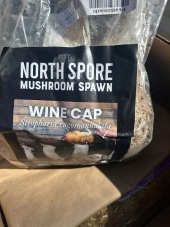
IDK if you caught it, but the spawn is scattered between two layers of straw that came with the spawn. The only straw I have access to is the bulk stuff from stores like Tractor supply and other animal feed retailers. This contains seeds and I have vowed never to use it as mulch again. I spend way too much time weeding straw out of my beds. I have a good supply of oak leaves and pine needles though. I am using this as mulch in my new outdoor garden. Perhaps some of that would do?

2 weeks ago

Burton Sparks wrote:Joshua, how exciting! I've done a winecap bed, but only oyster in logs.

Joshua States wrote:The oyster bloc got cut in half and buried just below the surface, covered with dirt and wood chips.


You don't spread the oyster spawn like winecap? I couldn't tell from their website.
Is the thought that the beds get moisture from rain, or greenhouse runoff?


This company sells Italian Oyster block in a few varieties: some is spreadable spawn, log inoculation, bucket kits, fruiting blocks and plant & grow blocks.
https://northspore.com/search?q=Italian+Oyster&type=product&options%5Bprefix%5D=last

I wanted to buy the plant & grow block but accidently ordered the fruiting block. The fruiting block is "side fruiting" which means you are supposed to leave it in the bag and cut one of the sides open. The mushrooms grow out the side of the bag. It doesn't matter which side you choose. I wasn't going to grow these indoors, so I decided to take the chance and treat the fruiting block like two smaller plant & grow blocks. I cut it in half, turned each side up, and planted them. We will see what happens.

The beds will likely get watered by rain and by hand until I get my rain catchment system set up. I live in a very arid climate.
3 weeks ago