Benjamin Dinkel

Rocket Scientist
+ Follow
since Oct 01, 2019
Merit badge: bb list bbv list
Forum Moderator
Benjamin Dinkel currently moderates these forums:
Biography

Environmental engineer with a masters in renewable powers using the magic powers of permies.com to learn all about the "rocket" technology and innovate with the fellow rocket scientists.
For More
Province of Granada, Andalucía, Spain
Apples and Likes
Apples
Total received
In last 30 days
28
Forums and Threads

Recent posts by Benjamin Dinkel

Day 4 was probably my favorite day.

We raised all the brick walls to their finished height and solved a bunch of tricky situations with cob and brick cuts.


The exhaust path is closed off with a marble slab. On the bottom right you can see the bypass installed just after the manifold leads into the stratification chamber / bench.


Manifold installed and cobbed into place


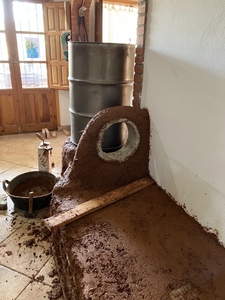
Then the whole space around the core was filled with expanded clay and the top barrel put in place.


Baffle and bypass both in place and sealed with super wool


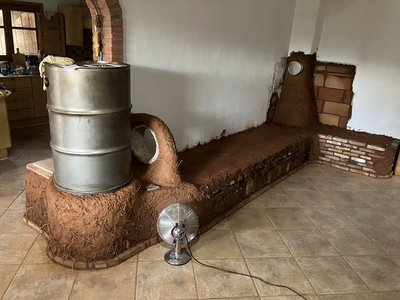
The first of the marble slabs covering the bench


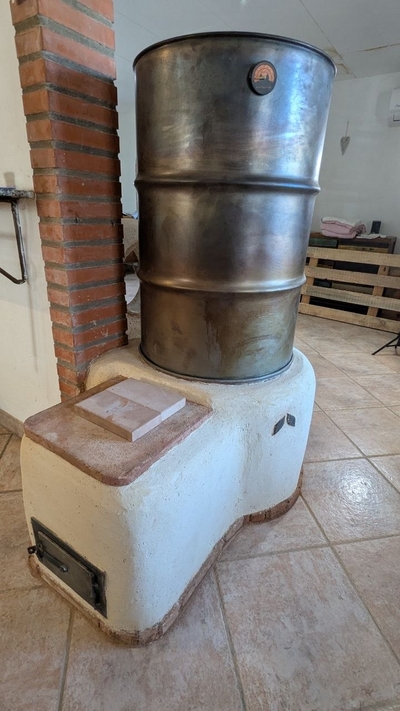
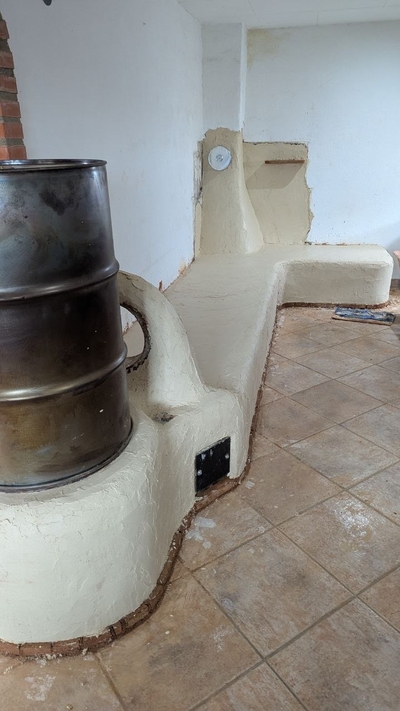
Almost ready for the first burn


Hey Coydon,
I don't understand what you're asking or saying.
I used a similar product. It's like little balls of cereal, but made of clay.
Hi Coydon,
under the core there is a 10 cm (4") layer of expanded clay. The expanded clay is just out down, without a binder. It has pretty good insulation properties.

The stratification chamber is built right on the existing concrete floor. No extras.
2 days ago
Day 3 started with yet another dry stack on the now insulated foundation


The foundation was then expanded and cobbed in place


At the same time the brick wall for the bench was continued


The first and second course of the core, held together with clay slip


I had the hands full, so the next photo is of the core built, with barrel and bypass in place

Also note the baffle to allow the hot exhaust to stay in the stratification chamber.

This is how we left it day 3.


While day 1 and 2 seemed like slow progress, day 3 was super fast and rewarding.
2 days ago

Coydon Wallham wrote:
Is the bypass not connected yet?


The bypass is situated inside the bench. I decided against locating it on the barrel. Instead it only bypasses the stratification chamber by allowing the exhaust to go straight to the chimney after exiting the manifold.
You’ll get some fotos soon
2 days ago
We built on the existing concrete floor
3 days ago
Day 2 started with finishing the roof. A chimney hat and rain protection was installed.


We then proceeded to do a mock up inside to see where to cut out the flooring.


This is after cutting out the flooring and protecting the surrounding area.


We then started building the first course of the perimeter of the bench and the core with red clay brick and clay mortar (clay and fine sand; 1:3 ratio).


With the perimeter set we proceeded to laying down the foundation of firebrick for the core in expanded clay and called it a day!


4 days ago
My computer is finally working again so I can start the documentation of the first RMH that I have built as the professional on site.

As written here, it's a 6" traditional J-tube with a relatively light stratification chamber. That is mostly due to us building on a second floor and also because of the mild mediterranean climate of the client.

Here is us setting up a mock up on day 1 of the build to find the correct position for the chimney.

The power lines will be just out of the stratification chamber, protected in the insulative expanded clay.

Then we went on to open the roof in the correct place (which I missed at the first try, so more roof repairs than originally needed unfortunately )


After the roof was opened we installed the stainless steel exhaust pipe.


Then we called it a good first day (more days to follow...)


5 days ago
Hi Michael. I imagine the application of the wood ash would be rather complicated.
If you get the ash on top of the cob I don’t know wether the next layer would adhere properly.
Also in this particular build the core needs the weight and the bracing by the cob, so I don’t think ash would work in this case here.
1 week ago
cob
Hey Michael.
Good question!
The method I’m familiar with is heating the rocket up as soon as possible, so while the cob still has some plasticity. This way it adjusts to the other parts in their expanded state and very limited cracks should appear.
If you can’t do it that way you need expansion joints. A lot of people here use some super wool between different materials. Often where metal meets cob.
1 week ago
cob