


Ian Thompson

+ Follow
since Feb 16, 2022
Merit badge: bb list bbv list
For More
North Central Indiana. USDA Zone 6, Clay Loam soil.
Apples and Likes
Apples
Total received
In last 30 days
8
Forums and Threads

Recent posts by Ian Thompson

Thekla McDaniels wrote:🤣🤣🤣


I ordered the first book you mentioned.  Very exciting!

I always thought you needed a lot of growth on the original tree because of what I had observed pruning 70 year old apricot trees….

Thanks very much


It is a very informative book.

I personally would not consider pollarding a tree over inches in diameter. If I had a such a tree I would select smaller lateral branches and make my pollarding cuts on the side branches. However, I would have not qualms about coppicing a 6 inch diameter tree.
1 week ago

Thekla McDaniels wrote:Not going to post the other stump.  It doesn’t have near as vigorous a set of sprouts, and it’s taking a long time to upload.


Yeah, that is more of shoulda started pollard cuts 10 years ago kind of situation.
1 week ago
You had a lot going on that year…wow.

At rate this is the most current and comprehensive publication I am aware of.

https://www.coppiceagroforestry.com/

And another called Sprout Lands

https://www.williambryantlogan.com/


1 week ago

Thekla McDaniels wrote:

I have, in my yard, evidence of a past error in my thinking.  I had 3 huge willows.  Now I have one, and two 4 foot tall 18-24 inch diameter stumps.  One has the sprouts I wanted, sort of.  I had the idea that pollarding a large tree would be successful, would be a good idea.  Now I know.  It’s possible I sometimes have too much confidence in my logic.🤭
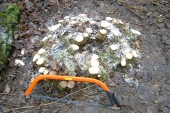


Well, so, the reasons why you ended up with two stumps and one sort-pollard can be multi-factorial. How it responds can depend on a lot of things such as the amount of light it receives, general health, trunk diameter, and species.  Willow is a fairly prolific sprouter, but to expect it to pollard with an 18-24" trunk is asking a lot.  If the trunk were receiving less than optimal light, that would be another reason for the less than optimal response.  Generally you start a pollard when that tree is quite young / small and with forethought of what you it to become, sort of like pruning.

1 week ago

Anne Stobart wrote:In my experience, for example willow species, it is important to manage coppicing from an early age and on a regular cycle in order to make it sustainable.


Can you describe what you mean by "sustainable" here?
3 weeks ago
Right, but managing slippery elm as a coppice gets around the unsustainability of the harvest techniques currently practiced in the wild, especially in a forest garden type setting as discussed in your publication.
3 weeks ago
I am surprised slippery elm is not in your list.

Looking at your list, I would say that most all of them will coppice.  Assuming that they are growing in sunny areas with adequate fertility it seems like all of those plants should thrive under coppicing, assuming they not subject herbivory.  Among broad leaved woody plants suitability for coppicing is the rule rather than the exception.  Anything that will pollard will coppice, but some, of course, are not suitable for pollard (plants such as elder, which naturally grow as multi-stemmed shrubs).
3 weeks ago

Cécile Stelzer Johnson wrote:

Rico Loma wrote:Ian, could you write more about your efforts? Color me intrigued,  this sounds like a stellar idea


Indeed it is! and if you have access to a lot of dead fish, (like from a lake where all the fishermen can clean their fish) you have it made. I found the process at this site, which gives you the recipe and proportions fish/ sugar/ lactobacillus:
https://www.ridgedalepermaculture.com/blog/making-fish-hydrolysate
It sounds relatively simple, if somewhat stinky.


Fish hydrolysate, made correctly, smells more cheesy or ketchupy than fish.  Not a great smell, but mush better than fish emulsion and potentially better than collected manure.
3 months ago

Rico Loma wrote:Ian, could you write more about your efforts? Color me intrigued,  this sounds like a stellar idea


Yeah, of course, is there is something specific that you would like to know? I live north central Indiana.  The largest body of water is the Wabash River with some others being the Tippecanoe River, Wildcat Creek and the Big Pine.  You fine the silver carp mostly in the Wabash and Tippecanoe rivers.  They are phyto/zoo-plankton eaters.  Grass carp are vegetation eaters.  They have become very prolific many waterways across the US due to their accidental release and compete with natives for food sources and / or foul the water with poorly digested plant material waste. Neither of these fish are omnivores or bottom feeders.  Like all fish in most waterways PFAS are becoming an issue. They are very bony, but the taste of the fish is very mild. They are just a typical "white fish". Season them up and they are tasty. Very boney though so like I said, I typically grind them twice through a meat grinder and just make fish cakes.  

Silver carp are not easy to catch because they are not going to go for most things you bait a hook with it. Bowfishing or netting is the way to go. Bow fishing is super fun.  A great hobby for spending time outdoors.  These carp species are grouped in to the "trash fish" category (a term that is misleading and misapplied to native nongame species).  You can basically take as many as you want at most waters where they exist.

I have tried at times to do a "fish rotation" through my garden, where I would save up the filleted corpses of the fish and bury them along an entire garden bed all at once. There were plenty of nutrients there but the practice took up a lot of freezer space, required a considerable time of bare soil and did not do the soil texture any favors.  A cover crop rotation is much healthier. I shot two silver carp on Saturday which came to about 3.4 kg.  I chopped up the fish put them in devoted "gross blender" and pulverized them.  Then you add you about 3 parts water per part fish and molasses and mix it all up. Molasses ratios seem to vary from 1/3 to 1 per part fish.   Stir it daily and this time of year, in about two weeks you can strain it for use.  I think it needs to pH stabilized to store with out further decomposition.  I have read dropping the pH to 3.5 with phosphoric acid is a good way to do that. All this will make about 4 gallons of concentrate which is greatly diluted and then soil / foliar applied.  Considering that 2 fish will make 4 gallons of concentrate (they are pretty big fish) and typical dilution rates are like an 1 oz per gal , this is the primary fertilizer I will need.  Considering I can spray it on cover crops, this means the cover crops will further enrich the soil (not to mention all the good they do with endomycorrhiza), fish hydrolysate is a great way to go. I will also soak my biochar (also made largely from invasive species) in dilute FH solution, making....biocharp.  It is a nice little local loop.

3 months ago
I bow fish silver carp out of my local waterways. Grass carp as well.  Their diets make them a little safer to eat due to less bioaccumulation.  They are boney though. I typically grind them and then make fish cakes, bones and all.

I am also starting to make fish hydrolysate out of them now.

3 months ago