

|

|

|

|

|

|
|
|
|
|
|
|
|

Myron Platte wrote: It would take a cup of apple seeds eaten straight to make you sick. That said, I have never gorged myself on the centers of stone fruits, so I wouldn’t know if it was just a low dose, or something.

Konstantinos Karoubas wrote:sea buckthorn. I am aware of but have not used in reforestation or on my farm. I should.

Eino Kenttä wrote:Wouldn't it be neat to have an apple landrace with the suckering trait, so you can dig up suckers from the nicest seed-grown trees and share around? I think I'm gonna try to make this happen. I've found a source of Malus sieversii (yay!) and also been given a sapling supposedly from an old norwegian variety which was described as suckering (if it's true, double-yay!) so we'll see in a couple decades if I can start sharing out own-root apple suckers...
Interesting thing about the supposed sucker I recieved, though: it has what very much looks like a taproot. So either the suckers form something resembling taproots, or it's actually a seedling. Hoping for the former...
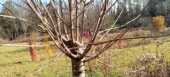
Paul Vid wrote:Trav Puteshestvennik where are you located and can you send scion wood of the plum variety that succeeded in grafting? I wonder if you think any myrobalan plum would work? Did you try out some other closely related species yet?

Jamie Chevalier wrote:"True Quince", (Cydonia oblonga) is an amazingly productive perfect for homesteads. Survives summer heat with little to no irrigation, l
Anthony Powell wrote:
Flowering quince is a bush, there's 3 or 4 species, common garden ones are Chaenomeles japonica (brick coloured flowers, small fragrant fruit with short shelf-life, dense bush - that I'm trying to extricate but it seems to have suckered to something really dense); and C. speciosa with flowers of various colours between white and bright red, fruit up to reasonable apple size that store pretty well. Both these fruit reliably, but are to some degree thorny.
Less hardy is Chaenomeles cathayensis, with the largest fruits and is very thorny.
Chaenomeles is so reliable in countries like Ukraine there are small plantations and research into developing commercial varieties, using various species and interpecific hybrids.
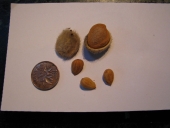
Denis Huel wrote: It also likely could be readily hybridized with the commercial almonds and even with peaches. All in all a very interesting plant with a lot of potential considering its cold hardiness.
Greg Martin wrote:, it's very interesting that most are not bitter but that some are. Is the ratio of bitter to non-bitter the same on both of your shrubs, or does one have the majority of those bitter nuts?
Doug Hack wrote:Today I collected 400 wild bitter almond seeds in a bucket and planted them about every two feet along about 800 feet of perimeter fencing. If even 5 percent of them survive I will have 20 new trees to start my hedgerow/shelter fence.