Ben Brownell

+ Follow
since Sep 12, 2024
Merit badge: bb list bbv list
Biography
Collaborative eco-design-build background. Most active on the creative edges of regenerative development and "wild placemaking" in temperate to arid western US states presently. Keen to cultivate more and better long term relationships between humans and their landscapes through apt engagement with and toward healthy whole systems.

I can help find, assess, and strategize optimal rural live-work real estate or land tenure situations if interested!
For More
Klamath-Siskiyou CA
Apples and Likes
Apples
Total received
In last 30 days
1
Forums and Threads

Recent posts by Ben Brownell

Fun wide-ranging convo, just jumped around through some of the replay. I met Stephen a few times in early 2000s as the Punta Mona project was growing, it was quite an inspiration then.

Some key points come out towards the end, where it's clear his approach is very much as a 'themed' real estate developer. I'm not sure this is the best or only approach to successful sustainable community, but it is effective and efficient in the current context since it's a (working) model many are familiar with, and capital is available to activate. Also important to note how much learning curve there is for all participants, continuously, such that people may ultimately 'graduate' from somewhat more conventional developments into more fully cooperative creative spaces, and/or serve as mentors and guides for others stepping in.
Deal, happy to aim for mutual uplift and/or sympathy as needed!

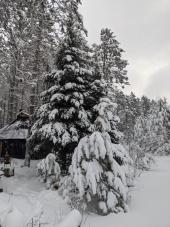
Actually I do get a taste of winter in my vicinity, being located above one of three major rivers that crosses the Cascade crest allowing much colder interior air/weather to 'leak' out West. Touched 2F last winter...although yes, generally above freezing most days and little accumulating snow.

This year has been a process of reorienting my game plan somewhat and trying some different angles of outreach, both locally and further reaching. I summarized that here a few months ago, and haven't advanced much since in terms of finding enthusiastic engagement:

https://permies.com/t/287020/Join-creative-rewilding-community-trial

Might work toward a more structured apprenticeship program next year where people could learn by building, and have use of the space provisionally thereafter, similar to programs running here (Permies). Lots of very affordable land nearby too, where people could then plant themselves longer term if desired. We'll see! I will do a little better end of year recap either in the above thread or a new one more like your blog format here.
2 days ago
I particularly want to get people to see that investing (financially) in Permaculture-informed regenerative development, with a focus on producing affordable ecological homesteads and housing co-ops, is a much needed fast acting systems-change lever that is actionable, reliable, sustainable, and beneficial in many places and contexts by small entrepreneurial design-build collectives!
4 days ago
This question was raised previously (by OP) here, perhaps best to merge or continue with that discussion?

https://permies.com/t/361408/Raised-Beds-Mediterranean-Climate
4 days ago
Good stuff! I can echo much of what you wrote from similar standing and orientation with a ~4 year new effort on beautiful semi-wild, long neglected land in far north California, which holds lots more to offer currently than people to embrace it. Glad to hear I'm not THAT eccentric or misguided

I take it you'd like this to be a personal record thread as your project evolves, so I'll steer commentary and discussion elsewhere. But good on you for persevering in a principled manner, I too believe this is important foundational work that will only grow in relevance and appeal - assuming all manner of inevitable pitfalls are nimbly dodged, hah! Thanks for sharing the journey.
1 week ago
Hi Gordon, sounds like a unique situation there. I'm considering a short term escape to southern california desert this winter, but would only be looking for a month or two accommodation and preferably in more of a work trade arrangement.

Can you say more about what else is happening on this property with respect to Permaculture practices and projects? Who else lives on site - especially since it sounds like there's no adjacent neighbors or nearby community center. Any horticultural or aquaculture efforts/potential?

Any economic activity that people can plug into on site or nearby, or do people need to be self-sufficient or working remotely?

I saw another somewhat similar sounding property north of Palm Springs that's hosting campers and seems to have good traffic with that, have you considered such an approach:

https://www.harvesthosts.com/hosts/california/bDiTNdOLiKVkeJF7WLcM
1 week ago
I'd like to hear some examples of (types of) groups that show a high success rate at cooperative community living in recent-era USA - without singling out religious groups or paradigms, as that seems like a cart-before-horse solution...?

As far as an economic engine to expand appropriate productive land stewardship, I think there's a big and growing opening for crucial 'pre-development' work at scale to adapt and prep suitable properties for future-ready permie inhabitation, with a tidy income to people with well honed local knowledge and skillsets to perform a package of complementary improvements that would save subsequent owner/developer a lot of time, expense, and complications, while still leaving room for personalized design-build in the following phases. Lots of people want access to resilient affordable living but are overwhelmed by all the obstacles and learning process of starting from 'scratch' - this approach can ease the transition and compensate capable land workers for their well honed knowledge and effort, win-win-win!

To sum up several preceding comments, I think the "trilemma" here (i.e. you can get at most two, not all three) is Cheap, Fertile, and Convenient. If you're not concerned about being close to much else in the way of civilization, there are options for low cost productive, sustainable living situations.

Here's a recent example in my region (paging Leila H. - nice secluded corner of Siskiyou!) with a modest two bed house on 40+ acres surrounded by public forest land, for $140k:

https://www.zillow.com/homedetails/10015-Eliza-Gulch-Rd-Yreka-CA-96097/15969513_zpid/

I helped a guy find a nice homestead-ready 160 acres with pasture and creeks for 100k earlier this year, same vicinity. Wildfire is a growing concern that's bringing some prices down here, but it's potentially a very manageable risk for those who know how to work with/around it, and won't be relying on bank loans.

Many rural parts of the state are struggling to retain people and economic activity right now, But if you're self-sufficient or entrepreneurial I think there's good reason to be optimistic for longer term stabilization as the next wave of sustainable/appropriate technology and lifestyle takes hold. That, and the weather's still pretty fantastic!

Enhanced berm sounds promising to me, unless you're really going for an architectural landscape feature. On top of a mound of earth, say half your target height, you can mound up a mass of entangled woody debris if that's readily available, such as sage brush, after clearing an area. Plant on the lee side, and let things overgrow it as it breaks down. Could call that "bergenkultur" if hugel=hill, bergen=mountain??

Another idea is working from the earthship style of 'formed' earth fill, with tires etc, or bag it as with superadobe. Reinforced stucco coat would hold up well.
3 weeks ago
Great stuff in these last two comments, thank you Burton and Douglas! Just the kind of info I was hoping for. Gives me a much better sense of what to anticipate with these situations, and where to dig deeper on case by case evaluations.

I'll highlight one key paragraph from Burton's first linked paper, which has some diagrams and elaboration starting on pg 28 (including details on groundwater transport which can carry much further, out to 50-100 feet):

"The study of methods of pollution of the soil and water by excreta also provides useful information concerning the design of disposal facilities, especially their location with respect to sources of drinking-water supplies. After excreta are deposited on the ground or in pits, the bacteria, unable to move much by themselves, may be transported horizontally and downward into the ground by leaching liquids or urine, or by rain water. The distance of travel of bacteria in this way varies with several factors, the most important of which is the porosity of the soil. Their horizontal travel through soil in this manner is usually less than 90 cm (3 ft) and the downward travel less than 3 m (10 ft) in pits open to heavy rains, and not more than 60 cm (2 ft) normally in porous soils."
3 weeks ago