Yeardly Arthur

pollinator
+ Follow
since Mar 31, 2026
Merit badge: bb list bbv list
Biography
Former hospital drone who quit drawing blood to draw funny pictures. Lately I spend most of my time pulling weeds and groceries from the dirt.
For More
Half acre on a hill in Central Alabama, Zone 8a and 8b
Apples and Likes
Apples
Total received
In last 30 days
38
Forums and Threads

Recent posts by Yeardly Arthur

Joao Winckler wrote: How long do the redbud ones last you before they start rotting out?


They generally last the whole season. I had a few rot at the base last year, and fall over after a late summer storm. All I had to do was stand them back up, and drive a couple of new sticks down next to them. The same solution solved a happy problem of overgrowth. Some of my tomato vines outgrew their cages and started to fall down over the top. I just cut taller saplings and added them to the structure.
1 day ago
I already posted these photos in another thread, but I promised to expand on the idea here.

Every spring, we have a profusion of new saplings in the wooded border of our half-acre lot, including invasive privet and thorny olive, elm, mulberry and especially redbuds. I like the redbuds because they are among the first plants to bloom and help the dandelions feed hungry bees. What I do not like is having to deal with redbud seedpods for the rest of the year. So, after the flowers are spent and the tomato seedlings are beginning to sprout in their starter pots, I'm out trimming branches, cutting saplings, and weaving them into tomato cages. ('Weaving' is a very generous term for bending a bunch of branching sticks into cone-ish shapes.)

Redbud branches also offer an extra benefit. You can peel the bark off of them and use it immediately for tying the cages together, without having to bother with twisting it into cordage.

The process is simple and straightforward: Cut the branches, strip the bark, stick the saplings in the ground in a circle and twist/tie the branches together. Fresh redbud bark is easy to peel, and easy to separate into thin strips, which have the feel of soft leather and hold a tight knot without breaking. Removing the bark has another advantage. If you leave it in place, the saplings will set new roots through the bark wherever you plant them, and sprout leaves that will compete with your tomatoes.

These cages are amazingly sturdy and withstand wind surprisingly well, especially in rows. They also scale up for indeterminate plants, depending on how tall your tomatoes and your saplings are. My first efforts to twist wreaths from vines and twigs turned into eight-foot Tomato Tornadoes, which still weren't tall enough for our vines that year.
2 days ago
One of my favorite games is to see what we can get at the grocery store that does well in the garden. One of the most successful experiments was the Dark Spanish Tomato from Aldi. Soft, sweet, flavorful, and sometimes volunteers the following season. Somehow I misplaced the seeds from last year's crop, or simply ate them all without saving seeds. (It happens. Mea culpa.)

It's getting late in the season, but I'm still on the lookout for hopeful volunteers. Or I could plan another trip into town to visit Aldi.
I had recurring yellow pear tomatoes for years, though eventually they cross-pollinated into yellow and finally red cherry tomatoes.
We'd probably still be growing them if we hadn't had to move. Yes, I saved the seeds, but haven't been able to duplicate whatever microclimate kept them going for so long.
We have two tiny bowls (custard cups) on the kitchen table all the time, one filled with chocolate chips, the other with dried fruit  - raisins, peaches, berries, etc.

I also make more toast in the morning than we need for breakfast. The extra pieces stay out until mid day when it gets nibbled up with nuts, cheese, peanut butter, jam, gravy (whatever is on hand) while we empty out the coffee pot.

For a more robust snack, there are always beans in the fridge, and usually some version of hash browns and/or fried rice.
3 days ago

Aaron Pate wrote:

Yeardly Arthur wrote:Naturalized lamb's quarters (Goosefoot, Chenopodium spp.) ... We've been eating a lot of it, and usually wait til July or August before trying to bring in a crop for storage.


Whoa, Yeardly! I've had fresh leaves a few times in a salad, but it looks like you have incorporated lamb's quarters in your kitchen in a big way. I'm impressed with the auto-dehydrator.

Is dehydrating your main way of working with it? How do you use the dehydrated leaves?


We use them mostly as a spinach replacement. They cook down almost identically in flavor and texture, and spinach is hard to grow here due to rapid increase in spring temperatures. Lamb's quarters grow all season from frost to frost, and we don't even have to sow it - just relocate it to the garden beds when it crops up anywhere on the property. We use it in salads, on sandwiches, in pasta dishes, scrambled eggs and and soups (even chili - it just melts away into the broth). We mix it with other cooked greens, too - kale, chard, collards, mustard, dandelion, curly dock - whatever is growing elsewhere in the garden. Add garlic, green onions and a pepper or two, and they're hard to beat.

The dried leaves get powdered in the coffee grinder and put up for winter. We shake the bright green dust into soups, flatbread, tomato sauce - anything that can use a little depth and extra flavor.
4 days ago
Naturalized lamb's quarters (Goosefoot, Chenopodium spp.) is going great guns wherever it has been planted this season, in spite of irregular rainfall. We've been eating a lot of it, and usually wait til July or August before trying to bring in a crop for storage. This year we will definitely get two, and maybe three or even four harvests.
4 days ago
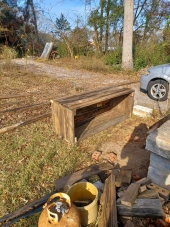
One day I'll build a proper sifting station, something I've been saying for probably twenty years. Until then I'll keep using a commercial bread tray, much like this one, to sift compost. They're fairly sturdy, and the handles are convenient, though you do have to lean forward a bit to shake them, and that can be a strain on the back. Not bad enough to make me quit using it - yet.

I've never purchased one, but there always seems to be one around. For some reason they turn up on roadsides and in ditches. I'm always glad to give them a new home. (Leave the ones that live behind the grocery store alone. Those are tame, and their humans would miss them.)
5 days ago
We live in an area that historically has steady rain throughout the year, but lately the climate has tipped 'historical' into the ashcan. Last year April and May brought us nearly 24" of rain. This year around 4", though we've had better luck this month. We have city water, but I simply refuse to use it on the garden, especially with thousands of gallons of runoff from the backyard every time it does rain.

Our answer is to catch as much as we can however we can, starting with two rain barrels harvesting water from the roof. I've seen criticisms elsewhere that all this does is gather a uselessly small amount of water, and threatens foundations in the process. Unfazed, I dug shallow gullies from the barrels to the gardens to allow immediate runoff to the front gardens, while setting up wide spillover containers to hold more of the water right next to the barrels. I use these to fill 1.5liter wine bottles for direct irrigation to individual plants.

In the backyard, we hold on to moisture by trapping it in heavily mulched hugelkultur terraces laid on top of the slope, and trenches dug into the clay soil. This is just a beginning, but we can already see results. A three-week drought in March and April didn't bother our early season plantings. Hopefully we'll eventually have a system in place to carry us through the hotter four- and five-week dry spells of autumn.
6 days ago

Sam Potter wrote:I have a starter pack of sorts Iv been giving out to friends who'v asked this year. Our gardens are finally coming in nicely again after moving a couple years ago so I have strawberries, thornless blackberries, asparagus, potatoes, walking onions and lots of herbs that have self seeded and came up this year that are free game to take. As well as extra starts of tomatoes, mints and peppers. I tell people a green thumb is hiding the compost pile of dead victims of previous plants and to not feel bad if they kill them all and then want to try again next year. Most of the plants I give out are weeds for me anyways!
I choose the plants I do because they do grow like weeds in my area with very little love and are familiar enough to normies for use in the kitchen continuously thru the year. Seeds are a gamble to give to a new person due to the learning curve is to likely to cause a failure that will discourage them from the journey in my area. I also have them come out to grab the plants so they can see how I grow them and maybe get them into thinking about getting chickens later. There fresh brains are easily moldable to permaCULTure as long as we don't overwhelm them lol  


Brilliant.
There is a growing (and in my opinion, justified) concern among 'normies' about food availability in the near future. Anything we can do to bridge the gap will help, and will help grow our own  cross-cult-ural community.