• Post Reply Bookmark Topic Watch Topic
  • New Topic
permaculture forums growies critters building homesteading energy monies kitchen purity ungarbage community wilderness fiber arts art permaculture artisans regional education skip experiences global resources cider press projects digital market permies.com pie forums private forums all forums
this forum made possible by our volunteer staff, including ...
master stewards:
  • Carla Burke
  • Nancy Reading
  • John F Dean
  • r ransom
  • paul wheaton
  • Jay Angler
  • Timothy Norton
stewards:
  • Pearl Sutton
  • Tereza Okava
  • Nicole Alderman
master gardeners:
  • Christopher Weeks
gardeners:
  • M Ljin
  • Megan Palmer
  • Pete Podurgiel

Plants which generate large volumes of green matter for compost?

 
Posts: 30
Location: Yorksire - North England
2
  • Mark post as helpful
  • send pies
    Number of slices to send:
    Optional 'thank-you' note:
  • Quote
  • Report post to moderator
Hi,

I have a lump of space in my garden which this year I have no significant need for. However - my compost heap can take as much green matter as I can throw at it.

What would be some good plants to grow where my focus is on generating the maximum amount of green matter for the compost heap?

The "soil" is pretty rich - it's two year old wood chip.
 
pollinator
Posts: 11856
Location: Central Texas USA Latitude 30 Zone 8
1295
cat forest garden fish trees chicken fiber arts wood heat greening the desert
  • Likes 2
  • Mark post as helpful
  • send pies
    Number of slices to send:
    Optional 'thank-you' note:
  • Quote
  • Report post to moderator
I'm really loving Cardoon, which is also edible. Mine are growing huge - it looks like I'll need to continually cut them back to keep them within bounds in my small kitchen garden.

cardoon.jpg
[Thumbnail for cardoon.jpg]
 
pollinator
Posts: 1824
Location: Victoria BC
338
  • Likes 1
  • Mark post as helpful
  • send pies
    Number of slices to send:
    Optional 'thank-you' note:
  • Quote
  • Report post to moderator
Borage and Comfrey are the first couple that come to mind for me. Careful with the comfrey, it can get outa control. The 'bocking 14' cultivar is sterile, but still spreads readily by roots cuttings, purposeful and otherwise.
 
Posts: 15
Location: Zone 5a Upstate NY
  • Likes 2
  • Mark post as helpful
  • send pies
    Number of slices to send:
    Optional 'thank-you' note:
  • Quote
  • Report post to moderator
Burdock will throw up some big leaves, and has an edible root (known as gobo root in Japanese cuisine) and stem. As a biennial, you can get of it, should you ever decide to, by cutting back before it goes to seed, and by not rototilling the substantial taproot - the pieces will regrow.
 
Posts: 100
Location: Denver, Co 6000ft bentonite clay soil
5
  • Likes 1
  • Mark post as helpful
  • send pies
    Number of slices to send:
    Optional 'thank-you' note:
  • Quote
  • Report post to moderator
What about big annual grasses? I'm thinking thing like rye and sorghum and corn. Probably many things that are traditionally cover crops would work.

Also, I would vote borage over comfrey since it's an annual.
 
pollinator
Posts: 148
Location: Indiana
36
5
  • Mark post as helpful
  • send pies
    Number of slices to send:
    Optional 'thank-you' note:
  • Quote
  • Report post to moderator
Sweet potatoes?
 
D Nikolls
pollinator
Posts: 1824
Location: Victoria BC
338
  • Likes 1
  • Mark post as helpful
  • send pies
    Number of slices to send:
    Optional 'thank-you' note:
  • Quote
  • Report post to moderator

Also, I would vote borage over comfrey since it's an annual.


Fair enough, comfrey is definitely something of a once-only choice! Despite this, it's so useful that I wouldn't want to do without it; I consider the very... persistent... nature of it to be a feature not a bug.

Conveniently, though borage is an annual, it readily self-seeds, so you have it as long as you want it, at least around here.
 
pollinator
Posts: 3830
Location: Massachusetts, Zone:6/7 AHS:4 GDD:3000 Rainfall:48in even Soil:SandyLoam pH6 Flat
562
2
forest garden solar
  • Mark post as helpful
  • send pies
    Number of slices to send:
    Optional 'thank-you' note:
  • Quote
  • Report post to moderator
I would vote for legumes. unless you are using fertilizer in which case a grass family plant.
 
Posts: 571
Location: Southern Michigan, USA
49
duck trees hunting food preservation wood heat rocket stoves
  • Likes 2
  • Mark post as helpful
  • send pies
    Number of slices to send:
    Optional 'thank-you' note:
  • Quote
  • Report post to moderator
Second vote for burdock.

But, now that I think about it, if the soil is great, then maybe squashes/pumpkins/melons? They may try to escape their bounds, sending vines around, but you just chop off the strays. And they'll definitely make lots of leaves. But the clincher is, if they set fruit, they'll make many POUNDS of compost. Much more weight, I expect, than anything that will be making only leaves.
 
Posts: 1
  • Mark post as helpful
  • send pies
    Number of slices to send:
    Optional 'thank-you' note:
  • Quote
  • Report post to moderator
In the tropical zone on the tongan islands i use Now the leafs and stems of outsorted papaya trees for compost. Will See how it works.

Nico
 
pollinator
Posts: 1793
Location: Wisconsin, zone 4
97
  • Likes 1
  • Mark post as helpful
  • send pies
    Number of slices to send:
    Optional 'thank-you' note:
  • Quote
  • Report post to moderator
Definitely Comfrey for me. My favorite plant.
 
steward and tree herder
Posts: 14358
Location: Isle of Skye, Scotland. Nearly 70 inches rain a year
8009
6
transportation dog forest garden foraging trees books food preservation woodworking wood heat rocket stoves ungarbage
  • Likes 14
  • Mark post as helpful
  • send pies
    Number of slices to send:
    Optional 'thank-you' note:
  • Quote
  • Report post to moderator
2 for one idea - rhubarb produces large (inedible) leaves. Some varieties you can harvest most of the year - eat the stems, compost the leaves
 
Steward of piddlers
Posts: 8201
Location: Upstate New York, Zone 5b, 43 inch Avg. Rainfall
4825
monies home care dog fungi trees chicken food preservation cooking building composting homestead
  • Likes 10
  • Mark post as helpful
  • send pies
    Number of slices to send:
    Optional 'thank-you' note:
  • Quote
  • Report post to moderator
In a similar vein to Nancy's thought, how about horseradish?

This is my first year growing it, and boy is it a vigorous plant! Maybe too vigorous for some people? I am not sure how resilient the plant is to trimming greenery but it produces a TON.
 
Posts: 18
3
  • Likes 6
  • Mark post as helpful
  • send pies
    Number of slices to send:
    Optional 'thank-you' note:
  • Quote
  • Report post to moderator
i believe the fastest growing plant is kan kong or some similar water lilly type plant. i believe any kind of fast growing water planet will also add to the nutrient density of your compost, considering that algaes like spirulina/chlorella are most nutrient dense foods on planet. perhaps even someone could experiment w throwing different algaes on a compost if its sturdy enough?
 
steward
Posts: 19522
Location: USDA Zone 8a
4915
dog hunting food preservation cooking bee greening the desert
  • Likes 3
  • Mark post as helpful
  • send pies
    Number of slices to send:
    Optional 'thank-you' note:
  • Quote
  • Report post to moderator
as others have said:  Comfrey, sweet potato, ...

Buckwheat, clover
 
master pollinator
Posts: 424
Location: UK
157
kids urban seed
  • Likes 9
  • Mark post as helpful
  • send pies
    Number of slices to send:
    Optional 'thank-you' note:
  • Quote
  • Report post to moderator
Surprised nettles haven't come up yet. Mine produce a huge amount of material through the season and I just cut them back before they flower. High nitrogen so they help get the heap going, and they regrow fast enough to cut a few times a year.
 
Posts: 53
11
  • Likes 13
  • Mark post as helpful
  • send pies
    Number of slices to send:
    Optional 'thank-you' note:
  • Quote
  • Report post to moderator
In my experience trust the natural flora of your region if you dont need that part of your garden. Organically fertilize it well and harvest the weeds that volunteer there. If you're wanting suggestions on food crops that add biomass you need to research what grows best in your garden there and accept a lot less biomass. Nothing beats the natural weeds in a temporary garden location. They are the best cover crops but they will be more labor to harvest and keep from volunteering again.  Weeds are adapted to thrive in your location on total neglect.  How can anything beat that?
 
master steward
Posts: 16161
Location: Pacific Wet Coast
10628
duck books chicken cooking food preservation ungarbage
  • Likes 9
  • Mark post as helpful
  • send pies
    Number of slices to send:
    Optional 'thank-you' note:
  • Quote
  • Report post to moderator
OK, I use this more for mulching than for compost, but I think it's work mentioning here. Wisteria! In my ecosystem, it grows like a weed! I have to prune it multiple times a year to stop it from taking over the house.

For several years, I've chopped it into ~6 inch bits into a bucket, then put it around various plants, but in particular my rhubarb. That, coupled with a little fertilizer P, has really helped the rhubarb, because I admit the soil in that area is really poor.

Some years I've used it over a garden bed that I didn't manage to get a cover crop growing on. It is slow to decompose compared to many leaves, but I can always pull it off in the spring when I need to plant. In the meantime, it has protected the soil from our winter rains.

I do find that in my ecosystem, "chop and drop" sometimes has to be "chop into a bucket and them put it where it's really needed."
 
pollinator
Posts: 122
Location: Half acre on a hill in Central Alabama, Zone 8a and 8b
114
hugelkultur art forest garden fungi foraging food preservation cooking writing composting
  • Likes 6
  • Mark post as helpful
  • send pies
    Number of slices to send:
    Optional 'thank-you' note:
  • Quote
  • Report post to moderator
This topic is speaking directly to me just now, since the Missus gave me permission to add a second-hand wood chipper to my arsenal of (now three) outdoor power tools. I plan to use it to clear old deadwood, turn new saplings into RCW, and process larger "weeds" for mulch and compost. (I'm liable to use it to pulverize charcoal as well.)

Living in the southeastern U.S., one of my favorite overgrowth mulch sources are Elderberry Bushes. One plant can reach 8 feet in every dimension in a single season, and send runners to all points in the garden. The starfish of the garden, they will also (Not Can. *Will*.) re-root if you try to chop-and-drop, so I'm hoping that the shredder will render small enough pieces to prevent a total garden takeover from ramial chips. If that doesn't work, I'll compost the chips and stir them until the roots cook away.

Two other sources for mulch in my garden are Sweet Potato vines (mentioned above), and Lamb's Quarters. This time of year (late August), both are reaching their full potential, the latter bushing out to 6 ft in height. After harvesting the leaves, the woody branches offer a satisfying crunch slipping through the shredder.

Finally, we live in a rural neighborhood, and our yard is fronted by a long row of Boxwood Shrubs. I actually enjoy trimming these back every year, since I know they will add a couple of truckloads of biomass to the garden spaces. This will be an even better source of mulch now, since I can chip them down to a more useful size.
 
pollinator
Posts: 993
Location: 10 miles NW of Helena Montana
572
hugelkultur chicken seed homestead
  • Likes 6
  • Mark post as helpful
  • send pies
    Number of slices to send:
    Optional 'thank-you' note:
  • Quote
  • Report post to moderator
I purchased 6 comfrey plants a few years ago and now have a couple dozen.  Lots of green for the compost.  Also have native grass that grows over my drain field I cut that goes into the compost pile 3 or 4 times a year.
 
Posts: 21
10
homestead composting greening the desert
  • Likes 6
  • Mark post as helpful
  • send pies
    Number of slices to send:
    Optional 'thank-you' note:
  • Quote
  • Report post to moderator
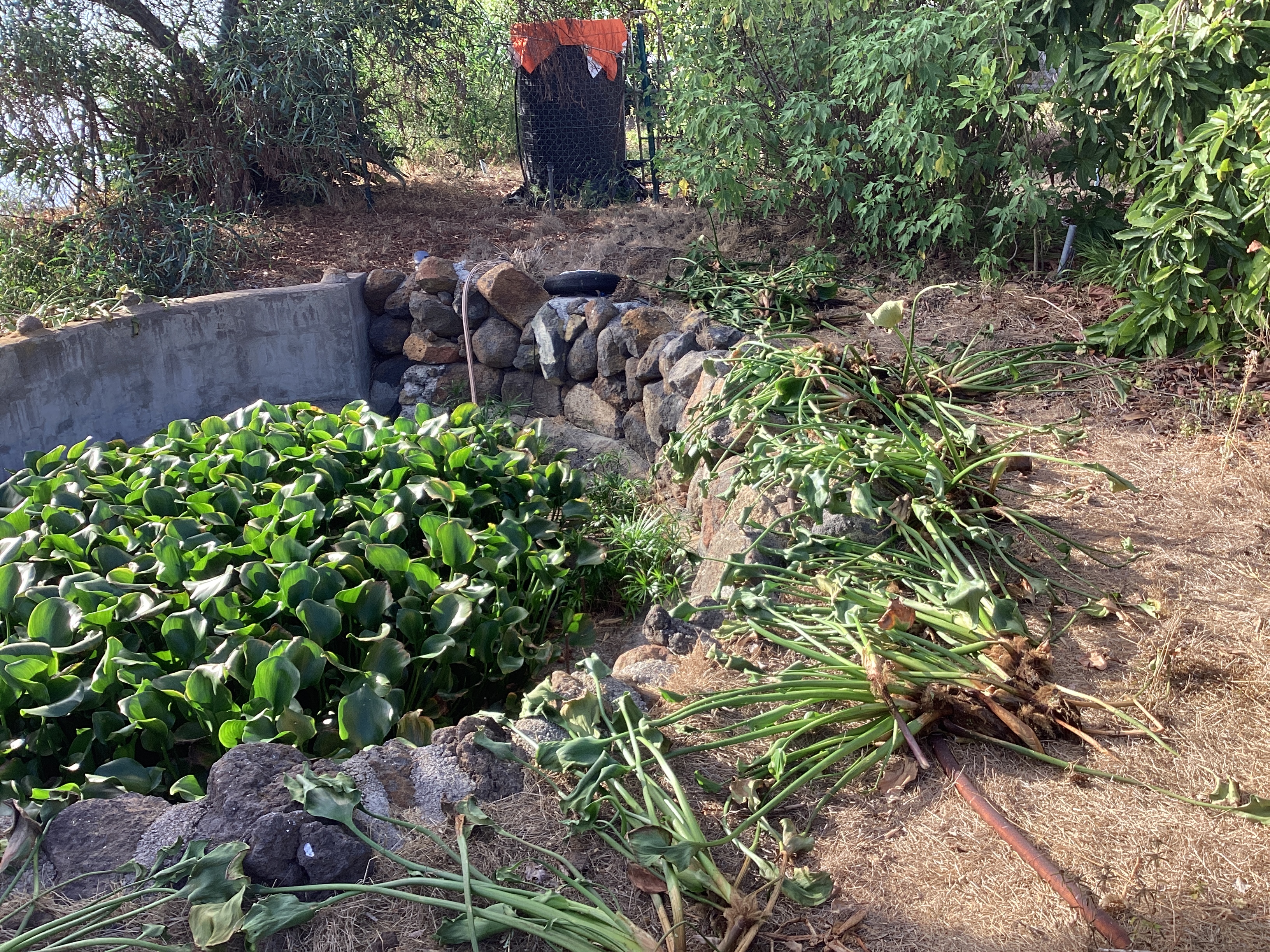
We live in a subtropical climate. Our sewage water goes in a three chamber system and afterwards in this pond. The water hyacinths   (Eichhornia) grow very abundantly and we can harvest every month green material for our compost.
IMG_4381.jpeg
harvesting water hyacinths for green compost material
 
Posts: 50
Location: Heart of the Great Lakes in Southern Ontario
14
4
forest garden trees chicken homestead
  • Likes 5
  • Mark post as helpful
  • send pies
    Number of slices to send:
    Optional 'thank-you' note:
  • Quote
  • Report post to moderator
Curious if any Permie has used Cup Plant as a compost-generator. We have a bunch which the pollinators love. Sometimes we feed a few to sheep which is a nice bonus. I've thought about hacking more for compost biomass but you'd have to break the stems a bit (easy to do).
 
pollinator
Posts: 209
Location: Schofields, NSW. Australia. Zone 9-11 Temperate to Sub Tropical
110
forest garden fungi books medical herbs bee seed
  • Likes 5
  • Mark post as helpful
  • send pies
    Number of slices to send:
    Optional 'thank-you' note:
  • Quote
  • Report post to moderator

Pete Grego wrote:i believe the fastest growing plant is kan kong or some similar water lilly type plant. i believe any kind of fast growing water planet will also add to the nutrient density of your compost, considering that algaes like spirulina/chlorella are most nutrient dense foods on planet. perhaps even someone could experiment w throwing different algaes on a compost if its sturdy enough?


This is true. I have been growing kangkong for over 20 years at the side of one of my backyard ponds, you can sit out by it and almost watch it grow.

Downside is it needs a very warm climate to thrive but you get tons of it for great crunchy salads, stir fries, stews or as mulch/chop and drop.

My compost heap gets barrow loads, I love it.
 
Getting married means "We're in love, so let's tell the police!" - and invite this tiny ad to the wedding:
Escape to a permaculture life in Montana
https://wheaton-labs.com/bootcamp
reply
    Bookmark Topic Watch Topic
  • New Topic