
• Post Reply Bookmark Topic Watch Topic
  • New Topic
permaculture forums growies critters building homesteading energy monies kitchen purity ungarbage community wilderness fiber arts art permaculture artisans regional education skip experiences global resources cider press projects digital market permies.com pie forums private forums all forums
this forum made possible by our volunteer staff, including ...
master stewards:
  • Carla Burke
  • Nancy Reading
  • paul wheaton
  • John F Dean
  • r ransom
  • Jay Angler
stewards:
  • Timothy Norton
  • Tereza Okava
  • Pearl Sutton
master gardeners:
  • Christopher Weeks
  • M Ljin
gardeners:
  • Jeremy VanGelder
  • Megan Palmer
  • Thekla McDaniels

Making a new garden on turf

 
steward and tree herder
Posts: 14076
Location: Isle of Skye, Scotland. Nearly 70 inches rain a year
7752
6
transportation dog forest garden foraging trees books food preservation woodworking wood heat rocket stoves ungarbage
  • Likes 10
  • Mark post as helpful
  • send pies
    Number of slices to send:
    Optional 'thank-you' note:
  • Quote
  • Report post to moderator
I'm going to start a new project this year. Partly because I want to reboot my polycultures area, and partly for intellectual curiousity, just to see what can be done.
I was inspired by paul on this thread to consider the possibilities of using vigorous growing plant to clear turf.

paul wheaton wrote:I would like to hand to them two small packets of seeds.  In packet 1 is a seed that can be tossed under a tree where there is grass; it germinates, grows, outcompetes the grass, smothers the grass, and then conveniently dies back ready for the seeds from packet 2.  Packet 2 contains the seeds for a nice guild planting under fruit trees (lots of tap rooted plants, including nitrogen fixers).


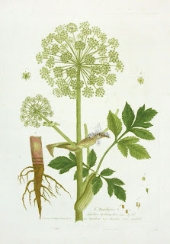
So I'm considering the first seed packet. To be honest I don't think just sowing seed on top of grass will work very quickly, but I have been pretty impressed with the ability of Angelica to smother out grass in time. I failed in the past trying a no till version of green manures in turf (see here) but my rye has grown pretty well this month in my kitchen garden, so I'm going to try a modification.

1: mow the turf as close as possible
2: fork the area to try and relieve some compaction and add drainage (just lift an inch or so with out turning if this is possible)
3: broadcast Angelica and fodder radish seed
4: cut narrow slits with a spade and sow grazing rye just under the surface
5: rake some of the cut vegetation back over the area
6: wait and hope over winter!
7: leave (assumed) growth of green manures and angelica to smother the turf for the first season
8: maybe resow or mulch over second winter
9: sow and plant new area!

If I get started in the next couple of weeks I think the rye will have a chance to get big enough to get a running start next year. Bonus if I get a crop of rye grain from the area!
 
master gardener
Posts: 6670
Location: Carlton County, Minnesota, USA: 3b; Dfb; sandy loam; in the woods
4088
8
forest garden trees books chicken food preservation cooking fiber arts seed woodworking homestead ungarbage
  • Likes 6
  • Mark post as helpful
  • send pies
    Number of slices to send:
    Optional 'thank-you' note:
  • Quote
  • Report post to moderator
I have lots of weeds that coexist with vigorous grasses just fine, but the only thing I've seen that eliminates it (other than tree canopy) is comfrey -- but having it everywhere would probably be even worse than the grass.

Actually, now that I've written that, I sort of wonder. In a small plot at least, it would be pretty easy to control with selective chop and drop. But I'm fighting to eliminate seeding comfrey now and don't think I'm willing to go backward on that.
 
Nancy Reading
steward and tree herder
Posts: 14076
Location: Isle of Skye, Scotland. Nearly 70 inches rain a year
7752
6
transportation dog forest garden foraging trees books food preservation woodworking wood heat rocket stoves ungarbage
  • Likes 10
  • Mark post as helpful
  • send pies
    Number of slices to send:
    Optional 'thank-you' note:
  • Quote
  • Report post to moderator
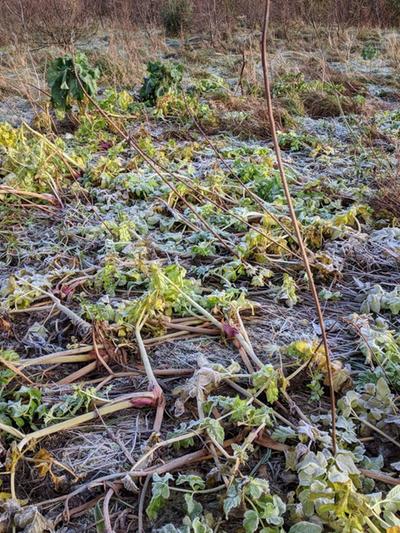
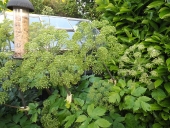
Yes I was a bit surprised too that the Angelica worked so well, considering I hadn't improved the soil that much. This isn't the best picture, but shows how clear the area under the angelica is over winter compared to the grass in the background. The thin sticks are the remains of my sunroot plants, which seem to coexist with the Angelica fairly well.

Angelica cleared polycultures
 
steward
Posts: 16234
Location: Northern WI (zone 4)
5337
9
hunting trees books food preservation solar woodworking
  • Likes 8
  • Mark post as helpful
  • send pies
    Number of slices to send:
    Optional 'thank-you' note:
  • Quote
  • Report post to moderator
I think rhubarb is also pretty good at smothering grass.  Not sure a solid patch of rhubarb is easy to convert to seed packet #2 either though.

I doubt you could throw them around and have it work, but some aggressive pumpkins could do something.
 
Nancy Reading
steward and tree herder
Posts: 14076
Location: Isle of Skye, Scotland. Nearly 70 inches rain a year
7752
6
transportation dog forest garden foraging trees books food preservation woodworking wood heat rocket stoves ungarbage
  • Likes 7
  • Mark post as helpful
  • send pies
    Number of slices to send:
    Optional 'thank-you' note:
  • Quote
  • Report post to moderator
Mike, Rhubarb is on my list as one of the follow on plants. I'll probably split my main plants, which are overdue dividing already.

"Aggressive pumpkins" don't do Skye weather in my experience. Well to be fair, I haven't even tried but feel it would be a waste of seed! I'm hoping for some in my polytunnel this year, but I think they're struggling with the poor acid soil there too.
 
master pollinator
Posts: 369
Location: UK
131
kids urban seed
  • Likes 8
  • Mark post as helpful
  • send pies
    Number of slices to send:
    Optional 'thank-you' note:
  • Quote
  • Report post to moderator
Rhubarb should do well for that on Skye. Ours gets dense enough by July that nothing much grows under it - not sure it kills grass outright but it definitely suppresses the growth. Worth splitting for the experiment at least.
 
Nancy Reading
steward and tree herder
Posts: 14076
Location: Isle of Skye, Scotland. Nearly 70 inches rain a year
7752
6
transportation dog forest garden foraging trees books food preservation woodworking wood heat rocket stoves ungarbage
  • Likes 8
  • Mark post as helpful
  • send pies
    Number of slices to send:
    Optional 'thank-you' note:
  • Quote
  • Report post to moderator
Well I've made a start, but didn't quite have time to finish the first stage yesterday.

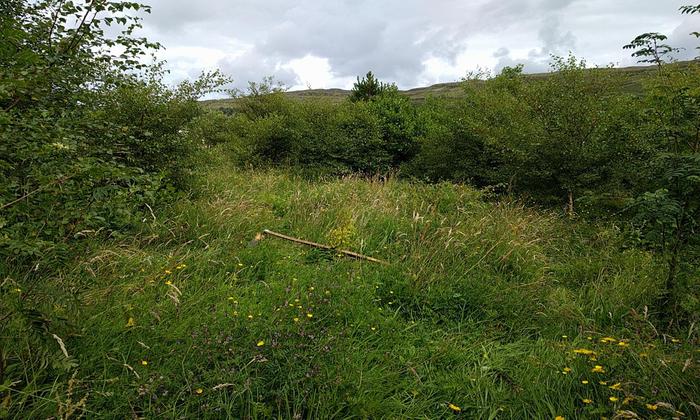
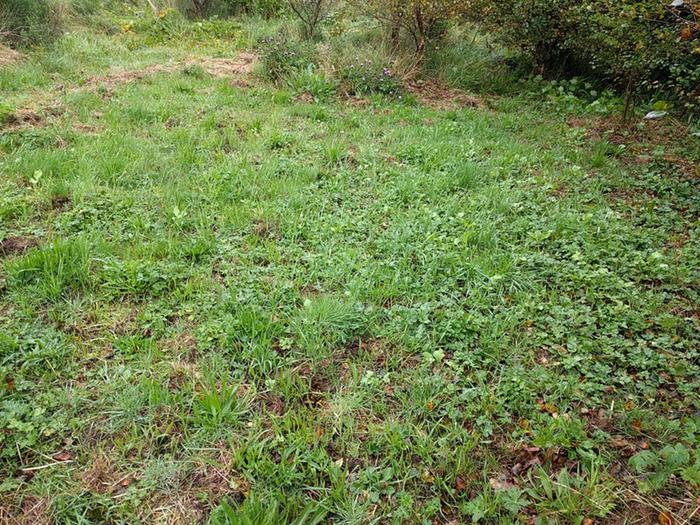
This is the area I'm working on before I started:

can I clear turf without digging
clearing in the tree field


I've had my eye on it for a year or two as it is currently about 4m x 4m with no trees. I've planted a couple of Gingko biloba at either end, which are slow, but seem OK after two years. I was thinking about making some more berry banks, but a perennial polyculture/backyard food pump seems like a valid choice too.

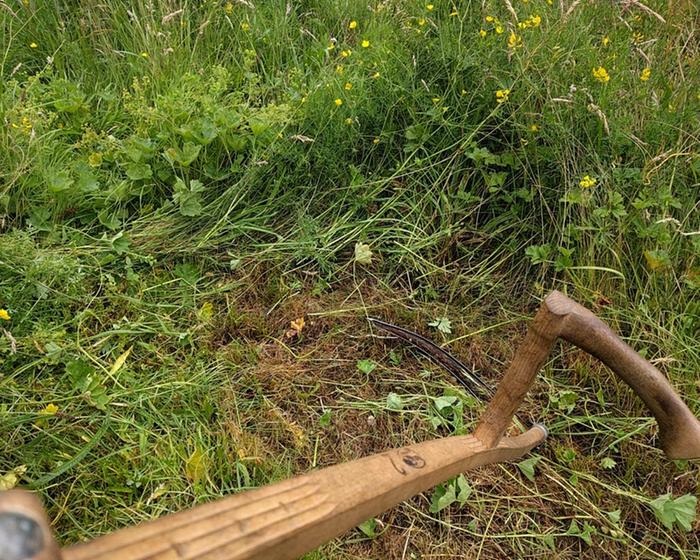
So first I scythed the vegetation as close to the ground as I could. The grass is mainly very fine grass, which in my experience is hard to smother out, so that is likely to be a challenge. There is a bit of ladies mantle, some plantain, both clumping and creeping buttercups, bluebells, a little sneezewort, cinquefoil and lots of vetch. To the downhillside the creeping buttercup seems to have shaded out much of the competition, so getting rid of that is also likely to be difficult.

meadow turf
typical vegetation being scythed


The greener grass on the left of the picture is where we have a path and the grass has already been cut a bit this summer.

The cut material was lifted off to the sides. I used it to mulch around the Gingko and some other adjacent trees and to form a boundary next to the path that goes down the hill beside the area. It occurs to me that just doing this - mulching thickly - does also clear an area fairly well for a season, but I still think there could be an advantage in having plants growing there as otherwise the buttercups and docken seem to move in more quickly than the plants I actually want.

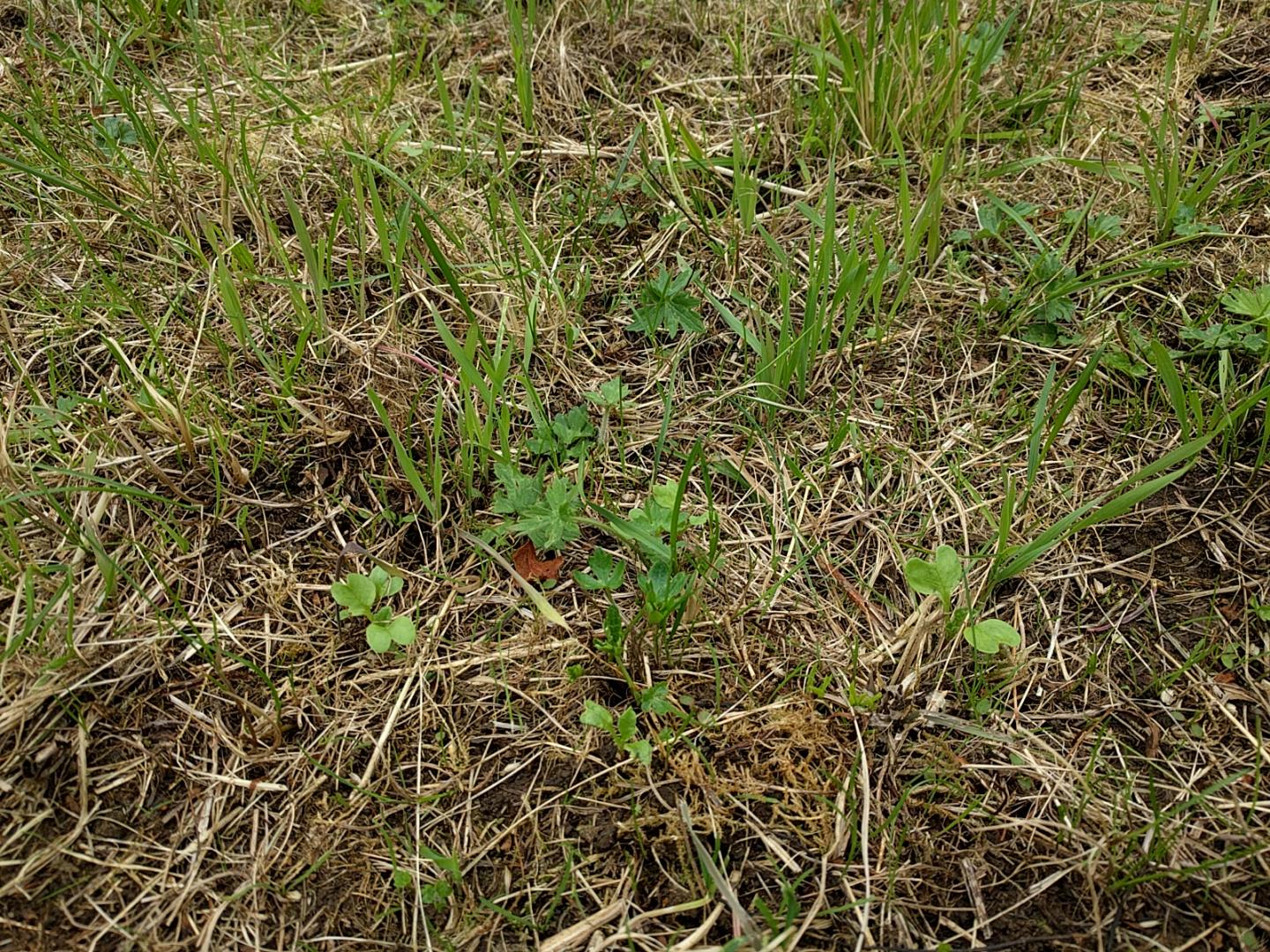
I then forked over the whole area, lifting the turf a little in patches about a foot to eighteen inches apart. I tried to get the fork to it's full depth (about 10 inches, but was aware that it would be rather easy to break my fork handle by overstressing it, so sometimes went a little shallower. I scattered some Angelica seeds quite thickly over the whole area, and then did the same with some fodder radish seed at what I estimate to be twice the recomended sowing density. The Angelica was freshly gathered seed from my own plants and the fodder radish was fresh seed from sowseeds. I've used their green manure seeds in my polytunneld this year and was pleased with how they turned out.
I started raking the area again to try and cover the seed a bit but didn't finish before I had to stop work. The raking was bringing more of the creeping grass and butrtercup solons up, so I'm going to go back over with the scythe again, maybe after I've sown the rye seed, which I am yet to do.

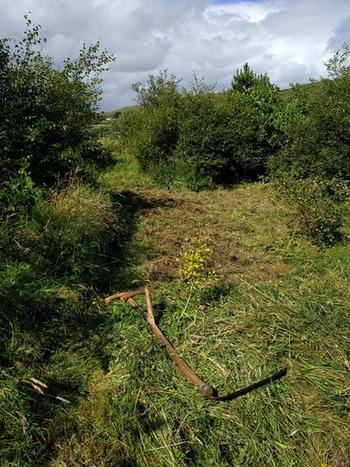
a mown area of meadon amongst trees
cleared area after sowing and partial raking....


So that's the status at present, which took about three hours for a 16m square patch (including extra scything along adjacent paths...). I expect it will take me at least another three hours to finish raking, cut slits and sow the rye and re-scythe to cut the vegetation as close as possible again.
 
Christopher Weeks
master gardener
Posts: 6670
Location: Carlton County, Minnesota, USA: 3b; Dfb; sandy loam; in the woods
4088
8
forest garden trees books chicken food preservation cooking fiber arts seed woodworking homestead ungarbage
  • Likes 4
  • Mark post as helpful
  • send pies
    Number of slices to send:
    Optional 'thank-you' note:
  • Quote
  • Report post to moderator
Sounds like you need a broadfork.
 
Posts: 156
Location: Payson, Utah, US of A - Zone6B/High Desert/4500' /14" Rainfall
88
  • Likes 6
  • Mark post as helpful
  • send pies
    Number of slices to send:
    Optional 'thank-you' note:
  • Quote
  • Report post to moderator
Okay, I'm gonna get some flack for this, but cardboard would do the trick. Pile on a triple layer, then a lay between 1-4" of soil, seed that soil layer, then cover it with a healthy 4-12" of mulch.

You'll murder most the stuff beneath and get your desirables rolling. By the time the cardboard gives up the ghost, you'll have your system already dominating the niche.

Another option I'll get flack for is solarization. If you've got some metal panels handy, like some corrugated fence panels or some sheet metal, you can lay 'em flat and let the summer sun cook everything beneath, then lay some seeds and compost after 4-6 weeks and get your system rolling.

---

Now, in terms of plants that could help with the smothering, don't overlook an aggressively stoloniferous strawberry. Some of my strawberries send out multiple 6-8' runners with multiple nodes and they're not shy about rooting in the sod.

Clover can coexist, and lawns with clover are generally healthier and more robust, but I've had patches of aggressive clover grow dense enough that the grass barely grew beneath it.

Sunflowers will happily grow in clumps next to each other and consume 90% of the available sunlight. They're great to grow with some of the broadleaf stuff you've already mentioned because they can elevate out of the herbaceous layer and add a bit of canopy shade on top of your comfrey.

I've also got monster perennial kales that drown everything beneath them with their dense foliage. Even bindweed has a hard time climbing through.

I've got plantain and sea plantain beginning to take root in my sod as well, and they're beginning to shade out the grass beneath.

Also, was it you who was intentionally growing burdock? That's another great option, and you'll have seed to sow pretty quick if that was you.

Black Medic is another that, like clover, can coexist or even enhance your thatch, but I've had it dominate sections before as well.

Western Mountain Aster is also one that coexists in the thatch but, I've found, over time weakens the sod and expands its influence. Other asters and daisies can perform similarly.

---

Anyway, good luck.
 
pioneer
Posts: 461
123
cat trees urban
  • Likes 7
  • Mark post as helpful
  • send pies
    Number of slices to send:
    Optional 'thank-you' note:
  • Quote
  • Report post to moderator

Nancy Reading wrote:Yes I was a bit surprised too that the Angelica worked so well ..


Oh, this is so interesting.

Something is inhibiting the growth of almost all my tomatoes this year, and possibilities include drought (despite almost daily deep watering), something in the tap water (we've long since run out of stored rainwater), the cardboard mulch I'm using since these are new beds on messy sward, lack of nutrients (despite planting in home compost, & mulching with dandelion greens & a little coffee grounds) ..

So another way to smother messy sward is very interesting.

I wonder if Alexanders would work?  I feel an experiment coming on, although I don't have the necessaries for all that scything.

Looking forward to your updates!
 
Ac Baker
pioneer
Posts: 461
123
cat trees urban
  • Likes 8
  • Mark post as helpful
  • send pies
    Number of slices to send:
    Optional 'thank-you' note:
  • Quote
  • Report post to moderator
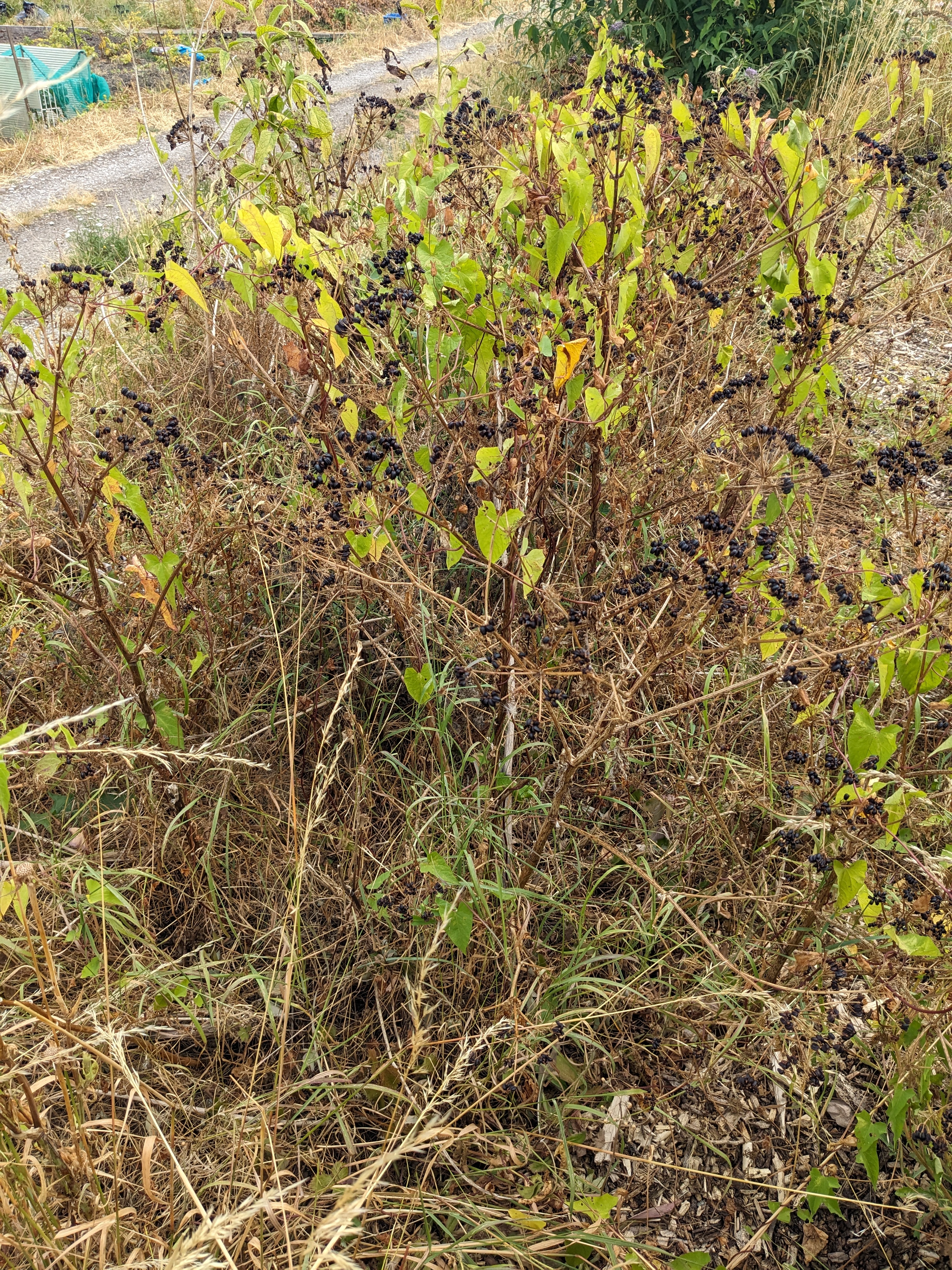
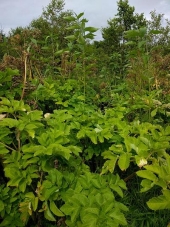
Here's a photo of the alexanders today, we're in drought & heatwave.  (The green leaves are bindweed.) They've self-seeded slowly over the past ten years, and at least disuaded the grass I think ..
2026-06-31-Alexanders-in-England.jpg
Alexanders in drought, with disuaded grass below.
 
Nancy Reading
steward and tree herder
Posts: 14076
Location: Isle of Skye, Scotland. Nearly 70 inches rain a year
7752
6
transportation dog forest garden foraging trees books food preservation woodworking wood heat rocket stoves ungarbage
  • Likes 7
  • Mark post as helpful
  • send pies
    Number of slices to send:
    Optional 'thank-you' note:
  • Quote
  • Report post to moderator

Christopher Weeks wrote:Sounds like you need a broadfork.


Hmm, tempting! I'm not sure whether it would be appropriate or not - whether I could justify going out and buying one that is. Once the compaction is relieved, I hope not to dig except to plant or harvest. Mostly I'm tending to raised beds and mini hugel, I think I will manage with my fork in the polycultures if I'm careful. If a broad fork did happen to arrive in my future, I'm sure I could give it a good home though!
 
Nancy Reading
steward and tree herder
Posts: 14076
Location: Isle of Skye, Scotland. Nearly 70 inches rain a year
7752
6
transportation dog forest garden foraging trees books food preservation woodworking wood heat rocket stoves ungarbage
  • Likes 7
  • Mark post as helpful
  • send pies
    Number of slices to send:
    Optional 'thank-you' note:
  • Quote
  • Report post to moderator

Chance Lunceford wrote:Okay, I'm gonna get some flack for this, but cardboard would do the trick. Pile on a triple layer, then a lay between 1-4" of soil, seed that soil layer, then cover it with a healthy 4-12" of mulch.
You'll murder most the stuff beneath and get your desirables rolling. By the time the cardboard gives up the ghost, you'll have your system already dominating the niche.


I've used cardboard before to clear ground, and I do have access to good amount of it through my shop. I don't however have access to weed seed free soil. Apart from the uncertain gick factors, I've also had glue and tape appear when I was certain I'd got all the tape off, so that is one reason I'm less inclined to use cardboard so much now. One other disadvantage is that I've end up with clear ground. Nature abhors a vacuum and I find that the pernicious weeds tend to recolonise the gap first. I think for it to work, I'd need to follow the cardboard with more cardboard, or thick organic mulch and plant transplants through that. I have had pretty good results using that method wth comfrey root cuttings planted at the same time as a cardboard mulch

Solarisation just won't work in my climate - you mention hot sunshine - no, we just don't get that here! The recent heatwaves in the UK have pretty much passed us by (thank goodness!). I believe that it can be very effective for some people though. I'm sure that the soil will recover it's biome is a season. A metal panel would have the effect of clearing the ground though blocking the light during a growing season though in any climate. I have used thick black plastic to the same end (still have it somewhere) I wrote about it on my 'blog - I think pignut, buttercup, couch and nettles were the survivors there!

Again I don't think strawberry would be vigorous enough to smother turf here (although if it works for you that is great!) I have found both siverweed and yarrow seem to be able to compete with grass, and intend to use the former at least in the polyculture as a groundcover. Clover is a great idea -I have noticed pink clover forming a big patch in the turf dometimes, and zigzag clover also can spread into a larger patch by stolons. I'd really like to see whether I can get springbank clover to establish here, but so far am finding it a little more tricky! I still have some seed though.... birdfoot trefoil is another tap rooted legume that I find establishes itself in the grass. I'm going for sunroot rather than sunflowers, as I feel the sunflower will need a warmer summer - we usually need to start it off and transplant rather than seed it direct in the UK (and the slugs love it!)  a perennial root gets a head start!

Lots of good suggestions there Chance, and I think they key is that everyone needs to choose the ones that will suit their growing conditions. Yes it was I who was growing burdock for seed. Mine is the cultivated form, and so far is not looking super happy. I've certainly got a couple of plants that came back after transplanting.

I think the tricky thing for me is that transition between meadow polyculture and edible polyculture, and avoiding going through that bare earth vacuum stage that results in unwelcome pioneers plants rather than the ones we want to encourage. I seem to generally end up with a polyculture of dock and buttercups....I'm hoping by making the transition using growing plants I can slip the plants I want in without giving the opportunity for the normal culprits to take over!
 
Ac Baker
pioneer
Posts: 461
123
cat trees urban
  • Likes 5
  • Mark post as helpful
  • send pies
    Number of slices to send:
    Optional 'thank-you' note:
  • Quote
  • Report post to moderator

Nancy Reading wrote: I think the tricky thing for me is that transition between meadow polyculture and edible polyculture, and avoiding going through that bare earth vacuum stage that results in unwelcome pioneers plants rather than the ones we want to encourage.


Re-reading this, that's a rather good summary of the struggles I'm having with my veg beds too.  Our community garden is, we believe, in the last local remnant of the fields our suburb was built upon.

Nancy Reading wrote:I'm hoping by making the transition using growing plants I can slip the plants I want in without giving the opportunity for the normal culprits to take over!


Oh, interesting thought.  Hmm.  Perennial vegetables ideas needed ..
 
pollinator
Posts: 112
Location: Half acre on a hill in Central Alabama, Zone 8a and 8b
107
hugelkultur art forest garden fungi foraging food preservation cooking writing composting
  • Likes 8
  • Mark post as helpful
  • send pies
    Number of slices to send:
    Optional 'thank-you' note:
  • Quote
  • Report post to moderator

Nancy Reading wrote:
I think the tricky thing for me is that transition between meadow polyculture and edible polyculture, and avoiding going through that bare earth vacuum stage that results in unwelcome pioneers plants rather than the ones we want to encourage. I seem to generally end up with a polyculture of dock and buttercups....I'm hoping by making the transition using growing plants I can slip the plants I want in without giving the opportunity for the normal culprits to take over!


I don't have quite as much space to transform (and where I do, not near enough energy), but I have had some luck in scything the meadow biomass and piling it up to smother-mulch prep for future edible spaces. Compost in situ. Nature's cardboard. Sure, you may eventually have to deal with meadow seeds and persistent natives, but by that time the edible polyculture has had a chance to take hold, and you can always add more meadow mulch to discourage. Probably best to plant the first round as seedlings rather than seeds, but at least you're one step closer.

If you ever do find the  magic wand, one-two punch mix of seeds to eliminate existing cover first and grow an instant guild second, wrap it in a nice package and market it everywhere.
 
Nancy Reading
steward and tree herder
Posts: 14076
Location: Isle of Skye, Scotland. Nearly 70 inches rain a year
7752
6
transportation dog forest garden foraging trees books food preservation woodworking wood heat rocket stoves ungarbage
  • Likes 7
  • Mark post as helpful
  • send pies
    Number of slices to send:
    Optional 'thank-you' note:
  • Quote
  • Report post to moderator

Yeardly Arthur wrote:If you ever do find the  magic wand, one-two punch mix of seeds to eliminate existing cover first and grow an instant guild second, wrap it in a nice package and market it everywhere.


I'm pretty sure what works for me wouldn't work for you and vice versa! I supposed that's where a really diverse mix of polyculture seeds would come in ("100 seeds, 2 might work" to misquote a certain overall garmented bearded man....) I've already got some radish and rye germinating. Hopefully in another week they should be general across the area.

I think I may try the cut and mulch across my polycultures area if I have time this season. I'm thinking doing strips on contour if I don't have enough to mulch the whole of the downhill patch (whch is the one that needs the most attention)
 
gardener
Posts: 2188
1008
14
homeschooling hugelkultur trees medical herbs sheep horse homestead
  • Likes 9
  • Mark post as helpful
  • send pies
    Number of slices to send:
    Optional 'thank-you' note:
  • Quote
  • Report post to moderator
I just over winter animals in the area that I want to garden.  I have to over winter them somewhere and in the spring I can plant whatever I want.  It works really well for me and there is no extra work.  

 
Yeardly Arthur
pollinator
Posts: 112
Location: Half acre on a hill in Central Alabama, Zone 8a and 8b
107
hugelkultur art forest garden fungi foraging food preservation cooking writing composting
  • Likes 4
  • Mark post as helpful
  • send pies
    Number of slices to send:
    Optional 'thank-you' note:
  • Quote
  • Report post to moderator

Nancy Reading wrote: ("100 seeds, 2 might work..." )


That's my entire gardening philosophy.

This year my neighbors think I am a genius for planting peanuts and sweet potatoes. Those are just the two of the hundred that survived.
(Not counting the zinnias that volunteered without any say-so on my part. The locals think the sudden addition of color is masterful.)
 
Evil is afoot. But this tiny ad is just an ad:
try homesteading without the stress and anxieties of buying a homestead
https://wheaton-labs.com/bootcamp
reply
    Bookmark Topic Watch Topic
  • New Topic