• Post Reply Bookmark Topic Watch Topic
  • New Topic
permaculture forums growies critters building homesteading energy monies kitchen purity ungarbage community wilderness fiber arts art permaculture artisans regional education skip experiences global resources cider press projects digital market permies.com pie forums private forums all forums
this forum made possible by our volunteer staff, including ...
master stewards:
  • Carla Burke
  • John F Dean
  • r ransom
  • Nancy Reading
  • Timothy Norton
  • Jay Angler
stewards:
  • paul wheaton
  • Pearl Sutton
  • Eric Hanson
master gardeners:
  • Christopher Weeks
  • M Ljin
gardeners:
  • thomas rubino
  • Megan Palmer
  • Benjamin Dinkel

Avocados and Frost in Europe (plus info on the cold-hardiest avocados and how to grow them)

 
pollinator
Posts: 112
Location: St Leonards-on-Sea, UK (50.86°N; 58 metres a.s.l; 1.8 Km inland)
18
  • Likes 6
  • Mark post as helpful
  • send pies
    Number of slices to send:
    Optional 'thank-you' note:
  • Quote
  • Report post to moderator

Peter Entwistle wrote: Wow, the Hass seedling has really thickened up nicely now, Mike!


Yes, around a 2 cm increase in mean trunk diameter at ground-level, compared to last year - it's very vigorous. Next spring, this tree will need to be pruned hard to control its size & shape, but that wont prevent its continued increase in trunk girth.
 
pollinator
Posts: 95
Location: Cascadian lowlands (8b, sunset zone 5)
31
  • Likes 5
  • Mark post as helpful
  • send pies
    Number of slices to send:
    Optional 'thank-you' note:
  • Quote
  • Report post to moderator

Mike Guye wrote:This year, I've been a bit delayed in getting my UK outdoor avocado-growing blogs up-to-date. However, Hass & Fuerte have now been updated, up until August 2024 (see links below).  There may be one more update in November, focusing on growth-rates towards the end of the growing season.

Hass (7-year-old tree)...    https://imgur.com/a/5gflnlU

Fuerte (5-year-old tree)... https://imgur.com/a/0XuODou

Blogs for Bacon, Del Rio, Daughter, Joey and Wilma are in the process of being updated and will post here when done.


Those are looking great! I'm guessing the lack of flowers was at least partly related to the amount of freeze damage, but it's interesting the least-damaged inner branches didn't put out a few flowers.

This is reminding me that I should post an update on the Cascadian avocado thread to show the amount of regrowth I've gotten on my various outdoor trees.... maybe tomorrow! Need to take a bunch of photos.
 
Winn Sawyer
pollinator
Posts: 95
Location: Cascadian lowlands (8b, sunset zone 5)
31
  • Likes 5
  • Mark post as helpful
  • send pies
    Number of slices to send:
    Optional 'thank-you' note:
  • Quote
  • Report post to moderator

Mike Guye wrote:

Peter Entwistle wrote: Wow, the Hass seedling has really thickened up nicely now, Mike!


Yes, around a 2 cm increase in mean trunk diameter at ground-level, compared to last year - it's very vigorous. Next spring, this tree will need to be pruned hard to control its size & shape, but that wont prevent its continued increase in trunk girth.


I like to do most of my pruning "for shape/size" right after they finish flowering and the first major fruit abscission in early summer, rather than risk removing branches earlier in spring that might have set fruit. Often only some of the branches set flowers, so it would be a shame to accidentally remove all of those.
 
Mike Guye
pollinator
Posts: 112
Location: St Leonards-on-Sea, UK (50.86°N; 58 metres a.s.l; 1.8 Km inland)
18
  • Likes 5
  • Mark post as helpful
  • send pies
    Number of slices to send:
    Optional 'thank-you' note:
  • Quote
  • Report post to moderator
Blog now updated for two 'Bacon' trees, now 2 years 10 months old:
https://imgur.com/a/FmRvs7d


Posts: 19
Location: NW England, UK (Zone 9a)
  • Mark post as helpful
  • send pies
    Number of slices to send:
    Optional 'thank-you' note:
  • Quote
  • Report post to moderator

Mike Guye wrote:
Around 6 months ago (scroll back), you were considering using a Raspberry Pi or Arduino set-up for monitoring temperatures. Did you try that, following Winn's guidance for the Pi? I took the easier option, buying a datalogger and thermocouples  from  https://www.omega.co.uk, but you might get cheaper if you shop elsewhere as they seem expensive.


Yeah, I was (and still am) considering something along those lines. Although, I might check out a few different options, including an off-the-shelf solution. I might be fine with the software side of that, but I'm not very good with electronics. But it would definitely be a great option for my greenhouse as I also like to keep track of temperatures in there as I store a lot of my citrus trees in it which need to be kept frost-free.
 
Mike Guye
pollinator
Posts: 112
Location: St Leonards-on-Sea, UK (50.86°N; 58 metres a.s.l; 1.8 Km inland)
18
  • Likes 4
  • Mark post as helpful
  • send pies
    Number of slices to send:
    Optional 'thank-you' note:
  • Quote
  • Report post to moderator

Winn Sawyer wrote: I like to do most of my pruning "for shape/size" right after they finish flowering and the first major fruit abscission in early summer, rather than risk removing branches earlier in spring that might have set fruit. Often only some of the branches set flowers, so it would be a shame to accidentally remove all of those.


Yes, that's wise Winn. I do much the same, waiting for the buds to break before doing any pruning just to check if there are any flower buds there. My situation is quite different to yours though, as I have trees that haven't been grafted  - timescales from germination to flowering are going to be significantly longer than for your grafted collection. Any flower buds on mine would be a real bonus at this early stage...
 
Mike Guye
pollinator
Posts: 112
Location: St Leonards-on-Sea, UK (50.86°N; 58 metres a.s.l; 1.8 Km inland)
18
  • Likes 4
  • Mark post as helpful
  • send pies
    Number of slices to send:
    Optional 'thank-you' note:
  • Quote
  • Report post to moderator

Winn Sawyer wrote: I'm guessing the lack of flowers was at least partly related to the amount of freeze damage, but it's interesting the least-damaged inner branches didn't put out a few flowers


My interpretation is slightly different - I think the flowering in 'Hass', observed in spring 2023, was due to environmental stress. Winter 2022/23 was more severe than last winter (e.g. 26 vs 12 frost days), and was reflected by the the more severe visible symptoms of winter-injury (95% defoliation) at the time.  I think this severe injury triggered the plant to flower, though it produced only three small inflorescences.  

Going into 'reproductive mode' is a common response of plants exposed to unusually extreme  environmental conditions for the plant species concerned, whether that's caused by  temperature, drought, a severe attack by insect pests, etc.  Though 'Hass' did suffer significant injury last winter, it was probably not enough to trigger flowering in spring 2024 - I may have to wait a few more years until the tree is naturally mature enough for flowering to occur on a regular basis ...
 
Mike Guye
pollinator
Posts: 112
Location: St Leonards-on-Sea, UK (50.86°N; 58 metres a.s.l; 1.8 Km inland)
18
  • Likes 5
  • Mark post as helpful
  • send pies
    Number of slices to send:
    Optional 'thank-you' note:
  • Quote
  • Report post to moderator
The remaining UK avocado blogs have now been updated to August 2024:
Del Rio (2-years-old) ..................................... https://imgur.com/a/dAbixIe
Daughter, Joey, Wilma (10½-months-old) ... https://imgur.com/a/FuxWI29

NB. Wilma is also known by the name Brazos Belle.
 
Winn Sawyer
pollinator
Posts: 95
Location: Cascadian lowlands (8b, sunset zone 5)
31
  • Likes 5
  • Mark post as helpful
  • send pies
    Number of slices to send:
    Optional 'thank-you' note:
  • Quote
  • Report post to moderator

Mike Guye wrote:

Winn Sawyer wrote: I'm guessing the lack of flowers was at least partly related to the amount of freeze damage, but it's interesting the least-damaged inner branches didn't put out a few flowers


My interpretation is slightly different - I think the flowering in 'Hass', observed in spring 2023, was due to environmental stress. Winter 2022/23 was more severe than last winter (e.g. 26 vs 12 frost days), and was reflected by the the more severe visible symptoms of winter-injury (95% defoliation) at the time.  I think this severe injury triggered the plant to flower, though it produced only three small inflorescences.  

Going into 'reproductive mode' is a common response of plants exposed to unusually extreme  environmental conditions for the plant species concerned, whether that's caused by  temperature, drought, a severe attack by insect pests, etc.  Though 'Hass' did suffer significant injury last winter, it was probably not enough to trigger flowering in spring 2024 - I may have to wait a few more years until the tree is naturally mature enough for flowering to occur on a regular basis ...


That does make some sense, but the problem with that theory is that the almost invisible dormant buds "decide" whether they are going to be flowers when the flush that created those buds is finishing the previous growth cycle in fall. No new flower buds can form on new growth in spring, they only come from the dormant buds that overwintered. So usually you cannot get flowers at all if the existing dormant buds on growing tips are all damaged, only vegetative buds will form adventitiously on older wood.

Your tree is larger than many seedlings I've seen flowering. One of my own seed-grown trees that's got a trunk half that diameter flowered for the first time this year (no fruit set). Once an avocado tree is "mature" (has flowered once) it typically remains that way and does not revert to a pubescent stage, though many do fall into biennial bearing patterns.
 
Mike Guye
pollinator
Posts: 112
Location: St Leonards-on-Sea, UK (50.86°N; 58 metres a.s.l; 1.8 Km inland)
18
  • Likes 4
  • Mark post as helpful
  • send pies
    Number of slices to send:
    Optional 'thank-you' note:
  • Quote
  • Report post to moderator

Winn Sawyer wrote: That does make some sense, but the problem with that theory is that the almost invisible dormant buds "decide" whether they are going to be flowers when the flush that created those buds is finishing the previous growth cycle in fall. No new flower buds can form on new growth in spring, they only come from the dormant buds that overwintered. So usually you cannot get flowers at all if the existing dormant buds on growing tips are all damaged, only vegetative buds will form adventitiously on older wood.


Thanks Winn. You’ve made a very valid point which made me look up when flower primordia are actually initiated which, as you state, is normally towards the end of the previous growth season.  As you rightly say, these buds will already be ‘committed’  to flower the following spring, irrespective of what happens during the winter period, unless of course the flower buds are actually killed by freezing temperatures.

In spring 2023, the three buds that gave rise to small inflorescences on the 'Hass' were apical buds (not ‘dormant buds’ in the botanical sense of the word).  The previous growth season during 2022, that gave rise to these flower buds, was very favourable for avocado growth generally. It was an exceptionally warm summer with three heatwaves, temperatures topping 34°C on one ocassion. Maybe such warm weather favoured the development of flower primordia. Perhaps, I would also have seen flowering in spring 2024 had the growth season temperatures in 2023 been as favourable as those in 2022.  Of course one can only speculate - it’s impossible to know with any degree of certainty.

I suspect that the prolific annual flowering/fruiting of the famous 30-year-old Southbank avocado tree (London, UK) is not only the result of the milder winters in a large built-up and sheltered urban environment, but also due to more favourable higher summer temperatures, compared to my cooler coastal location here in St Leonards-on-Sea.

I just want to check language-use here. Winn, when you use the term  ‘dormant buds’  do you mean the botanical sense of the word, i.e. inconspicuous buds that normally only open following a very stressful event, e.g. complete defoliation, or do you mean normal buds that are ‘overwintering’ ?

Winn Sawyer wrote: Your tree is larger than many seedlings I've seen flowering. One of my own seed-grown trees that's got a trunk half that diameter flowered for the first time this year (no fruit set). Once an avocado tree is "mature" (has flowered once) it typically remains that way and does not revert to a pubescent stage, though many do fall into biennial bearing patterns.


Do you think a reason that one of your seed-grown trees [i.e. a tree that hadn't been grafted] flowered at a smaller size than the 'Hass' was because it was glasshouse-grown, i.e. it had more favourable (warmer) growth conditions, including an extension of the growing season?  I'm sure genetic differences play a significant role too. I was surprised to see 'Hass' flowering at such a young age (6 years), when seed-grown trees  are normally expected to flower anytime between 4- and 20-years-old, and of course sometimes never flowering at all.
 
Winn Sawyer
pollinator
Posts: 95
Location: Cascadian lowlands (8b, sunset zone 5)
31
  • Likes 5
  • Mark post as helpful
  • send pies
    Number of slices to send:
    Optional 'thank-you' note:
  • Quote
  • Report post to moderator

Mike Guye wrote:
I just want to check language-use here. Winn, when you use the term  ‘dormant buds’  do you mean the botanical sense of the word, i.e. inconspicuous buds that normally only open following a very stressful event, e.g. complete defoliation, or do you mean normal buds that are ‘overwintering’ ?


This is a good question! I'm referring to all the buds on the tree that are not actively growing. As you correctly pointed out, the flowers generally only form on the terminal buds of the previous flush on each branch. However, I have noticed that sometimes a long-dormant bud on older wood under the canopy will grow just one or two leaves in summer, and that "terminal" bud will often flower the next year even though there was no clear stem extending from the branch.

If you have not seen it previously (I may have sent it to you?), I highly recommend this publication from the agriculture ministry of Western Australia. Here are some excerpts:

The first aspect is to consider what triggers flower initiation. The general consensus is that a period of low temperature (below 20°C) and short day length (less than 10 hours) is required to initiate the transition from vegetative bud to floral bud (Buttrose and Alexander 1978, Nevin and Lovatt 1990, Salazar-Garcia et al. 2006).

The term ‘irreversible commitment to flowering’ is used to describe the time when the apical bud becomes committed to reproductive growth. Generally, this is achieved after the accumulation of about 28 days of conditions suitable for flower initiation (Salazar-Garcia and Lovatt 2002, Salazar-Garcia et al. 2006).

The statement of ‘irreversible commitment to flowering’ can be a little misleading. It implies that once achieved, the bud will continue to develop as a floral bud regardless of conditions. However, certain events can arrest further development of the floral bud. For example, a moderate frost event on 17 June 2006 resulted in what appeared to be significant damage to buds (Figure 5), even on shoots with only minor leaf burn.

Based on the requirement of 28 days below 20°C and the temperature conditions normally experienced in the South-West, it could be anticipated that irreversible commitment to flowering had occurred prior to the frost. However, after the frost event the majority of buds that would have been expected to flower actually developed into vegetative growth in the following spring, with generally only a few weak late flowers. Therefore it would seem that the period of extreme cold temperature had either damaged the developing flowers or almost totally inhibited their further development while promoting vegetative growth.


Avocado flowers are borne on new season growth, that is, shoots produced during the previous season’s vegetative flush. Therefore, growth of shoots is required to produce buds that can develop into flowers. In the South-West of Western Australia, three vegetative flushes are normally observed – a spring flush, summer flush and autumn flush, similar to New Zealand (Dixon et al. 2008).

Flowers can develop on any of the flushes, but the spring flush reportedly provides the greatest contribution in Mexico (Salazar-Garcia et al. 2006) and New Zealand (Cutting 2003). These were both in minimally irrigated orchards that resulted in a strong spring flush — that is, a greater number of shoots produced per branch, compared to later flushes.

Salazar-Garcia et al. (1998, 2006) observed that under Californian and Mexican conditions, crop load did not have a significant impact on the number of shoots produced.  The percentage of floral to vegetative shoots produced from these shoots the following flowering period was affected in California but not in Mexico. In California, the ratio of inflorescences to vegetative shoots was significantly higher after a light crop as compared to a heavy crop. What was not reported was the length of the shoots produced or the total number of flowers produced as a result of differing crop load. However, Salazar-Garcia et al. (1998) reported that in California the return flowering after a heavy crop was less intensive than after a light crop.

Dixon et al. (2008b) estimated that a shoot producing at least six panicles gave the best initial fruit set. This was estimated to be a shoot of about 150 to 200mm long. Dixon also noted that in a heavy flowering year, there was a higher percentage of initial fruit set per inflorescence than in a light flowering year. Unfortunately, what was not reported was the total number of shoots produced in each year, to determine the impact of crop load on the total number of flowers, rather than just the impact on the individual shoots.


I should add that the precise thresholds they cite were generally for Hass specifically, so other cultivars (including seedlings of Hass) likely have different specific temperature and daylength thresholds, but they probably all follow a similar basic pattern.
 
Peter Entwistle
Posts: 19
Location: NW England, UK (Zone 9a)
  • Likes 4
  • Mark post as helpful
  • send pies
    Number of slices to send:
    Optional 'thank-you' note:
  • Quote
  • Report post to moderator

Mike Guye wrote:

Winn Sawyer wrote: I'm guessing the lack of flowers was at least partly related to the amount of freeze damage, but it's interesting the least-damaged inner branches didn't put out a few flowers


My interpretation is slightly different - I think the flowering in 'Hass', observed in spring 2023, was due to environmental stress. Winter 2022/23 was more severe than last winter (e.g. 26 vs 12 frost days), and was reflected by the the more severe visible symptoms of winter-injury (95% defoliation) at the time.  I think this severe injury triggered the plant to flower, though it produced only three small inflorescences.  

Going into 'reproductive mode' is a common response of plants exposed to unusually extreme  environmental conditions for the plant species concerned, whether that's caused by  temperature, drought, a severe attack by insect pests, etc.  Though 'Hass' did suffer significant injury last winter, it was probably not enough to trigger flowering in spring 2024 - I may have to wait a few more years until the tree is naturally mature enough for flowering to occur on a regular basis ...


I have been told by a friend who knows the owner of the large London Avocado tree (the one in Southwark) that it only started flowering after it was cut back heavily around 8 years ago or so. The tree is around 25-30 years old I believe so for at least 17 years it didn't flower at all. But since that severe pruning, it has been flowering yearly (or at least most years). My friend Joe discusses this briefly in this video: https://youtu.be/SwRHGRIVw9Q?t=90
 
Mike Guye
pollinator
Posts: 112
Location: St Leonards-on-Sea, UK (50.86°N; 58 metres a.s.l; 1.8 Km inland)
18
  • Likes 5
  • Mark post as helpful
  • send pies
    Number of slices to send:
    Optional 'thank-you' note:
  • Quote
  • Report post to moderator

Peter Entwistle wrote:
I have been told by a friend who knows the owner of the large London Avocado tree (the one in Southwark) that it only started flowering after it was cut back heavily around 8 years ago or so. The tree is around 25-30 years old I believe so for at least 17 years it didn't flower at all. But since that severe pruning, it has been flowering yearly (or at least most years).


It underlines that, for non-grafted trees, the wait until regular flowering occurs may be a long one!
I suspect the two events, i.e. hard pruning & subsequent flowering, were not causally related, merely coincidental.  
 
Mike Guye
pollinator
Posts: 112
Location: St Leonards-on-Sea, UK (50.86°N; 58 metres a.s.l; 1.8 Km inland)
18
  • Likes 4
  • Mark post as helpful
  • send pies
    Number of slices to send:
    Optional 'thank-you' note:
  • Quote
  • Report post to moderator
28 Dec 2024: 4 new pics added for the 7½-year-old 'Hass' tree:  https://imgur.com/a/5gflnlU
 
Peter Entwistle
Posts: 19
Location: NW England, UK (Zone 9a)
  • Likes 2
  • Mark post as helpful
  • send pies
    Number of slices to send:
    Optional 'thank-you' note:
  • Quote
  • Report post to moderator

Mike Guye wrote:28 Dec 2024: 4 new pics added for the 7½-year-old 'Hass' tree:  https://imgur.com/a/5gflnlU


Thanks for the update, Mike. It seems to be progressing really well. I agree, it does look like there might potentially be some flower buds forming on it again. Hopefully, the temperatures in your area stay mild enough not to cause any damage to them 🤞.
We had a low of around -3°C here last night, although in the area next to the wall where my avocado is planted I recorded a low of -1.6°C (I have some temperature sensors set up now). I had the avocado and my clementine trees covered separately in frost cloth plant jackets with the incandescent lights turned on, so it stayed above freezing. Looks like we will be getting several nighttime lows of between 0°C and -3°C over the next week.
 
Mike Guye
pollinator
Posts: 112
Location: St Leonards-on-Sea, UK (50.86°N; 58 metres a.s.l; 1.8 Km inland)
18
  • Likes 3
  • Mark post as helpful
  • send pies
    Number of slices to send:
    Optional 'thank-you' note:
  • Quote
  • Report post to moderator

Peter Entwistle wrote: Hopefully, the temperatures in your area stay mild enough not to cause any damage to them.


Well, we appear to have had a very hard frost in the early hours of Friday morning (3 Jan 2025). Not unheard of here by the coast. Guessing around –5°C.  The seafront was forecast for around –2°C, but we're on a steep north-facing slope which often makes the microclimate cooler than the official local weather forecast in winter. The 'Hass' and 'Bacon' leaves haven't fallen limp yet (a good sign), but then visible symptoms of frost-injury often only show a few days later. The trees always recover though, based on previous years, even if they lose practically all their leaves.

Edit 5 July 2025 ...
Datalogger analysis shows that winter 2024/25 was the mildest winter in the avocado orchard for the last 5 years.  There were only two days with a frost below –3°C, i.e. 3 Jan (–3.84°C) and the 10 Jan (–3.45°C); my 'guess' above was colder than it actually was. The 8-year-old 'Hass' tree showed minimal winter damage, injury restricted to some apical leaves. It appeared to hold onto all its leaves throughout winter and spring, remaining largely green and visibly healthy.
 
Mike Guye
pollinator
Posts: 112
Location: St Leonards-on-Sea, UK (50.86°N; 58 metres a.s.l; 1.8 Km inland)
18
  • Likes 3
  • Mark post as helpful
  • send pies
    Number of slices to send:
    Optional 'thank-you' note:
  • Quote
  • Report post to moderator
I've just edited my previous post (of 6 months ago) regarding winter 2024/25, for the avocado orchard here in St Leonards-on-Sea - scroll back one post to view my 5 July edit, which was in response to Peter.

Recently, I've had a growing suspicion as to why there only appears to be documented evidence of avocado trees fruiting within the London area, in the U.K. I don't think it's merely due to warmer winters in London, compared to elsewhere in most of the U.K., but also the result of significantly hotter summers, given the mediterranean-like climate of inner London.  This thought is also based on the observation that the non-grafted 'Hass' tree, in my orchard, has only flowered once and this was in spring 2023 at the 6-year-old stage. That flowering was preceeded by a summer of unusually hot weather in 2022, and a summer of extreme heat generally throughout Europe. At that time, temperatures were frequently above 30°C in St Leonards-on-Sea (unusual for our coastal location); since then, our summers have been significantly cooler, again a possible explanation as to why it hasn't flowered since.

SE1 is the postcode location for the famous London avocado tree that has appeared to fruit annually, since it was around 17-years-old. Below is a screenshot of  the max/min daily temperatures, forecast for the period 9-20 July 2025, comparing SE1 with St Leonards-on-Sea (taken from the BBC website). It gives you some idea of the temperature differences between the two locations, during spells of warm summer weather. Sometimes, inner London can be as much as 9-10°C warmer than down here on the southeast coast. The hour-by-hour data, shown below in the screenshot, represents the weather for the 7 July (today).

Frustratingly, there appears to be no peer-reviewed research specifically stating the heat-unit requirement (number of 'growing degree days' or 'GDD') that a mature avocado tree needs to induce flowering. A figure of 500-1000 GDD is sometimes quoted, but this doesn't seem to be based on any specific evidence for avocado, as far as I can see.

SE1-vs-St_Leonards_on_Sea_July2025.jpg
[Thumbnail for SE1-vs-St_Leonards_on_Sea_July2025.jpg]
 
Peter Entwistle
Posts: 19
Location: NW England, UK (Zone 9a)
  • Likes 3
  • Mark post as helpful
  • send pies
    Number of slices to send:
    Optional 'thank-you' note:
  • Quote
  • Report post to moderator

Mike Guye wrote:I've just edited my previous post (of 6 months ago) regarding winter 2024/25, for the avocado orchard here in St Leonards-on-Sea - scroll back one post to view my 5 July edit, which was in response to Peter.

Recently, I've had a growing suspicion as to why there only appears to be documented evidence of avocado trees fruiting within the London area, in the U.K. I don't think it's merely due to warmer winters in London, compared to elsewhere in most of the U.K., but also the result of significantly hotter summers, given the mediterranean-like climate of inner London.  This thought is also based on the observation that the non-grafted 'Hass' tree, in the orchard here in St Leonards-on-Sea, has only flowered once and this was in spring 2023 at the 6-year-old stage. That flowering was preceeded by a summer of unusually hot weather in 2022, and a summer of extreme heat generally throughout Europe. At that time, temperatures were frequently above 30°C in St Leonards-on-Sea (unusual for our coastal location); since then, our summers have been significantly cooler, again a possible explanation as to why it hasn't flowered since.

SE1 is the postcode location for the famous London avocado tree that has appeared to fruit annually, since it was around 17-years-old. Below is a screenshot of  the max/min daily temperatures, forecast for the period 9-20 July 2025, comparing SE1 with St Leonards-on-Sea (taken from the BBC website). It gives you some idea of the temperature differences between the two locations, during spells of warm summer weather. Sometimes, inner London can be as much as 9-10°C warmer than down here on the southeast coast. The hour-by-hour data, shown below in the screenshot, represents the weather for the 7 July (today).

Frustratingly, there appears to be no peer-reviewed research specifically stating the heat-unit requirement (number of 'growing degree days' or 'GDD') that a mature avocado tree needs to induce flowering. A figure of 500-1000 GDD is sometimes quoted, but this doesn't seem to be based on any specific evidence for avocado, as far as I can see.


Thanks for the updates about the minimum winter temperatures you received last winter, Mike. It got a lot cooler in my location, at least on a couple of nights; the rest of winter was pretty mild, however.

Interesting idea about the warmer weather being the reason for the flowering on your tree after the summer of 2022, but none since. I'm not sure what it has been like in your area, but so far this year has proved to be much warmer than average here, especially over spring. It will be interesting to see if your tree decides to flower next year. But like you said, there doesn't seem to be much (if any) research about GDD required for flowering on avocados. I suspect your tree may simply not be mature enough yet. Perhaps it flowered early that year due to stress? I think I remember your tree completely defoliated that winter? Someone else who has been documenting growing avocados on YouTube on the southeast coast (Folkestone, I believe) had some flowers on his seedling tree this year (I think he said it's around 12 years old from seed). Interestingly, though, it has only flowered on one section of the tree that he attempted to air layer (which failed). I suspect the air layer attempt has effectively girdled that section of the tree and forced it into flower. He has it growing in the ground, but I think he constructed a greenhouse around it about a year ago. He attempted some hand pollination and has some fruits developing. This is his latest update: https://www.youtube.com/watch?v=tTGZcWJf4lo. Perhaps it may be worth experimenting with girdling a few branches on some of your larger trees?

I now have 3 reasonably sized grafted avocado trees and around 6 smaller ones of various varieties that I have grafted myself, including the London (Julienne) avocado and Joey. I also have the seedling (unknown variety), which I planted in the ground last year; it's growing very fast this year. It's developing some very thick vertical shoots at the moment. I'll post some photos of some of the trees soon. My largest grafted tree, which was labelled 'Fuerte' (although I suspect it may be mislabelled), didn't flower this year, despite having it in the greenhouse most of last year and overwintering it there too. However, it barely grew at all last year due to being kept in the original pot, which was far too small and kept drying out. It has grown pretty well so far this year after repotting it, however. I also have it outside now since I was seeing leaf scorch on the newest leaves when it was in the greenhouse. It was getting far too hot in there, and I don't have roof vents in it (it's just a cheap plastic one). I'm not sure what I will do with them all since they probably won't do well in containers long-term. I don't have enough space to plant them all in the ground and provide winter protection for all of them. Equally, they will soon end up too large to fit inside my greenhouse over winter.
 
Mike Guye
pollinator
Posts: 112
Location: St Leonards-on-Sea, UK (50.86°N; 58 metres a.s.l; 1.8 Km inland)
18
  • Likes 4
  • Mark post as helpful
  • send pies
    Number of slices to send:
    Optional 'thank-you' note:
  • Quote
  • Report post to moderator
I got chatGPT to do an approx calculation for 'degree days' or 'growing degree days' (GDD), based on published weather data for St Leonards-on-Sea, inner London (location of fruiting outdoor trees), and Axarquia (productive avocado growing area in Spain). Using 10C as a baseline, and published historical monthly weather data, the results are as follows:
 
St Leonards-on-Sea....917
Inner London..............1365
Axarquia.....................2800-3200

The values would be a bit higher and more accurate if the A.I. model had used max/min daily temperatures, but the above is enough to give a clear idea of the large differences in heat that the trees are exposed to on an annual basis for the three different locations.

Growing avocado trees here in St Leonards-on-Sea is relatively easy, provided frost-protection is given for the first 3 years. However, the key here is getting them to flower and fruit successfully.

I strongly suspect the limitation to flowering/fruiting is the amount of GDD that the trees receive.  With a much lower GDD, here in St Leonards-on-Sea compared to inner London, I suspect that regular flowering/fruiting may out of reach. However, I'm still interested to see how the five younger Mexican trees progress (all representing different 'named' genotypes) as they are still only at a very young stage (20 months to 6 years). Again, I suspect that they, like 'Hass', will need a significant amount of summer heat to complete the annual vegetative/reproductive cycle.  

PS. Winn, have you seen any reliable published data for the GDD level required for avocado?
 
Posts: 26
4
  • Likes 3
  • Mark post as helpful
  • send pies
    Number of slices to send:
    Optional 'thank-you' note:
  • Quote
  • Report post to moderator

Mike Guye wrote:..
St Leonards-on-Sea....917
Inner London..............1365
Axarquia.....................2800-3200
...
With a much lower GDD, here in St Leonards-on-Sea compared to inner London, I suspect that regular flowering/fruiting may out of reach.


Interesting, how much was the GDD level for the year when your avocado tree got flowers (As compared to London. ) ?
 
Priyanshu Uniyal
Posts: 26
4
  • Likes 1
  • Mark post as helpful
  • send pies
    Number of slices to send:
    Optional 'thank-you' note:
  • Quote
  • Report post to moderator
There is a research paper which you might saw already : https://www.cropj.com/Roa_18_09_2024_547_554.pdf

 
Mike Guye
pollinator
Posts: 112
Location: St Leonards-on-Sea, UK (50.86°N; 58 metres a.s.l; 1.8 Km inland)
18
  • Likes 2
  • Mark post as helpful
  • send pies
    Number of slices to send:
    Optional 'thank-you' note:
  • Quote
  • Report post to moderator

Priyanshu Uniyal wrote:

Mike Guye wrote:..
St Leonards-on-Sea....917
Inner London..............1365
Axarquia.....................2800-3200
...
With a much lower GDD, here in St Leonards-on-Sea compared to inner London, I suspect that regular flowering/fruiting may out of reach.


Interesting, how much was the GDD level for the year when your avocado tree got flowers (As compared to London. ) ?


Hi Priyanshu, that's a really good question.

Unfortunately, I'm unable to carry out the GDD calculations you mention, as I only record temperature data, in the avocado orchard, during the winter periods.

However, it's possible to get an approximate idea by using published archived weather-data for St Leonards-on-Sea  vs. SE1 for 2022 for example, or comparisons between years in St Leonards itself, but it wouldn't give the real situation in the orchard. The orchard site has its own microclimate which can be quite different from the official local weather data. Thank you for the research paper link - unsurprisingly it reports that progressively higher heat levels (GDD) are needed as fruit development goes from the early stages through to the later stages.
 
Peter Entwistle
Posts: 19
Location: NW England, UK (Zone 9a)
  • Likes 3
  • Mark post as helpful
  • send pies
    Number of slices to send:
    Optional 'thank-you' note:
  • Quote
  • Report post to moderator
My in-ground avocado tree has been growing very rapidly over the last month. It's been putting out some very fast vertical growth recently. It will have been in the ground for 1 year next month. I'm not sure how much more it will grow this year, but I'm delighted with its progress so far. I recorded a video of it the other day: https://youtu.be/3cPzlipbdEw
inground-avocado-july-2025.jpg
[Thumbnail for inground-avocado-july-2025.jpg]
inground-avocado-july-2025-2.jpg
[Thumbnail for inground-avocado-july-2025-2.jpg]
 
Mike Guye
pollinator
Posts: 112
Location: St Leonards-on-Sea, UK (50.86°N; 58 metres a.s.l; 1.8 Km inland)
18
  • Likes 3
  • Mark post as helpful
  • send pies
    Number of slices to send:
    Optional 'thank-you' note:
  • Quote
  • Report post to moderator
That's a really nice example, Peter, of a healthy young avocado tree that you have growing against a wall.
Avocado are meant for the open ground, as Peter's photos & video show, where roots can wander at will, not being permanently imprisoned in pots.

My avocado blogs have just been updated; the next time will be at the end of the growth season in late autumn (~ Nov 2025), where I'll post measurements (height, trunk diameter) and any other interesting observations. The links for the avocado orchard are as follows:

Hass (Guatemalan x Mexican hybrid): https://imgur.com/a/5gflnlU
Bacon (Guatemalan x Mexican hybrid): https://imgur.com/a/FmRvs7d
Fuerte (Mexican): https://imgur.com/a/0XuODou
Del Rio (Mexican): https://imgur.com/a/dAbixIe
Daughter (descendent of Gainesville), Joey (a.k.a. Brazos Belle) & Wilma (all 3 varieties are Mexican): https://imgur.com/a/FuxWI29

Edit (26 Jul 2025): apologies for any confusion that arose for the Winter 2024/24 table of data, in the links I gave above. The years in the 'Summary' are now corrected, and any links from it to photos are also corrected.
 
Posts: 130
Location: Nova Scotia
19
  • Likes 4
  • Mark post as helpful
  • send pies
    Number of slices to send:
    Optional 'thank-you' note:
  • Quote
  • Report post to moderator
Old article on cross species grafting of Persea.
http://avocadosource.com/CAS_Yearbooks/CAS_42_1958/CAS_1958_PG_102-105.pdf
 
Mike Guye
pollinator
Posts: 112
Location: St Leonards-on-Sea, UK (50.86°N; 58 metres a.s.l; 1.8 Km inland)
18
  • Likes 2
  • Mark post as helpful
  • send pies
    Number of slices to send:
    Optional 'thank-you' note:
  • Quote
  • Report post to moderator

Douglas Campbell wrote:Old article on cross species grafting of Persea.
http://avocadosource.com/CAS_Yearbooks/CAS_42_1958/CAS_1958_PG_102-105.pdf


This early work, which is fascinating in itself,  has been superceeded by the widespread use of Mexican (var. drymifolia) rootstocks (especially in Mexico and parts of California), due to their vigour & adaptibility, disease resistance, compatibility and seedling abundance (for seedling rootstock).  

The exceptions are:
(1) the humid tropics (Central America, Caribbean):  where West-Indian (var. americana) type avocado rootstocks are used as they are more tolerant to moisture & heat.
(2) commercial orchards: where clonal rootstocks (like Dusa, Toro Canyon, Zentmyer) are often used, selected from Mexican or Guatemalan (var. guatemalensis) genetic backgrounds for disease resistance and uniformity.

Greg Alder's article on rootstocks is of interest here: https://gregalder.com/yardposts/avocado-rootstocks-what-do-they-matter/


Priyanshu Uniyal
Posts: 26
4
  • Likes 5
  • Mark post as helpful
  • send pies
    Number of slices to send:
    Optional 'thank-you' note:
  • Quote
  • Report post to moderator
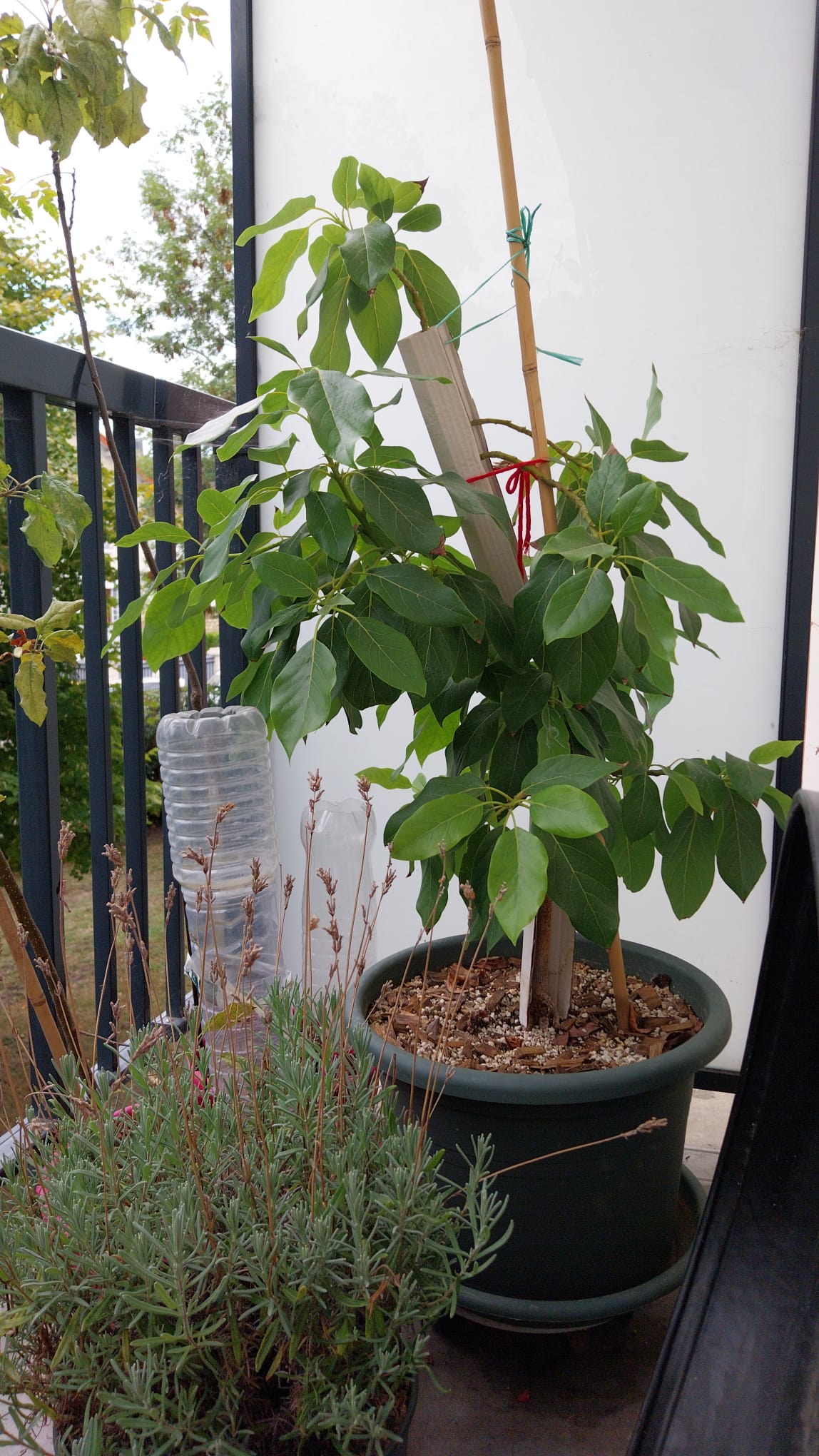
Here is my container growing avocado tree update (Mexicola scion and hass seedling). It is flowering every year but is not able to fruit yet. Last winter for the 1st time I had put it outside in the balcony facing south east. It survived with a minimal protection with leaf damages. I added a white cover to protect it from late january to march. I placed 3-4 other container plants around the tree to give it some extra warmth. It snowed here for few days (3 to 4 days in total if i remember well) and winters were very chilly. I have a limited space so can't plant it on the ground. I hardly watered the young tree during winters (Once in 2 weeks). This spring I have completely removed commercial potting soil (even from the root ball) and made my own soil mixture according to Gary Matsuka's soil tips to avoid root rot. It was in complete shock but recovered in a month. The new soil comprises of a mixture of pumice, peat moss, vermiculite, perlite and river sand. I am only adding Osmocote (long term fertilizer) and very less amount of compost uptop with old avocado leaves and wood chips. Not sure how the tree will react to the soil change during winters if I think about the overall temperature inside the soil. But it is doing really well so I am satisfied with the result. I'll surely repot it next year onto a bigger container.
Avocado.jpeg
The young tree with a scion grafted by meself.
The young tree with a scion self grafted.
Avocado-flower-late-march.jpeg
Flowers late march
Flowers late march
 
Mike Guye
pollinator
Posts: 112
Location: St Leonards-on-Sea, UK (50.86°N; 58 metres a.s.l; 1.8 Km inland)
18
  • Likes 3
  • Mark post as helpful
  • send pies
    Number of slices to send:
    Optional 'thank-you' note:
  • Quote
  • Report post to moderator
That's a wonderful looking potted avocado, Priyanshu - it looks very healthy - it seems very happy on your balcony
This year, did the flowers begin to set any small fruit or did the flowers/fruit abscise prematurely?

All five of my UK avocado blogs on imgur have been updated (Nov 2025) - just scroll back 4 posts for the different links if you want to view these.
For those viewing from the UK, you will need to use a VPN, as imgur is no longer directly accessible to UK users.
 
Priyanshu Uniyal
Posts: 26
4
  • Likes 4
  • Mark post as helpful
  • send pies
    Number of slices to send:
    Optional 'thank-you' note:
  • Quote
  • Report post to moderator

Mike Guye wrote:
This year, did the flowers begin to set any small fruit or did the flowers/fruit abscise prematurely?


All flowers fell off during the month of july this year if I remember well. Hand pollination was tried multiple times and during different moments of the day (morning, afternoon, evening). Right now there is no fruit. I usually get flowers in my avocado tree during late February or early March every year. Hard to tell if I have any flower buds right now.
It is always great to see your trees' update. Thanks for sharing.
 
Peter Entwistle
Posts: 19
Location: NW England, UK (Zone 9a)
  • Likes 3
  • Mark post as helpful
  • send pies
    Number of slices to send:
    Optional 'thank-you' note:
  • Quote
  • Report post to moderator

Mike Guye wrote:All five of my UK avocado blogs on imgur have been updated (Nov 2025) - just scroll back 4 posts for the different links if you want to view these.
For those viewing from the UK, you will need to use a VPN, as imgur is no longer directly accessible to UK users.


Thanks for the update on all of your avocado blogs, Mike. It's great to see them all thriving in the ground there! I'm very impressed with the increased thickness on some of the stems. I have noticed the truck on my in-ground one has increased a lot over this last year, while it's been in the ground. I should start recording the thickness, as it does seem a good way to keep track of the development.

I have noticed that my avocado has begun to lean over with the weight of the lights and plant jacket I have added due to the frost we had the other week. I will have to stake it upright with a strong wooden stake and also put up some posts to hold up the fleece bag so it's not resting directly on the canopy.
 
Posts: 5
  • Likes 4
  • Mark post as helpful
  • send pies
    Number of slices to send:
    Optional 'thank-you' note:
  • Quote
  • Report post to moderator
How much does the rootstock matter if the variety grafted onto it is cold hardy mexicola joey etc.
Most commercial avocados will be a cross of hass and fuerte/zutano so probably a decent rootstock
Where can budwood be sourced I know about the company in America but is anyone is uk/Europe selling budwood of the Mexican hardier varieties like mexicola
 
Mike Guye
pollinator
Posts: 112
Location: St Leonards-on-Sea, UK (50.86°N; 58 metres a.s.l; 1.8 Km inland)
18
  • Likes 5
  • Mark post as helpful
  • send pies
    Number of slices to send:
    Optional 'thank-you' note:
  • Quote
  • Report post to moderator

Joseph Byrne wrote:How much does the rootstock matter if the variety grafted onto it is cold hardy mexicola joey etc.
Most commercial avocados will be a cross of hass and fuerte/zutano so probably a decent rootstock
Where can budwood be sourced I know about the company in America but is anyone is uk/Europe selling budwood of the Mexican hardier varieties like mexicola


Hi Joseph, yes I had this same question a while ago.
While it is true, for different plant species, that cold-hardy rootstocks can be used to increase the cold-hardiness of the grafted scion, a survey of the literature revealed that this does not appear to be the case for avocado. The main feature that is exploited with avocado rootstocks is either their increased tolerance of saline soils or their tolerance to root-rot, caused by the pathogen Phytophthora cinnamomi which thrives in cold wet soils and which apparently is a major threat to avocado production.  
 
Joseph Byrne
Posts: 5
  • Likes 6
  • Mark post as helpful
  • send pies
    Number of slices to send:
    Optional 'thank-you' note:
  • Quote
  • Report post to moderator
That’s good to know as scions are much easier to source than Mexican race seeds/seedlings
I reckon in 5 ish years it might be possible to grow an avocado in ground even pretty far north in England I think spring 2027 I will order some bud wood from america and gray onto seedlings
 
Mike Guye
pollinator
Posts: 112
Location: St Leonards-on-Sea, UK (50.86°N; 58 metres a.s.l; 1.8 Km inland)
18
  • Likes 5
  • Mark post as helpful
  • send pies
    Number of slices to send:
    Optional 'thank-you' note:
  • Quote
  • Report post to moderator

Joseph Byrne wrote: ... it might be possible to grow an avocado in ground even pretty far north in England ...

If you are anywhere north of London, it's my guess that you'll need a polytunnel or glasshouse to get the number of growing degree days (GDD) up high enough to evoke flowering, i.e.  1300 GDD or more. My gut-feeling is that this is probably true for  both Mexican and other avocado types.  Additionally, you'll need good winter protection to prevent any flower buds that form from being damaged or reverting to vegetative buds.  Good luck Joseph with this project - it could well be several years until seed-grown trees fully transition to the reproductive phase  - it might be quicker if you bought a tree that's already grafted for you, e.g. a grafted Bacon. I think there are some suppliers online for those living in the UK ...
 
Joseph Byrne
Posts: 5
  • Likes 5
  • Mark post as helpful
  • send pies
    Number of slices to send:
    Optional 'thank-you' note:
  • Quote
  • Report post to moderator
Seeing as I’m in rural Yorkshire a greenhouse is a good shout plantsforpresents will have grafted zutano plants in may do you know anywhere else that would sell.I will probably plant it in ground in the greenhouse and then experiment outside but with climate change you never know.
 
Peter Entwistle
Posts: 19
Location: NW England, UK (Zone 9a)
  • Likes 4
  • Mark post as helpful
  • send pies
    Number of slices to send:
    Optional 'thank-you' note:
  • Quote
  • Report post to moderator

Joseph Byrne wrote:Seeing as I’m in rural Yorkshire a greenhouse is a good shout plantsforpresents will have grafted zutano plants in may do you know anywhere else that would sell.I will probably plant it in ground in the greenhouse and then experiment outside but with climate change you never know.


The Plants4Presents ones probably won't be grafted. I got 2 from them when they first got them in (back in spring 2024), and they were meant to be grafted, but I couldn't see any graft union on them at all. I suspect their supplier is selling them failed grafted plants, as some of them had remnants of parafilm tape on, but no actual union. On my 2, it looked like the graft had simply failed, and they had cut it off, so a new side shoot from the rootstock could take over. I saw a number of other people's trees that got them from them at the same time, and theirs looked the same as mine. I think a couple of their trees were grafted and had flowered in their nursery, but the vast majority had no sign of any graft union at all. I emailed them last year when they got a new batch in to see if they had changed supplier, as they told me they would try to source new trees from somewhere else, but they said they were from the same supplier and looked the same as the last batch they got. The good news, though, is I suspect the seed they used was a Zutano, which is of Mexican heritage. Both of mine have a strong aniseed scent to the leaves when I crush them. Of course, they won't come true to type, so I will need to either graft them myself, or wait a very long time for them to flower on their own lol. I have one of them planted in the ground in the northwest (Lancashire/Greater Manchester border), although I do heat it with incandescent lights and wrap it in fleece to prevent it from getting below freezing. I do plan to graft onto the in-ground tree this year. Of course, as Mike mentioned, they may not get enough heat to flower this far north outside. Although one of my trees (I purchased as a grafted Bacon) appears to have buds that might possibly be flower buds developing on it. But I will have to wait until they start opening to know for certain. Growing a grafted one in the ground inside a large greenhouse could be a good option though.
 
Joseph Byrne
Posts: 5
  • Likes 5
  • Mark post as helpful
  • send pies
    Number of slices to send:
    Optional 'thank-you' note:
  • Quote
  • Report post to moderator
Yes I was wondering that I’m not sure £80 is a very good price for a Mexican race seedling.
I may just graft onto my own seedlings and then grow on in a greenhouse until it fruits and then use those seeds to plant outside as they may fair better.
Do you know anywhere that sells avocados taht may be slightly more tolerant of cold - Don’t they use fuerte/zutano/bacon to pollinate commercial hass groves.
Your in ground tree looks wonderful.
What varieties where you thinking of grafting onto it.
I suspect some varieties require less heat than others to flower.
Do you know a good source of budwood ( I don’t want to order from America this year as I would like to buy pawpaw and persimmon wood at the same time as it is so expensive.
I have planted lotus persimmon seeds for grafting next spring hopefully.
Planting a ‘vaniglia’ tree fairly soon so we shall see how that goes.
Maybe by 2030 you’ll be harvesting the most northern avocado Peter!
 
Peter Entwistle
Posts: 19
Location: NW England, UK (Zone 9a)
  • Likes 4
  • Mark post as helpful
  • send pies
    Number of slices to send:
    Optional 'thank-you' note:
  • Quote
  • Report post to moderator

Joseph Byrne wrote:Yes I was wondering that I’m not sure £80 is a very good price for a Mexican race seedling.
I may just graft onto my own seedlings and then grow on in a greenhouse until it fruits and then use those seeds to plant outside as they may fair better.
Do you know anywhere that sells avocados taht may be slightly more tolerant of cold - Don’t they use fuerte/zutano/bacon to pollinate commercial hass groves.


Yeah, I don't think it's worth it at those prices, unless they were actually grafted with a named variety and they could verify it with photos of the graft union before sending. Although be aware, they aren't that clued up about avocado grafts as they were showing me and others photos of side shoots and claiming they were graft unions lol. I believe I paid about half that at the time, but they have since increased the price. And if you're going to be trying in a greenhouse where you have the ability to add a heat source for really cold nights, then a seedling Hass should be absolutely fine. I know occasionally some supermarkets sell Bacon and Fuerte avocados. I think M&S occasionally sell Bacon when it's in season. I have also ordered boxes of fresh Bacon avocados from 'CrowdFarming'. They sell directly from the farmers, who are usually based in southern Spain, as they have a small commercial avocado-growing region there. I think Bacon is out of season now, though. At least the Spanish Bacon season seems to be autumn. It's possible some from the southern hemisphere could show up in spring from places like South Africa.

Yes, I believe a lot of the commercial orchards do have a few B flowering types like Bacon, Fuerte and Zutano in their orchards to help with pollination. That being said, many of the A types, such as Hass, will readily fruit on their own. I suppose there is a chance a regular Hass avocado from the supermarket could have been crossed with one of the hardier types (although not guaranteed).

Joseph Byrne wrote:Your in ground tree looks wonderful.
What varieties where you thinking of grafting onto it.
I suspect some varieties require less heat than others to flower.


I will try a few different ones from some of my other grafted trees. I have (at least allegedly) Hass, Fuerte, Bacon, Pinkerton, Reed, Joey, Mexicola & Julienne (the large London specimen that seems to reliably fruit). Although some of those trees are still really small, so I may not be able to use them to graft this year. I'm also not 100% sure if all of them are the right variety, as some of their leaf shapes and other characteristics don't match what they're meant to be for a couple of the trees. The Hass, I'm pretty sure will be right, the Joey I also think is correct (the leaves have a very strong aniseed scent when crushed and match photos and videos I've seen of it), and of course, I know the Julienne is right as well. I have a grafted 'Fuerte', but I'm pretty sure that might be a Hass too, as I managed to source a Fuerte scion from California and that one has the aniseed scent to the leaves, whereas the tree I got labelled as Fuerte doesn't. The Bacon, I'm still not sure about either. But the growth has been stunted due to it still being in the original pot, so the leaves could just be stunted by a lack of nutrients. I will get that one either repotted or in the ground this year. Although, as it might be showing signs of flower buds developing, I might be able to determine which it is based on the flowers, as Bacon is a type B and Hass (which is the most likely variety if it's not labelled correctly) is a type A. The Pinkerton & Reed are still too small to be able to tell if they are correct, although I've had scions of other species from the same source, and they have been correct. The Mexicola is the most recent one I've grafted, although I'm not 100% sure if it's still alive (I know 1 of my grafts failed, but there was another in my greenhouse that I think was doing ok). So, as it's not really grown much, I can't say for certain if that one is correct, but it does have the aniseed scent that Mexicola should have.

Ideally, I would graft pure Mexican types only onto it so that it may not need as much protection in the future as the tree matures. I would also like to graft at least 2 varieties, 1 type A and 1 type B, to try to improve the pollination. Although avocados can be self-pollinating due to a crossover period between the flower stages that can occur, so it might not be 100% necessary. I guess Joey (type B) and Mexicola (type A) would be 2 good choices, although I probably couldn't graft Mexicola this year from my existing plant, unless it puts on a lot more growth (and also assuming it survives the winter in the greenhouse). I will probably add a Hass scion as well as a Bacon or Fuerte. According to Greg Alder and the research he links to, Fuerte needs more heat for the flowers to actually set while flowering https://gregalder.com/yardposts/the-fuerte-avocado-tree-a-profile/, specifically, he mentions daily highs above 70°F (21.11°C) are required. So that one might not do well in the UK, unless the flowering is delayed until summer (or it's inside a greenhouse/polytunnel and we get enough sun to heat it up while flowering).

Joseph Byrne wrote:Do you know a good source of budwood ( I don’t want to order from America this year as I would like to buy pawpaw and persimmon wood at the same time as it is so expensive.


You'll find it quite hard to source any avocado budwood or any that are able to ship to the UK. I will private message you about where I got my Reed and Pinkerton from, as I believe they might still be available. I'll check if the Mexicola is still available too.

Joseph Byrne wrote:I have planted lotus persimmon seeds for grafting next spring hopefully.
Planting a ‘vaniglia’ tree fairly soon so we shall see how that goes.
Maybe by 2030 you’ll be harvesting the most northern avocado Peter!


Sounds like a good plan! I have a few different persimmon varieties. I'm planning to plant a couple of them in the ground before spring.

Yes, I would love to eventually be able to get some avocados to fruit here, of course, it's going to be a real challenge and possibly require a good set of circumstances. E.g. a long, warm summer, followed by a relatively warm autumn to hopefully trigger them into flower the following spring. Winter won't be as big of a challenge as long as I can provide my usual protection to keep the fruits and tree protected from frost and sub-zero temperatures. And also assuming we don't get much colder than usual.
 
Joseph Byrne
Posts: 5
  • Likes 4
  • Mark post as helpful
  • send pies
    Number of slices to send:
    Optional 'thank-you' note:
  • Quote
  • Report post to moderator
Yes I reckon pure Mexican types are the best Lila  can apparently survive down to -10 but struggles to hold its fruits - it has been documented for 6 years or so by the millennial gardener in North Carolina (zone 8b/a).A similar humid climate which could be another issue with fruit development as Mexican types are native to fairly dry climates and with there thin skins are more susceptible to fungus diseases etc but probably not the biggest issue😂
I reckon as hass types are 61% Mexican genetically and are possibly pollinated with a Mexican race variety a chance seedling could be quite hardy.
A documented tree that is 4 years old in British Columbia survived a -14 freeze but I can’t rerify that.I will probably be trialling as many seedlings as I can- obviously any grafted plants I’m not going to risk especially when they are only a few years old or so.
I think the idea of grafting a and b types makes sense -how do you tell them apart other than the fact that the male and female parts of the flowers open at different times?
Yes I have looked it the heat requirements of avocados to produce flower buds and there is pretty much zero research which makes sense as we have quite a unique climate in which we don’t get very cold or hot - even if you were breeding avocados to survive hard freezes in say northern Florida heat in the growing season would never be an issue.
I suppose that will slowly be solved by climate change anyway so having an established cold hardy tree in ground would be an advantage in itself but from the scientific papers on avocados I have seen the only documented requirement for flower buds to be produced is interestingly a cool period in autumn or towards the end of the growing season and this is variable - Mexican cultivars struggle to produce well in really warm areas like the Caribbean because of this.
I suspect that the GDD requirement is also variable depending on cultivar and is one of the easier traits to breed - think of evergreen blueberries in south Florida and peach with ~ 250 chilling hours and naturally you would expect the requirement for the Mexican types to be lower as they developed in colder climates.
I don’t know of any pure Mexican trees in the uk that have flowered but hopefully you can test this theory.
Fruitwood Nursery I think it’s based in California shops budwood worldwide with a £70 charge for a phytosanitary certificate and a little more for shipping the sell about 10 different Mexican race types and restock in late autumn they currently have a good few still available but I’m not considering it for this spring I don’t have enough rootstocks -I would like to order some other scions form them aswell.
I think it’s quite possible and with breeding over time will become easier.
Really interested to see your trees development this year -the bacon looks very promising.
Kind regards Joseph

 
Get me the mayor's office! I need to tell her about this tiny ad:
Learn Permaculture through a little hard work
https://wheaton-labs.com/bootcamp
reply
    Bookmark Topic Watch Topic
  • New Topic