David Milano

+ Follow
since Apr 11, 2024
Merit badge: bb list bbv list
For More
North-central Pennsylvania
Apples and Likes
Apples
Total received
In last 30 days
0
Forums and Threads

Recent posts by David Milano

Noting the number of ukulele videos posted on this thread is all the evidence one needs to see that a portable, (relatively) simple, 4-string instrument is a pretty popular item. The potential for creating a satisfying result simply is truly one of the ukulele’s biggest appeals.

I once taught an adult, group ukulele class that covered no theory, no note-reading, no nothing at all technical. The goal was to play nice stuff without having to become a “real musician” (as a couple of the participants noted). It went over real well. In a few short weeks everyone was singing and strumming and, clearly, enjoying themselves.

I attached a link to a (little-viewed) video of myself playing a Joni Mitchell tune. It was posted for the adult class to help  a couple of the more advanced beginners transition from strumming to finger-picking. The song is pared down to minimize complexities. If you look at the YouTube description you’ll see that I also posted sheet music for it in tablature form, which the students thoroughly ignored. Fun is so much more pleasant than the technicals, especially when one is getting older and not sopping up new ideas and skills like a hungry child might!


1 day ago
I’m a woodturner and rustic furniture maker. Most of my shop turning time is spent making finer, gallery-type items, which frankly can be a hard sell in our small, rural town, thus can end up shipped to a city gallery somewhere, which for some reason is, to me, kinda sad. But… if commerce is the metric, fancy things need to be sold in fancy places!

So I’ve been spending more time lately with small, crafty-type items, which are affordable and pretty popular locally, especially around Christmastime. The pics show a representative sampling.

The Christmas tree is adorned with shop made, functional toys (that are, dare I say, wholesome) and ornaments that span from the whimsical (mini rolling pin that spins around its handles) to the semi-fine (hollowed wooden globe). The top spinner is pure fun for kids who are used to needing batteries for their toys (https://www.youtube.com/shorts/W4GW2RLHw8Y).

The birdhouses are a new idea, made from tree trimmings and cheap plastic mini-birds. The idea with the birdhouses is that the roof/lid can be lifted and a special gift, or perhaps a spare house key, placed into the cavity.

Since my shop work soaks up an often alarming amount of time for what is essentially a hobby, it’s good to be able to get a bit of a financial reward. And I can’t help but notice that each completed project, big or small, brings a bit of self-satisfaction.
1 week ago
Denis’ description of Bayside, Maine, tugs at the heart.

Happily, and not incidentally, his description could easily stand in for my own town, and of course many other old places.

Denis wrote that Bayside is “… still thriving with a core of folks that are multigenerational in Bayside alongside a nice diversity of newer folks from all over the country…”

It occurs to me that, of the two groups, the former (the multigenerational family) is the indispensable one. These are the folks most securely tied to their place and thus the ones with the fullest knowledge of it and faithfulness to it. It’s difficult to overstate the importance. Without an investment of time it’s difficult, maybe impossible, to developing a complex understanding of a place, and it is complex understanding that prevents inhabitants from being careless with their place.

Notably, old-timers seem to have an innate, natural tendency to adapt themselves to their place (another way of saying “preserve” their place) while newcomers can easily go the other way, expecting a place to adapt to them. The latter invites a squandering of conventions and traditions that maintain long term functionality (ironically the very characteristics that make a place attractive to newcomers in the first place).

There’s a joke where I live that you’re not a “local” until your grandfather was born here. I used to roll my eyes when I heard it, but as time has passed and more knowledge of my place has come to light (stuff "I didn’t know that I didn’t know”), the joke holds more sagacity than humor.

I hope this doesn’t come off as lecturing…
1 month ago
Wendell Berry’s compact description of a community says it all to me:

“A community is the mental and spiritual condition of knowing that the place is shared, and that the people who share the place define and limit the possibilities of each other’s lives. It is the knowledge that people have of each other, their concern for each other, their trust in each other, the freedom with which they come and go among themselves.”

Curiosity compelled me to search my vast store of digital photos with the term “community.” The search algorithm (that most devilish of inventions) actually got it right this time, more or less. What appeared was pic after pic of people grouping together for all sorts of purposed activity. Also mixed in was a pic of my ouse, my garden, our town’s main street, and one particularly poignant, somewhat grainy pic of my daughter’s wedding, which I attached. The attractive young lady with the black sweater and big smile, standing there in front, is shown just before she caught the thrown bouquet. Seven months later she became my daughter-in-law.
1 month ago
I’m sure there will be nothing original in this post, but I feel compelled to pipe in with this:

The appeal of a scythe for our tiny farm was irresistible. I thought, “Cheap mowing, good physical exercise, and another tether on my sometimes type-A rushing about.” Two out of three isn’t bad. The miss was “cheap.” Actually it was not completely a miss… rather just mostly. In the end, unless I counted my time as free (laughable), mowing hay with a scythe was pretty wasteful, as it overwhelmed everything else, leaving me unable to get my other work done.

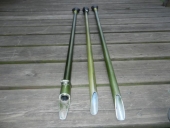
For the record: I used an old American scythe (curved handle—a barn find that I had to modify to fit me) for mowing our hayfield, and a new European scythe (straight handle with a ditch blade—wider and shorter than the hay blade) for mowing banks, between fence posts, and generally at the edges of things to keep the flora from going woody.

The first year I struggled with everything—sharpening, work endurance, and efficiency were all terrible, and of course all tied together, which made me wonder if I could ever make the scythes really useful. The second year everything magically improved, but while the ditch blade compared favorably to gas-operated machines both in cost and time, the haying was still woefully uneconomical, even though I was, while not a champion scyther by any means, pretty okay compared to the expert demonstrators I had seen. For haying then, I reverted back to machinery, and then subsequently to having a local farmer do it.

The scythe still holds top honors for ditch and similar mowing. As you can see in the photos, my beloved ditch blade is a bit chewed up (from hitting bits of fence wire, stones, etc.) but judicious peening and of course very frequent field sharpening keeps its performance more than adequate, even with jagged spots.
1 month ago
Hi Cécile.

You are quite right that currants and elderberry share the characteristic of being very easy to propagate from cuttings. Sean from Edible Acres covers this thoroughly, and much better than I could, in a YouTube video:


6 months ago

Cécile Stelzer Johnson wrote:David Milano, I wonder if you pruned/trained your elderberry to be a tree? Or did you buy it that way?


Yes, we “created” the shape, merely by cutting the lower branches and a bit of judicious branch pruning. We like the form, and it’s well suited for berry collection.

No need for us to buy elderberry—they’ve naturalized here and there around our ponds and swamp—so we just take 12”+/- twig cuttings from them and stick them in the ground. Our success rate for rooting is in the neighborhood of 50% so I “plant” 3 or 4 twig cuttings in a clump and later gently pull the ones that haven’t rooted or that seem weak. This is, as far as I know, the most common way to propagate elderberry.

NB: In our region elderberry is so common that if we didn’t have it on our own land, it would be easy to find available cuttings on someone else’s. Most farms have at least a few elderberries, and permission to take a handful of cuttings is readily given. Of course if you’re looking for a specific variety...
6 months ago
Though my climate is essentially identical to Sean’s, our experience with to-the-ground pruning doesn’t seem to match his. It seems to set the fruiting way back—two years before significant fruiting returns. Maybe it’s a variety issue, maybe microclimate, don’t know. Whatever the reason, my solution is to maintain four, maybe five bushes, each in a different stage of development.

Started the process two years ago by planting cuttings in our vegetable garden, the cuttings taken from a strong pond-side elderberry (no idea what variety). Pulled all but the strongest, and after two years put another in the ground next to it. That’s what you see in the attached picture. I’ll start another each year until I have the desired 4 or 5 bushes. By then the oldest bush can be pruned to the ground and the others (with light pruning) will be supplying us with berries. Keep cycling and the bushes should live long and prosper, and give us plenty of berries.

The cuttings of course find their uses, though it never occurred to me that elderberries could be coppiced for biomass. I generally rely on Alder for that since it’s so well established around our ponds, but all things considered, the elderberries would likely have greater value than the alder. Time for a change!
6 months ago
For anyone interested in the life-history of city neighborhoods, I must recommend, strongly recommend, Jane Jacob’s wonderful book, “The Death And Life Of Great American Cities” (still in print; originally published in 1961). Jacobs delineates the colossal failures of centralized city planners and their “urban renewal programs” which did great damage to neighborhood communities, mostly by aggressively down-ranking mixed-use city development in favor of mono-use zones (the urban socioeconomic equivalent of agricultural monoculture). She describes, in essence, the destruction of the front porch.

At 71 years old I’m old enough to remember the pre-urban-renewal era. I recall vividly at about 5 years of age visiting my grandparents in Albany, New York, walking a few blocks around their home and seeing, for example, ground floor shops (whose proprietors lived upstairs), a small shirt factory (where my grandmother worked) and many tenement homes and the people who lived there (often porch-sitting with neighbors). In a short 20 years almost all of that was gone, replaced by empty, untended, often boarded up buildings, and far, far fewer people. In my youth, the lively city porch was a happy fixture; in my adulthood, it became mere memory.

We are country dwellers now, and although we have precious few “just-stopped-in” visitors (most visits these days are planned events) we nevertheless maintain a front porch, which I must say is much enjoyed by family and visitors alike. We decorate it, keep it tidy, and make sure the view from it is pleasant. For us that means creating and maintaining “domesticated grounds” which we plant, mow, and trim. The attached pictures are views from our porch.

Oh, and one more (important) thing: Our house is perched on a west-facing hillside, and most of our weather comes from that direction. The front porch faces east, a protected position. When weather is rushing in from the west the back of the house can get hit pretty hard, but the front porch is usually quiet. The big winds and blowing storms that pound us from the west are just breezes and harmless rain to porch sitters.
6 months ago
Lots of good stuff in this thread!

Cattle panels find uses all over the place here. Fencing (cattle and otherwise), trellises, hoop houses, temporary awnings… I’m sure I’m forgetting some. Our favorite is the cattle panel bean arch. I cut 4 pieces of ½” rebar, 18” long each, and drove them into the ground, angled toward the center, to support the four corners. Sowed the beans at the base on both sides. Easy building, easy planting, easy harvesting, and kinda pretty too. Behind the arch in the attached picture are peas on a cattle panel.
6 months ago