Alex Howell

+ Follow
since Jul 08, 2025
Merit badge: bb list bbv list
Biography
Hi There!
Thanks for clicking on my profile and wanting to learn more about me. I look forward to interacting with you in the future on Permies!
Born in Jersey, Channel Islands, I was surrounded by farms for the majority of my childhood. At the time I took this for granted, but the longer I live, the louder the call of the land becomes, and I now know that in the long term I want to be involved in regenerative agriculture.
After moving to Japan in 2023 I started looking for a property with enough land to act as a testing ground, and finally found a place in November 2024. I've been living in the property as of April 2025, and have already learned so much. Every day is a challenge, but I'm hoping that the Permies community can help me learn, and grow going forwards.
Currently I am a Japanese translator by trade, so if you have any questions or documents you want some help with, feel free to ask!
For More
Japan,Toyama (Zone 9a)
Apples and Likes
Apples
Total received
In last 30 days
5
Forums and Threads

Recent posts by Alex Howell

Laume Fae wrote:Damn it I'm a bit too old, who want's a milenial thread ?Looking for friends


Hey, there was a millennial permies thread some years back. I'm sure you could drop a post there and revive it!

Link: https://permies.com/t/101996/Millennial-Permies#840895
22 hours ago
I had similar issues with adding photos (on firefox mobile browser).

Switched browsers to chrome and had no problems, so if you still can't upload in desktop mode then I suggest trying another browser!

Fox James wrote:Well it is a small world, I bet you are glad you left that horrible place…should have moved to Guernsey   ha ha!


Guernsey wasn't quite far enough from Jersey for me, so I decided to move to Japan instead, hahaha

Fox James wrote:Peters latest Shorty core is relatively easy to build and is much more forgiving about re loading to produce radiants heat all day long. A lot depends on how well your house is insulated and how much wood you have to burn?


Firewood is expensive here, so not a lot. And the house is currently very drafty (working on that part of it), which is why I was hoping to get a good amount of mass... That being said, I would also like to feel warm sometime in the near future, so a small setup for the coldest rooms might be the way to go for the immediate future (as long as I can figure out where to route a flue...)

Rico Loma wrote: One idea I want to toss out is maybe the smallest heater. Benjamin documented his  work here, Cottage rocket, first time build.  It is compact yet has a slight mass, please look.  If bolted to a wall it could handle an earthquake better than an all masonry build, I presume?


Will definitely take a look into this! Regarding bolting things onto walls, the main issue with earthquakes isn't the stove falling over, it's the stove acting as an anchor and preventing free movement/flexing during the shaking (these old timber houses are supposed to move with the quakes, not resist them). It's not really something you think about unless you live in earthquake prone countries, so it's been a big learning curve for me!

Coydon Wallham wrote: I wonder if the obstacles leading you to abandon a sunken design here are insurmountable? If you are going to have a massive object, surely having it constructed roughly two feet shorter (half height?) would make it far less subject to damage from seismic activity? As for your mention of using rock wool for insulation/fill to seal edges between mass and floor, Morgan Superwool would be beneficial there if you have access to it or something similar- regular rock wool has hazardous properties in normal handling which Superwool does not, as long as it is kept below furnace temperatures.


There are a few issues with the sunken idea (albeit aesthetically preferable) which are currently turning me off the idea. It really depends on how sunken we are talking about, but in a 1-2 foot step-down scenario the biggest risk is the trapped heat zones becoming a pyrolysis risk to the surrounding bearer posts/joists, and that the close the slab is to ground level, the more we have to start accounting for condensation... Building it directly on the ground might seem like it would be seismically safer, but there's a real risk of soil liquefaction during quakes, if the heater moves and the house doesn't, or visa versa, then you're suddenly ramming a large mass into the foundations of the building... It's all a bit messy.

Will definitely take a look at superwool, thanks!


2 days ago
Hi James, Pleasantly surprised to hear from another channel islander! (I was born & raised in Jersey)

Fox James wrote:
Also there are other options that might help you build a lightweight stove with less mass, maybe not exactly what you planed but still a super efficient stove that can be placed in you home without massive foundation work.


Did you have any potential recommendations here? I'm making sure to consider all my options before I make any costly mistakes.
3 days ago
Hey Everyone, thanks again for your interest and your comments.

I decided to veer away from pebble mass entirely for the reasons you mentioned above + I ran some seismic simulations and pebble mass fared much worse due to all the individual pebbles having their own inertia, which resulted in a lot of stress on the frame/anything it was attached to... In general it seems to be a bad idea in an earthquake prone country (unless you're bringing it around as an outdoor promotional item at fairs, etc.)

Since my last post I have decided that sinking it into the crawl space is  a bit of a recipe for disaster (Soil moisture migration and restricting crawlspace airflow are just a couple of concerns here), so my next steps really are deciding what work needs to be done to make everything earthquake/fire safe for the standard above floor setup.

I'm estimating that is would weigh about 3.5–5 metric tonnes over about 4-6 meters squared, so I'm thinking that it would be best to seismically isolate the heater from the house.New piers or short strip footings, build a new platform concrete rebar slab on top, with an isolation gap between the slab and the house frame (Maybe 10–15 mm filled with rock wool). Other than that, keeping the bench low and spreading the surface area as wide as possible is logical.

The seismic logistics are turning into a bit of a mammoth task, so I'm currently thinking I may build a test unit in my barn as there are solid concrete floors there and I could pipe the flue directly out of the wall. Would give me a much more holistic idea of what I'm dealing with and work out any potential kinks during this initial testing stage, then if necessary calling in someone to help with the foundation work if it feels out of my depth.

Will continue to update this thread as things progress.
3 days ago
Not a single permie, but wanted to chime in as a (barely) Gen Z permie (1997).

Living with my wife in an old Japanese house, with a little bit of land and a big old barn (we never could have afforded property in the UK, so it felt like a blessing for it to suddenly be within our reach).

I look forward to seeing all of you around the forums!


Tommy Bolin wrote:He told me his outlet friend had a hungry black bear that had broken into his stash, and what he did not eat, he demolished, leaving a smelly pond of goo in his barn, forcing him to run the persistent bear off a couple times.


Good to know that black bears are just as weak to the smell of deep fried foods as humans are!
1 week ago
Wow, thank you everyone for your interest in the project and all your replies! I'm happy to hear that if I insulate the sides below the floor I could viably re-direct heat up and into the rooms... I assume I would need to make sure whatever foundations I built on were also well insulated for similar reasons.

I'll do my best to go through any questions you've all had below, and will create a sketch that's less visually confusing than my initial madman scribble drafts for everyone to consult in the near future.

Climate: The coldest we get are temperatures around 0⁰C to -5⁰C, lots of snow so I need to be careful about where I'm placing the chimney. I am planning on a 8" J tube.

Design: The bell would be coming up into the room to act as a radiant heater. The feed tube would be at floor level, this might sound awkward to tend, but I spend 80% of the time on the floor (tatami mats) and most Japanese furniture is built low to the ground to accommodate for this style of house

I played around with the idea of having the bell below floor height, but felt that it would only really make sense if I was making some kind of conversation-pit style design where the whole room was sunken down like Peter Sedgwick's RMH Hokkaido build. If possible I would like to avoid interrupting the flow of movement between rooms as much as possible, which is why I started playing around with this idea.

What did I mean by pebbles?: Pebbles were referring to the pebble RMH build that's shown in the free heat movie as I thought the look was quite Japanese and would work well in my interior. That being said, the same effect could be achieved by having a solid cob/rock base and a small sandpit facade on the top, so I'm not ruling out any options yet. Ultimately I would want the most efficient thermal mass possible, so if pebbles fall short here then I may steer away from that design.

Video of the Pebble RMH below for reference:
1 week ago
Hello Everyone! I'm in the early planning stages for my RMH and had a few questions before I invest too much time considering potentially unviable builds.

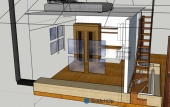
To give you some context for the question, my house is about 1 meter off the ground with a very large crawl space. I live in earthquake country, so building the heater directly on the ground is much safer than trying to reinforce the existing floorboards from below. I've been playing around with different ideas and came up with a Pebble design similar to a Japanese Irōri (essentially a sand pit in the middle of the room that people keep hot coals in to keep their living spaces warm. Have attached a picture to this post).

I currently have a vision of having the pebbles, chamber and feed hole at around the same height as the current floor level and sinking the rest of the unit below the floor (built up from the ground). My main worry is whether this is a fire hazard, or whether I'm going to be losing too much heat out the side of the unit into my foundations... At least it would keep them nice and dry!

My initial thoughts are that heat rising dictates that the majority of it will be radiating up and out from the upper pebble surface anyhow, but that I wanted to consult the Permies board of rocket scientists and see what you all thought about the idea! If it's totally unviable I am open to any suggestions you might have.

Thank you for your time!
1 week ago
I'm surprised nobody has mentioned the old cooking oil conversion diesel cars yet. Conversion kits can be a bit expensive if you don't make them yourself, but providing you are using old, filtered & recycled oil from fast food places then you're reducing waste for every mile you drive!

There used to be a local legend where I grew up who converted a diesel VW Polo and had an agreement with all the local restaurants to pick up their used oil.

The main downside was that he always smelt like chips (fries)... That being said, some might consider that a perk! 😂
1 week ago