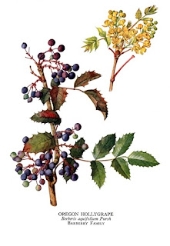
Depending on where you live, the berries of Oregon Grape maybe ripen in late spring or early summer. Its cousin, Barberry, may have last fall’s berries still on its thorny stems in spring, as well. I prefer the larger, blue to reddish berries of Oregon Grape, although I have both growing on my property. Both plants are very important to herbal medicine, having strong antiseptic properties and being very good for the liver and stomach. The berries of Oregon Grape, like the entire plant, are extremely bitter, but not unpleasant. Combined, in small amounts, with either other fruits or large amounts of sugar they can make a very nice jelly or wine. Once you get used to their bitterness, you may enjoy snacking on a few berries while hiking. The flavor can be quite shocking to the uninitiated, but gradually you can develop a taste for them as I have.
Oregon Grape berries are more like cranberries than any other fruit that comes to mind. A simple compote made of them makes an excellent side dish for roasted meat and fowl. Put a cup or two of berries into a pot, along with a cup of water and bring to a low boil. Once cooked, press the berries through a strainer to remove the seeds. Return to the pot and add a cup or so (to taste) of sugar, a cup of water and some citrus zest. Bring to a simmer and stir until the sugar is dissolved. You can add any spices you like – I think cinnamon and clove are very nice. The flavor will be something like a tart cranberry sauce and should not be too sweet, but will have a distinctive Oregon Grape taste and aroma. A small serving should ensure good digestion with even the heaviest meal.
Medicinally, Oregon Grape is among our most important plants. Let's turn to Plants For A Future again:
Medicinal use of Oregon Grape: Oregon grape was often used by several native North American Indian tribes to treat loss of appetite and debility. Its current herbal use is mainly in the treatment of gastritis and general digestive weakness, to stimulate the kidney and gallbladder function and to reduce catarrhal problems. The root and root bark is alterative, blood tonic, cholagogue, diuretic, laxative and tonic. It improves the digestion and absorption and is taken internally in the treatment of psoriasis, syphilis, haemorrhages, stomach complaints and impure blood conditions. Externally, it has been used as a gargle for sore throats and as a wash for blurry or bloodshot eyes. The roots are harvested in late autumn or early spring and dried for later use. The fruit is an excellent gentle and safe laxative. Berberine, universally present in rhizomes of Mahonia species, has marked antibacterial effects and is used as a bitter tonic. Since it is not appreciably absorbed by the body, it is used orally in the treatment of various enteric infections, especially bacterial dysentery. It should not be used with Glycyrrhiza species (Liquorice) because this nullifies the effects of the berberine. Berberine has also shown antitumour activity. The root and root bark are best harvested in the autumn.
This article is an excerpt from
The Spring Foraging Cookbook:
https://southernappalachianherbs.blogspot.com/2024/01/the-spring-foraging-cookbook.html
Available for purchase on Amazon:
https://www.amazon.com/dp/B0CRP63R54
Also, I am back on Youtube. Please subscribe to my channel: @judsoncarroll5902 Judson Carroll - YouTube
PS. New today in my Woodcraft shop:
Toasted Holly Coffee Scoop
Toasted Holly Coffee Scoop - Judson Carroll Woodcraft
https://judsoncarrollwoodcraft.substack.com/p/toasted-holly-coffee-scoop
Read about my other new books:
Herbal Medicine for Preppers, Homesteaders and Permaculture People:
https://southernappalachianherbs.blogspot.com/2021/10/herbal-medicine-for-preppers.html
Available on Amazon: www.amazon.com/dp/B09HMWXL25
Medicinal Ferns and Fern Allies, an Herbalist's Guide
https://southernappalachianherbs.blogspot.com/2022/11/medicinal-ferns-and-fern-allies.html
Available for purchase on Amazon:
https://www.amazon.com/dp/B0BMSZSJPS
A Daily Catholic Devotional Reflections on the Daily Mass readings July-December, 2025
https://southernappalachianherbs.blogspot.com/2023/12/a-daily-catholic-devotional-reflections.html
Medicinal Weeds and Grasses of the American Southeast, an Herbalist's Guide
https://southernappalachianherbs.blogspot.com/2023/05/medicinal-weeds-and-grasses-of-american.html
Available in paperback on Amazon:
https://www.amazon.com/dp/B0C47LHTTH
and
Confirmation, an Autobiography of Faith
https://southernappalachianherbs.blogspot.com/2023/05/confirmation-autobiography-of-faith.html
Available in paperback on Amazon:
https://www.amazon.com/dp/B0C47Q1JNK
and
Medicinal Shrubs and Woody Vines of The American Southeast An Herbalist's Guide
Read about Medicinal Shrubs and Woody Vines of The American Southeast An Herbalist's Guide:
https://southernappalachianherbs.blogspot.com/2022/06/medicinal-shrubs-and-woody-vines-of.html
Available for purchase on Amazon:
https://www.amazon.com/dp/B0B2T4Y5L6: by Judson Carroll
Visit my Substack and sign up for my free newsletter:
Judson Carroll, Master Herbalist
Herbal Medicine
Read about my new other books:
Medicinal Ferns and Fern Allies, an Herbalist's Guide
https://southernappalachianherbs.blogspot.com/2022/11/medicinal-ferns-and-fern-allies.html
Available for purchase on Amazon:
https://www.amazon.com/dp/B0BMSZSJPS
The Omnivore’s Guide to Home Cooking for Preppers, Homesteaders, Permaculture People and Everyone Else:
https://southernappalachianherbs.blogspot.com/2022/10/the-omnivores-guide-to-home-cooking-for.html
Available for purchase on Amazon:
https://www.amazon.com/dp/B0BGKX37Q2
Medicinal Shrubs and Woody Vines of The American Southeast an Herbalist's Guide
https://southernappalachianherbs.blogspot.com/2022/06/medicinal-shrubs-and-woody-vines-of.html
Available for purchase on Amazon
https://www.amazon.com/dp/B0B2T4Y5L6
and
Growing Your Survival Herb Garden for Preppers, Homesteaders and Everyone Else
https://southernappalachianherbs.blogspot.com/2022/04/growing-your-survival-herb-garden-for.html
https://www.amazon.com/dp/B09X4LYV9R
The Encyclopedia of Medicinal Bitter Herbs:
https://southernappalachianherbs.blogspot.com/2022/03/the-encyclopedia-of-bitter-medicina.html
Available for purchase on Amazon:
https://www.amazon.com/dp/B0B5MYJ35R
and
Christian Medicine, History and Practice:
https://southernappalachianherbs.blogspot.com/2022/01/christian-herbal-medicine-history-and.html
Available for purchase on Amazon: www.amazon.com/dp/B09P7RNCTB
Podcast:
https://www.spreaker.com/show/southern-appalachian-herbs
Blog:
https://southernappalachianherbs.blogspot.com/
Free Video Lessons: Herbal Medicine 101 - YouTube
Disclaimer
The information on this site is not intended to diagnose or treat any disease or condition. Nothing on this site has been evaluated or approved by the FDA. I am not a doctor. The US government does not recognize the practice of herbal medicine and their is no governing body regulating herbalists. Therefore, I'm just a guy who studies herbs. I am not offering any advice. I won't even claim that anything I write is accurate or true! I can tell you what herbs have "traditionally been used for." I can tell you my own experience and if I believe an herb helped me. I cannot, nor would I tell you to do the same. If you use any herb I, or anyone else, mentions you are treating yourself. You take full responsibility for your health. Humans are individuals and no two are identical. What works for me may not work for you. You may have an allergy, sensitivity or underlying condition that no one else shares and you don't even know about. Be careful with your health. By continuing to read my blog you agree to be responsible for yourself, do your own research, make your own choices and not to blame me for anything, ever.






 4
4