• Post Reply Bookmark Topic Watch Topic
  • New Topic
permaculture forums growies critters building homesteading energy monies kitchen purity ungarbage community wilderness fiber arts art permaculture artisans regional education skip experiences global resources cider press projects digital market permies.com pie forums private forums all forums
this forum made possible by our volunteer staff, including ...
master stewards:
  • Carla Burke
  • John F Dean
  • Nancy Reading
  • r ransom
  • Jay Angler
  • Timothy Norton
stewards:
  • paul wheaton
  • Pearl Sutton
  • Anne Miller
master gardeners:
  • Christopher Weeks
  • M Ljin
gardeners:
  • Jim Garlits
  • thomas rubino
  • William Bronson

Any ideas how to haul long logs from the woods with no vehicle?

 
Kim Wills
pollinator
Posts: 149
Location: Southern Tier NY; and NJ
87
monies foraging medical herbs
  • Likes 16
  • Mark post as helpful
  • send pies
    Number of slices to send:
    Optional 'thank-you' note:
  • Quote
  • Report post to moderator
I want to bring long-ish logs (lengths for garden beds & minor hugel-ing; some short but up to 8' or so if I can) from the woods on top of a hill down to the house. They're already cut to various lengths, and some are starting to decay; they're not all smooth and straight. The path out of the woods is pretty clear, just minor weeds & leaf litter. The distances to the edge of the woods will vary based on where the logs are; could be up to 100 yards. Then there's a big field of hay (it's May now, so it shouldn't be too high), which is luckily downhill, about 230 yards.

I feel like I could drag them on a tarp behind me walking but I might be over-estimating myself! I'm in decent shape but even still, I could do a little at a time, if needed, like over a few days. I have a one-wheel wheelbarrow but I can't imagine that working; the land is bumpy and I want longer logs than could fit. The only vehicle I'll have at the time is not able to reliably go through a hay field. I have rope, a straight ladder, and tools of almost any kind available, and maybe a couple 2x4's. I have 4-wheeler that doesn't work, so I can't get it up the hill. I have a dog but I think he's too old to play Iditarod, lol. We have a small dresser we'll be throwing out, and some throw rugs also destined for trash. Not sure why I'm mentioning them but I love a good brainstorming session and who knows what whacky ideas you all might come up with! I wonder if rolling them somehow, or prying them up to roll in bits at a time could work. The hill isn't very steep, for example if you imagine being a kid and rolling down a hill for fun, it isn't steep enough for that.

Now I'm thinking of tying rope to 2 corners of the tarp and getting inside the rope so it's across my chest? So I'd be like an ox, dragging the tarp of logs with the rope...?

Any cleverer ideas out there?
 
George Ingles
pollinator
Posts: 94
Location: Zone 7b, 600', Sandy-Loam, Cascadian Maritime Temperate
75
  • Likes 14
  • Mark post as helpful
  • send pies
    Number of slices to send:
    Optional 'thank-you' note:
  • Quote
  • Report post to moderator
Do you have block & tackle / pulleys available?
If so, I think you could save your back some considerable strain from pulling logs on tarps.
That is a lot of distance for a single length of rope, but if you did it in batches, pulling the logs to stations along the way, and moved your block & tackle setup a few times, it might be somewhat easy (depending how heavy these logs are).  

You would need some anchor points along the way to tether the pulleys, but your heavy work could be much reduced.

Just a thought.
 
Douglas Alpenstock
master pollinator
Posts: 5768
Location: Canadian Prairies - Zone 3b
1655
  • Likes 22
  • Mark post as helpful
  • send pies
    Number of slices to send:
    Optional 'thank-you' note:
  • Quote
  • Report post to moderator
Like you, my natural urge is to DIY. That's not always the most effective way.

Is there an option to bring in friendly neighbours with quads and offer them coffee and cookies? Or if it's a big job, beer and burgers?

This accidentally builds community. When asked to help, people don't necessarily feel you're imposing -- in fact they feel you are showing great respect by asking for their expertise.
 
E Nordlie
Posts: 48
Location: Southeastern Norway, half coastal - half inland climate
14
  • Likes 14
  • Mark post as helpful
  • send pies
    Number of slices to send:
    Optional 'thank-you' note:
  • Quote
  • Report post to moderator
You say some logs are starting to decay, which probably means they are damp? If you are not in a hurry, you may want to get them off the ground to let them dry out more, they would be a lot lighter. Depending on the size, species and general conditions it may be months before there is a real difference, though. A good steel digging bar / pry bar would be useful - I don't know if there is an exact english language equivalent for the tool I am thinking of, they are usually about 1,2-1,5 m long, octagonal or round for most of the length, but the last 1/4 or so of one end is square, thicker than the rest, and wedge shaped at the very end. They are super useful for manipulating heavy stuff, like getting stones out of the ground or into a specific position, taking out or breaking up stumps, or in this case, lifting the end of a log or rolling it over.
I'm not very familiar with non-metric units, but 8' seems to be something like 2,5-3 m, and you are not moving them more than a few hundred meters (very roughly the same as yards?) - in which case, by far the lowest tech solution, rolling them, seems completely doable. Unless the logs are too crooked to roll or even tip over repeatedly, or the ground is very uneven.
I would not try to pull them on a tarp, it would likely be ruined (and leave little pieces of plastic all over). Unless you get frozen ground and good snow cover there, and are willing to wait until then!
 
John C Daley
pollinator
Posts: 6119
Location: Bendigo , Australia
572
plumbing earthworks bee building homestead greening the desert
  • Likes 14
  • Mark post as helpful
  • send pies
    Number of slices to send:
    Optional 'thank-you' note:
  • Quote
  • Report post to moderator
an you lift them between a set of wheels and a long drawbar,perhaps with a x bar at the front so you can push it.

or a log arch
 
Anne Miller
steward
Posts: 18990
Location: USDA Zone 8a
4809
dog hunting food preservation cooking bee greening the desert
  • Likes 12
  • Mark post as helpful
  • send pies
    Number of slices to send:
    Optional 'thank-you' note:
  • Quote
  • Report post to moderator
My vision would be to use a log to move other logs.

I am not strong enough to load up a tarp with logs and pull the tarp so I would need to move one log at a time.

One log would be laid the direction the logs are to be moved. Then roll a log over that log.

Lay the second in log the direction to be moved then roll the first log to the end of the second long.

This is repeated until the destination is reached.
 
Kevin Olson
gardener
Posts: 501
Location: The Old Northwest, South of Superior
296
books building wood heat
  • Likes 12
  • Mark post as helpful
  • send pies
    Number of slices to send:
    Optional 'thank-you' note:
  • Quote
  • Report post to moderator
How large in diameter are these logs, and of what species (probably not balsa!)?

I'm with John Daley on rigging up a timber cart or log arch, if you can.  If you had a draft animal or the 4-wheeler operational, that would help, but "If wishes were horses"...  As it stands, maybe rigging a tump line strap, as you've suggested, is the best option.  A seat belt from a scrapped car is wide enough to not saw into too badly, but a thrift store man's belt could be made to work, too.

If you had a friend to help, a timber carrier or "Sweet William" - log tongs hung on a stout cross handle - would permit you to share the misery, but even a set of log tongs might help when man-handling the logs.  The usual suspects, everyone from Timber Tuff to Stihl and Fiskars make log tongs, at various price points.

What about a skidding cone or pan?  Failing that, maybe cut a bevel or taper on the "front" end of the logs to ease their passage over asperities.

A length of light chain (maybe even dog chain or similar) wrapped around the logs will save the rope from abrasion.  A "needle" - a length of stiff wire or small diameter rod - can help to fish the chain under a log without lifting it.  A slip hook or cold shut can secure the loop of chain around the log.

If the logs are really big, you might be forced to warp them from one set of anchor or picket points to the next.
 
John C Daley
pollinator
Posts: 6119
Location: Bendigo , Australia
572
plumbing earthworks bee building homestead greening the desert
  • Likes 4
  • Mark post as helpful
  • send pies
    Number of slices to send:
    Optional 'thank-you' note:
  • Quote
  • Report post to moderator
A flying fox may be good fun.
 
thomas rubino
master rocket scientist
Posts: 7108
Location: latitude 47 N.W. montana zone 6A
4245
cat pig rocket stoves
  • Likes 12
  • Mark post as helpful
  • send pies
    Number of slices to send:
    Optional 'thank-you' note:
  • Quote
  • Report post to moderator
Lots of good ideas here, although it would take a mighty big flying fox to move logs!
The cart with two wheels and a long handle is probably the best way to move those logs by hand.
However, I doubt that you are set up to weld a cart yourself.
It would take some scrounging but all you really need is two wheels with an axle in between.
A really crude method would be an old lawnmower body without an engine, though the wheels are often too small.
Pulling by hand with a strap would work if you're stout enough to pull them (it is downhill) If you try this you would want a metal can to put over the log end to ease sliding.
Perhaps the very best idea if you can find  one of the elusive teenagers who seem to be located near homes with a cell phone in hand...
Bribe them with food and a few bucks.
Or go to the local high school and talk to a coach, they love to work young athletes in different ways to build muscles.  
If you try it yourself, do not overdo it!
 
Kevin Olson
gardener
Posts: 501
Location: The Old Northwest, South of Superior
296
books building wood heat
  • Likes 16
  • Mark post as helpful
  • send pies
    Number of slices to send:
    Optional 'thank-you' note:
  • Quote
  • Report post to moderator
"Walking" the logs with a pair of shear legs may be workable for you, too.  Definitely more tortoise than hare.  I saw a nice video on YT a while ago - I'll try to track it down and add the link.

Here we go:

 
M Ljin
master gardener
Posts: 2522
Location: Zone 5
1491
ancestral skills forest garden foraging composting toilet fiber arts bike medical herbs seed writing ungarbage
  • Likes 9
  • Mark post as helpful
  • send pies
    Number of slices to send:
    Optional 'thank-you' note:
  • Quote
  • Report post to moderator
My suggestion is find a friend to help, or maybe cut them smaller.

Or work very slowly.

I wasn’t quite able to visualize Anne’s method but imagined it as rolling the logs down the hill each one a little at a time? and to add that a long, strong stick or pry bar could be very helpful, the sort that is used for prying large stones.
 
Gray Henon
pollinator
Posts: 900
Location: Appalachian Foothills-Zone 7
234
  • Likes 12
  • Mark post as helpful
  • send pies
    Number of slices to send:
    Optional 'thank-you' note:
  • Quote
  • Report post to moderator
What is wrong with the 4 wheeler?  Probably easier to fix than to drag logs.
 
Pearl Sutton
steward & bricolagier
Posts: 16161
Location: SW Missouri
12499
2
goat cat fungi books chicken earthworks food preservation cooking building homestead ungarbage
  • Likes 12
  • Mark post as helpful
  • send pies
    Number of slices to send:
    Optional 'thank-you' note:
  • Quote
  • Report post to moderator
If the 4 wheeler cannot be fixed  (and THAT is REALLY the best option) steal it's front axle and wheels for a wheeled cart like is posted above.

I'd suggest block and tackle pulling the wheeled thing up the slope, but I'm into them and a biased opinion. (BUT! If you are stealing the front end off the four wheeler, the back wheels might make good pulleys!!)
 
Daniel Andy
Posts: 115
29
gear fiber arts building
  • Likes 12
  • Mark post as helpful
  • send pies
    Number of slices to send:
    Optional 'thank-you' note:
  • Quote
  • Report post to moderator
If you have 200 yards of very strong rope, you can pull all the logs in one go, with no effort, and no block and tackle.

Use a flip flop log winch....

https://youtube.com/watch?v=QFDGGht3CQU

Lay a blanket over the rope or cable to lessen the risk of it breaking, and use a rope youre confident can handle the extreme weight.
 
Catie George
gardener
Posts: 982
Location: Ontario - Zone 6a or 4b, depending on the day
697
dog foraging trees tiny house books bike bee
  • Likes 10
  • Mark post as helpful
  • send pies
    Number of slices to send:
    Optional 'thank-you' note:
  • Quote
  • Report post to moderator
If the logs are well limbed, and the terrain isnt too bushy, I'd haul them out using a rope and a timber hitch.

It's a tightening hitch that's easy to release, and doesn't slide much (use a rougher rope), but tightens so you can pull logs behind you while walking somewhat upright.

I find wheeled contraptions more annoying than they are worth a lot of the time.

https://en.wikipedia.org/wiki/Timber_hitch
 
Mark Reed
pollinator
Posts: 785
Location: SE Indiana
463
dog fish trees writing
  • Likes 8
  • Mark post as helpful
  • send pies
    Number of slices to send:
    Optional 'thank-you' note:
  • Quote
  • Report post to moderator
Since the original poster thought about dragging the on a tarp, I'm assuming an easy cheap way is what is being looked for. If the work proposed is to be done by hand it might work to just attach a rope to on one end just to lift and pull so as you're dragging it the weight is on just the edge of the other end. Something to reduce friction on the other end might help too.

I'd try something like cutting up some plastic milk jugs or pop bottles and wrapping anything touching the ground with it. Attach it with staples or something. The slick plastic won't scratch up and accumulate dirt, thus slowing you down and it will ride over on obstacles like rocks or branches much easier than the wood.  If they are too big for that, then you might have to replace the plastic with some kind of "easy on easy off" wheels. I've done both of those things to move some good-sized logs around the place.

Being downhill certainly should make it easier but be careful putting anything heavy on wheels and pointing it downhill.
 
Kevin Olson
gardener
Posts: 501
Location: The Old Northwest, South of Superior
296
books building wood heat
  • Likes 15
  • Mark post as helpful
  • send pies
    Number of slices to send:
    Optional 'thank-you' note:
  • Quote
  • Report post to moderator
For visual reference, here are a couple of photos of homemade timber carts, from an old thread on the Timber Framer's Guild forums:


Both used two wheel barrow wheels.  Jim Rogers said in his post that the second one worked better than the first.

The full thread is here:
http://forums.tfguild.net/ubbthreads.php?ubb=showflat&Number=29445&page=all

Grigg Mullen makes a fancier version, sold here:
https://timbercarts.com/

One of my timber framing books has a photo of a similar homemade version, made either by Jack Sobon or his partner.

If you have a bit of old pipe, chain link fence post or metal conduit, Unistrut, etc. and a couple of garden cart wheels, you could probably cobble up a reasonable facsimile of Grigg's for occasional personal use.  Dimensioned lumber could work for the frame, too.

More than once, I've temporarily swiped the pair of wheel barrow wheels off my little two-wheeled cart (yard sale find, priced right) to move something.

Kevin

 
Anne Miller
steward
Posts: 18990
Location: USDA Zone 8a
4809
dog hunting food preservation cooking bee greening the desert
  • Likes 13
  • Mark post as helpful
  • send pies
    Number of slices to send:
    Optional 'thank-you' note:
  • Quote
  • Report post to moderator

M Ljin wrote:

I wasn’t quite able to visualize Anne’s method but imagined it as rolling the logs down the hill each one a little at a time? and to add that a long, strong stick or pry bar could be very helpful, the sort that is used for prying large stones.


My suggestion starts off like the logs in the Flip Flop Winch video without the rope and Mazda.  The logs make a "T" where the top log is rolled to the end of the bottom log then moved to become the bottom log.  The first bottom log is now on top of the second log and (if using 8 ft logs) now moved 8 feet.
 
Kevin Olson
gardener
Posts: 501
Location: The Old Northwest, South of Superior
296
books building wood heat
  • Likes 14
  • Mark post as helpful
  • send pies
    Number of slices to send:
    Optional 'thank-you' note:
  • Quote
  • Report post to moderator
Here's a skidding pan demo (though he calls it a "scoot", and a "scoot" - at least in my acquaintance - is similar to a "go-devil" or to a one-bob sleigh without a swiveling bunk on the bolster):


Not too far from a stone boat.

Bonus: he uses a "needle" to fish the chain under the log he's skidding, as I'd mentioned above.

Skidding cones are similar, but are in-the-round, i.e. a full cone, instead of half of the end of a sausage link, as seen here.

Kevin
 
Jay Angler
master steward
Posts: 15511
Location: Pacific Wet Coast
9898
duck books chicken cooking food preservation ungarbage
  • Likes 10
  • Mark post as helpful
  • send pies
    Number of slices to send:
    Optional 'thank-you' note:
  • Quote
  • Report post to moderator
Do you know anyone with an electric winch? Some are battery. You would still have to find solid things to attach the winch to.
 
Alder Burns
pollinator
Posts: 1814
Location: southern Illinois, USA
368
  • Likes 12
  • Mark post as helpful
  • send pies
    Number of slices to send:
    Optional 'thank-you' note:
  • Quote
  • Report post to moderator
I've been moving some extremely heavy gate fence posts...treated 6 inch rounds, eight feet long, with concrete attached to one end, around my place with a dolly.  I laid the dolly flat, got the post up onto it, heavy end down, and tied it securely in place.  Then with gloves I pick up the far end of the post, and it is then supported on the wheels of the dolly at the other end.  Balanced just right, I can then wheel the post wherever I want it....provided it's dry weather, otherwise the wheels would get stuck!
 
George Yacus
pollinator
Posts: 609
Location: Mid-Atlantic, USDA zone 7
478
3
forest garden trees books building
  • Likes 6
  • Mark post as helpful
  • send pies
    Number of slices to send:
    Optional 'thank-you' note:
  • Quote
  • Report post to moderator
Here's a permies wiki for ways to get logs out of the woods:

https://permies.com/wiki/205378#1709766
 
Mart Hale
pollinator
Posts: 1222
344
5
tiny house food preservation cooking rocket stoves homestead
  • Likes 5
  • Mark post as helpful
  • send pies
    Number of slices to send:
    Optional 'thank-you' note:
  • Quote
  • Report post to moderator

Kevin Olson wrote:Here's a skidding pan demo (though he calls it a "scoot", and a "scoot" - at least in my acquaintance - is similar to a "go-devil" or to a one-bob sleigh without a swiveling bunk on the bolster):


Not too far from a stone boat.

Bonus: he uses a "needle" to fish the chain under the log he's skidding, as I'd mentioned above.

Skidding cones are similar, but are in-the-round, i.e. a full cone, instead of half of the end of a sausage link, as seen here.

Kevin


On our farm one of the most useful things we had was a car hood turned upside down.     We pulled that with horses and tractors looks much like this.
 
Nick Mick
Posts: 168
24
  • Likes 12
  • Mark post as helpful
  • send pies
    Number of slices to send:
    Optional 'thank-you' note:
  • Quote
  • Report post to moderator
You can use small round logs or pipes to roll the logs out, or use the ladder as a travois.
 
Kim Wills
pollinator
Posts: 149
Location: Southern Tier NY; and NJ
87
monies foraging medical herbs
  • Likes 13
  • Mark post as helpful
  • send pies
    Number of slices to send:
    Optional 'thank-you' note:
  • Quote
  • Report post to moderator
Hey everyone, OP here! I'm at my Future Land (in my happy place) with almost no signal so I need to keep it short and can't address everyone yet. THANK YOU for every single suggestion, and for the wiki. You guys are awesome! It's been raining up here and the field I need to come down has been brush hogged by the guys who have been doing the hay. That's good because the grass/weeds are nice & short. It's bad because there are muddy ruts, making the ground even more uneven. Every step I take is so wet it squishes under my feet, and ruts and dips have puddles. So I'll wait a couple days to go into the woods. Meanwhile, I have read every reply and will be thinking of what method(s) I'll try, and I'll let you know afterwards how it went.
Thanks again!
Talk to ya soon!
 
Kevin Olson
gardener
Posts: 501
Location: The Old Northwest, South of Superior
296
books building wood heat
  • Likes 9
  • Mark post as helpful
  • send pies
    Number of slices to send:
    Optional 'thank-you' note:
  • Quote
  • Report post to moderator
I debated relating this tale, but decided that people will just need to use their good sense to determine whether or not it can be applied safely to their particular circumstances.

When I was quite young, my dad bid on cleaning the dead standing lodge pole pine out of a US Forest Service administered parcel.  There were many beetle-killed trees, the fuel load was high, and the management practices of the time dictated that dry combustibles be removed.  As I recall, the parcel was 40 acres.  My father was often over-engined for his beam, but he was no dummy; the parcel he'd bid on was on a slope, but everything was uphill of the access point, fairly steeply so, and the road had a switchback hairpin turn just there, with a big landing area where fill had been taken when the road was constructed.  And, I'm relating this all by hearsay, since I was too young to go out into the forest with my dad for two or three days at a time.  Or, at least, so my mother thought.

My dad blocked up our Dodge Dart at the landing, with an empty wheel on one side of the rear axle.  The other rear wheel was still resting on terra firma.  He'd use the empty wheel as a capstan drum to snake the felled and limbed trees down to the landing, guiding them down through the remaining live trees with a succession of snatch blocks slung to the standing trees.  He didn't have self-releasing snatch blocks, and he had to pay attention to the logs' progress relative to his rigging, so he could scramble back up to re-rig when a log was getting close to a snatch block.  He just put the car in gear (reverse, as I recall, because that was the lowest gear, but with an automatic transmission and the capstan, I doubt the exact gear ratio was important, as long as it was low enough for the line speed to be manageable), with a few turns of his rope on the wheel; when he pulled, the rope tightened and snaked the logs down the slope; when he slacked it, the rope slipped on the drum and stopped pulling the logs down, and he could go adjust his rigging.  Self-releasing snatch blocks would probably have made for fewer trips up and down the slope, but he had no such.

At night, he'd sleep in the back seat of the Dart.  I'm sure it got pretty chilly up where he was working, but you do what needs done, and that was how he was going to get enough logs to build a house.  Plans changed, the house was never built, but he sold the logs to the friend who had a truck with a homemade log loader and a Ford Pinto engine powered sawmill, so it all worked out, in the end.

There are many potential pitfalls and hazards of this method, and my father was never safety-conscious;  I often said he was "risk blind" - he assessed all hazards as equi-probable and  of similarly minimal consequence, and he mostly got away with it.  The only serious mishap in these proceedings was that he dropped a tree on the roof of the car and cracked the windshield.  His guardian angels must have been very tired.

Anyway, use the information in this little tale as you see fit, but think through what you are doing and realistically assess the consequences of errors and failures.
 
Kevin Olson
gardener
Posts: 501
Location: The Old Northwest, South of Superior
296
books building wood heat
  • Likes 4
  • Mark post as helpful
  • send pies
    Number of slices to send:
    Optional 'thank-you' note:
  • Quote
  • Report post to moderator
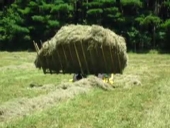
A different way of rigging up a winch would be to use an open differential (i.e. not posi-traction or limited slip, just a standard automotive differential) solid rear axle, as seen in this video:


A brake, manually applied on the end of the axle opposite the winch drum, controls the drive: release the brake and the winch has minimal to no torque applied by the truck PTO drive as the unbraked end freely rotates; engage the brake (locking the opposite end) and the drive transfers to the winch drum; feather the brake, and some of the torque goes to the drum, with some measure of control.

This video is part of a series on beaverslide hay stackers, probably in the Big Hole Valley of Montana, featuring a complex choreography of side delivery rakes pulled by ag tractors, buck rakes on doodlebugs and the hay stacker powered by the truck-mounted and PTO driven homebrew winch.

I don't know if this is the Grant-Kohrs ranch, but it likely is; as far as I know, they are or were the only establishment still actively using beaverslide stackers to put up hay.  In the old days. the stacker would have been powered by a team of horses, rather than the winch.

When I was a kid, the big square bales were starting to replace small square bales in to the Mountain West, being stored in open hay sheds.  I never saw a beaverslide stacker - or even an overshot stacker - when we lived out there, to the best of my recollection.  Or, at least, not in action.  I was quite attuned to any mechanical contrivance, from steam locomotives to pianos, so I think I'd recall.

There are also a couple of good YT videos on building a DIY 3-point skidding winch for a small tractor, with well-explained construction details.  I'd corresponded briefly with the channel owner a couple of years ago, but I haven't built one, though I did think it might be a useful addition to the suite of tools, especially if I ever needed to snake out enough logs to build a cabin. Which could still happen (that quest runs in the family!).   With a spade/blade to anchor the winch, a lighter rig can still pull pretty hard, and the forces are mostly internal to the winch attachment, rather than playing "make a wish" with the frame of the tractor or truck.  I'll try to dig up the links and post them, even though such a dedicated tool is probably beyond what the OP needs or wants.  Still, someone here might benefit from the shared knowledge, and the construction was relatively straightforward for someone with fabrication skills and tools.
 
Kevin Olson
gardener
Posts: 501
Location: The Old Northwest, South of Superior
296
books building wood heat
  • Likes 4
  • Mark post as helpful
  • send pies
    Number of slices to send:
    Optional 'thank-you' note:
  • Quote
  • Report post to moderator
Found 'em:


And some more details:

 
We kept yelling "heart attack" and he kept shaking his head. Charades was the tiny ad's idea.
Gardening and natural building at a delightful pace
https://wheaton-labs.com/bootcamp
reply
    Bookmark Topic Watch Topic
  • New Topic