• Post Reply Bookmark Topic Watch Topic
  • New Topic
permaculture forums growies critters building homesteading energy monies kitchen purity ungarbage community wilderness fiber arts art permaculture artisans regional education skip experiences global resources cider press projects digital market permies.com pie forums private forums all forums
this forum made possible by our volunteer staff, including ...
master stewards:
  • Carla Burke
  • John F Dean
  • Nancy Reading
  • r ransom
  • Jay Angler
  • Timothy Norton
stewards:
  • paul wheaton
  • Pearl Sutton
  • Anne Miller
master gardeners:
  • Christopher Weeks
  • M Ljin
gardeners:
  • Jim Garlits
  • thomas rubino
  • William Bronson

This made my day!

 
master gardener
Posts: 2583
Location: Zone 5
1520
ancestral skills forest garden foraging composting toilet fiber arts bike medical herbs seed writing ungarbage
  • Likes 13
  • Mark post as helpful
  • send pies
    Number of slices to send:
    Optional 'thank-you' note:
  • Quote
  • Report post to moderator
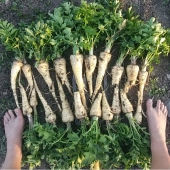
Wild and out of control parsnips does describe what happens to gardens, yards, or any sunny, disturbed area here  (New England) when abandoned….

For this heimish soup, the humbler the ingredients and methods of preparation, the better. Mirepoix and herbs de provenance are lovely, but I’m talking about the kind of soup where the starring role are things like “petrushka,” as my Bubbie used to say. That’s Yiddish (or is it Hungarian?) for parsnip.

Which then reminds me of a wonderful unique Yiddish expression: hefker petrushka, meaning chaos, or as would be translated into modern Hebrew, balagan. It’s a pretty unbeatable expression — perhaps parsnips grew wildly in Europe and so the Yiddish saying for a wild, out-of-control situation developed from out of a patch of disorganized, overgrown parsnips?


https://www.ijn.com/jewish-penicillin/
 
M Ljin
master gardener
Posts: 2583
Location: Zone 5
1520
ancestral skills forest garden foraging composting toilet fiber arts bike medical herbs seed writing ungarbage
  • Likes 7
  • Mark post as helpful
  • send pies
    Number of slices to send:
    Optional 'thank-you' note:
  • Quote
  • Report post to moderator
Apparently the meaning is either ownerless (wild) parsley or parsnip depending on the source. Wild parsley sounds like ground elder, or perhaps cow parsley, indeed crazy and out of control!
 
Steward of piddlers
Posts: 7846
Location: Upstate New York, Zone 5b, 43 inch Avg. Rainfall
4489
monies home care dog fungi trees chicken food preservation cooking building composting homestead
  • Likes 6
  • Mark post as helpful
  • send pies
    Number of slices to send:
    Optional 'thank-you' note:
  • Quote
  • Report post to moderator
I'm a novice when it comes to plant identification so when the wild parsnip/wild carrot/poison hemlock starts growing, I just appreciate them from afar.
 
M Ljin
master gardener
Posts: 2583
Location: Zone 5
1520
ancestral skills forest garden foraging composting toilet fiber arts bike medical herbs seed writing ungarbage
  • Likes 12
  • Mark post as helpful
  • send pies
    Number of slices to send:
    Optional 'thank-you' note:
  • Quote
  • Report post to moderator
Wild parsnip is easy to distinguish, especially when young—the young leaves have a coat of fine hair over them. Hemlock is a completely (or nearly) hairless plant, and I almost never run into it. On most parsnip plants, they are only once compound, i.e. the larger oval leaflets all emerge from the same long rachis (stem). Parsnip, unlike the others, has yellow flowers that bloom in summer (not spring—golden alexanders bloom in spring, are much lower, and have foliage similar to ground elder).

Wild carrot, at least here, tends to be very hairy, covered all over with stiff hairs. They have a delicious, carroty-anisey smell. Both wild carrots and cow-parsley have multiple-compound leaves, but on cow parsley there are fine hairs covering the leafstalks, and the leaves (i.e. fronds) are more triangular in outline compared with carrot and parsnip.

Cow parsley is the most hemlock-looking of the three but has triangular rather than rounded leafstalks, is finely hairy (velvety), and doesn’t have any white bloom. There are other characteristics too but these are good to get you to the “I think I know!” stage.

Ground elder is wildly invasive along riversides, and they also grow in variegated form next to buildings. They form a carpet of green and have a celery-parsley-ish scent. They are hairless, and have leaf stems triangular in cross section. The leaves are twice compound (splits into three, then each division is either lobed or divided into 2 or 3 parts). They are larger and more erect than golden alexanders, and bloom in summer rather than spring. The flowers are white and there are a number of ridges running up the flowerstalks. There are no large taproots, and are rhizome-forming (and quite aggressive).

I hope this helps! If you have any others you want to ask about I can try to answer.
 
Is that almond roca? Did you find it in the cat box? What is on this tiny ad?
change the world (for the better) with hands on permaculture
https://wheaton-labs.com/bootcamp
reply
    Bookmark Topic Watch Topic
  • New Topic