• Post Reply Bookmark Topic Watch Topic
  • New Topic
permaculture forums growies critters building homesteading energy monies kitchen purity ungarbage community wilderness fiber arts art permaculture artisans regional education skip experiences global resources cider press projects digital market permies.com pie forums private forums all forums
this forum made possible by our volunteer staff, including ...
master stewards:
  • paul wheaton
  • Anne Miller
  • Carla Burke
  • Nancy Reading
  • John F Dean
  • Timothy Norton
  • Jay Angler
stewards:
  • r ransom
  • Pearl Sutton
  • Tereza Okava
master gardeners:
  • Christopher Weeks
gardeners:
  • M Ljin
  • Megan Palmer
  • Kate Downham

Linseed oil for oilcolours - coldpress vs artist refined? Is yellow oil okay?

 
steward & author
Posts: 48476
Location: Left Coast Canada
20323
10
art trees books chicken cooking fiber arts
  • Likes 2
  • Mark post as helpful
  • send pies
    Number of slices to send:
    Optional 'thank-you' note:
  • Quote
  • Report post to moderator
Linseed oil is one of the best things for oil painting. It makes a strong paint film, makes paint behave kindly to the painter,  it's the base of many mediums.  It's also handy for cleaning brushes while painting.  We don't need much Linseed oil, but even still, with the amount I paint these days, I go through it.

One big downside of modern Linseed oil is the tendency to yellow as it ages.  Depending on the quality of the Linseed oil, it can take weeks or a century before the yellow shows up.  And there are different factors that cause yellowing like being in the dark (reversible by exposing to bright light) or age (not reversible).

The general theory going around these days is that modern Linseed oil yellows primarily because of extra non-oil stuff in it.  One theory says we can clean it, like artist refined linseed oil, it's fine,  another theory says we should start with cold pressed Linseed oil as there is less extra stuff in it to start with.  

From there, it gets complicated.

But they all agree, the oil should be clear when we start to paint with it.  Or mostly agree.  If it's yellow, it's going to keep getting yellow...
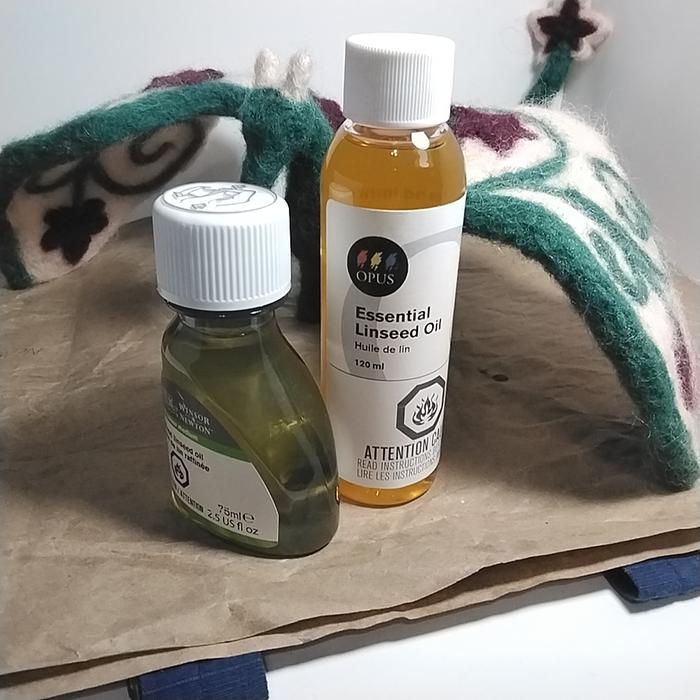


Nicole's dragon helping with my still life painting

The little bottle is my normal oil - W&N refined linseed.   The big bottle is "premium quality oil made from 100% cold press flax seed".  I took that and combined it with the maker being a high end art supply brand to mean it had been cleaned like refined linseed, just starting from a better place.  Now I see it, I have doubts. It looks like edible cold press oil before cleaning.   So yellow!

Do I trust it?  Or is this for practice painting only?

 
r ransom
steward & author
Posts: 48476
Location: Left Coast Canada
20323
10
art trees books chicken cooking fiber arts
  • Likes 1
  • Mark post as helpful
  • send pies
    Number of slices to send:
    Optional 'thank-you' note:
  • Quote
  • Report post to moderator
https://www.wetcanvas.com/forums/topic/raw-linseed-vs-cold-pressed/

This seems to address the issue.  In the 1800s and early 1900s when people started publishing opinionated books like it was going out of fashion, cold press linseed oil was the best available.   There seems to be some assumptions that people would have cleaned it themselves.  

With the technology for modern refined artist oils, we got a less yellowing oil that could be adjusted to have the other qualities we need from linseed in painting.  But the old information remains in circulation

The reason why so many artists recommend the use of cold-pressed raw linseed oil for making oil paint is that they read artists’ manuals that are outdated, and even most current artists’ manuals repeat the same misinformation. Cold-pressed raw linseed oil was recommended in past artists manuals for paint making because it contained more free fatty acids (so it had a greater acid value) than refined and stand oils, giving it better pigment wetting properties and better body for paste paint. This was the only oil available prior to the 20th century suitable for grinding pigments to make paint. The downside of using cold-pressed raw linseed oil is that it is darker and contains impurities, which lead to further yellowing.

In the early 20th century, oil processors developed ways to refine vegetable oils so that you could have the best of worlds, higher acid value and refined, well-settled oil with little or no impurities.


Right! We're on it! Let's get to work tiny ad!
new feature: easy peasy thread boost stuff
https://permies.com/t/377515/feature-easy-peasy-thread-boost
reply
    Bookmark Topic Watch Topic
  • New Topic