G B Spencer

+ Follow
since Jun 09, 2020
Merit badge: bb list bbv list
For More
Apples and Likes
Apples
Total received
In last 30 days
1
Forums and Threads

Recent posts by G B Spencer

I listened!
I'm one of those people who is still in the "grow what you eat" camp, with a side order of "eat what you grow".
I'm the crazy one in my family, so the rest of them are various levels of reluctantly along for the ride.  To that end, I have an orchard, chickens, feeder pigs, and working on getting a milk cow.  I'm planting potatoes, squash (summer and winter), lettuces, tomatoes, cucumbers, and the like.  Familiar stuff the family will eat.  
In addition, I'm going to work towards perennial veggies, sunchokes being a primary one thanks to your encouragement, and trying to prepare them in "familiar" ways to transition the family to them.  Also, I'm contemplating foraging, nettles being high on the list right now because they're in season, abundant, and easily identifiable!

Thanks for the response, and the tip about setting the gap on the stones.  
All the people I know with gluten allergies would need their own mill, due to cross-contamination.  But that's good info about milo.  
I just acquired a vintage Excalibur Flour Mill, and I'm wondering if anyone has any tips or suggestions for its use.
It seems pretty intuitive, and I watched a youtube video about it.  From a quick online search there's not much documentation out there.
My favorite is either a 3-month Manchego, or Mobay from Carr Valley Cheese Company.
I found out about both of those at The Cheese Lady, a shop in Traverse City, Michigan.
That's where I learned I love sheep cheeses!
1 year ago
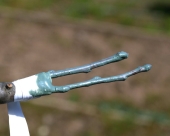
I used beeswax and oil as grafting wax, and used masking tape as the mechanical method to hold it together.  I got 17 of 22 apple grafts to take on my first-ever grafting effort, so that's pretty good!
If I were trying to be as all-natural as possible, I would probably use the warmed beeswax/oil mix again as grafting wax, and then wrap the graft with cloth or twine that's been coated in melted beeswax as the mechanical fastening.
2 years ago
If I use an iPhone, what settings do I need to make sure I have set correctly?  Right now it's set to 1080p HD at 30 fps.  Sufficient?
2 years ago
I'm in!  At this point I'd get the Paperback, because I'm a big fan of having hardcopies when available.
2 years ago
FOUND IT!
Thanks to a bookmark I'd saved to http://journeytoforever.org/compost_humanure.html (I hope it's okay to put that here; I want to give credit where due), I found the link.
The book is "Essays on Rural Hygiene" by George Vivian Poore, M.D., F.R.C.P., published in 1893.  It's in pdf form but I might try to get a physical copy.
Thanks, John, for your recommendation.
2 years ago
I thought I had an electronic book about this topic, but I can't find it in my files, so I'm hoping someone here can point me to it online.  Some things I remember about it are:
Discusses in depth the use of earth to filter urine, and earth closets;
Relates the account of a wealthy landowner insisting on enclosing the sewers, and the rise of cholera and dysentery in the region;
Tells about the well in a (his?) garden in town that the local authorities wanted him to fill in, but he tested the water and it was clean even though there was manure applied in the garden above.

Does this sound familiar to anyone?  
2 years ago
Another Status Update!

Regarding Experiment 2 here:

G B Spencer wrote:
2) The 8 dozen I didn't put back into the water I rinsed lightly again and put them in cartons in the fridge.  These are the oldest, so anywhere from 3-7 months old, stored in lime water almost the entire time.  (They didn't go in the water the same day they were laid).  We'll eat those first, while storing or sharing the fresh eggs that come from the chickens.  That'll take a few weeks to go through!


We've used up almost all the rinsed and refrigerated eggs, and no problems at all!  

I've not checked on the re-limed eggs since I posted the first item a month ago, so I'll try to get to that soonish.
3 years ago