Andre Wiederkehr

+ Follow
since Jan 27, 2025
Merit badge: bb list bbv list
For More
Apples and Likes
Apples
Total received
In last 30 days
2
Forums and Threads

Recent posts by Andre Wiederkehr

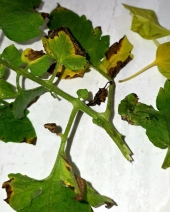
It can be helpful to figure out what specific disease(s) you're dealing with. There are various things called "blight," as Mary pointed out, and they behave differently. Fortunately, there's lots of info out there because everyone has problems with these diseases, including large growers. Not all the management information will be appealing (potatoes, for example, are often sprayed repeatedly through the season), but there are lots of pictures that help with diagnosis and some cultural practices that are easy to implement.

Without double checking, here's what I took away from my reading on late blight (phytophthera infestans) in potatoes after we got hit badly a few years ago.

Volunteers:
In Ontario, it only lives on living plant tissue, not in the soil over winter. Some places two differing strains that can mate and produce oospores that do overwinter on their own, so maybe check that. In this climate, tomatoes fully die on their own over winter, so potatoes are the concern - the tubers can be infected and, when shoot in the spring, can infect your new planting. For that reason, it's recommended to dig any volunteers and get rid of them (compost or bury very deep). In the fall when digging, do the same with any tubers you're not eating (damaged or diseased), or leave them fully on the surface so they can freeze and die that way.
When planting, I prefer to use tuber pieces that are big enough that they need to be cut at least once. This lets me see if there are signs of disease within the tuber. Otherwise you could be planting blight that you yourself kindly overwintered in optimal conditions.

Moisture:
Late blight usually gets into your garden by traveling on wind, so you can't keep it away if it's in your area. You can limit your plants' susceptibility by keeping them as dry as possible. The main tool for that is keeping foliage density a little lower so that plants can dry promptly after rain. For tomatoes, that means pruning all suckers on indeterminate varieties for a while, and for both tomatoes and potatoes it means planting far enough apart (you need to determine what that is in your conditions) and removing weeds. I don't like plastic, so I don't do this, but I have friends who have had success with the mini-greenhouse idea, so that you can keep the leaves entirely dry and water at ground level.

Infected plants:
If it's still just a few, remove them promptly and hot compost fully covered or bury deep. If possible, do this on a dry day to limit spreading spores. This probably won't stop the infection, but may slow it down.
For potatoes, a key understanding is that the top gets infected first, then spores from the top wash down through the soil in the next rain to infect the tubers. So once you identify infected tops, remove them immediately (before the next rain), and you can likely still harvest clean tubers. I like a sickle. Wait a few weeks to dig, to allow any spores surviving on the surface to hopefully die.

Varieties:
Good genetics go a long way with disease resistance, although blight is also constantly evolving new strains, so we lose resistance again. For potatoes, I've had some success with Sarpo Mira surviving in the presence of infected neighbours. For tomatoes, LYC 859 El Salvador and Bosu seem to have good late blight resistance (these are OPs, so seeds are as cheap as your labour!). When looking for seeds, google lists of resistant varieties and see if your favourite seed company has anything on the list.
If you prioritize disease resistance, it might mean letting go of focusing on your preference for colour/texture/flavour. It's a tradeoff.
1 week ago
Now with diagrams.
As before, let me know if you have feedback from trying it out.
1 month ago
Tony, thanks for more info about that article. With the date I was able to dig it up in the Internet Archive. Looks interesting. Not sure whether it's what I want, but definitely will keep it in mind.
The Energy Saving Stove
1 month ago
Coydon, you're in a pretty cold location for yurt living! Although I have run into a few in Ontario at Ottawa latitude and in central Vermont, both of which also get pretty cold winters.
Your reflections on the materials are worth hearing. Thanks for sharing them.

Coydon Wallham wrote: One element of "local" is how to view the existing production and distribution networks. 'Scrapping' makes use of readily available materials that would otherwise become landfill waste. But if use of such materials becomes part of a codified, growing system, it helps reinforce production methods that produce waste and excess. It would seem a tough call at what point making use of 'waste' products becomes encouragement to produce more of that waste. Using scrapped materials though often makes an RMH more reliable and reproducible than creating a similar element from local, scratch material. I guess that is the trade off you are looking to find help deciding on?


My own journey is a mixed focus on here-and-now impacts and modelling visionary alternatives. I sometimes follow the salvage mentality in areas where I am choosing to not give up a technology (e.g. some internet access: I got a computer from community computer recycling NGO), or where doing so has a positive footprint impact (e.g. a more efficient biomass cookstove from scrap metal makes less air pollution than a three stone fire - maybe important given how many people we have right now). I think the modelling of true alternatives is important too. As you say, depending on salvage ultimately requires the continuation of the present system. So I don't want to eat primarily on dumpster diving, or mulch my garden with cardboard, or get all my clothes at thrift stores, even though those things are possibilities in the wasteful context I'm in. We need people dancing to different music, expanding our collective vision for what is possible and how.

For this particular need, I'm not looking for help deciding which path to lean toward so much as putting the question out there about what options people are aware of so I can make a more informed decision about what to try. What I take from your writing is that you would suggest that I build a proven design so I know what good operation looks like, and then experiment from that baseline later.

Coydon Wallham wrote:As such, I've discovered it would likely have been better to install a 6" system.


Can you explain why 6" would be better than 8" for that situation?

Your notes on cooking are helpful. Sounds like it'd be okay, but not any too much cooking power. I'm a bit spoiled having recently switched my summer cooking from a bare firebrick J-tube to a TLUD based on Paul Anderson's Champion design. It boils water fast, and fries quite well.

Coydon Wallham wrote: I have to wonder what objections you have to wool insulation? Are you referring to rock wool/super wool? Or actual sheep's wool?


Yup, I was vague. I meant ceramic wool - high embodied energy and high-tech/centralized processing needed (very hard to localize). I have no problem with sheep's wool in reasonable quantities. I guess the latter is pretty fire resistant for an organic material - are you suggesting it could have a place in RMH building?
1 month ago
Thanks, Tony. I'm having trouble finding the article you referred to on the MHA site. Can you link it for me?
1 month ago
I want to heat and cook in a cabin. I am curious about building a rocket mass heater to meet this need. I have a lot of questions to see whether it's a good idea, and, if so, exactly how to do it.
I know there's a huge amount of info in this forum already, so if you are aware of specific posts that answer my questions, please do point me to them. I'm just having trouble pulling all the infomation I need together into one place.

Situation:

1360-1540 ft³ room volume, depending on how thick the slip-straw walls are. That range represents 12" thick (leaving a smaller volume inside) to 8" thick (larger volume). I'd welcome input on how thick (i.e. how much insulation value) makes sense given how small the footprint is.

Here's data for my climate (how it used to be, anyhow):
OctNovDecJanFebMarApr
Daily Average (°C)8.52-3.6-7.1-6.9-25
Daily Maximum (°C)135.5-0.5-3.3-2.62.510.2
Daily Minimum (°C)4.1-1.5-6.7-10.9-11.1-6.5-0.2
Extreme Minimum (°C)-6.2-19.5-27.4-31.1-31.5-32.5-15.4

I am okay with a cool room in the winter, 14-16°C, as long as there's a warm spot to sit. That's one of the things that attracts me about the mass bench idea - keep me warm rather than the whole room. However, I want the capacity to warm it up to 20°C or so if I have company who likes it warm.

I am working on the land, so I can tend the fire somewhat, but don't want to babysit it all day. I am fine with it getting pretty cold overnight as long as the room doesn't freeze.

The floor is going to be softwood, the walls light straw clay, and the roof steel for now, hopefully switching to thatch within a few years. Support to ground for the mass would be challenging.
I can and will run calculations on the dead load capacity of my floor once I have a clearer idea of the shape of the mass (which affects where the weight lands relative to the floor supports).

Questions
Cross-section of system:
I understand that one can build a variety of cross-sectional area systems, with 6" diameter being the smallest that usually works. I imagine for such a small space it would make sense to keep it as small diameter as possible: 6". Does that make sense? I've heard rumours that you actually need to run quite long fires with some rocket mass heaters to be warm enough, which isn't all that appealing given the repeated feeding required. Would 6" be large enough to allow relatively short/few fires per day?

Stovepipe:
I got some insulated stovepipe for only $25, but it's 7" ID. Is it possible to increase from 6" to 7" at the transition to insulated stovepipe? I think this is considered a very bad idea with conventional woodstoves because the gas expansion results in cooling that may consense water vapour, leading to creosote adhesion, leading to a chimney fire. But I think the exhaust from a rocket stove is already below condensation temperature at this point in the system, so does it matter?

Mass sizing:
I imagine a 6' long bench would be nice so I can sit or lie on it, but I'd rather not make it bigger so it doesn't take up more of the room. I would like to do a stratification chamber design; would a 6' bench be enough internal surface area to absorb enough heat to be efficient? How thick would the walls need to be? This correlates to: how much does it need to weigh to provide enough thermal mass? I need to make sure the floor can take it. It would be nice if the mass is big enough to let me be away for a day or two without the room freezing - is that realistic?

Fire safety:
How can I install the rocket stove and mass so they don't set the floor on fire? My impression is the light straw clay wall should be fine being near or against the mass - is this correct? What about a structural post in the wall buried a few inches into the LSC?

Cooking:
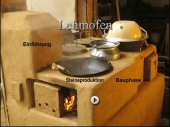
How well does it really work to cook on the barrel? Anyone here using it as their only cookstove in the winter? Are there options that work better than a barrel? Is it possible/practical to build in an oven where the exhaust first enters the bench?

Materials:
I have a powerful ethic of living my life using low-embodied energy, low-tech, local materials. The things I don't love in some rocket mass heaters are: purchased firebrick, wool insulation, foil tape, the barrel, stovepipe, metal heat shielding, perlite/clay mixtures, hardware cloth or hog panel for forming the cob bench... that sort of thing. Perhaps you get the picture. I will use this stuff if I'm convinced it's the best overall option available (compared to much worse performance, or a different kind of stove), but I'd like to push the envelope: how localized can this technology get? How much of it can be made of cob? What options are there for effective homemade insulating firebrick? Are there other chimney options?

1 month ago
Stir fry snow peas (giant snow peas, if you have them!) and add the ricotta near the end with herbs like thyme. Serve with potatoes or polenta.

another one:

Mix with cooked greens such as lambsquarters, add sauteed onions and garlic, cayenne and bergmot or oregano, and use for filling calzones (dough pockets). Can bake in the oven or stove top on a griddle/frying pan, flipping halfway.
1 month ago
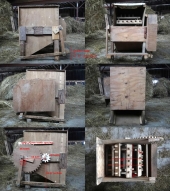
I have made and used a wooden version of Burra's corn sheller. It takes a scant hour to make, and works really well. My family has shelled thousands of cobs this way over the past few years. The + shape tapers from one end to the other. Leaving a short non-tapered section on the small end lets me sharpen the corners again whenever they get really dull. When it's too worn down to sharpen it again, just chuck it in the wood stove and carve a new one.

I wrote an article that describes the process here.

Phil Stevens wrote: I replaced the top with a piece of heavy steel plate so I'd have a better cooking surface and because that part of the drum was spalling after a few years of use.


How did you do that? Weld it in? How thick is the plate? I haven't built a RMH (yet!), but as I consider it I've wondered about whether the top would wear through from the intense heat, and also how to make it an effective cookstove, so this is of great interest to me.
5 months ago

Nancy Reading wrote:
You can see from the undergrowth behind that the grass is normally still green, if not growing overwinter, yet the angelica canopy succeeded in shading it out.


That's pretty cool! I will tuck the idea away to try.