gift
Rocket Mass Heater Manual
will be released to subscribers in: soon!
  • Post Reply Bookmark Topic Watch Topic
  • New Topic
permaculture forums growies critters building homesteading energy monies kitchen purity ungarbage community wilderness fiber arts art permaculture artisans regional education skip experiences global resources cider press projects digital market permies.com pie forums private forums all forums
this forum made possible by our volunteer staff, including ...
master stewards:
  • Carla Burke
  • Nancy Reading
  • paul wheaton
  • John F Dean
  • r ransom
  • Jay Angler
stewards:
  • Timothy Norton
  • Tereza Okava
  • Pearl Sutton
master gardeners:
  • Christopher Weeks
  • M Ljin
gardeners:
  • Jeremy VanGelder
  • Megan Palmer
  • Thekla McDaniels

Easy Instructions for Making a Solar Emergency or Recharging Station

 
Posts: 56
Location: Rocky Mountains, USA
15
  • Likes 6
  • Mark post as helpful
  • send pies
    Number of slices to send:
    Optional 'thank-you' note:
  • Quote
  • Report post to moderator
I live off grid full time and started with just a 45 watt Harbor Freight solar kit and an old truck battery to run my water pump, lights and a radio.

That was over 20 years ago and solar was hardly available and expensive. That 45 watt kit cost almost $300.

There also wasn't any forums or groups helping people to understand solar which is why I started a group and then produced videos starting in 2006 to help people get started with solar and to find equipment and appliances that worked well with small systems.  http://www.youtube.com/solarcabin

Today solar is everywhere and there are state and fed rebates to install systems and panels, equipment and good batteries have come way down in price.

However, there is still a need for small systems and emergency back up systems that people can make themselves and understand how they work so I made a series of videos just for those people.  These are systems under 400 watts and my system I use at my cabin is 400 watts main system and two 200 watt recharging stations and that powers everything I need to ive completely off grid.

I run my water pump, LED lights, laptop/tv, small cooking appliances and swamp cooler off the 400 watt system and my recharging stations are used for charging tools, ebike batteries and to run my microwave and larger appliances as needed and act like a generator but no gas or oil needed.

So, here are those videos to show you small solar power systems anyone can make with out spending a lot of money and these can be used for recharging stations for your shed or workshop, emergency power in a blackout or for an off grid housing system.


pollinator
Posts: 1003
Location: Central Ontario
212
kids dog books chicken earthworks cooking solar wood heat woodworking homestead
  • Likes 7
  • Mark post as helpful
  • send pies
    Number of slices to send:
    Optional 'thank-you' note:
  • Quote
  • Report post to moderator

LaMar Alexander wrote:I live off grid full time and started with just a 45 watt Harbor Freight solar kit and an old truck battery to run my water pump, lights and a radio.

That was over 20 years ago and solar was hardly available and expensive. That 45 watt kit cost almost $300.

There also wasn't any forums or groups helping people to understand solar which is why I started a group and then produced videos starting in 2006 to help people get started with solar and to find equipment and appliances that worked well with small systems.  http://www.youtube.com/solarcabin

Today solar is everywhere and there are state and fed rebates to install systems and panels, equipment and good batteries have come way down in price.

However, there is still a need for small systems and emergency back up systems that people can make themselves and understand how they work so I made a series of videos just for those people.  These are systems under 400 watts and my system I use at my cabin is 400 watts main system and two 200 watt recharging stations and that powers everything I need to ive completely off grid.

I run my water pump, LED lights, laptop/tv, small cooking appliances and swamp cooler off the 400 watt system and my recharging stations are used for charging tools, ebike batteries and to run my microwave and larger appliances as needed and act like a generator but no gas or oil needed.

So, here are those videos to show you small solar power systems anyone can make with out spending a lot of money and these can be used for recharging stations for your shed or workshop, emergency power in a blackout or for an off grid housing system.


https://www.youtube.com/watch?v=xd-gL-_fg0U

https://www.youtube.com/watch?v=nnWE41uuhwM

https://www.youtube.com/watch?v=SwHpMRuT_lA

https://www.youtube.com/watch?v=8cUA96Bl0co

https://youtu.be/yk5wW81-8uI


nice videos. My only point of contention would be you should not lock them into the 12 volt panels with the pwm controller because that is what worked at the time you built your systems. A cheaper route would be a single larger higher voltage panel and an entry level mppt charger like the epever the victrons or the midnite kid. As a bonus they would get 20 percent more power from the same system at a cheaper price.
 
Steward and Man of Many Mushrooms
Posts: 6201
Location: Southern Illinois
1953
transportation cat dog fungi trees building writing rocket stoves woodworking
  • Likes 3
  • Mark post as helpful
  • send pies
    Number of slices to send:
    Optional 'thank-you' note:
  • Quote
  • Report post to moderator
LaMar,

That is a nice setup there!  I am trying something similar, though much less ambitious, just to have some type of emergency solar power.  It is definitely a learning experience, but I am sure that you already experienced that!  I have plans to upgrade and expand my setup, but that is getting to be a longer term project than I originally anticipated.

Eric
 
author & steward
Posts: 6076
Location: Southeastern United States - Zone 7b
3888
7
goat cat forest garden foraging food preservation fiber arts medical herbs writing solar wood heat homestead
  • Likes 9
  • Mark post as helpful
  • send pies
    Number of slices to send:
    Optional 'thank-you' note:
  • Quote
  • Report post to moderator
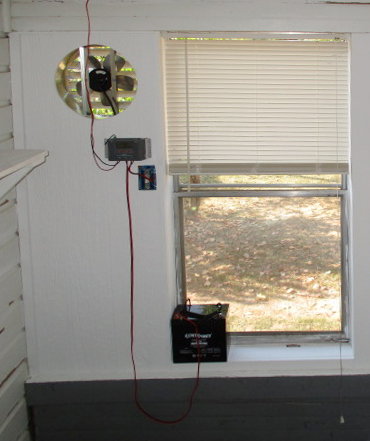
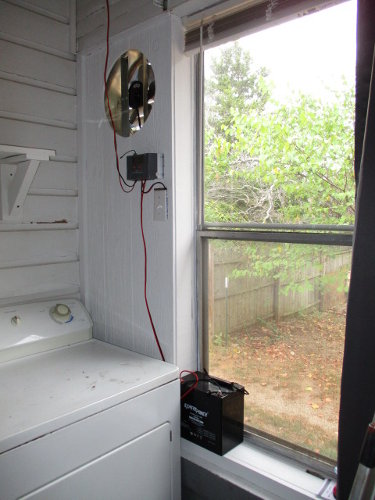
I have a couple of small solar setups that serve as recharging stations and for power emergencies. This first one was originally to install a solar vent fan on our back porch. Our back porch is my summer and canning kitchen, which helps keep cooking and canning heat out of the house and I wanted a vent fan there.

The setup was inexpensive and simple:
    - 80-watt solar panel
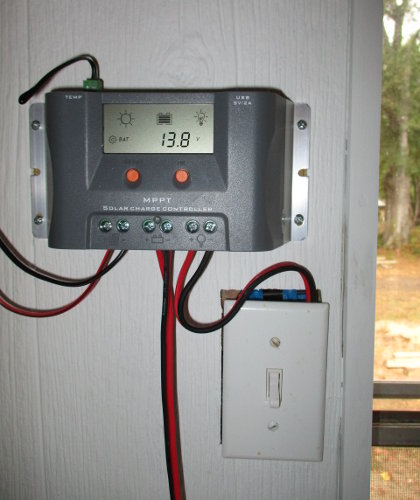
    - small MPPT solar charge controller
    - 35 amp-hr wheel chair battery

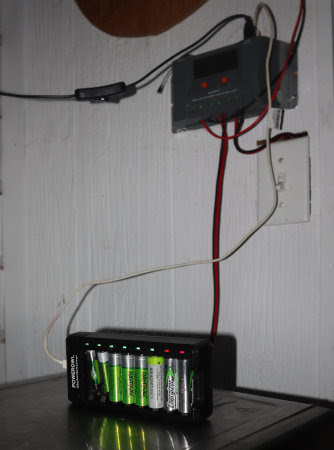
my small solar recharging station

The solar panel is installed on the roof and connected to an inexpensive MPPT solar charge controller.


The light switch was installed to operate the vent fan. The problem was that the 80-watt fan drained the battery too quickly, so I quit using it for that purpose and the switch is not necessary.

The battery is also connected to the charge controller.


Since the battery resides indoors, I installed a sealed (gel) battery.

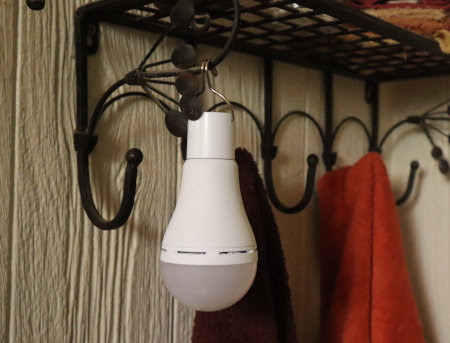
We use our charging station all the time for everything rechargeable including batteries, headlamps, flashlights, camera, phone, and solar light bulbs.


rechargeable solar light bulbs for camping

The lightbulbs are wonderful for after dark to light the kitchen, bathroom, and bedrooms, or as a reading light. Better than candles, I think, because there's no danger of pets or kids accidentally knocking them over.

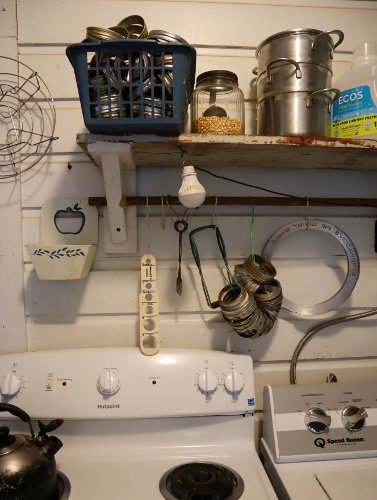
I also have a USB light bulb plugged into the charge controller. It resides over the stove and we use it all the time even when there isn't a power emergency. If needed, it can shine out the back door so we can negotiate the back steps at night when the grid is down.

light bulb with a USB plug is plugged into the charge controller

Our second emergency solar station is larger and used differently. I'll see if I can rustle up some photos to share.
 
pollinator
Posts: 149
Location: The soggy side of Washington
76
goat cat dog personal care duck books chicken food preservation horse wood heat homestead
  • Likes 9
  • Mark post as helpful
  • send pies
    Number of slices to send:
    Optional 'thank-you' note:
  • Quote
  • Report post to moderator
My emergency solar backup is actually a Jackery power station.  I bought the whole shebang which was the battery and six solar panels that each fold up into a thin suitcase with a sturdy handle for packing them around. I use it occasionally so it's not just sitting.  Giving my husband (or the dog) haircuts on the back porch with the horse clippers, mostly.  

But I love having that thing available in case we lose power.  Unfortunately,  it won't be much good in winter as we're too far north and generally have months of cloudy skies...
 
pollinator
Posts: 389
Location: New Mexico USA zone 6
88
3
  • Likes 7
  • Mark post as helpful
  • send pies
    Number of slices to send:
    Optional 'thank-you' note:
  • Quote
  • Report post to moderator
I've been on solar for around 30 years now. I went the same route as has already been described - few knew anything back in the beginning - and being land rich and financially poor, I upgraded along the way as I could afford it. Because all the government incentives seem to only be offered for new installations, I've never had any help exept from a relatively local (75 miles away) solar company that would not do the actual installation or troubleshoot my system (unsurprisingly) because it was too far away.

My system now is more than adequate for my current (very conservative) electrical needs, but experience has taught me to keep my generators full of fuel, just in case [note generators is plural! I want backup for everything!].

I'm planning on installing a separate, parallel power system to use as a backup - very basic, just enough to run a few lights, my Starlink, and charge the phone, flashlights, etc. As I upgrade everything in the future,  I will take the functional replaced components and install that in my barn (right now it's flashlights at night and generators for power tools).

Security for me is not about having money in the bank or depending on the grid, but having functioning backup systems for as much as I can on my property.
 
Posts: 14
Location: Butler county, Alabama
9
  • Likes 2
  • Mark post as helpful
  • send pies
    Number of slices to send:
    Optional 'thank-you' note:
  • Quote
  • Report post to moderator
I could not get the web site to load. any details on your direct DC setups would be very appreciated. I also am off grid with (currently) 400 watt system.
 
Eric Hanson
Steward and Man of Many Mushrooms
Posts: 6201
Location: Southern Illinois
1953
transportation cat dog fungi trees building writing rocket stoves woodworking
  • Likes 7
  • Mark post as helpful
  • send pies
    Number of slices to send:
    Optional 'thank-you' note:
  • Quote
  • Report post to moderator
I thought I would post an update and and recent progress:

Ok, my project from back in 2023 took unexpected turns.  The biggest was figuring out just what battery to use.  Originally I anticipated using a 100AH Lead Acid battery.  I got convinced to try LiFePO4 Lithium batteries.  But that seriously complicated the design.

Instead of going with a full sized LiFePO4 100AH Battery (which is expensive!), I decided to do a sort of test run on a 20AH LiFePO4 and just run smaller loads. I basically completed this build on the 20AH battery but there are two built-in complications:

1. This is a rolling tool case build for a puny battery

2.  That battery won’t even begin to power up the 1500 Amp inverter that I built and installed.


So in the meantime I have almost completed a different build.  

Physically it is much smaller—it is based on a plastic ammo can for 5.56mm magazines (about 16” long).  However, this time I decided to build the actual battery—that’s the cells plus the Battery management system.

This time it is built on 105AH LiFePO4 cells, slightly higher than the battery size I was originally planning for the previous build.

This time I kept the inverter out but I kept a port to connect one.

I also left out a solar charge controller—for the moment, I charge using an ac charger and if I get to using a solar set, I will use the same charge port that currently is used for the ac charger.

For outputs, I got a variety of USB ports.  My experience from other builds is that 4 USB ports is a pretty generous number.  So I put in six and called it a day.

For 12v outlets I have XT60 and four Anderson Power Pole connectors.


I will update some pictures soon.


Eric
 
We're all out of roofs. But we still have tiny ads:
permaculture bootcamp - gardening gardeners; grow the food you eat and build your own home
https://permies.com/wiki/bootcamp
reply
    Bookmark Topic Watch Topic
  • New Topic