gift
The Humble Soapnut - A Guide to the Laundry Detergent that Grows on Trees ebook by Kathryn Ossing
will be released to subscribers in: soon!
  • Post Reply Bookmark Topic Watch Topic
  • New Topic
permaculture forums growies critters building homesteading energy monies kitchen purity ungarbage community wilderness fiber arts art permaculture artisans regional education skip experiences global resources cider press projects digital market permies.com pie forums private forums all forums
this forum made possible by our volunteer staff, including ...
master stewards:
  • Carla Burke
  • John F Dean
  • r ransom
  • Nancy Reading
  • Timothy Norton
  • Jay Angler
stewards:
  • paul wheaton
  • Pearl Sutton
  • Eric Hanson
master gardeners:
  • Christopher Weeks
  • M Ljin
gardeners:
  • thomas rubino
  • Megan Palmer
  • Benjamin Dinkel

Turmeric in arid climes

 
gardener
Posts: 597
Location: Boudamasa, Chad
223
2
forest garden
  • Likes 2
  • Mark post as helpful
  • send pies
    Number of slices to send:
    Optional 'thank-you' note:
  • Quote
  • Report post to moderator
On a trip to the Philippines I dug up a bunch of turmeric to plant at my home in central Africa. I live in the wet/dry tropics. Rain for 4 months,  not a drop for 8 months.

I planted them in my garden during dry season and watered them well. Months went by and no sprouts. Then rainy season arrives when the climate is like a rain forest,  and they popped up happily. I transplanted them under the partial shade of my lime tree,  knowing that in dry season they wouldn't handle direct sun.

Well here we are in dry season,  2.5 months so far without rain. Daily temperatures in the mid 30's C (upper 90's F). They are watered every other day but still slowly fading. Over the next 6 months it's going to get a lot hotter.

My question is: should I let them go,  and will the rhizome survive another 6 months until the rains return, or is that not realistic? Any other suggestions?

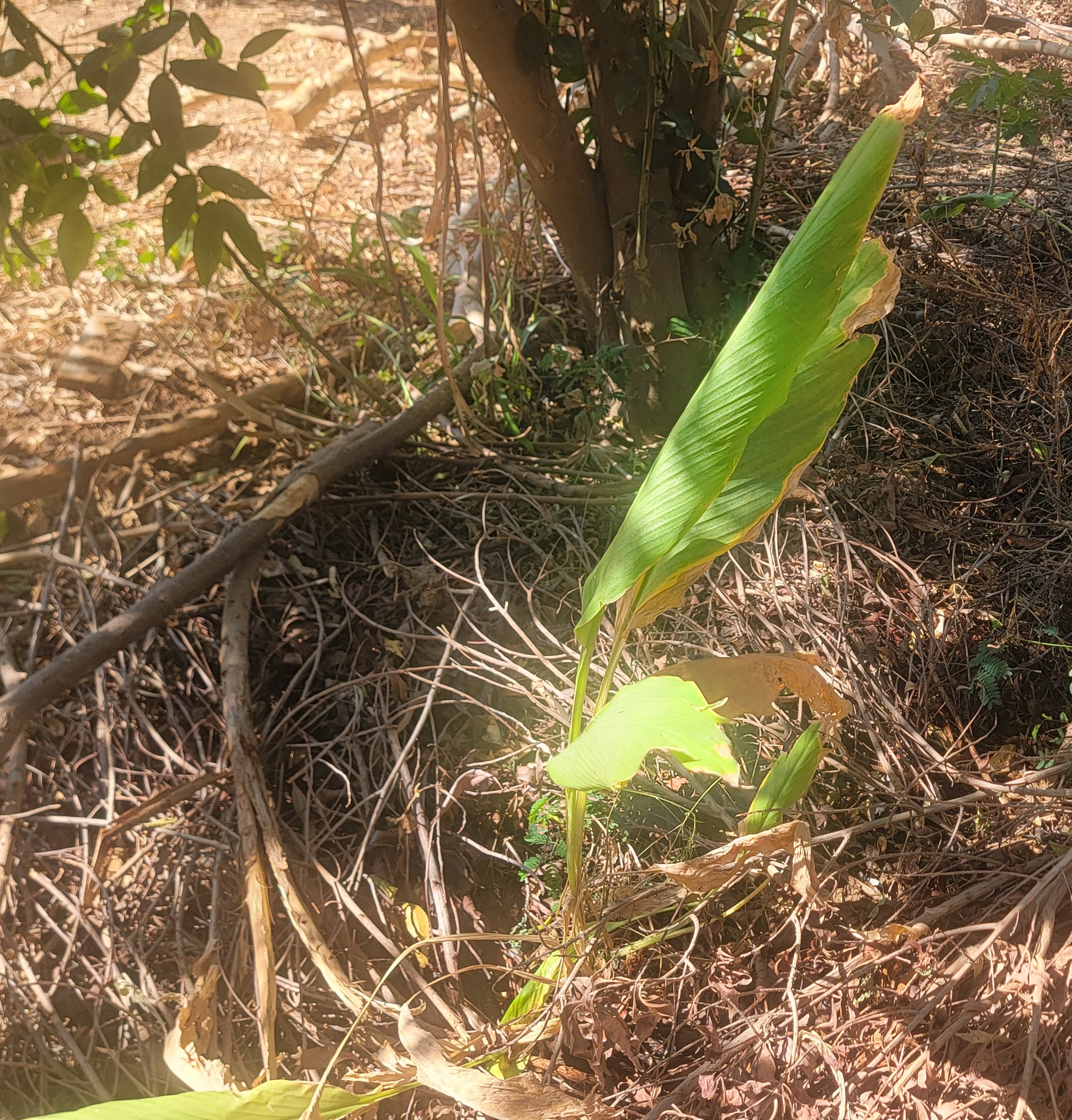
Here's a sad specimen:
20251231_101104.jpg
A sad looking turmeric in dry season
 
Posts: 11
Location: Rayong, Thailand
1
  • Likes 5
  • Mark post as helpful
  • send pies
    Number of slices to send:
    Optional 'thank-you' note:
  • Quote
  • Report post to moderator
I also live in the wet and dry tropics (but with much more rain: 6-7 months) and my turmeric also dies in dry season but comes back in the next rainy season. I read somewhere that watering (when the leafs wants to die anyway) can be counterproductive and and lead to rot. If your plants have formed rhizomes they should be able to come in my opinion.
 
Nathanael Szobody
gardener
Posts: 597
Location: Boudamasa, Chad
223
2
forest garden
  • Likes 2
  • Mark post as helpful
  • send pies
    Number of slices to send:
    Optional 'thank-you' note:
  • Quote
  • Report post to moderator

Thomas Schendel wrote:I also live in the wet and dry tropics (but with much more rain: 6-7 months) and my turmeric also dies in dry season but comes back in the next rainy season. I read somewhere that watering (when the leafs wants to die anyway) can be counterproductive and and lead to rot. If your plants have formed rhizomes they should be able to come in my opinion.


That's good news! Thanks:-)

Incidentally,  I've also been to Thailand,  and it looked magically lush to me!
 
gardener
Posts: 634
Location: Grow zone 10b. Southern California,close to the Mexican border
461
4
home care duck books urban chicken food preservation cooking medical herbs solar homestead greening the desert
  • Likes 3
  • Mark post as helpful
  • send pies
    Number of slices to send:
    Optional 'thank-you' note:
  • Quote
  • Report post to moderator
We live in a similar but more desert like climate than yours, but here is what I have learned about growing turmeric.
1. Turmeric is a perennial plant in tropical climates. To harvest you dig down and remove what you need, leaving the rhizomes closest to the stem intact. Then you replant it. During a season it will grow, produce a flower and then die down for a little while (when too cold or too dry). Once conditions have improved, it will start growing again.
2. To get large crops/plants they need compost and regular watering. Otherwise the plant won’t have the energy to produce large crops.
3. Turmeric loves full sun, as long as they get a thick layer of mulch to protect the roots from overheating. Mulch also prevents water evaporation during the dry season, and will suck up some of the extra  water during big rain falls. I only provide shade when temperatures go over 105F. At 120F (July through October) most things need a little shade.
4. To get a large harvest from new plants, wait at least a year before you start harvesting and preferably 2 years.
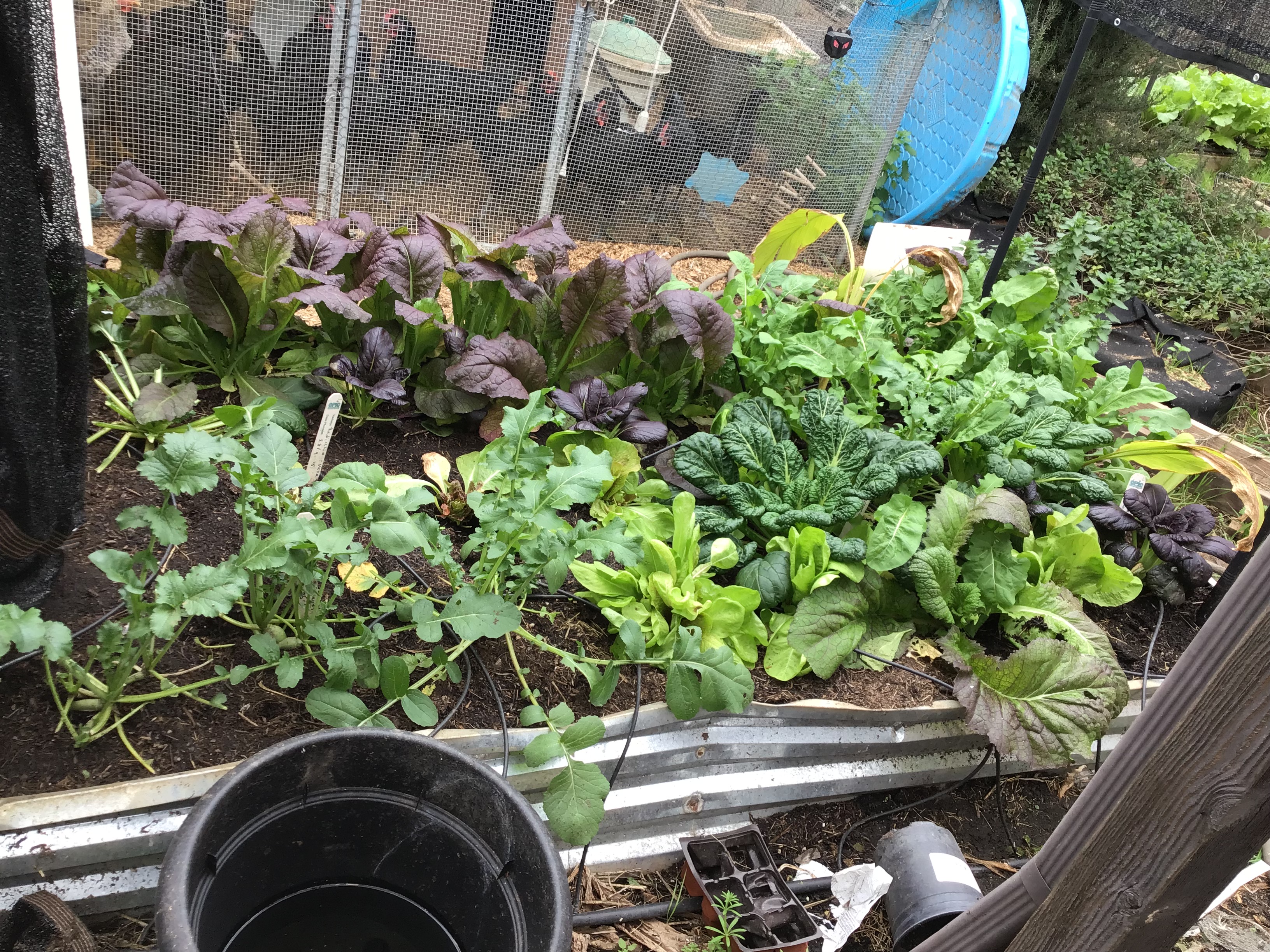
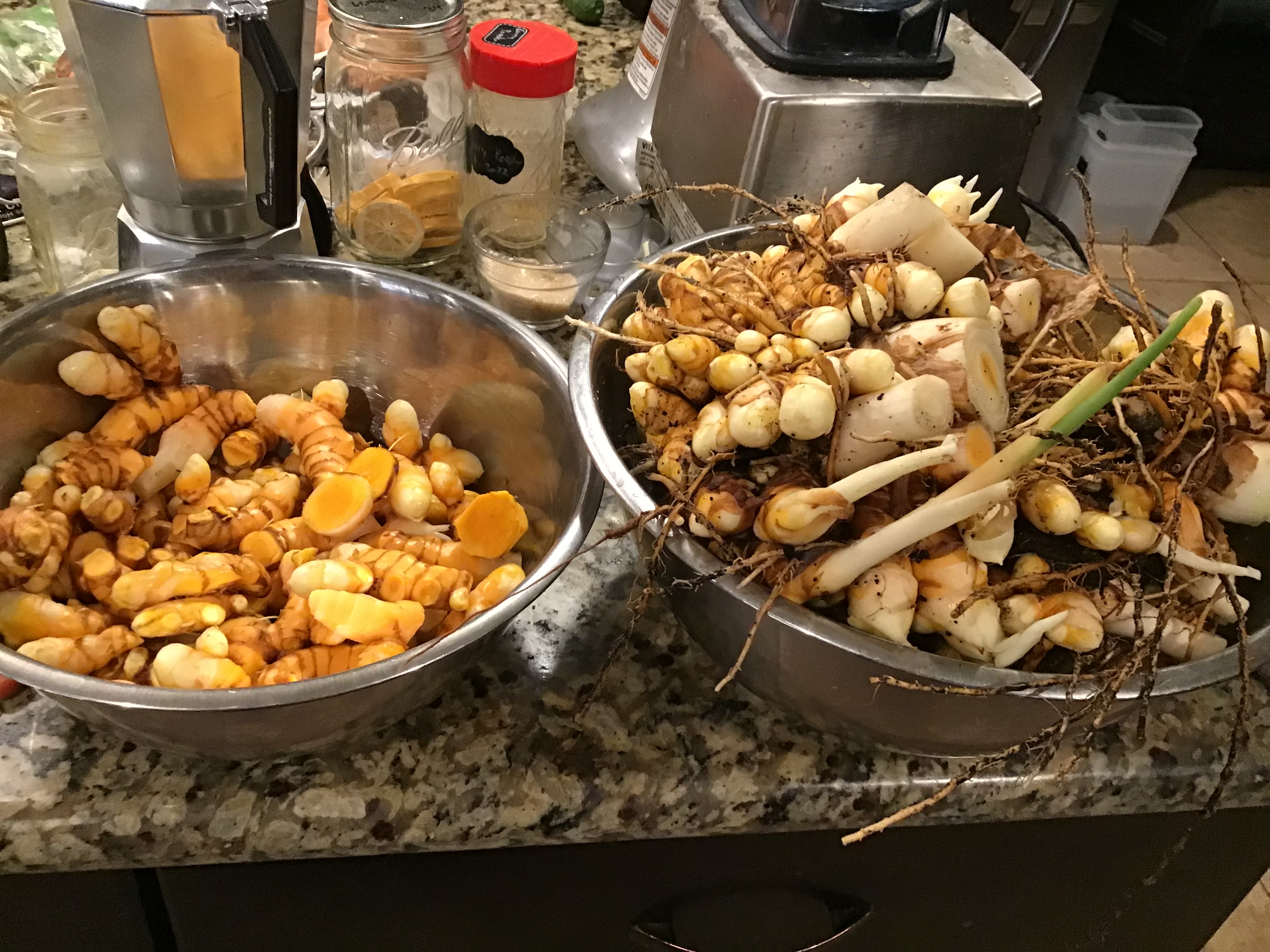
This year I got 17 pounds from 3 clusters of plants. Since the clusters had gotten too big, I divided them, and removed some of them, but the rest are still growing. Though most has died down, to rest until spring. I am growing lettuce on top of them right now. I will add a photo, where you can see it poking through the greens on the right side of the picture.
IMG_3218.jpeg
Turmeric in the right part of the raised bed
IMG_3137.jpeg
Part of my harvest
Part of my harvest
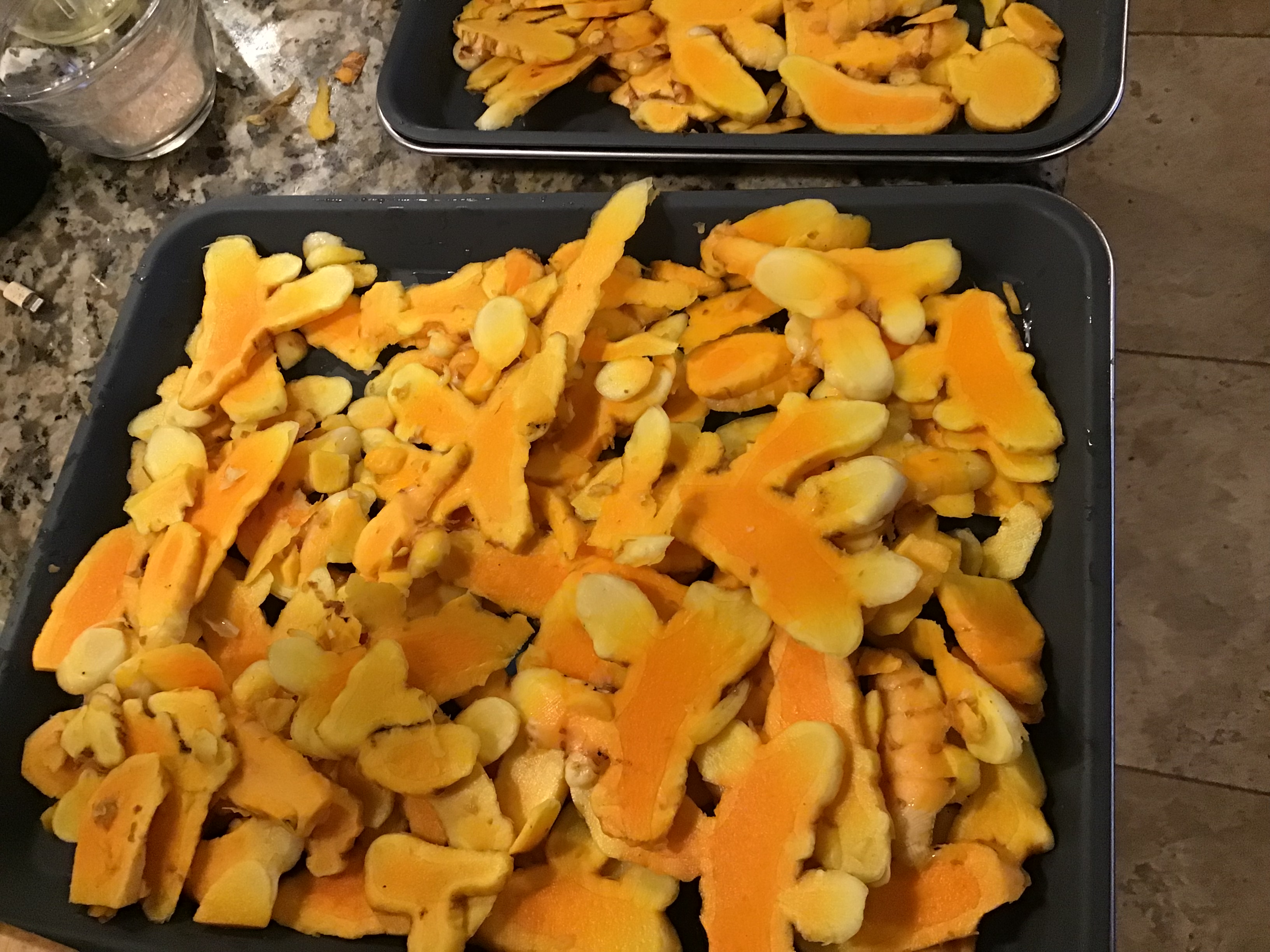
IMG_3139.jpeg
Ready for freeze drying
 
pollinator
Posts: 439
Location: Oz; Centre South
102
trees books cooking fiber arts writing
  • Likes 3
  • Mark post as helpful
  • send pies
    Number of slices to send:
    Optional 'thank-you' note:
  • Quote
  • Report post to moderator
Here's what I wrote down when researching turmeric:
Plant into warm soil. . .5-7 cm deep. . .rows 30-40cm apart and 15-30cm between plants. . .use setts with 1 or 2 buds. . .needs frost free conditions (may need to be in a glasshouse depending on local conditions). . .well drained, loamy alluvial fertile soils with  1000-2000mm rainfall, NO WATERLOGGING. . .partial shade.
So, I can't see where you might have gone wrong.  I had mine in a pot and it failed, but we did have a very dry year.
 
Nathanael Szobody
gardener
Posts: 597
Location: Boudamasa, Chad
223
2
forest garden
  • Mark post as helpful
  • send pies
    Number of slices to send:
    Optional 'thank-you' note:
  • Quote
  • Report post to moderator
Thanks Ulla, so helpful.

Ulla Bisgaard wrote: During a season it will grow, produce a flower and then die down for a little while (when too cold or too dry). Once conditions have improved, it will start growing again.


Do you think they'll survive 6 months with high temps and no water?

Also,  do you think a 4- month rainy season is long enough for production?
 
Nathanael Szobody
gardener
Posts: 597
Location: Boudamasa, Chad
223
2
forest garden
  • Mark post as helpful
  • send pies
    Number of slices to send:
    Optional 'thank-you' note:
  • Quote
  • Report post to moderator

Jill Dyer wrote: I can't see where you might have gone wrong.  I had mine in a pot and it failed, but we did have a very dry year.


I'm hoping that they're simple going dormant after the rainy season. Thanks for sharing your research Jill!
 
Ulla Bisgaard
gardener
Posts: 634
Location: Grow zone 10b. Southern California,close to the Mexican border
461
4
home care duck books urban chicken food preservation cooking medical herbs solar homestead greening the desert
  • Likes 1
  • Mark post as helpful
  • send pies
    Number of slices to send:
    Optional 'thank-you' note:
  • Quote
  • Report post to moderator

Nathanael Szobody wrote:Thanks Ulla, so helpful.

Ulla Bisgaard wrote: During a season it will grow, produce a flower and then die down for a little while (when too cold or too dry). Once conditions have improved, it will start growing again.


Do you think they'll survive 6 months with high temps and no water? No I tried that, and the plants died without haven grown any rhizomes. When we get high temperatures, I water underneath the mulch to keep it all moist. I use drip irrigation now. I also have shade cloth over them, also to prevent evaporation. Very few things can handle a desert climate without irrigation. I do hope, that once the food forest has matured, the trees will lower the temperatures and increase moisture, but that’s another 5 years ahead of us. We started 10 years ago.

Also,  do you think a 4- month rainy season is long enough for production?

no, turmeric takes a minimum of 8 months to produce, and will do better with 10 to 12 months.
 
I agree. Here's the link: http://stoves2.com
reply
    Bookmark Topic Watch Topic
  • New Topic