
• Post Reply Bookmark Topic Watch Topic
  • New Topic
permaculture forums growies critters building homesteading energy monies kitchen purity ungarbage community wilderness fiber arts art permaculture artisans regional education skip experiences global resources cider press projects digital market permies.com pie forums private forums all forums
this forum made possible by our volunteer staff, including ...
master stewards:
  • Carla Burke
  • John F Dean
  • r ransom
  • Nancy Reading
  • Timothy Norton
  • Jay Angler
stewards:
  • paul wheaton
  • Pearl Sutton
  • Eric Hanson
master gardeners:
  • Christopher Weeks
  • M Ljin
gardeners:
  • thomas rubino
  • Megan Palmer
  • Benjamin Dinkel

Turkey Nest or Ring Dam house construction

 
Posts: 44
Location: Canet lo Roig, Castellon, Spain: Mediteranean:cool wet winter, warm to hot dry summer
3
4
  • Mark post as helpful
  • send pies
    Number of slices to send:
    Optional 'thank-you' note:
  • Quote
  • Report post to moderator
I want to build a rammed earth house below ground using a turkey nest or ring dam construction. Both Bill Mollison and Geoff Lawton have said it is the cheapest and
quickest way to build and it´s flood proof and fire proof!
Geoff has built one for a prepper but unfortunately he isn´t in touch. I would love to connect with anyone who has built one as I need expert advice.

If you haven´t come across this type of construction before, the idea is you excavate a trench around the house site which will become your wall, you then excavate
the centre (the house) putting the most appropriate subsoil in the trench which the digger keeps compacting until you reach the desired height.  
You end up with a mainly underground house. You can put windows at the top under the roof, or cut out walls for door and windows.

Ideally, I would love to build one as a workshop to benefit from expert advice and to share the experience with others. It could be filmed.

I´m living on the East coast of Spain in Castellon some 30 km inland.

Would love to hear from you. Thanks
 
pollinator
Posts: 5842
Location: Bendigo , Australia
524
plumbing earthworks bee building homestead greening the desert
  • Likes 2
  • Mark post as helpful
  • send pies
    Number of slices to send:
    Optional 'thank-you' note:
  • Quote
  • Report post to moderator
image of turkey nest dam

I have built such dams, you description does not sound correct.


Try this
Essentially such a dam is build by excavating the soil within the circumference of the circle and placing it on the outside, thus building up the walls.
That is a bit different from what you have said.
But you finish with a sunken hole and raised walls on a flat plain.
You would not want any rain enter whatsoever
 
  • Likes 4
  • Mark post as helpful
  • send pies
    Number of slices to send:
    Optional 'thank-you' note:
  • Quote
  • Report post to moderator
A bit late to the game I'm afraid, but for reference to others who might come across this thread.
I agree it's not a turkey nest, but I can see where the confusion came from.
I believe the technique being referred to is as follows.


3. HOUSE OR BARN WALLS. Unrealised by most architects and home builders, machines exist which can raise and compact a complete house or barn wall in a morning's work. All we need to add is a floor and roof (another two days work) to be in a long-term, fireproof, silent, energy-conserving and sheltered house. This technique is suited to open-space situations, cheap barns and large outbuildings. As the walls are raised, a small tractor and roller can compact them. Almost any earth will do, providing the compacted rest angle is watched. This technique is not suited to sands unless wall corners are bagger (stabilised with soaked bags filled with cement and sand or sandy soil). Figure 9.19.
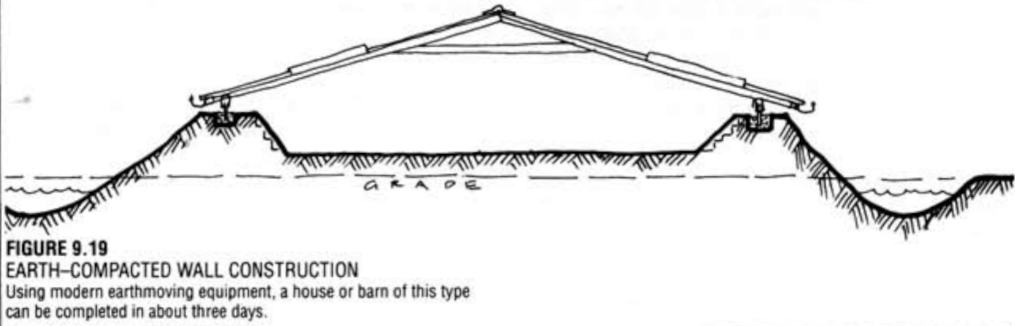

- p238-9 'Permaculture: A Designers' Manual'; Bill Mollison

0_compacted-wall-house.png
earth-compacted wall construction
 
Rocket Scientist
Posts: 4717
Location: Upstate NY, zone 5
665
5
  • Likes 2
  • Mark post as helpful
  • send pies
    Number of slices to send:
    Optional 'thank-you' note:
  • Quote
  • Report post to moderator
On dead flat land, except where there is no possibility of flooding such as a desert, this would definitely be the best version of the general concept.

If there is any slope to the land, it would be possible to make some or most of the finished floor below original grade and be even more sheltered.

In most cases, I expect the undisturbed subsoil would be better compacted than any mechanically placed soil, so the more excavation compared to raising the better.
 
professionalism is finding the perfect flavor of apathy --tiny ad
Learn Permaculture through a little hard work
https://wheaton-labs.com/bootcamp
reply
    Bookmark Topic Watch Topic
  • New Topic