Phil Stevens

master pollinator
+ Follow
since Aug 07, 2015
Merit badge: bb list bbv list
Biography
Got my upbringing and intro to permaculture in the Sonoran Desert, which is an ideal place to learn respect for limits and to appreciate the abundance of biodiversity. Now in Aotearoa (New Zealand) growing food and restoring habitat on a small patch of land. Into biochar, regenerative grazing, no-till cropping, agroforestry, energy and appropriate technology.
Discussion of perpetual motion belongs in the cider press.
Critical thinking is a permaculture principle.
For More
Ashhurst New Zealand (Cfb - oceanic temperate)
Apples and Likes
Apples
Total received
In last 30 days
4
Forums and Threads

Recent posts by Phil Stevens

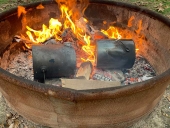
I make biochar from old hay, bean vines, corn stover, sunchoke stalks, hemp, and lots of other non-woody biomass. If you're using a flame cap method, you may need to do a lot of stirring to keep things hot. Or you can combine dry leaves with sticks and woody material for a more manageable burn. If you're using a retort, just try to pack them in as tightly as possible so you get a decent yield.
19 hours ago
Depends on your requirements, really. Is this for a forklift? You can usually put a slightly smaller Ah capacity LifePO4 in place of a lead acid, but if you put the larger one in you get longer running times.
2 days ago
A LiFePO4 forklift battery could be a real bargain when you consider that the usable capacity is easily 80% of the battery's rated energy storage. The very best you can hope for with lead acid is usually somewhere in the vicinity of 40-50%. Another point in lithium's favour is the number of charge/discharge cycles it will endure, which can be in the thousands while the best lead acid can do is hundreds (and the deeper the discharge, the shorter the lifespan).
3 days ago

Peter Chauffeur wrote:
Hi Phil, I have to admit I enjoyed your posts but I have no idea what your reference to horses have to do with rocket mass heaters. As for “building it by the book” I would appreciate you provide information where it suggests a metal riser and the heat specification for your oil drum and where it says to cut off the top and adding 5mm plate. I’m certain that the seam of your oil can will be the next thing to heat fail due to thermal cycling. I think your book needs a re- edit!


OK, first of all:  I never said anything about a metal riser.

"Horses for courses" is a common saying about matching one's needs with the resources available. When I needed occasional heat in a glasshouse and had access to most of the materials for free, there was (and still is) very little motivation for me to radically overbuild the thing. I accepted the 100 L oil drum as a consumable and at the rate of material depreciation I'm observing I should get at least another ten years out of it, and I fully expect it to fail from rust, not thermal cycling. If I'm wrong, I will let you know.

The "book" is the product of many years' worth of community knowledge, most of it gained via this forum but also the publications by Evans, Jackson, Wisner, etc. When I describe my build as following that template, it means that I used the tested and proven ratios for the J-tube dimensions, as well as for the mass bench. This "book" is always evolving, but I don't think there's any reason to claim that replacing the warped and rusting surface of the drum amounts to a deviation from the spec. It's maintenance plus upgrade, in my view, sort of like putting a better tyre on your bike when the old one wears out does not mean you suddenly no longer have a bike.

Peter Chauffeur wrote:I do agree with you that the thickness of oil drum barrels are way too thin to take the massive amounts of heat exiting the riser and there is a need to add a thicker flat plate of steel to prevent your ceiling or home burning down due to a melt thru during operation.


I would say that the thin top surface was a liability for my application. It was not flat to begin with, and was extra hot in the middle, which made it suboptimal for cooking. I got it to glow dull red once or twice with a crazy hot fire, so it might have approached 600 degrees, but in ordinary operation 300 is the max. Mild steel melts at 1200. It also spalled somewhat during use and rusted in the off season. An indoor installation probably would not have seen much of this. Anyway, 5 mm plate has fixed those problems. It still spalls and rusts a bit, but there's probably 25 years or more of useful life in that plate. Melting is almost out of the question, since the 4" burn tunnel simply does not develop that kind of thermal output *and* because steel radiates the heat away quickly. But remember that this radiation is a design feature of the simple J-tube RMH.

Peter Chauffeur wrote:I also agree that a metal riser is a poor decision to use which is why I chose to dole out $100 for the proper ceramic 4” I.D.  Tubes to withstand the heat.


I would never use metal for a riser. I started with perlite and fireclay, then upgraded to a 5-minute riser. I think the insulative performance of my riser is good enough for the application. Again, if and when it bites the dust, I can carefully consign it to its next life entombed in a brick and replace it...dozens of times for the cost of insulative ceramic tube that I would need to ship internationally if I decided to use it.

Peter Chauffeur wrote:Choosing a 100 lb. Propane cylinder for the bell was the engineering product of choice as their thickness and quality of metal are designed to take massive amounts of heat while containing propane and preventing a rupture leading to a BLEVE (if the pressure valve fails)


The time and expense of procuring one of these, plus how much harder they are to cut to size, means that this was never a candidate for my application.

Peter Chauffeur wrote:I will include a picture of the inside of my ceramic riser shortly after shutdown looking down the 3/4” threaded “scully fitting” that used to hold the brass valve. The glowing red area is where the horizontal burn tunnel hits the vertical ceramic riser.
My design is solid, takes a bit of craftsmanship and safety engineering so I can leave it to heat my home and hot tub while I’m out enjoying riding my horse in the Great Canadian pacific northwest!
Build it right the first time. I strongly suggest you get an empty , devolved 100 lb propane cylinder for and replace you re-engineered oil can for safety’s sake.
Be safe and be warm.


Thanks for your concern, but I have made an independent evaluation based on eight years of performance about how fit for purpose my RMH is and don't intend to do anything major design-wise. Like I said earlier, the bench might get an upgrade to a stratification box next time I have to clean the ash out of the pipe.

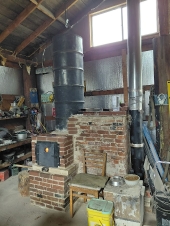
Before you dismiss the oil drum radiator design out of hand, consider how many of them are out there in the real world, quietly just doing what they need to do. They didn't cost much to obtain, they were easy to modify, and there won't be a lot of drama when they need to be replaced as part of ordinary maintenance. If they were really as dangerous as you suggest, we would be hearing the tales of woe by now, and the reputable designers and builders like the Wisners, Uncle Mud, and others, would be advising against them. For example, this one seems to be working stunningly:

3 days ago
If you put about 2m of flue pipe on that you will be amazed by the difference. Stack effect is critical to performance of all mass heaters, and more so for the small cross sections like this one, where the friction really impedes gas flow.

Everything else about this build looks good to me, and the fact that you're getting a weak draft, but at least in the proper direction, says that this little dragon is begging for a pull on its tail.
6 days ago

Coydon Wallham wrote:
I ocassionally pull stuff out of my RMH that are dense and chunky, but they have the consistency more of sandstone (or something friable) than glass. Is that simply ash?

What are some uses for slags and/or clinkers?


That's slag or maybe sand if you put in branches that had dirt on them. The best thing to do with it is use it anywhere you need aggregate. I like to sieve it into various grades for adding to earth and lime plaster mixes. Or you can use it to bulk up garden beds and potting mix.
2 weeks ago
Bones in my soil take decades to break down. If I put them through a fire I can crumble them and get those nutrients available much faster. All bones and shells get the biochar treatment here.
3 weeks ago
I coppice lots of willows and have started doing it with the hazelnuts. Some willows and poplars get pollarded, like the ones in the fruit orchard where I have this plan to stretch a network of wire and put bird netting over all the trees at once. I also pollard most of the Tasmanian blackwoods that pop up semi-randomly from root suckers, with the plan to eventually harvest the trunks for timber and firewood. And last winter I decapitated three redwoods but left a few horizontal branches on each with the idea of training them daisugi style.
3 weeks ago