• Post Reply Bookmark Topic Watch Topic
  • New Topic
permaculture forums growies critters building homesteading energy monies kitchen purity ungarbage community wilderness fiber arts art permaculture artisans regional education skip experiences global resources cider press projects digital market permies.com pie forums private forums all forums
this forum made possible by our volunteer staff, including ...
master stewards:
  • Carla Burke
  • Nancy Reading
  • r ransom
  • John F Dean
  • paul wheaton
  • Jay Angler
stewards:
  • Timothy Norton
  • Pearl Sutton
  • Tereza Okava
master gardeners:
  • Christopher Weeks
  • M Ljin
gardeners:
  • Jeremy VanGelder
  • Matt McSpadden
  • thomas rubino

8"J-tube with Bell to heat living room and kitchen

 
Posts: 27
Location: Güéjar Sierra, Granada, Spain
15
kids purity chicken rocket stoves homestead
  • Likes 9
  • Mark post as helpful
  • send pies
    Number of slices to send:
    Optional 'thank-you' note:
  • Quote
  • Report post to moderator
Hello rocket people,

After spending 2 winters (in our new house) burning a lot of wood and still not being very warm i have decided to put the rocket mass heater project higher on the prio list. So i'm working on a design at the moment with the intention to build it this summer.

I have an open living room with high sloped ceilings and a loft that takes all the heat. At the moment we have 2 ceiling fans blowing the warm air down. Total volume of the salon is about 150m3, with heighest point of the ceiling almost 5m. The heater will be placed in this living room, but the bell will be attached to a divinding wall of the kitchen.  My plan is to heat both the living room and the kitchen. The kitchen has a way lower ceiling (it is below the loft), so that helps. Ideally the kitchen would get so toasty warm that we can open the door to our bedroom and bathroom and also heat those a little.

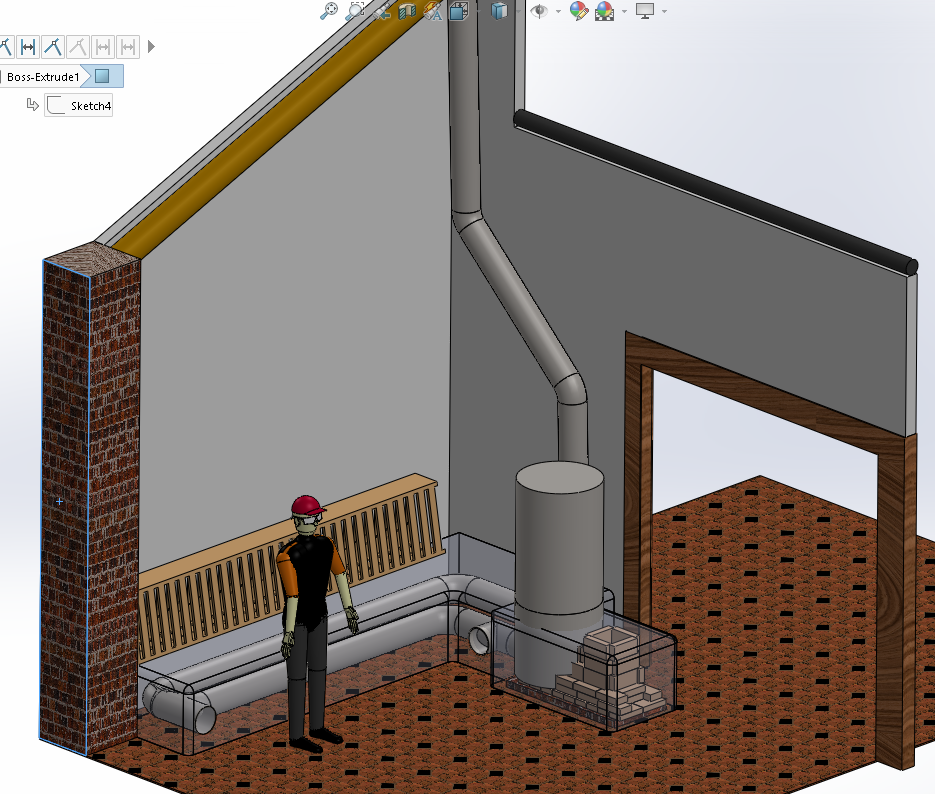
In the picture you have the layout (not the entire living room or kitchen depicted in the floor surface, i just drew up the corner of interest), with the heater in the middle of the livingroom, the wooden frame is the opening to the kitchen, with above the black beam which is where the opening of the loft starts (the ceiling fans are in front of this opening).  The big brick column is not the end of the living room, but it is the end of the seating area. Before the brick column is a desk/workspace. I have chimey on the roof which is about 1,5m height of bricks and 2,5 meters of black steel pipe. I want to have the exit pipe of the bell more or less straight underneath it giving me about 9m of straight pipe. We live in a mountain house with 80cm thick stone walls, so we have quite some mass to warm up

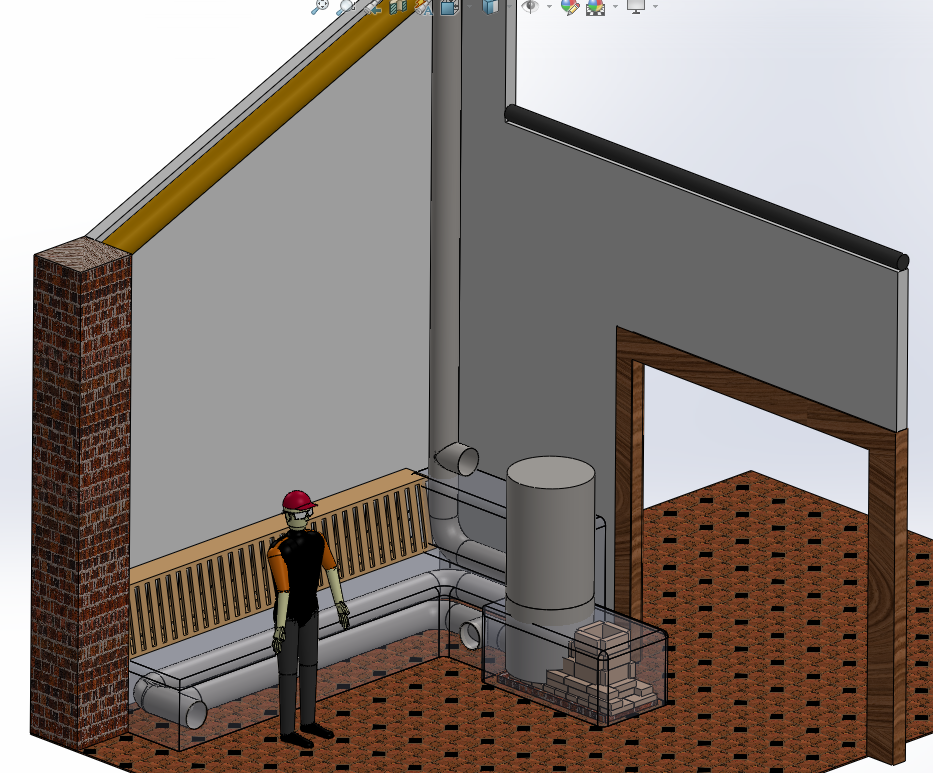
2nd picture is the current setup. We have a huge open fire place that will only warm you because of all the tree trunks you have to haul into the house. So we put a simple stove/fire box in front of it. The entire open fire place including the chimey up will be torn down. We do not really like it, and it serves very little purpose and takes up a lot of space. Somewhere in that chimey is the tubing, which is 25cm diameter.

After some iterations I think a 8" J tube with a bell is easiest and gives us freedom to arrange the seating area with sofas etc, instead of having fixed benches. Although a batchbox looks nice as well, i would like to start with a more easy build. Also I like that the J tube has a higher woodfeed, so my 1 year old is less tempted to have a look at/meddle with the fire.

I will document my design and progress here.

I have some questions so far, if anybody would be so kind to chime in, that would be much appreciated:
- Having the cold air exhaust and heat riser close together: Would that cause any issues regarding draft? Only thing that I can think of is that the exit would be warmed immediatly upon firing and therefore draft would increase.
- I heard Glenn talk about his system which has already a very strong draft with a 8" system and a 6" exit. I'm thinking that in my case, because of my straight chimey, I might also have good draft with a 6" pipe. I have space for a 8" also, so reducing would only save me some money. I wouldn't want to get a too strong draft either, that is why i'm thinking of 6".  
- I'm taking the ISA of a 6" batch rocket system, I believe Glenn's build had the same and that worked nicely. Does anybody have any experience with 8" J tubes and corresponding ISA? I could not find a lot of details for this in the forums.
- With the current measurement of my bell the ISA is a bit to large: 5.77m2. I would like to insulate the bell at least on one side (which is an outer wall of 80cm stone, that feels a bit like an infinite heat sink), and maybe even on the top. Could I disregard these insulated surfaces in the calculation of the ISA, because they will radiate a lot less heat?

Thanks so far for reading. I'm really looking forward to this build, I have read about the these heaters and everything makes sense on paper. So i'm really curious to see what they can do, they sound too good to be true


Schermafbeelding-2026-01-25-212557.png
General layout
General layout of design
WhatsApp-Image-2026-01-26-at-12.45.31.jpeg
current situation
current situation
 
Mark Roelofs
Posts: 27
Location: Güéjar Sierra, Granada, Spain
15
kids purity chicken rocket stoves homestead
  • Likes 9
  • Mark post as helpful
  • send pies
    Number of slices to send:
    Optional 'thank-you' note:
  • Quote
  • Report post to moderator
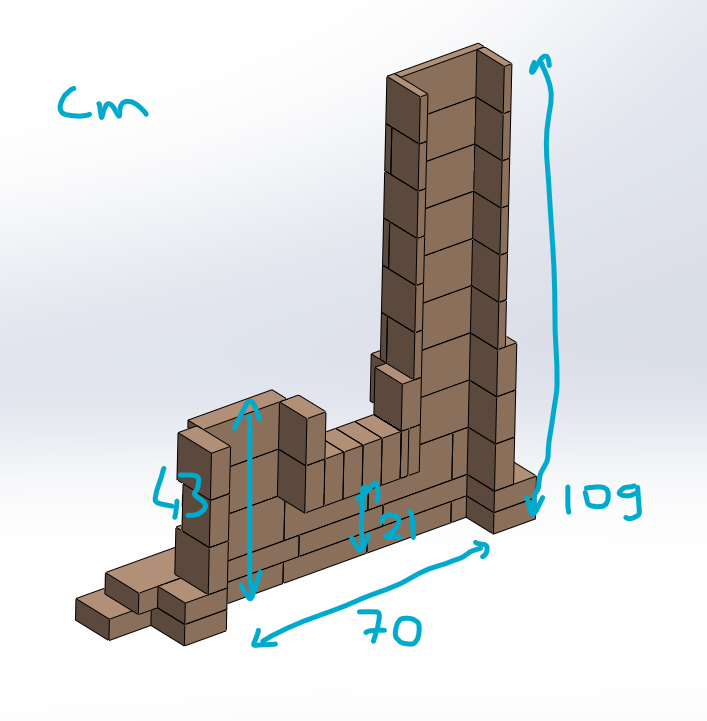
I have made a more detailed layout of the core. I'm shooting for 35cm, 70cm and 105cm for the woodfeed, burn tunnel and riser. The layout I have now is pretty close (37cm, 70cm, 114cm)

The surface area of the burn tunnel is a bit less than needed. The height is 15cm, the width 18cm, which is 270cm2 instead of 314cm2 for the 8" system. Would this be a big problem? I have ordered the book of the Wisner's (assuming they will discus this topic), but Amazon says it is only going to be here in May...... i do not want to wait with the design untill then. I could add another layer of bricks at the bottom, but that would make the dimensions of the whole core a bit bigger, which would become tricky with the space I have inside the bell.

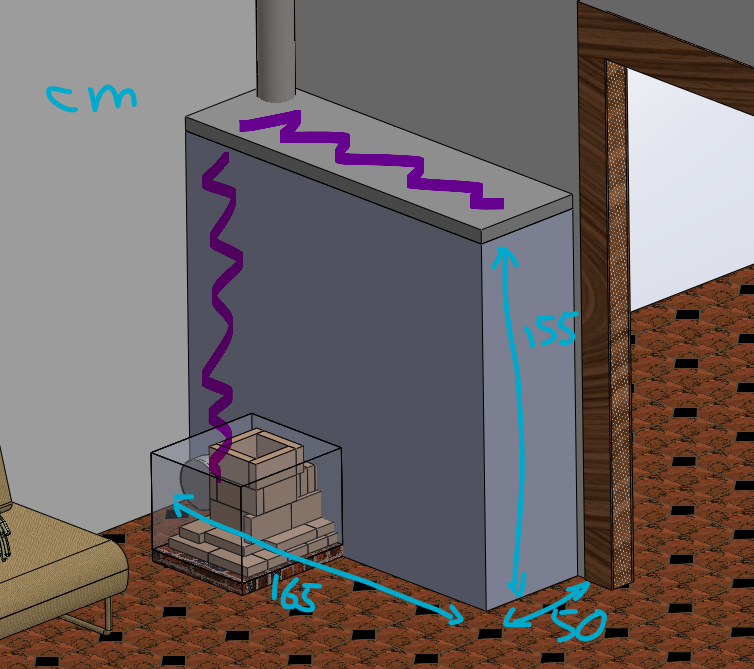
The measurements of the bell are 165x155x50cms. The purple areas I want to insulate to reduce heat transfer. Heat going out the top will not really warm the room and the heat against the outside wall will just heat up a very thick stone wall (~infinite heat sink). The ISA of the bell will be ~5,4m2 (not counting the insulated areas) which is a bit over the recommend ISA for a 8" J-tube (5,3m2). The ISA might change a little depending on the thickness of the brick I will be able to find here. Would adding a column of bricks for extra mass inside the bell change anything about the ISA calculation? Since the the column would not radiate heat outside of the bell.

I have also added a clean out in the left lower corner, right underneath the exhaust. Although I have read many times on these forums that a clean-out is not really needed with a bell system, because blockage is very unlikely. Eventhough ash will build up somewhere in the system, so over many many years there might be a big layer of ash on the bottom of the bell right?

I'm thinking about also adding a 45degree downwards T just above the bell on the exhaust pipe for chimney sweeping. But i feel that that should never be needed in this type of system, so i'm not sure i want to spend money on it.

Anybody has any thougths on overall weight? With the regular bricks i'm finding here the weight of the bell is about 600 kg. The core about 100 kgs. The weight would be a thermal mass, but the prolonged heat would be more because of the hot air in the bell. Are there any general guidelines about this? Or is the weight not really import, but the material (and how fast it radiates the heat) is?

Any inputs are welcome
Schermafbeelding-2026-02-04-185557.png
Core Layout 8" system
Schermafbeelding-2026-02-04-185739.png
Measurements
Measurements
Schermafbeelding-2026-02-04-190111.png
Bell dimensions
Bell dimensions
 
master rocket scientist
Posts: 7010
Location: latitude 47 N.W. montana zone 6A
4058
cat pig rocket stoves
  • Likes 8
  • Mark post as helpful
  • send pies
    Number of slices to send:
    Optional 'thank-you' note:
  • Quote
  • Report post to moderator
Hi Mark;
Welcome to the wonderful world of rocket science.
I have not had time to study your plans in detail, but here are my initial observations.
I had to start by converting your numbers to inches, since we weren't taught the metric system (like the rest of the world).
Your feed tube is 37cm (14 1/2"). This should be taller. 41 cm (16") is the recommended depth. You have not mentioned the dimensions; they should be 20cm x 20cm
Your burn tunnel is shown to be 15 cm tall (6"). The width would need to be 26cm (10")   to achieve the correct proportions. The recommended size would be 20cm x 20cm
It is more common to have your burn tunnel taller than wider, as specified, to allow for ash buildup.
The burn tunnel length you show as 70cm (27.5"), provided the feed tube and riser are not larger than 20cm across, is perfect.
The riser at 114cm (45") tall is perfect.

The exhaust chimney, if located inside the bell, must be insulated.
Adding a cleanout door is always a good idea, but be aware that all of mine will leak condensation when the system is cold. (Black drips)


thomas rubino
master rocket scientist
Posts: 7010
Location: latitude 47 N.W. montana zone 6A
4058
cat pig rocket stoves
  • Likes 9
  • Mark post as helpful
  • send pies
    Number of slices to send:
    Optional 'thank-you' note:
  • Quote
  • Report post to moderator
Hey Mark;
I took time to read more, and here are a few more observations.
I found the width of your burn tunnel.
This is not going to work properly at all. It must be the correct area; it cannot be smaller, or your feed tube will become a chimney.
Your riser is perfect at 114cm (45"), but it can be made shorter, 100cm (39")
Any wall or roof that is insulated is not counted towards the ISA.
Correct an 8" J-Tube uses the ISA numbers for a 6" Batchbox. Perhaps your bell can be enlarged
The exhaust chimney should be 8" inside the bell, with a funnel-shaped bottom.
I suggest using 8" indoors until you reach the ceiling and switch to 6" to exit the building.
Skip the extra 45 pipe; you will not be chimney sweeping anytime soon, if ever.

 
Rocket Scientist
Posts: 999
Location: Province of Granada, Andalucía, Spain
728
6
cooking rocket stoves woodworking wood heat
  • Likes 10
  • Mark post as helpful
  • send pies
    Number of slices to send:
    Optional 'thank-you' note:
  • Quote
  • Report post to moderator
Hey Mark,
It's great to have another Rocket enthusiast in the neighborhood! We live in the Valle de Lecrín, maybe 45 min from you.
I'm happy to drop by on Saturday (if the roads are clear) and bring the Wiesner book, I'll be in Cenes de la Vega. Or you could pick it up there and we can chat over a coffee.

Trying to answer some of your questions:

-6" or 8" exhaust: if you have the space going for 8" has no downsides. Draft can always be controlled with a brick on the feed tube. Will you replace the 250mm exhaust or try to fit the 200 mm (8") exhaust in there?

-I've also read in more than one post that the 8" J-tube is comparable to the 6" BBR. So orienting on the ISA for the 6" BBR should be good. Worst case (too much mass, too low exhaust temp) you could always raise the exhaust pipe, making the ISA smaller.

-Definitely insulate the bell against the outer wall. Maybe even build a double wall filled with insultaion. I like to use Arlita (expanded clay), but you might need 15-20 cm as it's not very insulative. That would probably bring your ISA down already.
Insulated surface as well as the floor of the bell don't count towards ISA.

-Core design: You could have another row (course) of flat laying fire brick as the first course to raise the height of the burn tunnel. Which size firebrick are you using/planning with? Do you have a height restriction with your bell?

-I would add both the T and the cleanout. They're easy to integrate now and in case anything should not work as planned they are ways to look inside, measure, clean, etc. The T could also help you prime the chimney on bad days or with a very cold mass.


Mark Roelofs
Posts: 27
Location: Güéjar Sierra, Granada, Spain
15
kids purity chicken rocket stoves homestead
  • Likes 6
  • Mark post as helpful
  • send pies
    Number of slices to send:
    Optional 'thank-you' note:
  • Quote
  • Report post to moderator
Thank you Thomas and Benjamin!

It's great to have another Rocket enthusiast in the neighborhood! We live in the Valle de Lecrín, maybe 45 min from you.
I'm happy to drop by on Saturday (if the roads are clear) and bring the Wiesner book, I'll be in Cenes de la Vega. Or you could pick it up there and we can chat over a coffee.


Yes, I saw that you could potenially be close by! Very nice to have a fellow permaculture person, most people here just tell me i'm nuts and everything i want to do will not work haha (or jaja in Spanish ) . I was planning on contacting you somewhere along the line the have a chat. Tomorrow (sorry for the late reply, this week has been nuts with the weather as you might know), might be tricky. On my altitude they are expecting quite some snow starting tonight and through the whole weekend.  I will send you a private message to talk.

Will you replace the 250mm exhaust or try to fit the 200 mm (8") exhaust in there?


I will take down the entire chimney all the way to the ceiling. I'm not sure what I will find in regards to tubing. This week I was sweeping and after about 1,5 meters I could hear my chimney sweeper going from the tube to something else. There is (of course) a whole in the ceiling and my plan is just to stick the exhaust pipe in it and cover up whatever is ugly regarding the old tubes/exhaust.

-Definitely insulate the bell against the outer wall. Maybe even build a double wall filled with insultaion. I like to use Arlita (expanded clay), but you might need 15-20 cm as it's not very insulative. That would probably bring your ISA down already.


I was thinking of using superwool, and attaching it with some concrete wire mesh. Or perhaps taking the bell of the wall, but that would require an extra wall of bricks, and still with insulation.

-Core design: You could have another row (course) of flat laying fire brick as the first course to raise the height of the burn tunnel. Which size firebrick are you using/planning with? Do you have a height restriction with your bell?


Yes, i was thinking of adding another row of bricks. After reading Thomas's post about 20x20cm i was reminded that I have read that on the forum. That is why I ordered the book, to have the info a bit more in one place. Leroy Merlin is selling 22x11x4cm and 22x11x2cm firebrick. That is what i'm using now for the design, but I was planning on asking my neighbor (who does construction) whether he knows maybe a better place to get better materials compared to Leroy Merlin. Maybe you know any as well? Quality in Leroy Merlin always seems a bit dubious to me.. Don't really have a height restriction on the bell, except that I was thinking that all height above human length goes a bit wasted because of the high ceiling (this is not an issue in the kitchen since the ceiling is way lower). I would prefer to make the bell a bit deeper to radiate more heat into our living room as opposed to higher to radiate more upstairs.

Welcome to the wonderful world of rocket science.


Thank you, i'm excited to be here.

I found the width of your burn tunnel. This is not going to work properly at all. It must be the correct area; it cannot be smaller, or your feed tube will become a chimney.


Ok, i think I read somewhere on the forum 20x20cm is recommended, but forgot it for a second. I will change the areas to 20x20cm. There are also recommended sizes for the core, i was under the impression that the ratio of woodfeed, burn tunnel, riser where most important. I did not want a too large burn tunnel because the core would stick out to much into the living room. But i will keep it at 70cms and change the rest accordingly.

Adding a cleanout door is always a good idea, but be aware that all of mine will leak condensation when the system is cold. (Black drips)


You mean cold as in, completely cooled down after not firing it for many days/ a week. Or cold as in, after firing in the night, it cools and it is cold in the morning? And therefore you have condens dripping every day?

The exhaust chimney, if located inside the bell, must be insulated.


Good to know, i was wondering whether this would be needed.

The exhaust chimney should be 8" inside the bell, with a funnel-shaped bottom.


The air will go the opposite direction as the liquid goes in a funnel? So 8" exhaust with a funnel that is 6" at the entry of the exhaust?

I will get back to the drawing board and post an update here soon. Thanks for the comments!


thomas rubino
master rocket scientist
Posts: 7010
Location: latitude 47 N.W. montana zone 6A
4058
cat pig rocket stoves
  • Likes 8
  • Mark post as helpful
  • send pies
    Number of slices to send:
    Optional 'thank-you' note:
  • Quote
  • Report post to moderator
Hi Mark
No, an 8" pipe that expands to 10" near the floor of the bell. An upside-down funnel.
Cold, as when you build it, and when you light it at the start of the season.
Firing every day or even every few days will maintain the heat inside.  
Your chimney temperature must be above 140°F (60 °C), or condensation will occur.
 
Benjamin Dinkel
Rocket Scientist
Posts: 999
Location: Province of Granada, Andalucía, Spain
728
6
cooking rocket stoves woodworking wood heat
  • Likes 7
  • Mark post as helpful
  • send pies
    Number of slices to send:
    Optional 'thank-you' note:
  • Quote
  • Report post to moderator
Hey Mark,

Materials: they have standard sized firebrick in most building material stores. I don’t mind Leroy Merlín, but I think the FB there was expensive. I buy mine at BigMat, Pérez Lázaro or the local “material de construcción”.
Splits might be harder to find. Also I find them harder to stick together. I usually just use clay slip.

ISA, insulation and bell depths:
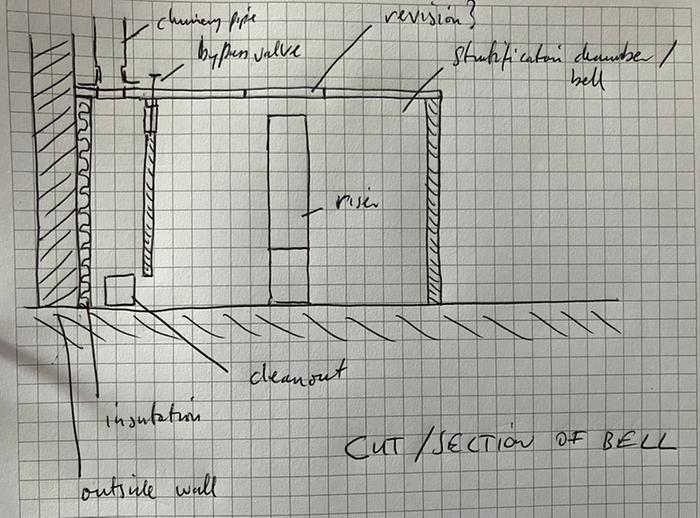
I was thinking whether building a brick chimney against the outside wall, whithin the bell, would be an option to include a bypass, solve connection problems metal/brick and take care of the insulation problem.

 
Mark Roelofs
Posts: 27
Location: Güéjar Sierra, Granada, Spain
15
kids purity chicken rocket stoves homestead
  • Likes 6
  • Mark post as helpful
  • send pies
    Number of slices to send:
    Optional 'thank-you' note:
  • Quote
  • Report post to moderator
Benjamin, thank you for the sketch. I think a brick chimney would indeed help with some design issues with a metal tube through the roof. The bypass could also be pratical, although I wonder whether having the bypass go up would not result in massive heat loss through the bypass, which never is really closed of properly.

The brick chimney cannot be interlocked with both walls of the corners, because those walls are already in the house. So it would require quite some cutting of brick to make the chimney. And if the outer wall is insulated, then the brick chimney would be attached to the isolation. Unless I only insulate the part of the outer wall that has no chimney, in the end the colder air going up the chimney also insulates a bit. Because this is brick, the chimney would not heat up simarly to a metal tube i guess. So it would remain cool at the bottom like the rest of the bell, and insulating the chimney might not be needed. The Walker stove that was build in the other thread does not have a high chimney like mine, so temperature gradient is not so important.

I do worry a bit about construction integrity for this chimney. Not sure if clay alone will fasten it nicely against the wall so it doesn't fall over.

Or the chimney could be along the entire depth of the bell, but that seems a bit overkill.

I was listening to Matt Walker and he mentioned to put a ceramic fiber board on top of the bell, and then put whatever material you want over that. That seems like a simple idea. As long as i can buy CFB of the correct dimension to span the depth of the bell. I saw the idea of using concrete pavers as top, in Spain they also have cobremuros, which seems like more or less the same thing as pavers (which are also available here). Or natural stone, which we have a lot of in our land anyway.  

I have also made a new layout for the core. I have swapped the 4cm thick brick for 5cm thick to get the burn tunnel to a better heigth. Now the woodfeed and riser are 20x20cm area, and the burn tunnel 20x21 (widthxheigth).  The woodfeed is a bit heigher than Thomas recommended. And i made the riser a bit shorter, also to have more space between it and the top of the bell.
Schermafbeelding-2026-02-09-182643.png
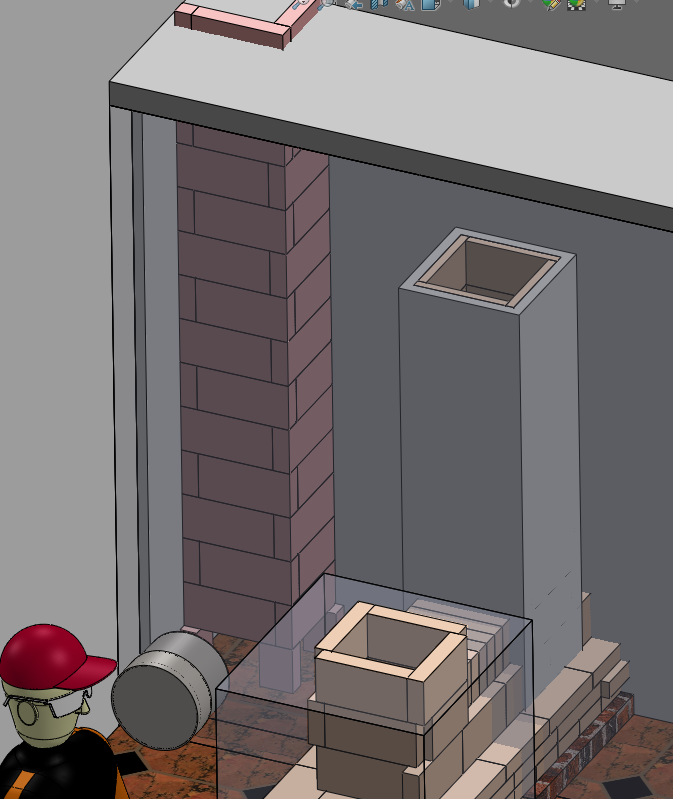
Chimney inside the bell
Schermafbeelding-2026-02-09-182718.png
Chimney not against outer wall, but against insulation
Schermafbeelding-2026-02-09-184149.png
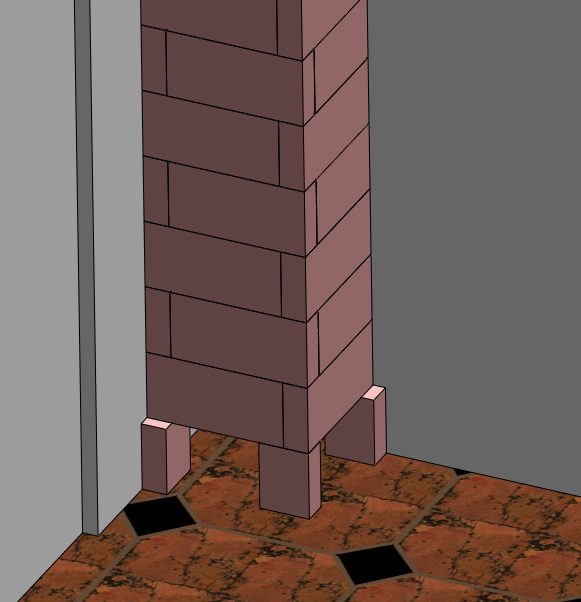
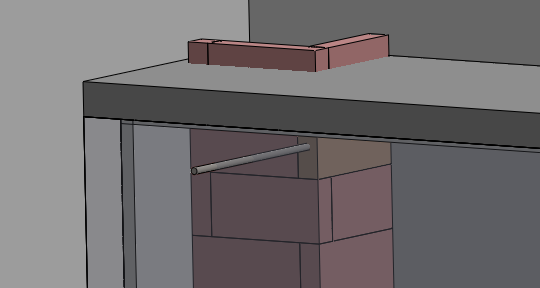
Bypass brick with rod through front of bell
Schermafbeelding-2026-02-09-190719.png
New core layout
New core layout
 
Benjamin Dinkel
Rocket Scientist
Posts: 999
Location: Province of Granada, Andalucía, Spain
728
6
cooking rocket stoves woodworking wood heat
  • Likes 8
  • Mark post as helpful
  • send pies
    Number of slices to send:
    Optional 'thank-you' note:
  • Quote
  • Report post to moderator
Hey Mark.

Mark Roelofs wrote:
Or the chimney could be along the entire depth of the bell


That was what I was thinking. I don't think it would be too big and much easier to build.

The bypass needs to be up I think. Otherwise it won't have much effect.
Depending on the type of bypass I think they can close quite well. Check out the one I used (attached).

The CFB sounds like a good idea. Is it the same as calcium silicate? I've seen that available here

Bypass.jpg
[Thumbnail for Bypass.jpg]
 
Mark Roelofs
Posts: 27
Location: Güéjar Sierra, Granada, Spain
15
kids purity chicken rocket stoves homestead
  • Likes 5
  • Mark post as helpful
  • send pies
    Number of slices to send:
    Optional 'thank-you' note:
  • Quote
  • Report post to moderator
I was thinking about the brick bypass I saw in the other thread. But a rotating one would indeed not have the issues I was thinking about with the brick one.

Yeah, I think CFB is the same calcium silicate, at least google gives me both option for sale and they look very very similar. Matt Walker mentioned that they also give some support for whatever you put on top, as long as what you put on top spans the depth of the bell.
 
master pollinator
Posts: 2090
Location: Ashhurst New Zealand (Cfb - oceanic temperate)
693
duck forest garden fungi trees chicken cooking solar sheep wood heat woodworking rocket stoves
  • Likes 6
  • Mark post as helpful
  • send pies
    Number of slices to send:
    Optional 'thank-you' note:
  • Quote
  • Report post to moderator
Not sure about the suppliers you're dealing with, but in this market CFB and calcium silicate are two very different products.
 
Posts: 857
Location: Sierra Nevada foothills, 350 m, USDA 8b, sunset zone 7
187
  • Likes 8
  • Mark post as helpful
  • send pies
    Number of slices to send:
    Optional 'thank-you' note:
  • Quote
  • Report post to moderator
Mark,

I like your Andalusian house, despite seeing only part of the interior. The house I have built is aesthetically, structurally, and material-wise fashioned after Spanish architecture of your region, but more opulent - I would call it a small house of a wealthy landowner,  jaja.

If I was doing it I would love to preserve the slanted beauty of your fireplace bell. I would:
-keep the massive masonry chimney as it's a part of the room attractiveness
-insert insulated stainless chimney pipe
-build a square bell, 30 cm away from the walls, that would be almost touching the chimney with one corner, so all walls would effectively radiate heat (if heater walls are at least 15 cm away from the wall they are included in calculations of the amount of heat radiated by the bell)
-build slanted top corners of the bell to preserve the style then plaster and whitewash
-insulate the house wall around the bell

I know that you have a different idea, but I was itching to express it. I'm just talking about it from a perpective of someone, who as a 12 year old child, demolished 2 kachel heaters and two kachel cooking stoves, so we could have "convenient" gas, without any regard for preserving the heritage, work of my great-grand father and without any self-preservation instinct (wood can be always gathered, gas - rather not). I also love beautiful design costing a lot of sweat to achieve it.
 
pollinator
Posts: 496
60
  • Likes 5
  • Mark post as helpful
  • send pies
    Number of slices to send:
    Optional 'thank-you' note:
  • Quote
  • Report post to moderator
Thank you for a gem, a post that effortlessly combines science, utility, and artistic effort. Respect.  
 
Mark Roelofs
Posts: 27
Location: Güéjar Sierra, Granada, Spain
15
kids purity chicken rocket stoves homestead
  • Likes 8
  • Mark post as helpful
  • send pies
    Number of slices to send:
    Optional 'thank-you' note:
  • Quote
  • Report post to moderator
Welcome to my thread Cristobal

I understand the appeal of the gaint chimney, that is probably the reason the previous owner build it as well. But we really do not like it. We definitly like the style of this house, that is why we bought it. And my wife will be in charge of the aesthetics, she likes a bit more modern stuff, but it will definilty fit nicely into the room. IF i manage to work out the functional design first. So my 3d model that I share here now should not be seen as an aesthetic idea, merely functional. For one thing, the beams with carvings in them, we want to reuse them on the top of the bell as a reminder how it used to be.

By placing the bell more or less where our current stove is, we lose a lot of space. Something that cannot be overcome if we keep the chimney, and not use it as our primary heating source for the room. A bell more in the middle of the livingroom would take up a lot of space in the middle of the room, making it more difficult to partition the room in different functions, like 1 or 2 offices, a relaxing area and a play area for our todler. The previous owner, who restored the house, was an older man, who was mostly here alone. Which shows in the way he designed the house and its rooms, it is just not very pratical, especially if you have children.

Also with your bell location the living room will be heated very nicely, but my kitchen wont be i think. I really want to incorperate the kitchen wall into the bell, because then I could heat the most important rooms of the house with 1 heating system. Also, because our living room has such heigh ceiling, and the kitchen doesnt, i hope to make the kitchen TOO warm, so we can open the door to our bedroom and/or bathroom so we can kill part of our diesel bill. Because besides the fireplace we also have central heating/hot water via a "concenient" and "being dependent on ~half the world" diesel heater.  The previous owner also liked to behave as a wealthy landowner and burn a lot of diesel jaja

 
Cristobal Cristo
Posts: 857
Location: Sierra Nevada foothills, 350 m, USDA 8b, sunset zone 7
187
  • Likes 7
  • Mark post as helpful
  • send pies
    Number of slices to send:
    Optional 'thank-you' note:
  • Quote
  • Report post to moderator
Mark,

I understand it all. Working within constraints is actually exciting - more than starting carte blanche.
What are the dimensions of the room and what is the distance from the corner to the passage to the kitchen?
Have you considered to open the dividing wall (is it structural, probably yes if it holds the loft) and placing a heater and also a cooking stove? I have seen numerous such builds. I'm just throwing ideas, because I was also going to purchase a house in Spain and renovate it.

After edit:
I have noticed that the distance is 165 cm. Since the perimeter of the feeder part is already encroaching the room, you could also build a BBR sidewinder with door facing towards the room or straight BBR with door facing along the dividing wall. 165x70 footprint would hold straight BBR nicely. It would have a normal single skin (double in the top part) bell. It could be shorter, for example 140 (25 cm distance to the wall), so the chimney pipe would fit in the corner
 
Rocket Scientist
Posts: 881
Location: Guernsey a small island near France.
377
  • Likes 8
  • Mark post as helpful
  • send pies
    Number of slices to send:
    Optional 'thank-you' note:
  • Quote
  • Report post to moderator
Hi Mark, what a great project and it sounds like you are having fun already?

I just read your opening post and wonder about your logic regarding your one year old verses a J tube!
Firstly I will just say that I really like J tube’s designs, they make a lot of sense for many applications, relatively simple to build and very easy to use.
However the open top fire box will be an irresistible draw any child of any age and a perfect hight too!
Something like shorty batch box design can be set quite high off the ground and also have a door.
Secondly I would advise reading up on the use of any high temperature matting or wool, its use is very popular on this forum but as an example, if you use it inside your bell and you get a down draft of wind (very common with open top J tubes) you could be allowing your room to be contaminated with potentially toxic dust.
Of course that is totally up to your discretion as the product  is very effective but does come with some risk!
Your ideas about building an internal brick chimney is unusual but sound….. and should be very long lasting, the down sides might be the work and cost involved or maybe the fact that you just can’t check to see if it has cracks or leaks but that would also apply to  any internal chimney. Something like a cast iron pipe or stainless steel pipe might be an option.
You may want to look at cement board and find out what is available near to you. I often use high temp cement board for chimney construction. That would be long lasting and simple to use.
Vermiculite board would kill two birds with one stone as it is very insulating and also very easy to work with.
Good luck in any case……
 
Mark Roelofs
Posts: 27
Location: Güéjar Sierra, Granada, Spain
15
kids purity chicken rocket stoves homestead
  • Likes 6
  • Mark post as helpful
  • send pies
    Number of slices to send:
    Optional 'thank-you' note:
  • Quote
  • Report post to moderator

Cristobal Cristo wrote: Have you considered to open the dividing wall...


We very much like our kitchen the way it is now, and it already has an old school wood powered cast-iron cookstove with oven.

Regarding the J-tube: I also like the simplicity, and since im completly new to this sort of construcions and design i find the BBR a bit to daunting. I also really like to have hole for the fire, I do not know why, it just looks appealing haha. Maybe because it is so different from a regular fireplace. Yes, my child will be able to burn himself anyway.... maybe a BBR is safer, but if it is really needed I could always make a tight wooden fence around the firebox.
The encroachment in the room of the woodfeed will be less, because now there are a number of whole bricks that take up space and serve no purpose. So I will cut those to size. And I like the small space between the wall and the wood feed to store some firewood.

Fox James wrote:what a great project and it sounds like you are having fun already?


Yes. very excited. Eventhough my brain tells me all the crazy stories about effeciency and comfort should be true, I still want to expierence it to know
The main reason is indeed the simplicity of the J-tube. In the end, children should also learn to not just touch flames. My toddler already is very carefull with the fireplace, and is turned off by the heat.

Yes, I heard about toxic dust from the thermic wools, that is a definite issue.  I have not yet decided on what materials to use. I have to find out what is available here, and also get myself a bit more informed about the options. What type of material I need will also be dependend on the design in some ways.

The brick chimney inside the bell is not my idea. It came from a different thread, and there they mentioned Matt Walker's cookstoves. I'm not sure if it will be a good idea here, for reasons I will discuss below.

-----------------------------------------------
Tying the bell to the excisting wall
So the challenge that Cristoball mentioned earlier. I want to make a L shaped bell-wall, because i want to use 2 excisting walls of the house. 1 wall is the kitchen wall I want to heat up, and the other is an outside wall which I will insulate. I have 2 ideas that might work, see attachment below. One is more simple, the other more robust. Neither really fixes the bell to the wall, but this is not really what I want do due to different thermal expansions of the bell and the wall. The idea is to have a flexible and leak-proof seal.

1. Build up the bell wall and add in a typical seal for stoves/bbqs. This alone will never seal properly because you would have to apply force in the mentioned directions (the arrows). This is what you normally do with a stove/bbq door/lid. Since the bell wall is pretty much rigid, applying a force towards the wall will crack the bell wall in other location. Especially considering that I have to close the bell wall at 2 location, in different directions. To create the leak-proof seal I would use Silicone. High temp Silicone can withstand 180C and 300C peaks. For the outside of the bell this should be enough. For the inside of the bell, the silicone is (hopefully) protected by the seal.

2. Applying the same kind of seal between the bell wall and the excisting wall. Screwing a stainless steel strip into the wall that is made to put pressure on the bell wall. Between the wall and the strip and between the bell wall and the strip there will be a seal. By applying force on the bolts the strip will rotate towards the bell wall and put pressure to seal it (see the picture on the right). This is a lot more complicated and expensive then silicone. and still at the beginning and end of the strip it might be more difficult to get a good seal, and air may still leak.

This type of seal is available everywhere and can go up to high temperatures

For both options the bell wall will be not fixed, so in theory you could pull the wall over and destroy it. Of course the walls will be held in place by the top of the bell which will be attached. And eventhough I was thinking of using clay as mortar for the bell wall (because i like the idea of being able to take the wall down and re-use the stone), I heard that this kind of mortar does not really 'stick' and hold the wall together. So maybe it would be better to use cement anyway, to at least have the walls as a whole structure. Not sure about this, anybody any insight in the structural integrity of a single brick wall with clay mortar?

The stone chimney inside the bell is also related to this challenge, because it will have to be sealed properly against the excisting wall. But option number 1, with silicone, is not possible inside the bell because of too high temperatures. So maybe in the end the chimney will turn back into a metal tube with insulation....

If anybody has any ideas/thoughts/feedback, i'm all ears

WhatsApp-Image-2026-02-12-at-19.11.24.jpeg
2 designs to 'fix' the bell to the wall
 
Cristobal Cristo
Posts: 857
Location: Sierra Nevada foothills, 350 m, USDA 8b, sunset zone 7
187
  • Likes 7
  • Mark post as helpful
  • send pies
    Number of slices to send:
    Optional 'thank-you' note:
  • Quote
  • Report post to moderator
Sometimes unorthodox approaches are not used, because people are stuck in the (imperfect) tradition, but sometimes that may not work. Are you doing it to save the material or to save 13 cm (12 cm Spanish brick + 1 cm bell/wall gap) of living room space? I want it to work for you and it would be sad if you had to disassemble the heater in a year or two to build the continuous bell. Of course we will not know until you try and operate it for a few years. I can imagine what kind of massive heart attack it would give to authorities here who already do not tolerate even single skin :) Your design can be called "half-skin". Please also consider that this region of Spain has some seismicity. Good masonry relies on gravity - so buildings and structures are designed to work even without the mortar, by interlocking pieces, thick walls for stability, erecting thick buttresses for vaults and arches, cornices with proper cantilever per brick, etc.
Have you checked if the floor will support the heater weight?

Permies is a forum where people usually do not boldly say "do not do it" assuming that there is some unexplored path that may be discovered. What I can only say that in hundreds of heaters and builds that I watched/studied all of them had a normal bell - similar like I never saw an engine with half an engine block - the other half being car body.

Despite the fact that I would never do it I remain curious of the outcome.
 
Mark Roelofs
Posts: 27
Location: Güéjar Sierra, Granada, Spain
15
kids purity chicken rocket stoves homestead
  • Likes 8
  • Mark post as helpful
  • send pies
    Number of slices to send:
    Optional 'thank-you' note:
  • Quote
  • Report post to moderator
It is not about saving livingroom space or money in bricks. It is to heat the kitchen via the wall that is already there. Making a continiuous bell, with a 1cm gap between the bell wall and the kitchen wall will ofcourse also heat the kitchen wall, but to much much lesser extent (i think). In the end the kitchen wall will become warm of course, but will it be enough to really warm the entire kitchen, and maybe even the bed and bath-room..... ?

I also do not want to tear everything down after a few years because it does not work. That is why i'm gathering ideas and opinions of people with experience. If everybody hear says, it will probably not work, I will change my design. I prefer to first make a proper working heater, and then maybe experiment with something later, instead of the other way around

The floor is thick concrete, everything in this house is build pretty massive as you mentioned. So the weigth of the bell will not be a problem
 
Fox James
Rocket Scientist
Posts: 881
Location: Guernsey a small island near France.
377
  • Likes 7
  • Mark post as helpful
  • send pies
    Number of slices to send:
    Optional 'thank-you' note:
  • Quote
  • Report post to moderator
Have you done any revision about the internal temperatures inside your bell?
Apart from the very top 8-12”  you might not need to worry about  expansion or high temperature cement.
In any case you can use the standard pizza oven cement mix called ‘home brew’
3 Parts Silica Sand
1 Part Portland Cement
1 Part Fire Clay (powdered)
1 Part Hydrated Lime
This is cheap, very easy to use and good for 4-500c
 
Cristobal Cristo
Posts: 857
Location: Sierra Nevada foothills, 350 m, USDA 8b, sunset zone 7
187
  • Likes 7
  • Mark post as helpful
  • send pies
    Number of slices to send:
    Optional 'thank-you' note:
  • Quote
  • Report post to moderator
Directly heated kitchen wall would surely transfer heat better. it is a normal problem in masonry buildings and that's why old houses had a separate heater per each room. Without that the heaterless rooms would remain cold. I experienced it first hand. The hallway to our living room felt warm only within 2 m from the door. I'm facing the same problem as the interior walls in my house are 40 cm thick. I have placed the heater (yet to be built, hopefully this year) in the space between the kitchen and the living room, close to two bedroom doors. I'm also planning to utilize mirrors to reflect radiant heat to the bathroom and the third bedroom. On the other hand, I live in rather warm place, massive house never gets too cold and I like to sleep in cool air.
If the opening to the kitchen was wide enough you could extend the bell and position the heater door to face the kitchen, but it would eat at least 60 cm of the opening and would look weird and rather ugly.
 
Benjamin Dinkel
Rocket Scientist
Posts: 999
Location: Province of Granada, Andalucía, Spain
728
6
cooking rocket stoves woodworking wood heat
  • Likes 9
  • Mark post as helpful
  • send pies
    Number of slices to send:
    Optional 'thank-you' note:
  • Quote
  • Report post to moderator
Hey Mark,

I don't see why the brick chimney makes it more complicated. It's whithin the bell, so as long as you find a solution for the bell it's going to be fine. Also you could build a 4 walled chimney whithin the bell, just to be sure.

As for the clay mortar, a brick wall doesn't get the stability form being "glued" together, but from gravity and friction. So as long as you interlace the brick correctly, an L-shaped wall should be very sturdy.

Now the biggest challenge, the "seal". Super wool and/or other gaskets would be an option. But a simple solution, which would also provide more stability, could be to chisel the existing wall, where old and new meet. Creating a space for the new wall to go a couple of cm into the old wall. Aplly plaster and done.

And as a precaution I would definitely go get a CO and smoke detector. With any woodburning device. They're only good for 10 years, not very permaculture, but a good safety measure.
 
I agree. Here's the link: http://stoves2.com
reply
    Bookmark Topic Watch Topic
  • New Topic