Jeff Bigelow

+ Follow
since Feb 07, 2025
Merit badge: bb list bbv list
For More
Apples and Likes
Apples
Total received
In last 30 days
0
Forums and Threads

Recent posts by Jeff Bigelow

Ben Brownell wrote:I went for something similar, but more 'rustic' I suppose with small-D roundwood frame pieces, offcut slabs, and salvaged roof tin - and realized I could scale up in size a bit and have a nice elevated outdoor summer bed/lounge when not in use for wood storage!


I like your creativity with this design. My snow load requirements are pretty high where I am so I probably couldn’t do something exactly like this but I may experiment with the next version using green roundwood.
4 weeks ago

Eric Hanson wrote:Jeff, I like your design.  It has a simple, functional elegance.

I have to ask if you are planning on waterproofing or covering the OSB roof.  OSB just doesn’t stand up well to water—any water.  But some simple waterproofing (or maybe a covering layer) will fix that just fine.


Nice job!


Eric



I’ve since put some scraps of Tyvek housewrap over it and will screw down some corrugated steel on top to finish the roof.
1 month ago
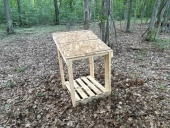
This is a woodshed design I came up with a few days ago. It took about an hour from start to finish and used only a pallet and some construction scraps. I used 2x6 and 2x4 lumber and some OSB to create a frame around the pallet. I estimate it’d hold maybe a half face cord of wood. It’s 32 inches deep so I can get two rows of wood in there. I’ll probably build 3 or 4 more of these to store the wood for my sauna.
1 month ago
I recall hearing about the rocket kiln that was built at Wheaton Labs on one of the podcasts but I haven’t seen any updates. This seems like a really cool piece of technology and was wondering if it’s been well-received in the wood-fired ceramics community?
1 month ago
Another food I’d like to share is Ful Medames (there are many spellings). It’s an Arabic dish of cooked fava beans with a variety of added ingredients depending on the version you are preparing (Egyptian, Lebanese, Yemeni, etc). I typically fry up a few cloves of garlic, toss in two cans of fava beans drained of their liquid, and add some water or stock until it looks just a little soupy. I cook it down for ten minutes and then stir in some tahini. Topped with some parsley and olive oil, it is pure heaven to spoon onto some warm pita bread. This is a common breakfast food in the Levant and Northern Africa. You will find many good recipes and variations online.

Admittedly, it’s not a very permaculture dish for me as it relies on the import of ingredients from the Arab world until I can produce fava beans myself, but it is healthy and high in fiber and protein. Canned beans are a shortcut but can be high in sodium. I aspire to switch over to pre-cooking batches of dried fava beans for the week to cut down on the sodium.
1 month ago
I find quinoa to be an excellent quick food. You can dress it up with spices or eat it with olive oil and salt (my favorite). It’s a decent protein source for being a grain and overall a fairly healthy food. Paired with some fermented veggies and maybe some sliced cheese, it’s a full meal.
1 month ago
I just watched this video about a low-cost method of performing Schlieren imaging
. For those who haven't heard this term, it's a method used often in R&D to visualize flow-related phenomena that aren't visible to the naked eye. It's found commonly in combustion research as well, and my head went immediately to rocket mass heaters and how this low-cost technology could be applied to their improvement. I am thinking that it could be good as a baseline to do this kind of imaging on several poorly performing heaters/combustion units (obviously, Schlieren imaging would only be relevant to the combustion portion of a RMH... no relevance I can think of to the other parts) and then compare the flow with that of a good heater. I'm sure that are myriad ways to apply this method of flow visualization given that the linked method is so cheap to get imaging going.
1 month ago

Cristobal Cristo wrote:The moisture from the soil will affect the wood from the bottom, especially when it rains. Digging rodents will disperse the soil and throw it on your lumber.
I store everything outside.
Masonry and steel I just store on pallets.
Cements, insulating firebricks, adobe, lumber I store on double pallets or double pallets separated with plastic.


What do you mean by “separated by plastic”?
2 months ago
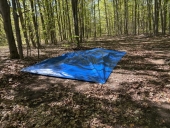
What do you all do for storing lumber outside? I’m currently building on an off-grid property and am early in the process of building my first outbuilding. I don’t have any permanent covered storage and have just been rigging a tarp across my lumber. I try to leave an air gap to let air run longitudinally and keep stuff dry. The lumber sits on some plywood which in turn sits on some scrap stickers. Does anyone have any better methods?
2 months ago
Not sure how “idiot-proof” this dressing is, but my “fancy” dressing when I want something with a bit more to it than just oil and vinegar is a Dijon dressing. I take a spoonful/forkful of Dijon mustard and put it into a small 4oz jar, then whisk it as best I can with a fork while drizzling in a little bit of good olive oil. Once it gets a bit airy and the volume has maybe roughly doubled, I mix in some apple cider vinegar/lemon juice and some maple syrup. Takes about 2 minutes start to finish and makes an excellent dressing.
4 months ago