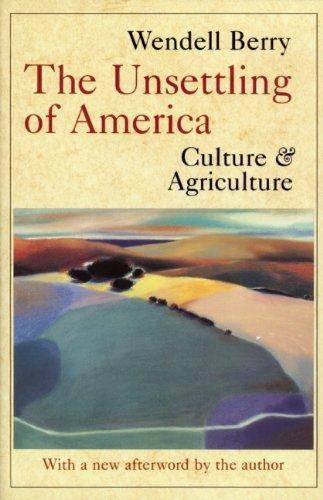
Since its publication by Sierra Club Books in 1977, The Unsettling of America has been recognized as a classic of American letters. In it, Wendell Berry argues that good farming is a cultural development and spiritual discipline. Todays agribusiness, however, takes farming out of its cultural context and away from families. As a result, we as a nation are more estranged from the land—from the intimate knowledge, love, and care of it.
“The soil is the great connector of lives, the source and destination of all. It is the healer and restorer and resurrector, by which disease passes into health, age into youth, death into life. Without proper care for it we can have no community, because without proper care for it we can have no life.”
― Wendell Berry, The Unsettling of America: Culture and Agriculture
that's why 'Wendell berry' looked familiar when I have seen him quoted here...that is indeed a great book.
i'll have to get another copy; mine got ruined in the jungle!
Wendell is one of my favorite authors (if not my favorite).
If you haven't read "The Long-Legged House", this book is one of his best collections and so many of those essays could have been written today. It was first published in 1969.
“It is certain, I think, that the best government is the one that governs the least. But there is a much-neglected corollary: the best citizen is the one who least needs governing.” ― Wendell Berry, The Long-Legged House
Jones...We lost quite a few books to the 'woods' when we first moved here...I still prefer a book to a computer screen though!
Tom...I haven't seen the book you mention. I am lazy about waiting to come across things so I don't find everything but I think I will see if our library will find it. I have seen that much of his work (poems and essays mostly) is online even though he doesn't use or like computers himself. A few years ago I wrote him a 'thank you' for his work and actually recieved a nice reply:)
One of the best books I've read in the last 25 years. I give this 10 acorns out of 10.
Where do you start to review a book like this? I'm not worthy of a review, but I will share at least this. Much could be written about his elegant and thoughtful diction and turn of phrase that we don't hear anymore in our spoken language. It's clear the man is a poet. But, I think the main point that I walk away with after reading TUOA is that the man was so prophetic in such an eloquent way. He didn't prophesy in general and vague ways, what he wrote in detail so many decades ago have come true in detail today and will continue to be discovered. In one volume, you have a succinct description of the bane that is industrial agriculture and the modern mindset and how it will degrade our biosphere and our society. He is no luddite, believe me. The bonus is that not only with the "how" of all this, but Berry in his unique way of communicating takes on the "why" of what has happened to us in this post-modern age. We walk away realizing our own complicity in the negative and, in that realization, can come to see our opportunity to take up the positive.
For those familiar with Wendell Berry and his writings, this is another essential work. I love Wendell's books on agriculture and his unique and eloquent writing style reveal the tragedies of corporate agribusiness and its influence on culture. Going far beyond the abuse of soil which can be easy to see to those living in and driving through America's sprawling acres of cropland, this book sheds light upon the myriad of other far reaching consequences that industrial agriculture besets upon rural Americans, having had and still dealing a firsthand impact on the ruination of their communities. Written more than forty years ago now, this book could easily be about todays agriculture, rural people and the continuation of politically driven and economy based crop production.
This was my first full-length Berry work, though I had read some of him over the years, and have loved "The Mad Farmer, Flying the Flag Rough Branch, Secedes from the Union" since I first read it over a decade ago. I have since perused the entire Mad Farmer volume, too, but that would be another review.
[EDIT - Sincere apologies, since I have been binge-reading Berry this month, I failed to recall that the opening essay below applies to The World-Ending Fire collection, which I also highly recommend. The second paragraph correctly focuses on the issues taken up in Unsettling. Apologies.]
Berry's opening essay, "A Native Hill", immerses the reader in the particularity and locality of Port Royal and its environs, but in so doing, urges the same particularity of us. If Wendell's leaves are so magical in their cycle of death and rebirth, maybe mine are, too. Above all, Berry accomplishes the goal of the poet (which is not always easy to do in an essay) of inviting us to see, smell, feel, hear, and co-experience the world about him in all its wonder. The work of a poet is to convey experience, whether the tragedy of the siege of Troy or the tragedy of an overplowed sloped field, and this Berry does with the simple grace of a thoughtful farmer. It's well worth a read, and even contemporaneous references in the book serve to illustrate how much things have changed, and yet how the policies and practices that lead to the unsettling have been remarkably consistent.
In the laws in Deuteronomy, Israel is forbidden from total war against enemies: "When thou shalt besiege a city a long time, in making war against it to take it, thou shalt not destroy the trees thereof by forcing an axe against them: for thou mayest eat of them, and thou shalt not cut them down (for the tree of the field is man's life) to employ them in the siege: Only the trees which thou knowest that they be not trees for meat, thou shalt destroy and cut them down..." (20:19-20). We have been at war with the trees and with all else that sustains our humanity for far too long. In The Unsettling of America, Wendell Berry urges peace: living at peace with our place and our limits, which is an even more unsettling idea in our times than when it was first penned almost fifty years ago.
Happy homesteading,
Mark
Post by:autobot
Something must be done about this. Let's start by reading this tiny ad:
![[Logo]](/templates/default/mobile/images/mobile-permies-2015.png)


 We lost quite a few books to the 'woods' when we first moved here...I still prefer a book to a computer screen though!


