
• Post Reply Bookmark Topic Watch Topic
  • New Topic
permaculture forums growies critters building homesteading energy monies kitchen purity ungarbage community wilderness fiber arts art permaculture artisans regional education skip experiences global resources cider press projects digital market permies.com pie forums private forums all forums
this forum made possible by our volunteer staff, including ...
master stewards:
  • Carla Burke
  • John F Dean
  • Nancy Reading
  • r ransom
  • Jay Angler
  • Timothy Norton
stewards:
  • paul wheaton
  • Pearl Sutton
  • Anne Miller
master gardeners:
  • Christopher Weeks
  • M Ljin
gardeners:
  • Jim Garlits
  • thomas rubino
  • William Bronson

Monocrystalline vs polycrystalline for small off-grid cabin - real world experience?

 
Posts: 1
  • Likes 2
  • Mark post as helpful
  • send pies
    Number of slices to send:
    Optional 'thank-you' note:
  • Quote
  • Report post to moderator
Hi folks, new here. Been lurking for a while reading the energy threads and finally getting serious about designing the solar setup for my small cabin build. I keep going back and forth between mono and poly.

I came across a nice selection of monocrystalline solar panel options while pricing things out and the efficiency numbers look great on paper, but I wanted to ask folks with actual boots-on-the-ground experience - is the extra cost over poly really worth it for a small cabin system (say 1-2 kW)?

The argument I keep seeing is that mono performs better in low light and has smaller footprint which matters on a small cabin roof. But some older threads here suggest poly is still plenty good for the money if you have roof space to spare.

Anyone switched from poly to mono (or vice versa) and noticed a real difference? Mostly running lights, small fridge, laptop, maybe a well pump eventually.
 
steward & author
Posts: 46686
Location: Left Coast Canada
19094
10
art trees books chicken cooking fiber arts
  • Likes 7
  • Mark post as helpful
  • send pies
    Number of slices to send:
    Optional 'thank-you' note:
  • Quote
  • Report post to moderator
It's so dependent on location and climate, these absolute one or the other just aren't universal.

I found having small solar experiments about the home now has taught us a lot about which panels are right for our climate and use patterns,  and which not. That way, when we upgrade the roof, we can get the right panels on there for us and our needs at that time.
 
pollinator
Posts: 997
Location: Central Ontario
206
kids dog books chicken earthworks cooking solar wood heat woodworking homestead
  • Likes 8
  • Mark post as helpful
  • send pies
    Number of slices to send:
    Optional 'thank-you' note:
  • Quote
  • Report post to moderator

Ethan Bell wrote:Hi folks, new here. Been lurking for a while reading the energy threads and finally getting serious about designing the solar setup for my small cabin build. I keep going back and forth between mono and poly.

I came across a nice selection of monocrystalline solar panel options while pricing things out and the efficiency numbers look great on paper, but I wanted to ask folks with actual boots-on-the-ground experience - is the extra cost over poly really worth it for a small cabin system (say 1-2 kW)?

The argument I keep seeing is that mono performs better in low light and has smaller footprint which matters on a small cabin roof. But some older threads here suggest poly is still plenty good for the money if you have roof space to spare.

Anyone switched from poly to mono (or vice versa) and noticed a real difference? Mostly running lights, small fridge, laptop, maybe a well pump eventually.

the only thing that really matters at the size you are talking is to make sure to design around an mppt charger and dont lock yourself into a 12 volt system. The mono vs poly debate played itself out and the market decided mono won hands down. The only thing poly had going for it was lower cost and the price of panels kept dropping to the point that poly's advantage disappeared. They still exist from secondary manufacturers but I would never put one into my builds. Racking, labour and space are what counts now not panel cost.
Cheers,  David
 
Posts: 511
72
  • Likes 5
  • Mark post as helpful
  • send pies
    Number of slices to send:
    Optional 'thank-you' note:
  • Quote
  • Report post to moderator
I don't even pay attention to it.  I purchase all my panels used on Craigslist, and my single most important criteria is watts/$.  BTW, don't shy away from used panels because they are used.  I've gotten better performance from used panels I got off Craigslist then the brand new panels I paid retail for.  Depending on your location, expect a good deal to be in the range of 3-5W/$.  Don't order your panels on the internet with shipping.  Cash and carry local purchases will be the best deals.

I do bring a voltmeter with me when purchasing to make sure one panel doesn't turn out to be a lemon.  Don't buy a panel that has a Voc more than 10% lower that what the sticker spec states.  So, if a panel sticker says the Voc is 37.5V, don't buy a panel putting out less than ~34Voc.
 
pollinator
Posts: 1200
Location: Greybull WY north central WY zone 4 bordering on 3
370
hugelkultur trees solar woodworking composting homestead
  • Likes 3
  • Mark post as helpful
  • send pies
    Number of slices to send:
    Optional 'thank-you' note:
  • Quote
  • Report post to moderator
You might want to add amorphic panels to what you are studying.  Because they absorb best at different frequencies it is suggested they work better in areas with lots of cloud cover.
 
pollinator
Posts: 481
Location: zone 5-5
165
  • Likes 2
  • Mark post as helpful
  • send pies
    Number of slices to send:
    Optional 'thank-you' note:
  • Quote
  • Report post to moderator
And there is N-type. To consider.
I hear they are supposed to degrade less.
Which could be important if you buy used panels.
I'm not sure how it affects the original output.
There were some used REC N-types on craigslist.
They didn't last long.
I've seen a few people on craigslist selling their old 12 volt setups.
I assume they are moving up to 48 volts equipment.
 
Posts: 44
Location: I am building a life project in the Spanish Pyrenees.
22
  • Likes 3
  • Mark post as helpful
  • send pies
    Number of slices to send:
    Optional 'thank-you' note:
  • Quote
  • Report post to moderator
I would add that, at least where I am, the mono vs poly debate is now mostly outdated. The low-cost panels available here are already monocrystalline, around 650 W each, and bifacial. The current price is about €98 per panel, roughly US$114, which puts them at around €0.15/W, or about US$0.18/W. At that price point, the real decision is no longer mono vs poly, but system architecture: string voltage, MPPT sizing, wiring losses, shading management, and future expansion.

The main advantage of wiring panels in series is that it raises voltage and reduces current. For the same power, higher voltage means fewer amps, lower voltage drop, and smaller cable size between the array and the inverter or charge controller. Of course, the string’s maximum open-circuit voltage must always be checked, especially in cold weather, so it stays within the MPPT input limit.

There is also simple panel-level electronics available, usually called power optimizers. They can be useful when there is partial shading, uneven dirt, panel mismatch, or one panel in the string is underperforming. If one panel is shaded or dirty, the optimizer helps prevent that panel from dragging the whole string down as much. They are not magic, and they do not replace proper MPPT design, but they can improve resilience in imperfect real-world conditions.

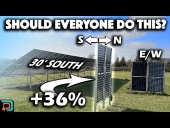
Regarding orientation, I would not overthink it for a small off-grid cabin, provided there are no major shading issues. In the northern hemisphere, facing south with a tilt close to the average annual optimum angle is usually a sound baseline. If the cabin is mainly used in winter, a slightly steeper tilt may make sense to improve winter production and help shed snow or dirt.

With 650 W panels, the options for a 1–2 kW target are quite simple:

* 2 panels: 1.3 kWp. Cheap and simple, but with limited margin.
* 3 panels: 1.95 kWp. Very close to the target, but usually ends up as a single string.
* 4 panels: 2.6 kWp. Slightly above the target, but it allows two balanced strings of two panels in series.

For an off-grid cabin, I would choose 4 panels configured as two strings of two panels in series. That gives a 2S2P array: two panels in series per string, and two strings in parallel, or preferably two independent MPPT inputs if the inverter/charge controller supports it.

That way, you are not betting the whole system on a single string, the working voltage remains sensible for the MPPT, current is reduced compared with a low-voltage 12 V setup, wiring costs stay under control, and there is real-world margin for lights, a small fridge, laptop use, and possibly a well pump later on.
 
Arthur, where are your pants? Check under this tiny ad.
building a permaculture community with hands on permaculture
https://wheaton-labs.com/bootcamp
reply
    Bookmark Topic Watch Topic
  • New Topic