• Post Reply Bookmark Topic Watch Topic
  • New Topic
permaculture forums growies critters building homesteading energy monies kitchen purity ungarbage community wilderness fiber arts art permaculture artisans regional education skip experiences global resources cider press projects digital market permies.com pie forums private forums all forums
this forum made possible by our volunteer staff, including ...
master stewards:
  • Carla Burke
  • John F Dean
  • Nancy Reading
  • r ransom
  • Jay Angler
  • Timothy Norton
stewards:
  • paul wheaton
  • Pearl Sutton
  • Anne Miller
master gardeners:
  • Christopher Weeks
  • M Ljin
gardeners:
  • Jim Garlits
  • thomas rubino
  • William Bronson

Strawberry Obelisk - Design Feedback

 
Posts: 7
3
  • Likes 6
  • Mark post as helpful
  • send pies
    Number of slices to send:
    Optional 'thank-you' note:
  • Quote
  • Report post to moderator
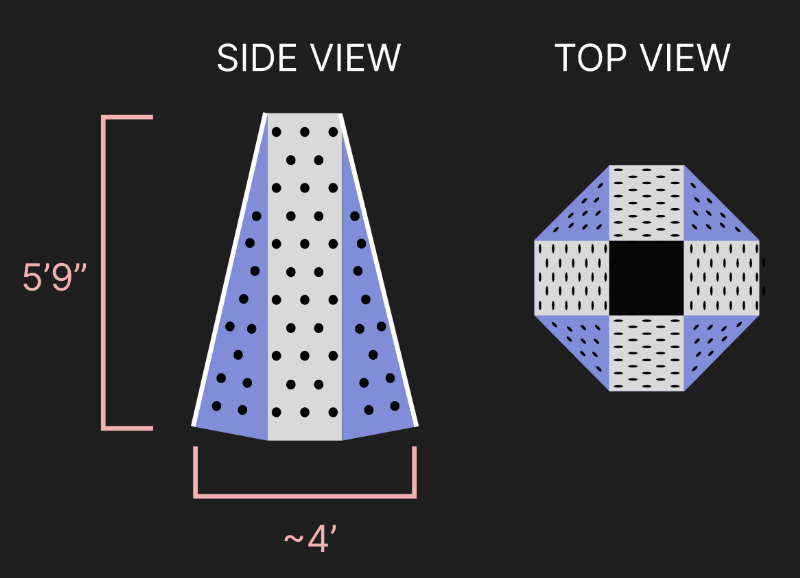
I made a design for a vertical structure to grow strawberries. It's an obelisk, so I shall name it... the Strawbelisk! Anyway, I wanted to run the design past you and get feedback. Particularly around watering.

Here's the gist of the design:


All sides taper inward at 13 degrees. There are 4 main sides and between them are triangle shaped "filler" sides (shown in blue above). The colors in the image are just to illustrate the different sides. In reality it'll all be made of white oak, sealed with tung oil. So brown.
I'll be able to fit a lot of strawberries in this thing. It's gonna be awesome.

But a few questions present themselves. One thing I'm wondering about is watering. Assuming I fill the whole thing with soil, if I water from the top in that 6"x6" opening... will it adequately spread throughout the soil and get to the strawberries on the outside? Particularly around the bottom area, which is furthest from the opening and most spread out away from the center.

I've never watered a body of soil in this shape before, so I don't know. Have any of you?

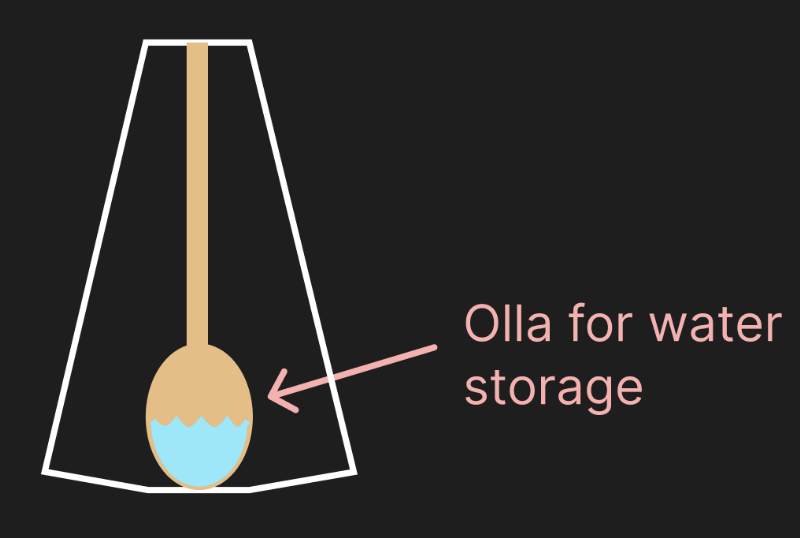
I'd love it if that was the case, because it would make things easy. But if not, there is another idea I had. A large olla.


Here, the bottom part could passively draw water from a reservoir in the terra cotta olla. I think this is a cool idea, because it also helps the overall structure not dry out as easily. More stable with hydration. But it's expensive to do this. So I'd prefer to not do it if I don't have to.

What do you think?
 
pollinator
Posts: 93
Location: Haarlem, The Netherlands
68
forest garden fungi trees urban writing ungarbage
  • Likes 7
  • Mark post as helpful
  • send pies
    Number of slices to send:
    Optional 'thank-you' note:
  • Quote
  • Report post to moderator
Good morning Peter,

Nice design. I think you need the olla or something like it. As an alternative, you could water into some of the holes in the side. Spiraling a drip irrigation hose inside the strawbelisk will certainly help. I think, the amount of soil in the strawbelisk, as well as the amount of plants, need a lot of water. It requires a lot of patience watering that all into the top of the strawbelisk, especially when the top is dry.

A cheap alternative for an olla, could perhaps be a bunch of sticks in the ground, sticking up almost to the top of the strawbelisk, wicking water from the ground (assuming there is water in the ground). I want to try this wicking myself this season, but I have no actual experience yet. The height of the structure might be an issue for wicking, so you still need to water from the top.

Good luck! Let us know what you did, and how well it worked. I would love to see a picture when it is ready.

 
steward
Posts: 18995
Location: USDA Zone 8a
4813
dog hunting food preservation cooking bee greening the desert
  • Likes 6
  • Mark post as helpful
  • send pies
    Number of slices to send:
    Optional 'thank-you' note:
  • Quote
  • Report post to moderator
I feel the water effect would be the same as if you were watering a 4 foot pot except the water would dry out faster due to the holes on the side.

I like this idea:

Nynke said, " Spiraling a drip irrigation hose inside

 
Posts: 206
59
kids urban seed
  • Likes 4
  • Mark post as helpful
  • send pies
    Number of slices to send:
    Optional 'thank-you' note:
  • Quote
  • Report post to moderator
The olla idea makes sense here. The soil volume is relatively small and spread across a tall structure so it'll dry out faster than a regular pot. A buried reservoir in the centre would help a lot more than top watering. The drip line spiralled inside is probably the most practical option if you don't want to make an olla.
 
Peter Alewine
Posts: 7
3
  • Likes 4
  • Mark post as helpful
  • send pies
    Number of slices to send:
    Optional 'thank-you' note:
  • Quote
  • Report post to moderator

Nynke Muller wrote:
A cheap alternative for an olla, could perhaps be a bunch of sticks in the ground, sticking up almost to the top of the strawbelisk, wicking water from the ground (assuming there is water in the ground). I want to try this wicking myself this season, but I have no actual experience yet. The height of the structure might be an issue for wicking, so you still need to water from the top.


This idea struck me. Sticks! Trees wick water upward all the time, quite high. So I did a little test, putting various objects into a bucket of water, to observe how high they wicked water. I did two wooden dowels, two types of string, a chopstick, bamboo, an old stick I found in the yard, and a paper towel. Oh, and a glass straw for good measure, just to see if it would do anything.

Image attached.

The wood dowels took water up a couple inches, nothing impressive, and certainly not good enough for this application (which would involve lifting water 5-6 feet), but at least you could see it working. Everything else was even less impressive. Except for the paper towel. That thing got all the way to the top! I wonder how high it could get eventually. Too bad it would rot relatively quickly inside soil, making it unsuitable for my application.

Anyway, this tells me that simply using the wood from a tree, to wick water upward, is not able to fully recreate what goes on inside trees to move water. There must be more to it. I would love to be able to passively recreate that phenomenon though.

Do we even have a full understanding of how it works? I did a little searching but didn't come up with a fully satisfying answer...

IMG_3101.jpeg
[Thumbnail for IMG_3101.jpeg]
 
master pollinator
Posts: 5410
Location: Due to winter mortality, I stubbornly state, zone 7a Tennessee
2374
7
forest garden foraging books food preservation cooking fiber arts bee medical herbs
  • Likes 2
  • Mark post as helpful
  • send pies
    Number of slices to send:
    Optional 'thank-you' note:
  • Quote
  • Report post to moderator
I do not have personal experience with using rope for wicking. However I found Mart's use of wicking for seed starting, here very interesting. Perhaps a length of rope, adding a nest shape at the base of your plants would keep the lower soil from absorbing all the water near the bottom?
 
You'll find me in my office. I'll probably be drinking. And reading this tiny ad.
It's like being on a deserted island - only with gardens and natural buildings in Montana
https://wheaton-labs.com/bootcamp
reply
    Bookmark Topic Watch Topic
  • New Topic