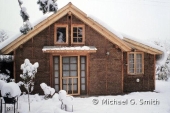
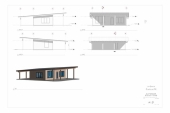
Back in 2001 the California Straw Building Association was only five years old.
Founding members--builders, architects, engineers and owner-builders--were excited by the new (to them) building system presented by stacking and plastering straw bales to form walls for buildings. Energy efficient, non-toxic, simple, and beautiful--lots to love! The straw bale "revival" had begun just a decade earlier--in the late 1980s when a handful of builders from the American Southwest learned of a building system that originated on the plains of Nebraska soon after baling equipment arrived there, circa 1890s. There was so much to learn--and much to share.
CASBA held a Pro-Course--a one day event where builders, engineers, and architects shared what they knew. That was in 2001.
How things have changed! After a twenty-five year hiatus CASBA is holding another Pro-Course, this time over several days in Cottage Grove, OR, from August 21st - 23rd (we hope participants can arrive early, the afternoon of Thursday, August 20th, but actual teaching time will be Friday - Saturday the 21st - 22, with wrap-up and departures on Sunday the 23rd.
Visit the California Straw Building Association's website for more details
https://strawbuilding.org/event-6704105 and to register!
The course has lots to offer. In 2001 pretty much everyone building with straw bales was laying them flat, sometimes load bearing (roof loads supported by the bale walls), but in the seismically active west, more often bales laid-flat within a wood frame of some kind (non-load bearing, or post-and-beam). Cement stucco was a common plaster finish. Building codes pertaining to straw bale buildings were rudimentary, and the building science around thermal and moisture management of bale wall assemblies wasn't well understood. There were just a couple of commonly used shear wall systems.
Today, straw bales go into building walls laid-flat, on-edge, and on-end, and there are a dozen lateral force resisting systems (shear walls) available to structural designers. There's a well-developed model code in the U.S. available for adoption. Clay and lime plasters have largely replaced cement plasters as finishes, and we know a good deal more about how these wall systems manage temperature and moisture fluctuations.
Finally, a lot of thought has gone into how to build more efficiently, and better.
And all of this will be part of the course, which features a pre-course on-line video component as well as on-site classroom and hands-on.
We have experienced instructors on-site--Miles Taylor, Lydia Doleman, Chris Foraker, Catherine Odell, Kita Glass, Jenna Bader, and me. The web instructors include straw-bale and straw-clay code authors Martin Hammer and David Eisenberg, architect Bob Theis, structural engineer Anthony Dente, CASBA's executive director Massey Burke, and natural builders Amanda Fischer and Myles Danforth.
I'll hazard a guess that between us we have worked on hundreds, if not thousands of straw bale buildings--plenty of insights to share!
Class size is limited to 30 participants; there's an early-bird special that ends on June 30th, so if you want to learn all about current best practice in North America for straw bale construction, check out this course!
I hope to see you there!
Jim
Many Hands Builders







 1
1




![[Download CASBA-Pro-Course-2026-Flyer.pdf]](https://permies.com/templates/default/betaview/images/download-attachment.gif)