Win a copy of Sourdough Without Fail this week in the Bread forum!"
  • Post Reply Bookmark Topic Watch Topic
  • New Topic
permaculture forums growies critters building homesteading energy monies kitchen purity ungarbage community wilderness fiber arts art permaculture artisans regional education skip experiences global resources cider press projects digital market permies.com pie forums private forums all forums
this forum made possible by our volunteer staff, including ...
master stewards:
  • Carla Burke
  • Nancy Reading
  • John F Dean
  • r ransom
  • paul wheaton
  • Jay Angler
  • Timothy Norton
stewards:
  • Pearl Sutton
  • Tereza Okava
  • Nicole Alderman
master gardeners:
  • Christopher Weeks
gardeners:
  • M Ljin
  • Megan Palmer
  • Pete Podurgiel

Fixing pond issues naturally

 
rocket scientist
Posts: 550
Location: in the Middle Earth of France (18), zone 8a-8b
345
2
hugelkultur dog tiny house chicken composting toilet cooking building sheep rocket stoves homestead composting
  • Likes 15
  • Mark post as helpful
  • send pies
    Number of slices to send:
    Optional 'thank-you' note:
  • Quote
  • Report post to moderator
I had a good pond ecosystem going on last summer, with water filtering plants, oxygenating plants and fish, when the heat and drought struck.
Grass dried up, and my three little sheep walked into the pond to drink, every day a little deeper...piercing the pond lining with their hooves.
I first didn't realise this was happening (my focus was with the renovation of our house), and by the time it dawned on me, I had to do a emergency pond rescue; moving the plants and the fish into buckets and tanks, pump out the water, replace the pond lining...

After the pond renovation the biological balance of the pond was off, but I was hoping it would recover by itself the next season.
I built edges around the pond that keep the sheep away, and am making sure they have drinking water elsewhere.
This season has been even hotter and drier. The pond water is green. The water filtering plants and the fish have all survived, but the oxygenating plants didn't survive the winter. Whenever I'm topping up the pond I make sure the water is falling in, bringing some oxygen with it.

I'm aware there are chemicals that would clear up the green water, but I want to keep my pond natural and be gentle with the plants and the fish.
I found out there's a French company (they also ship abroad) with 100% natural solutions to any and all pond problems. I ordered some water fleas that I think will multiply as they're consuming the micro algae, rendering the water clear, and new oxygenating plants that also use the excess nitrates as they grow.

I know this sounds like "blatant advertising", but 1) I'm not getting any compensation from them for my praise and 2) I'm genuinely happy and enthusiastic about finding them, which is why I want to let others know this interesting source of biological pond ecology boosters.

Their website is very clear and resourceful, prices not too elevated, service is good and fast and most and foremost, the received plants and water fleas were very healthy, thanks to the good (origins and) packaging.

You can take a look your self, they're called Aquazolla .

 
steward
Posts: 19580
Location: USDA Zone 8a
4923
dog hunting food preservation cooking bee greening the desert
  • Likes 2
  • Mark post as helpful
  • send pies
    Number of slices to send:
    Optional 'thank-you' note:
  • Quote
  • Report post to moderator
I would suggest adding an aerator as that seems to be the solution I have read.
 
Posts: 20
3
  • Likes 4
  • Mark post as helpful
  • send pies
    Number of slices to send:
    Optional 'thank-you' note:
  • Quote
  • Report post to moderator
+1 on getting an aerator, you can also usually get low wattage aquarium filters which i rescued from a bin. they usually come with either a plastic foam filter and some are charcoal or other medium. this is your first line of defense w aquariums and they are so low power they usually can run on a small solar panel that comes with them. if it was me id setup an aquaponics tub to drain the bottom of the pond onto a bed and have that filtered water trickle back
 
Nina Surya
rocket scientist
Posts: 550
Location: in the Middle Earth of France (18), zone 8a-8b
345
2
hugelkultur dog tiny house chicken composting toilet cooking building sheep rocket stoves homestead composting
  • Likes 9
  • Mark post as helpful
  • send pies
    Number of slices to send:
    Optional 'thank-you' note:
  • Quote
  • Report post to moderator
Anne and Pete, thank you for your contribution, but I'm looking for natural remedies, without any machines. That's why I was so delighted by the information, plants and critters I found on the website I mentioned.
 
Anne Miller
steward
Posts: 19580
Location: USDA Zone 8a
4923
dog hunting food preservation cooking bee greening the desert
  • Likes 1
  • Mark post as helpful
  • send pies
    Number of slices to send:
    Optional 'thank-you' note:
  • Quote
  • Report post to moderator
To aerate the water with out using a machine why not add a water fall feature using different levels of land or rocks?

Replace the oxygenating plants for the ones that died.
 
pollinator
Posts: 6283
Location: Bendigo , Australia
594
plumbing earthworks bee building homestead greening the desert
  • Likes 3
  • Mark post as helpful
  • send pies
    Number of slices to send:
    Optional 'thank-you' note:
  • Quote
  • Report post to moderator
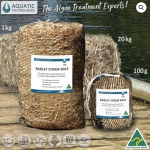
Here in Australia we use barley straw in a specific manner.
Here is a company that commercialised the idea. The Dam doctor
Some other information from that site;
"Using bales to clean dams primarily refers to using barley straw as a natural, preventative water conditioner.
 While regular hay bales are occasionally placed in runoff inflows to trap sediment and introduce nitrifying bacteria, barley straw bales are specifically deployed directly in the water to combat algae and improve clarity.
However, experts note that barley straw acts strictly as an algaestat (algae preventer) rather than an algaecide (algae killer), meaning it must be applied before an algal bloom establishes itself"
 How Barley Straw Works
When barley straw is submerged in a dam, it undergoes a slow bacterial decomposition process. As it rots in the presence of oxygen, it releases humic acids.
These acids react with sunlight and dissolved oxygen to create low levels of hydrogen peroxide, which inhibits the growth and reproduction of new algae cells without harming fish, livestock, or aquatic plants.
 Step-by-Step Application Guide
To effectively deploy barley straw bales in a dam, follow these standard guidelines:Calculate the Dosage: Measure the surface area of your dam (Length × Width in meters).
A standard application rate is roughly 100 grams of straw per 2 square meters of surface area. For large dams or lakes, this equates to roughly 100 to 300 pounds (about 4 to 5 large bales) per acre.
Keep It Floating: Do not sink the bales to the bottom.
They must be packed loosely into mesh bags with a floatation device so they sit near the surface where oxygen and sunlight are highest.
Position in Moving Water: Anchor the floating bales near the dam's inflow, water aerators, or windward sides. Adequate water circulation is essential to distribute the active compounds.
 Maintenance & Rotation:
Gently shake or wash the mesh bags every few weeks to clear away sediment buildup. Bales typically take 2 to 8 weeks to activate (depending on whether water temperature is above 20°C or below 10°C) and will last about 4 to 6 months.
 Crucial Removal Window:
You must remove old bales before they completely rot. If left to decay entirely in the dam, they turn into organic sludge, releasing nitrates and phosphates that actively fertilize the next massive algae bloom.
Start your next batch of straw 1 month before pulling out the old one to avoid a gap in coverage.

 
I am mighty! And this is a mighty small ad:
hands on gardening and natural building
https://wheaton-labs.com/bootcamp
reply
    Bookmark Topic Watch Topic
  • New Topic