Full disclosure first: I work for Stankotorg, a band saw and blade supplier in Moscow, and I wrote a free book on wood band saws (link at the end). This thread is the useful part of it, boiled down to three questions that come up again and again with vertical band saws and small band mills. Corrections and your own numbers are welcome.
1. How wide a blade for the curve you want to cut?
Width does two jobs. A wide blade is stiff in the cutting plane and holds a straight line; a narrow blade can turn in the kerf. For resawing, use the widest blade your machine allows. For curves, there is a handy estimate from Russian sawmilling literature for the smallest kerf radius:
ρ = 0.12 · B² / Δ
where B is blade width and Δ is set, all in mm. The original paper leaves open whether Δ means one side or both; I plug in the per-side value, typically 0.3–0.6 mm.
• 10 mm (0.39 in) blade, 0.45 mm set: ρ ≈ 0.12 × 100 / 0.45 ≈ 27 mm (1.06 in)
• 25 mm (1 in) blade, same set: ρ ≈ 0.12 × 625 / 0.45 ≈ 167 mm (6.6 in)
Notice the square: 2.5 times the width gives about 6 times the minimum radius. That is why a resaw blade is hopeless for scrollwork, and why it pays to keep a narrow blade around rather than forcing a wide one round a curve.
2. Set: more is not better
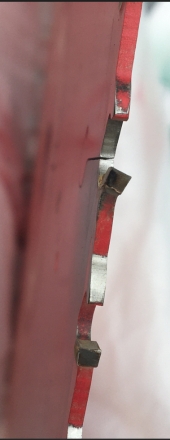
Set (tooth tips bent alternately left and right) makes the kerf wider than the blade so it does not rub, heat up and get pinched. The formula above shows the trade-off: more set means a tighter possible radius, but also a wider kerf, a rougher face and more wood turned into sawdust. In straight resawing, extra set only hurts.
What hurts even more is
uneven set. Research on a horizontal band mill blamed setting for over 90 % of the washboard problems they saw; grinding accounted for roughly one case in twenty. A quick check:
1. Put a dial indicator on a stand and run it over several dozen teeth on one side, then the other.
2. A difference between sides means asymmetric set: expect drift.
3. Scatter along one side means uneven set: expect washboarding.
4. Bring the teeth that stick out back in line; they are overloaded and score the face.
Two smaller points. Raker set (left, unset, right) cleans the kerf bottom and is recommended for large logs, but with one tooth in three going to each side the face comes out rougher. In frozen wood, side clearance can be reduced by 15–20 %. And after several resharpenings, check where the bend sits: the bent part should stay at 0.3–0.5 of tooth height from the tip.
3. Tension: habits rather than a magic number
There is no single tension figure for wood band saws, and the 250–280 N/mm² often printed in handbooks is for industrial metal-cutting saws. Do not carry it over to wood: follow your machine manual. What I would suggest instead is a routine:
• Teeth pointing down toward the table on a vertical saw, then tension to the manual or the machine scale.
• Turn the wheels by hand a few revolutions and check that the blade settles in the same place on the tire every time.
• Set the guides, make a test cut, then recheck tension after the first cuts: a new loop stretches a little.
• Note the handwheel or scale position that gave a good cut for each width, so the next install starts from a known point.
• Back the tension off when you finish for the day.
If you keep needing more and more tension to cut straight, stop cranking. The cause is almost always set, sharpening or guides.
One thing that often surprises people: tension is not the biggest load on the band. Bending over the wheels is. Bending a 1.05 mm band around a 600 mm wheel already gives about 367 MPa, while the pre-tension recommended for one wide resaw blade that was studied was only 50–100 MPa. So never fit a thicker blade than the manual allows: on small wheels it cracks from the gullets.
The book
All of the above, with sources, plus blade speed (in m/s) and how much each tooth should bite, wheels, guides, sharpening, log breakdown and winter sawing, is in
Wood-Cutting Band Saws: Resawing, Drift, Tension, Sharpening and Set (58 pages, PDF and EPUB, CC BY-ND 4.0),
free on Zenodo. There is also a
Russian edition, and the company's
woodworking reference section (in Russian) has more background. No prices, no brands in the book.
I'll keep this first post updated with corrections from the thread.

.png)


 3
3


![[Thumbnail for cover-en.jpg]](/t/390595/a/298144/cover-en.jpg "Filename: cover-en.jpg
Description:")