
• Post Reply Bookmark Topic Watch Topic
  • New Topic
permaculture forums growies critters building homesteading energy monies kitchen purity ungarbage community wilderness fiber arts art permaculture artisans regional education skip experiences global resources cider press projects digital market permies.com pie forums private forums all forums
this forum made possible by our volunteer staff, including ...
master stewards:
  • Carla Burke
  • Nancy Reading
  • John F Dean
  • r ransom
  • Jay Angler
  • Timothy Norton
stewards:
  • paul wheaton
  • Pearl Sutton
  • Tereza Okava
master gardeners:
  • Christopher Weeks
  • M Ljin
gardeners:
  • thomas rubino
  • Jeremy VanGelder
  • Megan Palmer

Taming the Reciprocating Saw

 
master pollinator
Posts: 5654
Location: Canadian Prairies - Zone 3b
1604
  • Likes 14
  • Mark post as helpful
  • send pies
    Number of slices to send:
    Optional 'thank-you' note:
  • Quote
  • Report post to moderator
Hi Folks. I really like my recip saws on the homestead, battery and plug-in, but I'm seeing comments where people have problems with them.

I like their flexibility, and with a range of instant-change blades they take on a lot of rough work at a moment's notice. (My big Stihl chainsaw is great, but it's a honking monster tool for monster-size jobs -- not for quick casual stuff or working up top a 30 foot ladder.)

What tricks can you share? Or experiences? Or problems? Maybe we can put our heads together and get the best out of these little workhorses.


master steward
Posts: 8397
Location: southern Illinois, USA
3310
goat cat dog chicken composting toilet food preservation pig solar wood heat homestead composting
  • Likes 11
  • Mark post as helpful
  • send pies
    Number of slices to send:
    Optional 'thank-you' note:
  • Quote
  • Report post to moderator
While I am sympathetic with those who complain about the vibration, I have not found it to be too bad. Then again, I keep and older B&D around for ladder work. That way I can drop the thing without concern about the loss.
 
Posts: 65
Location: Zone 7b, 600', Sandy-Loam, Cascadian Maritime Temperate
45
  • Likes 10
  • Mark post as helpful
  • send pies
    Number of slices to send:
    Optional 'thank-you' note:
  • Quote
  • Report post to moderator
We used to use a Sawzall reciprocating saw around here lots, but I never tried it for pruning.
Amazing tool for all sorts of jobs, though.  I used a plug-in type - for cutting holes in walls mostly for access to conduits etc.
always was bothered by the vibration, but I do think of it as a great tool for accessing difficult spots that need cutting.

For larger-than-lopper gauge pruning cuts on fruit/nut trees I like a nice sharp hand-saw made for the purpose.
I do get joint fatigue from too much of that, but the Sawzall gives extra stress to my 'under insulated' nervous system... so I stick with judicious use of hand tools as much as I can.


Posts: 809
190
  • Likes 12
  • Mark post as helpful
  • send pies
    Number of slices to send:
    Optional 'thank-you' note:
  • Quote
  • Report post to moderator
I think if you waxed the blade it would slice through things easier, no different than waxing a handsaw to get the same result. I often wax my screws before driving them if they are especially long or the wood is hard. Wax on steel really makes a difference.

But I just no longer use my reciprocating saw much. Its versatile and powerful, but other tools have really came along and replaced it.

For cutting steel, I found a thin wall grinding wheel works better.

For cutting in new outlets in an old wall, a multi-tool has greater control and does not break the keys out of my old horsehair plaster.

For cutting notches, my jigsaw has finer control.

For pruning my hand-held chainsaw works better and faster.

For long rip cuts, my skillsaw works better and is provides a better straight cut.

For cutting long curves in boards, I prefer my jigsaw.

For cutting pipes for plumbing, I get better control and can cut closer with my multi-tool.

I have a reciprocating saw, and it is a battery powered Milwaukee so certainly not a junk saw, but it comes out very sporadically. Mostly it is in demolition when I need to cut nails or boards with nails in them. Then I am glad I have it. It has brawn and can make longer cuts.

It just seems to be one of those multi-tools. Yes it does many, many things, but it does none of them well. As my tool collection has grown, it just seems to get less and less use. I'll always have one, but it will last a very, very long time when used but a few minutes a year.
 
Steward and Man of Many Mushrooms
Posts: 6068
Location: Southern Illinois
1867
transportation cat dog fungi trees building writing rocket stoves woodworking
  • Likes 10
  • Mark post as helpful
  • send pies
    Number of slices to send:
    Optional 'thank-you' note:
  • Quote
  • Report post to moderator
Hmmm,

Ok, I really like the direction of both sides of comments here and I strangely agree with both sides.  

First in favor of the reciprocating saw:

1.  With skill and patience I can make detailed cuts that other saws either won’t make or will take forever to do.  I am reminded of a plunge cut I had to make on the deck I built on my first house.  I took it slow, but I made a cut right in the middle of the material.  This would have been challenging with other saws.

2.  A Recip saw is a sort of do-it-all saw.  I can cut wood, metal, even tiles in a pinch.  I just can’t see myself being without one.

3.  I have also heard similar arguments about a traditional cordless drill being obsolete when an impact drill can basically do everything a regular drill can but in a smaller, lighter package.  Maybe.  But I will not give up my cordless drill anytime soon.

4.  In a pinch, a reciprocal saw doubles as a lightweight chainsaw without the pain of maintaining a chain..

I suppose that on the bad side there are saws that can do everything that a reciprocating saw can do but more precisely, accurately, easier, etc.  but I still don’t see a saw as flexible as a sawzall and my tool kit is incomplete without one.


Eric
 
pollinator
Posts: 469
Location: Klumbis Oh Hah, Zone 6
203
  • Likes 10
  • Mark post as helpful
  • send pies
    Number of slices to send:
    Optional 'thank-you' note:
  • Quote
  • Report post to moderator
I repeat my view that (in my experience*) an oscillating saw is superior: more adaptable, easier to control.

*Mostly doing electrical and other trades work rather than farming. Your mileage may vary.
 
Eric Hanson
Steward and Man of Many Mushrooms
Posts: 6068
Location: Southern Illinois
1867
transportation cat dog fungi trees building writing rocket stoves woodworking
  • Likes 8
  • Mark post as helpful
  • send pies
    Number of slices to send:
    Optional 'thank-you' note:
  • Quote
  • Report post to moderator
Ned, I have used an oscillating saw and in the right circumstances, you are absolutely correct.  It really is the ideal tool for fine cutting.

Now ripping and cutting--that's another matter entirely!


Eric
 
Steve Zoma
Posts: 809
190
  • Likes 9
  • Mark post as helpful
  • send pies
    Number of slices to send:
    Optional 'thank-you' note:
  • Quote
  • Report post to moderator

Ned Harr wrote:I repeat my view that (in my experience*) an oscillating saw is superior: more adaptable, easier to control.

*Mostly doing electrical and other trades work rather than farming. Your mileage may vary.


I agree, you could cut dovetails with an oscillating tool, or what I call, and have called on here: a multi-tool.

Of course when you wee done cutting the dovetails you could scrape off the glue, sand the work, buff out the finish... with one billion different tools to put on it, there is not much it cannot do with it, and with finesse.
 
Posts: 1551
124
  • Likes 7
  • Mark post as helpful
  • send pies
    Number of slices to send:
    Optional 'thank-you' note:
  • Quote
  • Report post to moderator
those safety switches that have to be held down while pulling the trigger make them just that much more difficult to use. I fixed that problem with some electrical tape to hold it down but that only lasted temporarily. I guess surgery is need to jump the wire eliminating the safety with. kind of reminds me of those spring loaded shutoffs on new gas cans that have to be pulled down in order to dispense gas out the spout that many times causes spills of the combustable refined dinosaur juice.
the extra long blades made for cutting branches actually work very well once you get the machine to run. but in no way compare to what a chainsaw will do. but battery powered sawsall has its place in pruning and cutting.
 
pollinator
Posts: 673
Location: Zone 8A
152
homeschooling kids rabbit tiny house books chicken composting toilet medical herbs composting homestead
  • Likes 12
  • Mark post as helpful
  • send pies
    Number of slices to send:
    Optional 'thank-you' note:
  • Quote
  • Report post to moderator

Douglas Alpenstock wrote:What tricks can you share? Or experiences? Or problems? Maybe we can put our heads together and get the best out of these little workhorses.


I like putting the blade in "upside down". Holding the saw the way it is supposed to be held, the teeth are pointing up if the blade is inserted the way I am describing.

I feel I have better control and I am able to get a nice close cut verses having the long portion of the guard and the rubberized handle protruding in the way.

Blade.jpg
[Thumbnail for Blade.jpg]
 
steward and tree herder
Posts: 12829
Location: Isle of Skye, Scotland. Nearly 70 inches rain a year
6710
6
transportation dog forest garden foraging trees books food preservation woodworking wood heat rocket stoves ungarbage
  • Likes 13
  • Mark post as helpful
  • send pies
    Number of slices to send:
    Optional 'thank-you' note:
  • Quote
  • Report post to moderator

bruce Fine wrote:those safety switches that have to be held down while pulling the trigger make them just that much more difficult to use.
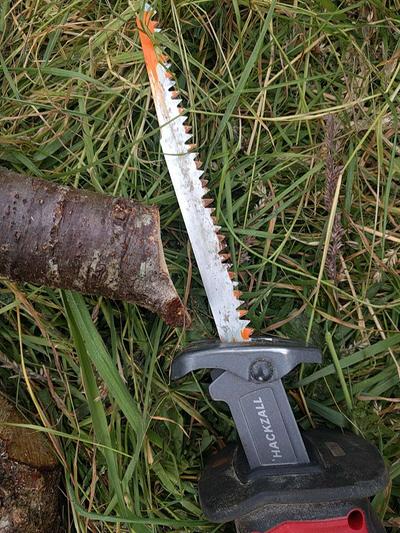

My (Milwaukee) reciprocating saw just has a push lock/unlock button and a trigger - you don't have to hold two buttons at once to make it work. I use it mostly for pruning - the blade gets into small spaces so can be more useful for delicate work. I find that it I have larger diameter wood to cut I just can't keep the cut square ( reported here)- the blade has a tendency to a curved cut.
a curved cut
 
Posts: 173
Location: 55 deg. N. Central B.C. Zone 3a S. Nevada. Hot and dry zone
57
  • Likes 14
  • Mark post as helpful
  • send pies
    Number of slices to send:
    Optional 'thank-you' note:
  • Quote
  • Report post to moderator
+1 for the upside down blade. Variable speed a must. Also, if you are framing on a slab, as in the photo above, keeps the tip out of the concrete.
Only One Way to Rock
Having a hand on top, pushing down, blade inverted, calms the saw a bit. Holding from the bottom and pulling down, not the same.
The saw chatters in direct relationship to the aggressiveness of the blade. Likewise using a blade that is far too long for the depth of work, the whip of a blade on the far side will let you know. Shortest blade that will allow you to work, best.
The Milwaukee blade above is extremely aggressive. If it has been inadvertently dulled on one side, or if the tooth offset is not identical, then it would have a curved cut.
Likewise for those bow saws. The ones you buy at the big orange box typically are no longer ground with a taper to the back, the kerf is too tight, the teeth not enough offset. The contemporary, cost mandated, weak, thin blade......
Absolute misery.

Lenox makes bi-metal blades for the SawZall. 10 teeth per inch will limb a small tree easily, 18 tpi or so handles most demo. Both will cut a few overlooked nails with no negative effects and 18 tpi will cut most metal. Keep speeds down to allow teeth to work and to avoid dulling them. A selection of these two blades, especially the 18, will do 90% of the work you'd likely ask this saw to do.
For cutting old lath, a fine metal cutting blade works well, moderate blade/travel speed, lean the saw slightly in direction of travel, helps keep lath tight to plaster.

Oscillating saws don't really belong in the same discussion as SawZalls. Not the same tool at all, but functions overlap.
Their size, smooth cut, and smaller kerf make them useful for remodel work, especially around drywall.

As a young framing apprentice, I once raced another carpenter down a hallway of a hotel we were framing in WestYellowstone, cutting out the wood floor plates in the door openings. He had a SawZall, I had a sharp Sandvik hand saw my dad had given me. No contest, I smoked him. New SawZalls are quite a bit faster, though.
 
Posts: 17
Location: Auvergne/France
41
gear rocket stoves homestead
  • Likes 10
  • Mark post as helpful
  • send pies
    Number of slices to send:
    Optional 'thank-you' note:
  • Quote
  • Report post to moderator
I use my reciprocating saw extensively as part of my off-grid lifestyle in the wilderness. Along with my drill, it’s one of only two power tools I own.
I have a battery-powered Makita model, which I mainly use for cutting firewood. For proper use, I recommend an 18V model with batteries of at least 5 Ah.
I use it for felling trees up to 30 cm in diameter, as well as for limbing and cutting logs to size.
To extend battery life, it’s very practical to cut one or two sections of the trunk, then switch to splitting and stacking the wood. This break between cuts allows the machine to cool down and helps save battery power.

Blade choice plays a major role in vibration levels and cutting efficiency. I particularly like IZAR blades.

 
pollinator
Posts: 521
70
  • Likes 9
  • Mark post as helpful
  • send pies
    Number of slices to send:
    Optional 'thank-you' note:
  • Quote
  • Report post to moderator
Remy, good help for firewood, I like your idea of using what you have.  If you can find a good bow saw, that could be beneficial for some work. For some reason I have better luck with Swedish steel blades.

Tommy, while reading about your saw race, I kept hearing strains of my favorite folktale,
" When John Henry was a little baby, sitting on his pappy 's knee....."

Sometimes manual labor is better
 
steward & manure connoisseur
Posts: 4977
Location: South of Capricorn
2954
dog rabbit urban cooking writing homestead ungarbage
  • Likes 10
  • Mark post as helpful
  • send pies
    Number of slices to send:
    Optional 'thank-you' note:
  • Quote
  • Report post to moderator
I also use my reciprocating saw for pruning. I have a nice hand saw, but occasionally I have a job that calls for more than I'm capable of by hand, and I feel like a chainsaw is the equivalent of a flamethrower on my little urban farm.
I do wish I had a better selection of blades, but I'm sort of at the mercy of what gets imported.
 
Rémy LaCabaneFieutée
Posts: 17
Location: Auvergne/France
41
gear rocket stoves homestead
  • Likes 10
  • Mark post as helpful
  • send pies
    Number of slices to send:
    Optional 'thank-you' note:
  • Quote
  • Report post to moderator
Hi Rico, I sometimes use a hand saw and an axe alongside my reciprocating saw. I don’t recommend a bow saw, as it will be less efficient than a reciprocating saw. As a manual alternative, I would go for the Silky Katanaboy.
I’ve shared some feedback on these different techniques, with plenty of photos :chainsaws alternatives

That said, I find the reciprocating saw to be a very valuable tool for off-grid living. Very few tools can cut such a wide range of materials: metal, wood, and even bricks. One of my friends even uses the saw’s vibrations to help vibrate concrete in small formworks. It’s also possible to find scraper attachments that can be fitted in place of the blade. One of the best techniques when using a reciprocating saw is to be familiar with as many compatible blades and accessories as possible.
 
Posts: 41
18
transportation books earthworks wofati building homestead
  • Likes 10
  • Mark post as helpful
  • send pies
    Number of slices to send:
    Optional 'thank-you' note:
  • Quote
  • Report post to moderator
There are a number of things I'll do to try to minimize vibrations and resonance of the material being cut, some work better than others depending on what I'm cutting:

-Clamp/hold down more tightly the thing being cut.

-Change the angle of the blade relative to the material being cut.

-Press the blade shoe (for lack of a better term) of the saw against the thing being cut: most blades cut on the pull.

-If it's a variable speed saw, try different blade speeds to find one that minimizes resonance of the material being cut.

-Vary the pressure applied on the blade.

-Especially if the thing being cut is unsupportable, and/or floppy, take weight off the saw blade, get it "up to speed", then slowly allow it to start cutting.

-Use a blade with finer/less aggressive teeth (more per inch).

-Find a blade with wider teeth set to be sure the blade isn't binding in the cut. (had this problem with some cheap pruning blades I got off Amazon: almost no tooth set, so the body of the blade drags in the cut, making them almost unusable)
 
master pollinator
Posts: 2108
Location: Ashhurst New Zealand (Cfb - oceanic temperate)
711
duck forest garden fungi trees chicken cooking solar sheep wood heat woodworking rocket stoves
  • Likes 8
  • Mark post as helpful
  • send pies
    Number of slices to send:
    Optional 'thank-you' note:
  • Quote
  • Report post to moderator

Rémy LaCabaneFieutée wrote:
To extend battery life, it’s very practical to cut one or two sections of the trunk, then switch to splitting and stacking the wood. This break between cuts allows the machine to cool down and helps save battery power.


This is a really useful piece of advice...keeping your battery cool will prolong its life considerably, too.
 
Can you smell this for me? I think this tiny ad smells like blueberry pie!
Learn Permaculture through a little hard work
https://wheaton-labs.com/bootcamp
reply
    Bookmark Topic Watch Topic
  • New Topic