Mary Cook

+ Follow
since Jan 27, 2015
Merit badge: bb list bbv list
For More
Apples and Likes
Apples
Total received
In last 30 days
0
Forums and Threads

Recent posts by Mary Cook

The setup seems problematic to me in that it seems raised above the floor of the cage--when the chicks hatch, they're liable to fall out. Also walk right through the open spaces in that cage. Chicks can fly a few feet within a week or two of hatching. We lost two or three a few years ago when they walked through the field fence of the chicken run, their mothers couldn't pursue them but a dog could and did. So I put a 18" tall strip of one-inch-mesh chickenwire all around the bottom of the run, and there have been no more chick escapes. It also helps keep snakes out, but not entirely. We have an enclosure within our coop we call chickland, fenced off from the rest with hardware cloth so nobody is laying eggs in a nest with half-gestated eggs, or bothering the hen. It has an opening to the outside which makes it more convenient for changing the water and adding feed. When the chicks are about a week old we start letting them out. Chickland is low and pretty dark.
4 days ago
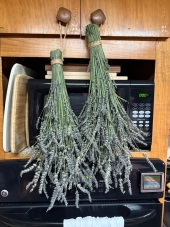
My opinion--it's fine to dry sliced fruit in direct sunlight, such as a dashboard--which I've done, in conjunction with using a dehydrator--but herbs should be dried out of direct sunlight. Here's how I do herbs: I have nails up and down the rafters in my kitchen--I also use these to hang onion braids on, and use the rafters to string a rope from which I hang ears of dent corn to dry enough for shelling and storing.  Most herbs I can clip a forked piece which can then just hang from the nail--if using finer ones, I suspend a clump of them from a string. After a few days, depending on the weather, the herbs are dry enough to take down and put in cake pans. If it has been unusually dry, low humidity, I may be able to strip the leaves off the stems now. Then the next time I use the oven, after turning it off and removing whatever I was baking, I put my cake pans in, at first with the door open and only a minute at a time. Usually they need a turn in the oven after being stripped off the stems to get to the crisp, crumbly stage from where I can put them in long term storage in glass jars.
1 week ago
I wonder what went wrong for Tanya. I found them easy to grow (except when the rabbits got at them) and easy to shell, easy to save seed. And I have clay soil, though well modified.
2 weeks ago
but Craig, aren't you worried about the pH skyrocketing in the adjacent beds?
2 weeks ago
What do you mean, "off"?
I've grown peanuts for years, I hang the whole plants until they're dry--I put them in my little attached greenhouse, but a covered porch works too, Just keep an eye out for mice. Then I pluck the pods off the plants, which can either be composted or fed to goats. I put every tenth peanut pod into a separate bowl to save for seed. That way the plants that are most productive are overrepresented in the seed stash, but most plants are in there to keep diversity up, all but the duds that had less than ten pods. If I have room I save these still in the pod. The rest I shell. I used to roast them with some oil and then salt them--but the salt always mostly fell off and collected in the bottom of the container. Then I found instructions to soak the peanuts in saltwater before roasting, and this works--I don't remember details but you can google it and find a video with instructions. It's really not a lot of trouble. I've never tried to make peanut butter, because we have an old weak blender and because dang, I can't devote that much space to growing peanuts.
3 weeks ago
I have rarely wanted to break a hen of broodiness--one time was when some idiot went broody in January. I had not read about the dunking method, but that you put them in a wire cage with no bedding so their bottom cools. The first years I kept chickens, we didn't have electricity so an incubator was not an option. Now I have it, but as off-grid solar so conceivably would worry about the drain during a long cloudy period. But in any case, as long as I have one broody hen, I'd MUCH rather let her handle it, because aside from the effort of maintaining an incubator--which is probably no more than keeping a hen fed and watered inside Chickland, the enclosure within our coop where we put a broody hen so the others can't keep laying eggs in her nest, and she's less likely to abandon the nest halfway through. But then! When the chicks hatch, she knows just what to do, and she keeps them all warm and fed and taught how to be a chicken. Once, we let a hen and her chicks out of the coop when they were 11 days old, and she led them straight to the sand pile, which I use in the garden. I guess she realized they needed grit for their gizzards, which I wouldn't have thought of.
Mostly I don't see why you'd want to break a hen of broodiness unless she's doing it off-season, or all your hens are going broody and you aren't getting eggs, or maybe you have no rooster so those eggs won't hatch. Right now I have two hens setting--which makes more of a dent in the egg supply than can be accounted for by the eggs under the hens and the hens out of the laying roster, it always seems--and someone coming to get a dozen fertilized ggs so she can replenish her flock after predators wiped out all but two hens.
4 weeks ago
Thank you Janie, now I can just leave my fennel where it is, in an improved garden bed where it has the best chance, without worrying about its effect on the flowers and peas and cumin I have near it.
1 month ago
Years ago I grew fennel from seed my brother gave me from plants growing ferally in Los Angeles. Not only did it survive in my West Virginia garden through a few years of (zone 6) winters, but I broke a couple of shovels trying to dig it out to move it. Too much damage to move, and I've never had such success with it since. I'm trying again and have a few seedlings in a garden bed now, figuring that's my best shot in getting it to germinate and survive, and I tried googling to see what the wisdom is on whether it's allellopathic or not. But I can tell you that the reason I dug that big healthy plat, that gave me a quart of seed every year, is because I noticed  other plants not doing well in the same bed. The one I specifically remember was peppers. Of course, you never know with a single trial whether what you observe is due to confounds, like different treatment of the soil, or being in the pathway of water moving underground, or maybe it was the shade. I've never seen it self-seeding, but that's probably because I'm growing it for the seed so I snip off seedheads as they ripen.
1 month ago
A couple of notes, not recipes. First, however you cook them, the thing that makes parsnips worth growing is the unique way they fill the "hungry gap" as they used to call it, here in Appalachia at least. The time when homesteaders/peasants were most likely to be hungry is not winter--there are wild animals to hunt, domestic livestock to slaughter, frozen and dried ...no, the hungry gap is in spring, when it's not a good time to hunt or slaughter, the frozen and canned and dried and root cellared stuff is used up, a garden is planted but isn't yielding anything yet--but the parsnips are at their best, and are hardy enough to come through till spring in most climate. The other biggies is eggs--chickens lay most heavily in spring, and resume laying in late winter.
On saving seed: be prepared for a six foot plant with a thousand seeds--but you almost have to do this every year, because parsnips are one of the plants whose seeds have the shortest longevity.
1 month ago
On smell, the three solutions are: tight lid as someone mentioned; a bucket of sawdust to put a handful on each deposit; and discourage people from using it for pee. We have a separate"pisseria" in the house, and that bucket gets emptied onto compost piles, some in the woods and composed of fallen branches, which can really use the nitrogen boost; The outhouse outside also has a bucket fitted to the toilet seat, and four spare buckets to switch in and cover a full bucket with a lid. When all five buckets are full I dump them in the poo bins farther from the house. On warmth, our outhouse hasn't ever gotten battens and occasionally wind-driven snow intrudes, but it's remarkable how little we mind the cold. Funny thing--an indoor toilet in a sixty degree house feels cold but the outdoor one when it's 15 degrees doesn't bother me. But I live in zone 6, it hardly ever goes below zero here and isn't often windy--your area is maybe quite another matter.
2 months ago