• Post Reply Bookmark Topic Watch Topic
  • New Topic
permaculture forums growies critters building homesteading energy monies kitchen purity ungarbage community wilderness fiber arts art permaculture artisans regional education skip experiences global resources cider press projects digital market permies.com pie forums private forums all forums
this forum made possible by our volunteer staff, including ...
master stewards:
  • Carla Burke
  • John F Dean
  • Nancy Reading
  • r ransom
  • Jay Angler
  • Timothy Norton
stewards:
  • paul wheaton
  • Pearl Sutton
  • Anne Miller
master gardeners:
  • Christopher Weeks
  • M Ljin
gardeners:
  • Jim Garlits
  • thomas rubino
  • William Bronson

Show me your rainwater irrigation setups!

 
Posts: 37
5
  • Likes 13
  • Mark post as helpful
  • send pies
    Number of slices to send:
    Optional 'thank-you' note:
  • Quote
  • Report post to moderator
Collect rainwater in some fashion? Use it to irrigate your forest garden or permaculture system, either gravity driven or maybe with solar pumps, maybe with drip lines? Seasonal drip lines? Buried drip lines (maybe in the mulch) that survive the winter without too much protection?

I'm way out from this stage, so I have plenty of time for inspiration and design, and I would love to see some setups!!
 
pollinator
Posts: 1017
Location: Porter, Indiana
180
trees
  • Likes 9
  • Mark post as helpful
  • send pies
    Number of slices to send:
    Optional 'thank-you' note:
  • Quote
  • Report post to moderator
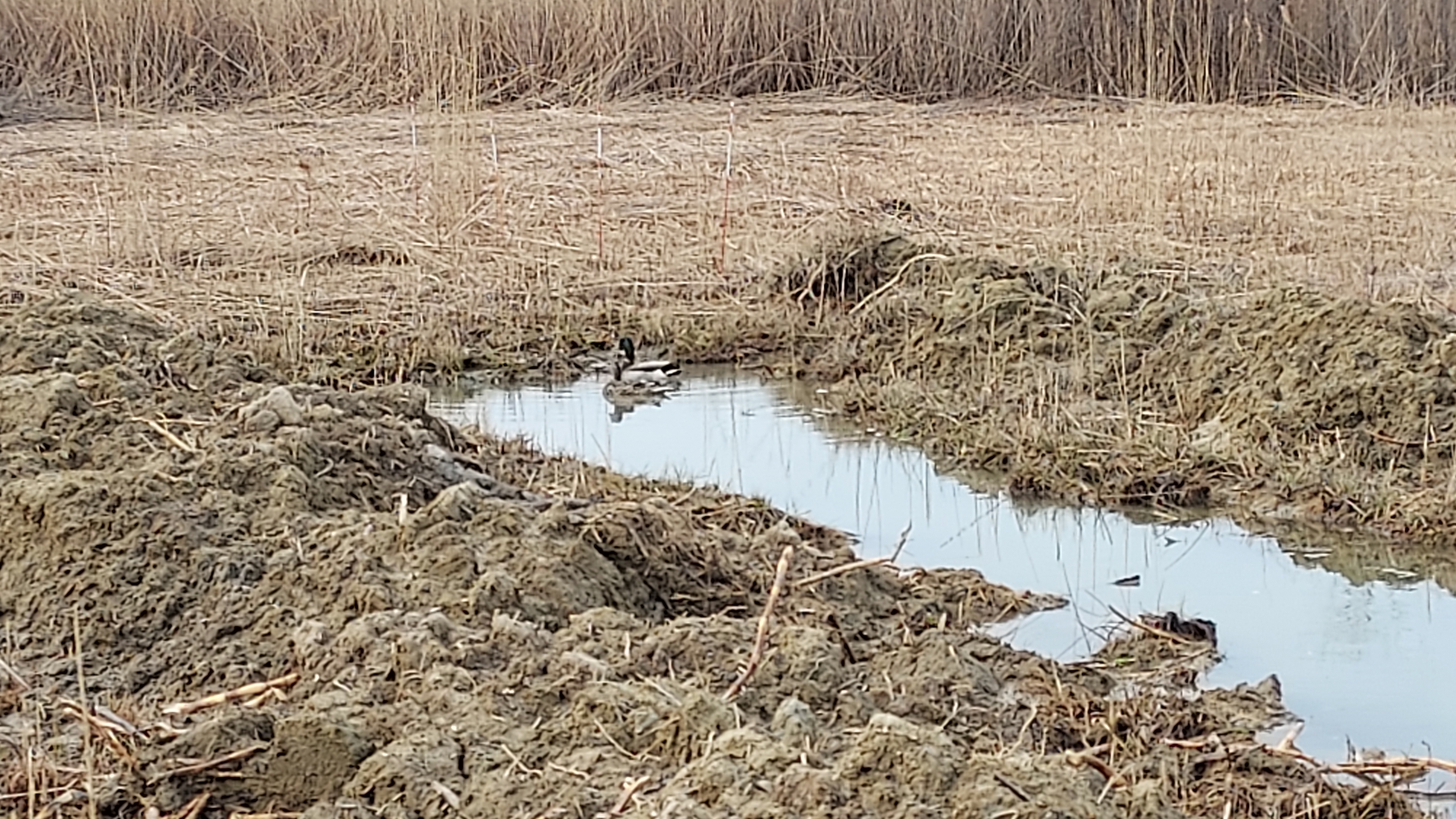
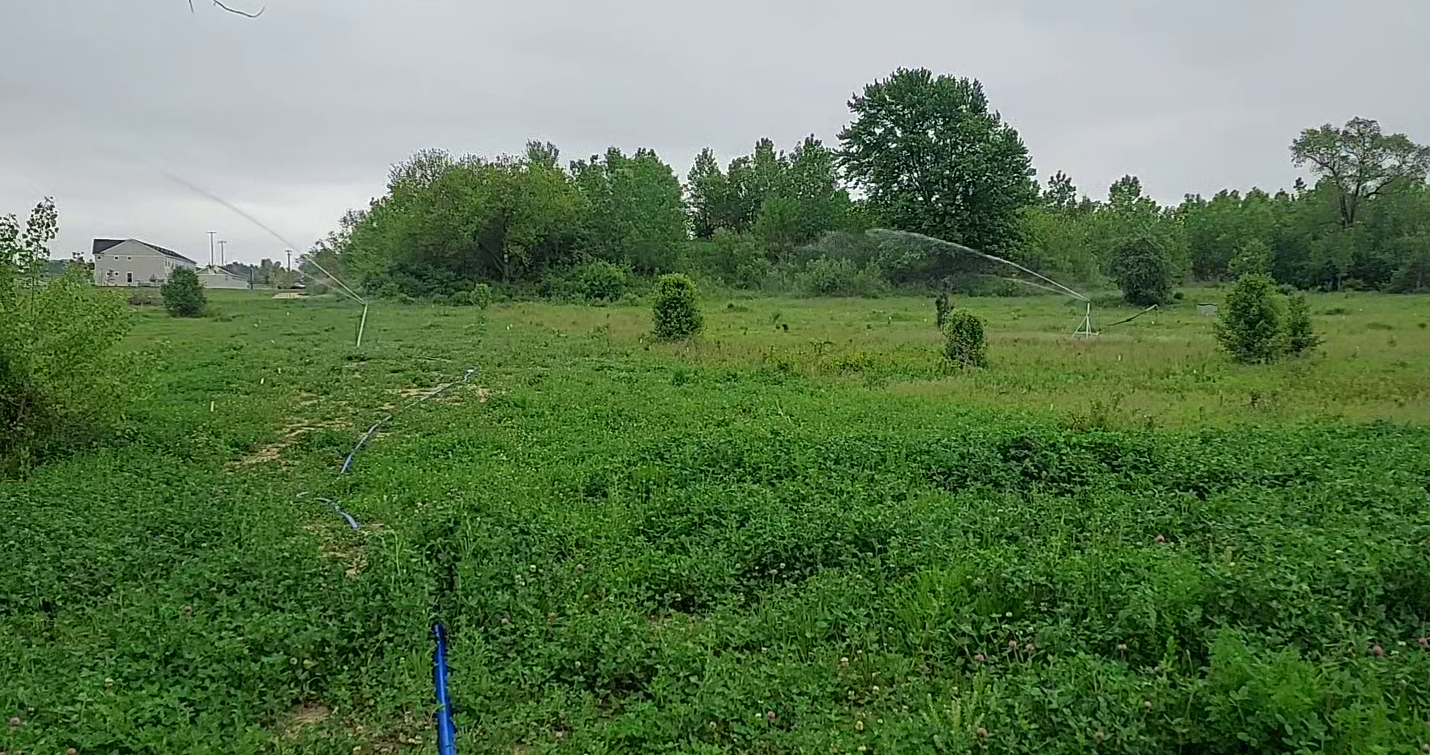
I’m in the process of building out my irrigation system. For collection, I’m digging out trenches in a low section of my property that are two feet wide and 2-3 feet deep. Then using a trash pump to send out water via agricultural sprinklers at a rate of 100-150 gallons a minute.

I had thought about doing a micro sprinkler set up, which would be far more efficient in terms of water usage. However, doing that would be significantly increase the complexity/cost of the system and would require filtering of the water. Since I can add 5,000 gallons of additional storage with a couple hours of backhoe time, it’s easier to just increase capacity than increase water efficiency.
20260321_084043.jpg
Water storing trench
Sprinkers-in-action.jpg
Sprinklers in action
 
Posts: 7
Location: North East Georgia Mountains, USA
2
hugelkultur forest garden fungi
  • Likes 3
  • Mark post as helpful
  • send pies
    Number of slices to send:
    Optional 'thank-you' note:
  • Quote
  • Report post to moderator
Here is the design I created for our raised bed garden.
Filename: Plan-Set-2-03-15-2026-Current.pdf
File size: 18 megabytes
Filename: layout.pdf
File size: 658 Kbytes
 
pollinator
Posts: 1629
Location: Zone 6b
241
goat forest garden foraging chicken writing wood heat
  • Likes 4
  • Mark post as helpful
  • send pies
    Number of slices to send:
    Optional 'thank-you' note:
  • Quote
  • Report post to moderator
My oldest daughter lives in northern Texas, a couple of hours west of Dallas. Summers are quite hot, and usually pretty dry. She's got an amazing garden already, only about four years after they bought the house (in town, on a city lot), including a young food forest and a few chickens. (She was raised on permaculture!) She's just now put in a home-made gutter - PVC pipe - on one side of their big shop/garage, and is installing two IBC totes, one at each end, to collect any rainwater that they get. She plans to attach drip tubing to the totes, running to her raised garden beds nearby. Their winters tend to be pretty mild, so I don't know if she's going to lift the tubing, or just leave it. She'll still have to hand-water some spots, like the small raised beds by the front door, and any new perennials and trees that go into the yard (she's got a bunch of fruit trees planted, with some already producing). Her plan is to have the entire lot turned into a combination of cottage garden and food forest - the property came with a mature pecan tree in the back yard (which provides useful shade for some of her plants that don't like hot Texas summers), and several young wild persimmons and mulberries. But it's been hard for her to leave home for more than a day or two in the summer without losing plants - hopefully the new irrigation system will help, as she's driving to TN for LibertyCon this week.
 
Posts: 776
Location: Iqaluit, Nunavut zone 0 / Mont Sainte-Marie, QC zone 4a
152
3
  • Likes 9
  • Mark post as helpful
  • send pies
    Number of slices to send:
    Optional 'thank-you' note:
  • Quote
  • Report post to moderator
I never needed to upgrade from a low tech design of barrels under the eves and additional barrels approximately 50 feet away, and 50 feet further away, and use the 120v 12v and hand pumps to pump the water from the eves relay style along towards growing areas getting established or otherwise requiring some watering.
None of the barrels use gravity flow, and some of the barrels are not open one end, so these ones have a roadside kitchen sink as a collector to funnel the water caught from the eves into the hole where the stopper twists out. I use watering cans to distribute. Very low tech and not beyond my abilities!

Edit: over a few hours we had over 2" of rain. That's why I put barrels under the eves and not buckets!
 
Posts: 52
Location: Colorado Springs, CO zone 5A / Canon City, CO zone 5B
6
2
  • Likes 6
  • Mark post as helpful
  • send pies
    Number of slices to send:
    Optional 'thank-you' note:
  • Quote
  • Report post to moderator
We collect water from our house's metal roof, an out building's metal roof, and our large solar array. All of the piping to the 12,000 gallon catchment pit is underground. The storage pit itself is filled with 55 gallon plastic drums with holes drilled in them so the water level can equalize. On top of the drums are plastic pallets to serve as a walking surface. Then there's a layer of heavy landscape fabric, a layer of heavy plastic grid to keep rocks from falling through, another layer of landscape fabric, and then fist size cobble topped with 3/4" river gravel.

There is a large snorkel in which the pump sits. The pump is hooked up to a manifold that allows the water to go to a water feature in our son's Memorial Garden, or to one of two hose bibs.

In the orchard is a 4' tall homemade platform on top of which sits a 275 gallon tote. We pump water from the pit to the tote. The tote feeds a seven (closed loop) zone irrigation system. Since the system is gravity fed, we use quarter inch feeder line to the trees with no emitter since there isn't enough pressure to push it through one.

Central Colorado, zone 5, 10"-12" precip per year.
 
Posts: 81
Location: Isle of Lewis, NW UK
14
  • Likes 6
  • Mark post as helpful
  • send pies
    Number of slices to send:
    Optional 'thank-you' note:
  • Quote
  • Report post to moderator
I'm thinking about setting up a catch system this winter, most of the roofs here don't have gutters yet. So rows of 20litre tubs under roof edges, decanted into a kids paddling pool is the current hi tech setup.

But although I can work out how much water to collect in theory if I was doing it for people, can anyone point me in the direction of how much water different plants require? Volume per lettuce, per pole bean, per kale etc?

I realise soil type plant type, etc etc will create big variables, and the answer will always be more than I have, but, any ideas?
Cheers
 
Posts: 393
Location: rural West Virginia
89
  • Likes 10
  • Mark post as helpful
  • send pies
    Number of slices to send:
    Optional 'thank-you' note:
  • Quote
  • Report post to moderator
Our system is pretty simple, and very effective. I live on a ridge in West Virginia, average rainfall 40" spread evenly through the year--but we do get droughts, and I do need to water new plantings till they're big enough to mulch. Since rain takes care of it most of the time, and winters here (zone 6B) are hard enough to freeze stuff, I don't have a setup involving hoses or sprinklers.  We have a system of plastic pipes that collect the rainwater off the gutters from six of the eight faces of our octagonal roof; the pipe runs down the side of the house and barely underground to a set of three 280 gallon plastic tanks. Another, buried pipe leads to a spigot in my main garden, and another in the patch where I put corn and such. So I still have use a watering jug but it's so much easier than carrying water from the house to the gardens. This is all gravity feed, no need for a pump. And it never runs out--a little rain over a house roof equates to many, many gallons of water. My husband built a sort of shed around the tanks, though, to keep sun from deteriorating the plastic tanks, and fomenting algae. Some years I do a lot of watering--and less weeding. Of course, a system this simple requires terrain that cooperates, the house being above the garden. We drain this system in the winter.
 
pollinator
Posts: 193
Location: Near Asheville North Carolina
71
3
  • Likes 6
  • Mark post as helpful
  • send pies
    Number of slices to send:
    Optional 'thank-you' note:
  • Quote
  • Report post to moderator
My system is simple: 2 large rain barrels that catch roof water. I attach a hose & water garden patches around the house. But my favorite feature is these are wonderful hand & veggie wash stations. I keep a bucket under each spigot.
 
Posts: 353
24
9
  • Likes 2
  • Mark post as helpful
  • send pies
    Number of slices to send:
    Optional 'thank-you' note:
  • Quote
  • Report post to moderator


00:00
Firstly, the Western roof empties into a drain which
I have filled with gravel so the rainwater overflows
unto the strip where Bananas are planted.

00:30
Secondly - for some unknown reason - I had to intercept
the gutter at the Eastern roof because it was saturating
the rear wall and dripping down the doorway and wetting
the kitchen floor. I use umbrells fabric and wire mesh
to break the force of the water and spread it out.
A rain chain will not do.

I use 5-gallon buckets to harvest this flow.

00:42
Then I have 4 elevated containers which distribute
its contents to far flung spots of the garden through
discarded garden hoses. Filling these is a manual affair.

01:22
One hose even reaches the front gate to water the
Banana plant there.

01:44
Back to the Eastern roof gutter. It is starting to
leak and overflow at the middle. I have added stuff
to arrest the water so that no splash builds up
enough head to get past the roof tiles interlocks.
This has to do until enough of the roof gives way
to require a full replacement.

02:22
There is a rust spot above the balcony. Again something
to arrest the water into a 5-gallon bucket which
overflows into a basin containing corrugated cardboard.
The rest is organic matter that was clogging the outlet
which I scraped and swept up. I use wire mesh and the
rim bits of broken clay pots(the rest go into the Terra
Preta mix). This prevents the balcony from flooding
but periodic cleaning is required.

And that is how I harvest and distribute the rainwater.

And about half of the drain from the exit is dammed up
with rocks and vegetation to the point that only
exceptional rainfall reaches the outer drain.
 
Bob Billings
Posts: 7
Location: North East Georgia Mountains, USA
2
hugelkultur forest garden fungi
  • Likes 4
  • Mark post as helpful
  • send pies
    Number of slices to send:
    Optional 'thank-you' note:
  • Quote
  • Report post to moderator
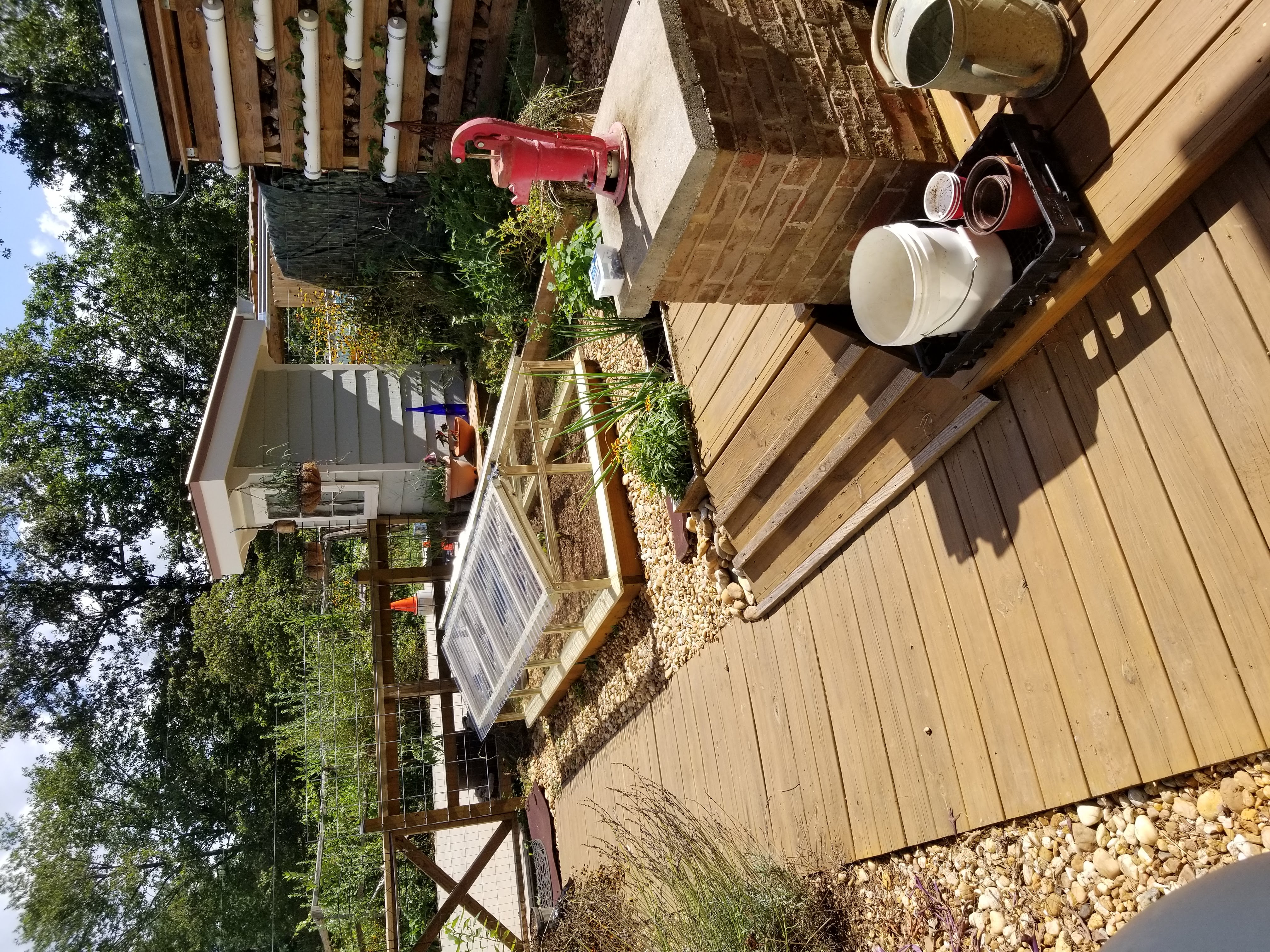
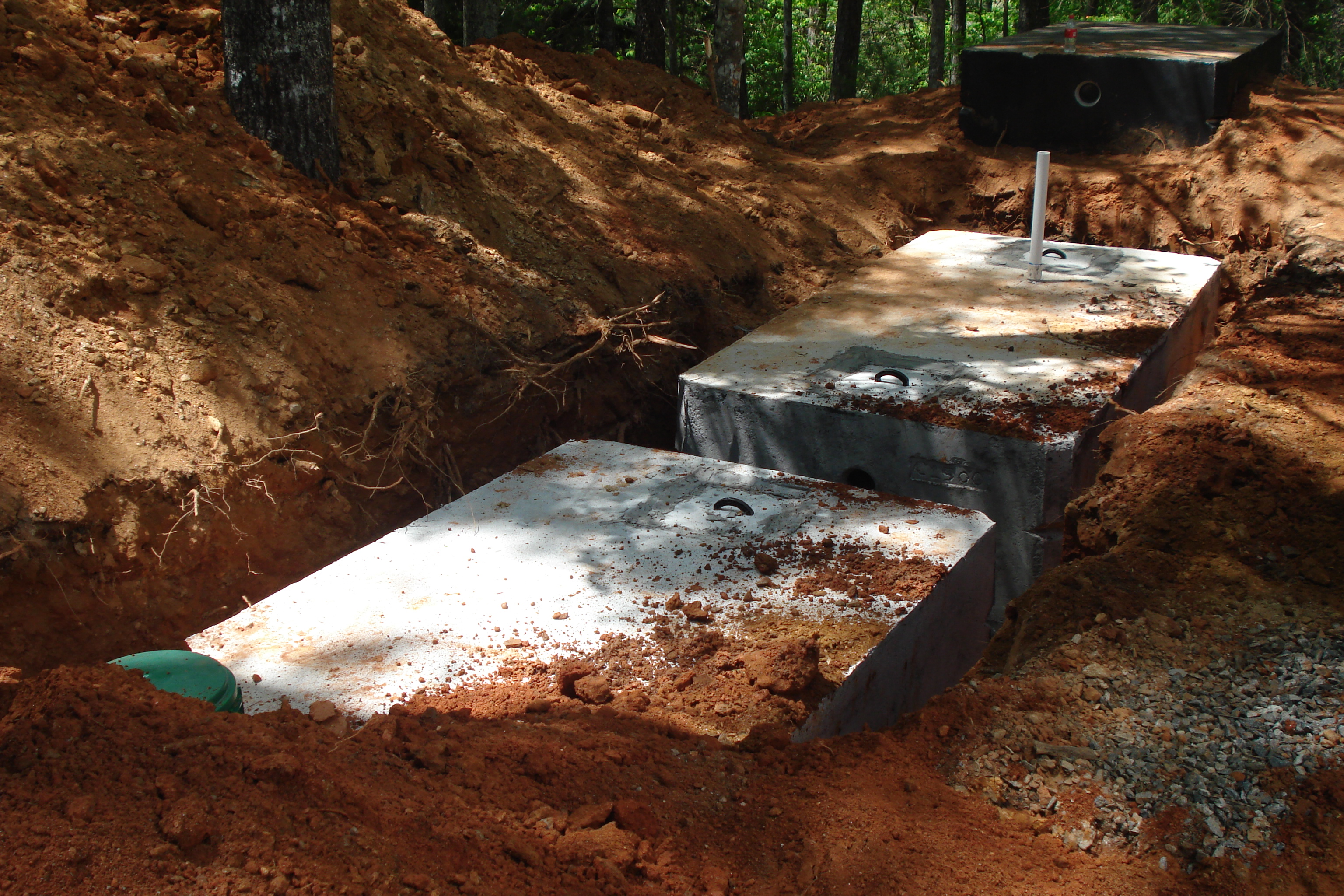
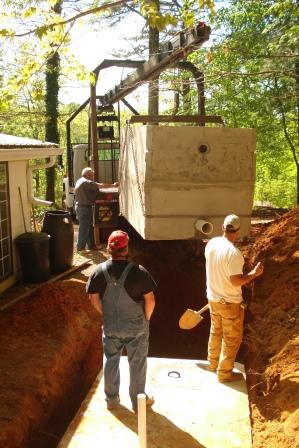
Our cabin has a metal roof, and we collect from the entire surface into a 3000-gal. below-grade concrete cistern and also divert into two 1200 gal. Above-ground tanks. The 3000-gal below-grade tank supplies potable water to the house via a cistern pump and proper filtration.  We also have a pitcher pump in the kitchen garden for watering.  The above-grade 1200-gal tanks feed the raised beds and hügelkultur beds during periods of drought.
20210827_155942.jpg
Kitchen garden with red pitcher pump just above the 3000 gal below grade concrete tank.
DSC06864.JPG
Installing tanks beneath the kitchen garden. Consist of two new 1500 gal septic tanks tied together.
DSC06861.JPG
Setting the tanks.
Setting the tanks.
 
pollinator
Posts: 439
133
2
dog trees books bee medical herbs
  • Mark post as helpful
  • send pies
    Number of slices to send:
    Optional 'thank-you' note:
  • Quote
  • Report post to moderator

John Wolfram wrote:I’m in the process of building out my irrigation system. For collection, I’m digging out trenches in a low section of my property that are two feet wide and 2-3 feet deep. Then using a trash pump to send out water via agricultural sprinklers at a rate of 100-150 gallons a minute.


Hi John - I'm wondering if the trench is lined with anything? I like this simple set-up and it would be inexpensive to do, but I am wondering how the water is staying put? Do you have heavy clay soil? Also, what about mosquitoes? Do you use those dunks? Dealing with a drought at the moment in an area that normally gets decent rainfall, like so many others, really has me thinking about setting up alternative systems. I have the IBC totes, but when needing to water a young growing food area with its roots not independently reaching into the earth for water yet, well, those totes run dry pretty quickly. I'd have the room for digging a couple of trenches on the property and even have a slight slope for leading the water to them, but just trying to figure out what's keeping the water in there with yours. Thanks for any information on that.
 
John Wolfram
pollinator
Posts: 1017
Location: Porter, Indiana
180
trees
  • Likes 3
  • Mark post as helpful
  • send pies
    Number of slices to send:
    Optional 'thank-you' note:
  • Quote
  • Report post to moderator

Annie Collins wrote:Hi John - I'm wondering if the trench is lined with anything? I like this simple set-up and it would be inexpensive to do, but I am wondering how the water is staying put? Do you have heavy clay soil? Also, what about mosquitoes? Do you use those dunks? Dealing with a drought at the moment in an area that normally gets decent rainfall, like so many others, really has me thinking about setting up alternative systems.


The soil in that area is a heavy clay soil with a CEC of about 30. This is my first summer using the setup, but I have not had an issue with it drying out.  Admittedly, June in my area has been crazy wet with 12 inches / 30 cm of rain, so the real test has not yet begun. So far, mosquitos have not been an issue. My hope is that the depth and volume of the trenches will be sufficient to support a population of wildlife that eat mosquitoes. So  far, lots of frogs have shown up along with a few muskrats and the ducks seen in the picture. If it becomes an issue mosquito dunks / BTi is something I would definately consider for mosquito control.
 
pollinator
Posts: 88
Location: Half acre on a hill in Central Alabama, Zone 8a and 8b
82
hugelkultur art forest garden fungi foraging food preservation cooking writing composting
  • Likes 8
  • Mark post as helpful
  • send pies
    Number of slices to send:
    Optional 'thank-you' note:
  • Quote
  • Report post to moderator
We live in an area that historically has steady rain throughout the year, but lately the climate has tipped 'historical' into the ashcan. Last year April and May brought us nearly 24" of rain. This year around 4", though we've had better luck this month. We have city water, but I simply refuse to use it on the garden, especially with thousands of gallons of runoff from the backyard every time it does rain.

Our answer is to catch as much as we can however we can, starting with two rain barrels harvesting water from the roof. I've seen criticisms elsewhere that all this does is gather a uselessly small amount of water, and threatens foundations in the process. Unfazed, I dug shallow gullies from the barrels to the gardens to allow immediate runoff to the front gardens, while setting up wide spillover containers to hold more of the water right next to the barrels. I use these to fill 1.5liter wine bottles for direct irrigation to individual plants.

In the backyard, we hold on to moisture by trapping it in heavily mulched hugelkultur terraces laid on top of the slope, and trenches dug into the clay soil. This is just a beginning, but we can already see results. A three-week drought in March and April didn't bother our early season plantings. Hopefully we'll eventually have a system in place to carry us through the hotter four- and five-week dry spells of autumn.
RainBarrel.png
[Thumbnail for RainBarrel.png]
Terraces-Trenches.png
[Thumbnail for Terraces-Trenches.png]
 
Annie Collins
pollinator
Posts: 439
133
2
dog trees books bee medical herbs
  • Likes 2
  • Mark post as helpful
  • send pies
    Number of slices to send:
    Optional 'thank-you' note:
  • Quote
  • Report post to moderator

John Wolfram wrote:
The soil in that area is a heavy clay soil with a CEC of about 30. This is my first summer using the setup, but I have not had an issue with it drying out.  Admittedly, June in my area has been crazy wet with 12 inches / 30 cm of rain, so the real test has not yet begun. So far, mosquitos have not been an issue. My hope is that the depth and volume of the trenches will be sufficient to support a population of wildlife that eat mosquitoes. So  far, lots of frogs have shown up along with a few muskrats and the ducks seen in the picture. If it becomes an issue mosquito dunks / BTi is something I would definately consider for mosquito control.


Thank you, John, very helpful. Being that this is your first year with it, and add to that that you've had a lot of rain, I think I will check back with you in another year or so (if I remember). Meanwhile, I will probably just set up more IBC totes. I'd much prefer capturing water that doesn't involve any plastic, though, which is why I am very interested in your set-up. Our CEC is around 25 which is quite a bit lower than yours. The whole thing may not work in our situation anyway, at least not with just using soil as the "holding vessel".
 
Annie Collins
pollinator
Posts: 439
133
2
dog trees books bee medical herbs
  • Likes 2
  • Mark post as helpful
  • send pies
    Number of slices to send:
    Optional 'thank-you' note:
  • Quote
  • Report post to moderator

Yeardly Arthur wrote:
Our answer is to catch as much as we can however we can, starting with two rain barrels harvesting water from the roof. I've seen criticisms elsewhere that all this does is gather a uselessly small amount of water, and threatens foundations in the process. Unfazed, I dug shallow gullies from the barrels to the gardens to allow immediate runoff to the front gardens, while setting up wide spillover containers to hold more of the water right next to the barrels. I use these to fill 1.5liter wine bottles for direct irrigation to individual plants..


Wow, quite the set-up! It sounds to me like you would greatly benefit from getting at least one IBC tote. You'd be going from a 55 gallon barrel to a 330 gallons container (at least the ones I have, which I think are pretty standard). I just put ours up higher so gravity helps us get the water where we want.
 
pollinator
Posts: 6153
Location: Bendigo , Australia
581
plumbing earthworks bee building homestead greening the desert
  • Likes 2
  • Mark post as helpful
  • send pies
    Number of slices to send:
    Optional 'thank-you' note:
  • Quote
  • Report post to moderator
I teach people around the world to catch and use rainwater.
My signature has a link.
Major points I want to address are;
- have a single large tank if possible 5000 gallons
- use 2 inch pipes to distribute the water to save frictional losses of water flow which improves pressures.
- fit first flush units to catch most roof debris.
Use of the big tank allows self cleaning to take place.

 
What kind of corn soldier are you? And don't say "kernel" - that's only for this tiny ad:
Grow a Salad in Your City Apartment E-book by Rosemary Hansen
https://permies.com/t/98392/ebooks/Grow-Salad-City-Apartment-book
reply
    Bookmark Topic Watch Topic
  • New Topic