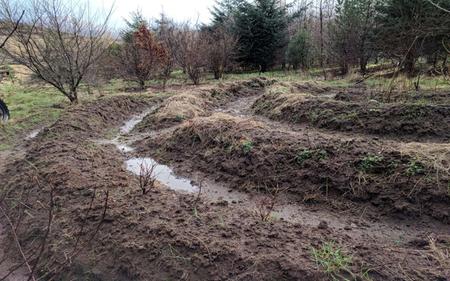
I'm a homesteader in Southeast Alaska. My family and I have been on our land for about 7 years and I'm starting to experiment with integrating gardening, grazing (goats) and agroforestry. I've got a slight slope to part of my land and want to make some huglekulture berms on contour that I plant trees and berries into a la Mark Shepard/Paul Wheaton/Sepp Holzer fusion, but I have a very practical question. Do trees go uphill of the berm, on the berm, or downhill of the berm. What parts of the berm grow what things the best? We're between zone 3 and zone 4. We get about 50" of rain per year, our summers can be highly variable but I find that I usually have to water seedlings for the first year during dry spells before they can fend for themselves. I like to plant alot of trees from seeds though and my thought is that getting them in the right spot in the system I can stop doing this chore and still have some survivability. The berms consist of cottonwood logs, brush and dirt. I'm experimenting with alot of different species: apples, hazelnuts, chestnuts, pine nuts, locusts, siberian pea shrub, pie cherries, plums, maples (cause they're purdy), raspberries, salmon berries, blue berries, thimble berries. Probably more stuff honestly, I plant a lot of things... Thanks ahead of time!
I have seen recommendation not to plant trees on the top of a berm though I feel with uphill or downhill might be okay. Hey, I am not sure which is uphill and which is downhill.
The inside of a berm if in a swale might be too wet? I don't know so maybe this will help:
Invasive plants are Earth's way of insisting we notice her medicines. Stephen Herrod Buhner
Everyone learns what works by learning what doesn't work. Stephen Herrod Buhner
Hi - Sounds like you've got some earth moving in your future!
I'm inclined to think like Anne, that it probably won't matter too much as long as you don't plant trees on the berm itself. The consensus does seem to be that is a bad idea. If you think that trees grow from seeds in the ground quite happily in nature, then really they shouldn't need too much attention, if as you say, you can get the conditions right. If you think they are likely to get short of water, then I suspect the uphill side of the berm is probably most likely to be successful. Also if you do get a dry summer, irrigation like a swale may be possible to save some labour.
My limiting factor in growing trees is grass (or other vegetation) swamping them, or nibblers eating them, rather than water availability. Seed grown trees should be far more resilient, once they get through the first few years, as they will have a stronger soil/mycelium relationship than a transplanted tree of the same age.
I only have 'mini hugel' - just raised beds with a twiggy core. I'm hoping this will make better growing conditions for my fruit bushes as my soil generally is compacted and acidic, with almost constant moisture. It seems to be working well for my bluberries! Where the beds are orientated to catch the water flow I do get a damp spot at the base, which I'm hoping will be good for damp loving plants like skirret and bistort.
rain capture in the shell garden
On top the beds should be well drained, so most perennial veg like asparagus and globe artichokes should do well. I'm expecting the downhill side to be damper again, but less damp than the uphill side. It is complicated for me due to wind having almost as much impact as the sun (or lack of) so the depressions appear to be much warmer than the hills, although I need to do more study on this during the autumn (if I get some more sun!).
Always plant trees and shrubs on the shelf (sides) of the berm, so that they can grip on to the native surrounding soil. As the berm decomposes, it will sink and damage the root system and possibly kill the plant. I have gotten away with planting a haskap on the top/middle of a berm for a few years now and the berm it was on dropped a substantial distance. I think the only thing that saved me was that the berm's trench wasn't that wide (about 3') and it was planted near the mouth of the trench for the hugel. The depth to the bottom is probably around 2' rather than 3'.
"Irrigation is not something that you just dump something on. It's not a big truck. It's a series of tubes."
That's super helpful. Thanks everyone! I think I'll focus my trees on the uphill side, maybe try some berries and veg on the middle and downhill sides.
Eliminate 95% of the weeds in your lawn by mowing 3 inches or higher. Then plant tiny ads:




 2
2