• Post Reply Bookmark Topic Watch Topic
  • New Topic
permaculture forums growies critters building homesteading energy monies kitchen purity ungarbage community wilderness fiber arts art permaculture artisans regional education skip experiences global resources cider press projects digital market permies.com pie forums private forums all forums
this forum made possible by our volunteer staff, including ...
master stewards:
  • Carla Burke
  • John F Dean
  • r ransom
  • Nancy Reading
  • Timothy Norton
  • Jay Angler
stewards:
  • paul wheaton
  • Pearl Sutton
  • Eric Hanson
master gardeners:
  • Christopher Weeks
  • M Ljin
gardeners:
  • thomas rubino
  • Megan Palmer
  • Benjamin Dinkel

potato disease, black scurf,

 
Posts: 19
Location: zone 5b / village of Priceville in Southern Ontario, Canada
wofati greening the desert ungarbage
  • Likes 1
  • Mark post as helpful
  • send pies
    Number of slices to send:
    Optional 'thank-you' note:
  • Quote
  • Report post to moderator
Any ideas on; treating or preventing black scurf in potatoes ?  And further; what is a good crop rotation, for potatoes ?
 
steward and tree herder
Posts: 11863
Location: Isle of Skye, Scotland. Nearly 70 inches rain a year
5975
5
transportation dog forest garden foraging trees books food preservation woodworking wood heat rocket stoves ungarbage
  • Likes 1
  • Mark post as helpful
  • send pies
    Number of slices to send:
    Optional 'thank-you' note:
  • Quote
  • Report post to moderator
Hi Ken,
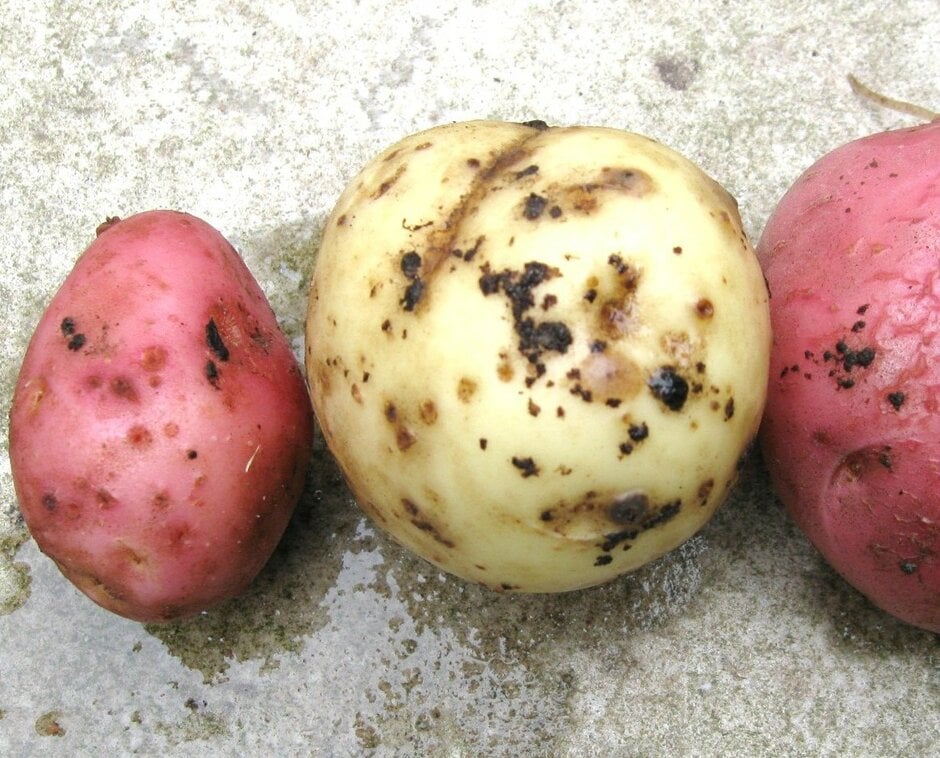
I haven't experienced black scurf myself, but according to the RHS it is a fungal disease that results in black growths on potato tuber surfaces that can be rubbed off. The marking is cosmetic and doesn't affect the tuber storage, but the fungus can also cause dieback of shoots and reduced yield.

black scurf on potato tubers

image: John Scrace

Apparently the fungus is present in the soil as well as on affected tubers, but avoiding replanting badly marked tubers can help reduce the incidence. As well as chosing clean tubers they suggest crop rotation (plant something else there for a few years), also avoid early planting, plant tubers that have been chitted and plant more shallowly (to speed up shoot emergence from soil and reduce stem canker) and lift tubers as soon as feasible to reduce the amount of fungal spores on them.

There's quite a bit in wikipedia on the causal agent Rhizoctonia solani, which seeems to be responsable for quite a few plant diseases. Apparently it prefers warm wet conditions, so improving drainage may also help. I'm also wondering if a covercrop of mustard might help reduce the presence of the fungal organism in the soil? I've heard that can be a biofumigant against some soil borne diseases.

 
Any sufficiently advanced technology will be used as a cat toy. And this tiny ad contains a very small cat:
Learn Permaculture through a little hard work
https://wheaton-labs.com/bootcamp
reply
    Bookmark Topic Watch Topic
  • New Topic