• Post Reply Bookmark Topic Watch Topic
  • New Topic
permaculture forums growies critters building homesteading energy monies kitchen purity ungarbage community wilderness fiber arts art permaculture artisans regional education skip experiences global resources cider press projects digital market permies.com pie forums private forums all forums
this forum made possible by our volunteer staff, including ...
master stewards:
  • Carla Burke
  • John F Dean
  • r ransom
  • Nancy Reading
  • Timothy Norton
  • Jay Angler
stewards:
  • paul wheaton
  • Pearl Sutton
  • Eric Hanson
master gardeners:
  • Christopher Weeks
  • M Ljin
gardeners:
  • thomas rubino
  • Megan Palmer
  • Benjamin Dinkel

How do you preserve your grain?

 
pollinator
Posts: 838
Location: Illinois
188
  • Likes 10
  • Mark post as helpful
  • send pies
    Number of slices to send:
    Optional 'thank-you' note:
  • Quote
  • Report post to moderator
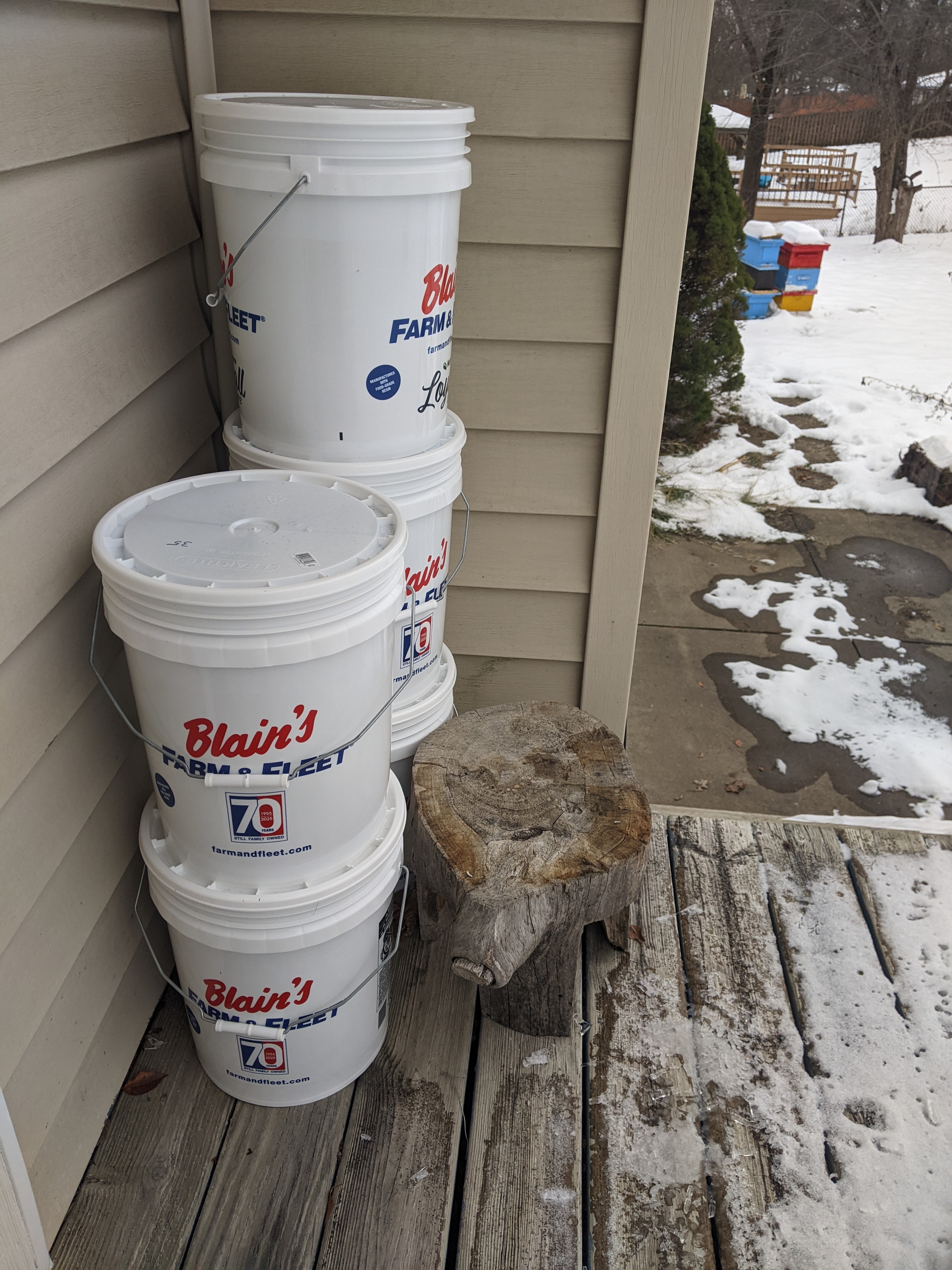
We get weevils and other small insects in the corn. Last year I moved my totes, about 200 Lbs. of corn outdoors in the winter and that seemed to work very well at killing the bugs. But the totes do not have perfectly tight lids and one tote got pretty buggy by summer.

This year I bought 5 gallon buckets with tight lids and now they are on the back deck enjoying freezing temps.

It got down to -2F (-20C) one day last week and below freezing most of the rest. A research paper I read showed that a few weevils can survive down to -25F for a several weeks! I plan to leave the corn outside until at least February.

How do you all preserve your grains?

The pic shows about 170 Lbs. of corn:
PXL_20251211_205536043.jpg
Corn storage
Corn storage
 
Posts: 44
Location: Missouri
11
  • Likes 7
  • Mark post as helpful
  • send pies
    Number of slices to send:
    Optional 'thank-you' note:
  • Quote
  • Report post to moderator
For long term use or if i really care about it, it goes in 5 gallon mylar with homemade o2 absorber where the mice can't get it. Buy cheap and stack it deep

For mostly long term use, i got air tight food grade barrels 55gal and i put Calcium Chloride pellets at the top to act as a dessicant.  Periodically you'll have to redehydrate but if you don't open it, it can last years

But mostly i rotate through what i got before its bad and if and when it gets bugs it becomes chicken food.

But i don't grow all my food, so if I'm going to buy from the store anyway, buy and use before its bad and do the mylar for food security.

Other option for very large scale is a grain bin

Flint corn keeps better too
 
Thom Bri
pollinator
Posts: 838
Location: Illinois
188
  • Likes 5
  • Mark post as helpful
  • send pies
    Number of slices to send:
    Optional 'thank-you' note:
  • Quote
  • Report post to moderator

Martin Mikulcik wrote:

Flint corn keeps better too


Most of my corn is now flint after a few years of selection. No question in my mind that the flint corn resists bugs better.
 
pollinator
Posts: 824
Location: Clemson, SC ("new" Zone 8a)
189
11
  • Likes 4
  • Mark post as helpful
  • send pies
    Number of slices to send:
    Optional 'thank-you' note:
  • Quote
  • Report post to moderator
I imagine for most bulk grain storage on a homestead scale, people will resort to 5 gallon plastic buckets with tight-fitting lids.  Pay attention to the lids, though; they are not all made equal.  While technically rats could chew through, I am sure buckets are perfectly adequate for most short- to intermediate-term storage, especially with some desiccant packs thrown in and occasionally replaced.

On my homestead, I am not currently growing grains, nor buying in bulk, either for myself or for feed.  In the future I hope to do both.  But in the meantime, just buying whole grains 2-3lbs at a time for kitchen use, I store them the same way I store all kitchen dry goods: vacuum sealed in mason jars.  Very convenient and effective!  But again, not a solution that scales well.
 
Posts: 14
3
4
  • Likes 5
  • Mark post as helpful
  • send pies
    Number of slices to send:
    Optional 'thank-you' note:
  • Quote
  • Report post to moderator
I use 5 gallon buckets with Gamma Seal screw lids. Throw in some slilca packets. I have blue flint corn that’s been stored perfectly for years.
 
pollinator
Posts: 1550
Location: zone 4b, sandy, Continental D
426
  • Mark post as helpful
  • send pies
    Number of slices to send:
    Optional 'thank-you' note:
  • Quote
  • Report post to moderator
Before I can preserve it, I'd have to grow it, and unfortunately, I do not have a machine that could harvest any amount of grain. I'm thinking of fabricating one with an electric hedge cutter (battery powered Ryobi) to which I would add wheels. I'm still thinking about that one, but I figured I could cut a couple of day's worth easily.
I don't have a thresher either, but since it is for chickens, they could get the whole plant, clipped at the base, especially for buckwheat, as this is a bugger to separate from the chaff.
I'd like to grow rye too, for ryegrass to bale and sink in the pond. (Great mosquito killer!)
Right now, I just buy grain as I go and store it in homer pails in the shed, near the coop. The homer pails with a good fitting lid are perfect: Mice can't get at them and they are not so heavy that I have a tough time taking them to the coop. In the winter, I have a rugged sled, like hunters use to bring home a big deer.
My discovery is that even when you don't have much snow at all, the sled will glide on grass... for a while.
Next, I switch to the little metal, hand pulled, trailer.

 
master gardener
Posts: 1482
Location: Zone 5
777
ancestral skills forest garden foraging composting toilet fiber arts bike medical herbs seed writing ungarbage
  • Likes 1
  • Mark post as helpful
  • send pies
    Number of slices to send:
    Optional 'thank-you' note:
  • Quote
  • Report post to moderator
You may want to look at this: https://en.wikipedia.org/wiki/Crispbread

These breads were baked from at least the sixth century in central Sweden.[6] They were usually hung above the stove to be dried. Traditional crispbread in Sweden and western Finland is made in this tradition with the form of a round flat loaf with a hole in the middle to facilitate storage on long poles hanging near the ceiling. It may also have been a way to keep the rats away from them.[7] Traditionally, crispbreads were baked just twice a year: following harvest and again in the spring when frozen river waters began to flow.[8]

 
Matthew Nistico
pollinator
Posts: 824
Location: Clemson, SC ("new" Zone 8a)
189
11
  • Mark post as helpful
  • send pies
    Number of slices to send:
    Optional 'thank-you' note:
  • Quote
  • Report post to moderator

M Ljin wrote:You may want to look at this: https://en.wikipedia.org/wiki/Crispbread

These breads were baked from at least the sixth century in central Sweden.[6] They were usually hung above the stove to be dried. Traditional crispbread in Sweden and western Finland is made in this tradition with the form of a round flat loaf with a hole in the middle to facilitate storage on long poles hanging near the ceiling. It may also have been a way to keep the rats away from them.[7] Traditionally, crispbreads were baked just twice a year: following harvest and again in the spring when frozen river waters began to flow.[8]


I buy Swedish-style crispbreads at the store.  They really are amazing: they stay fresh without going stale for months!
 
I agree. Here's the link: http://stoves2.com
reply
    Bookmark Topic Watch Topic
  • New Topic