• Post Reply Bookmark Topic Watch Topic
  • New Topic
permaculture forums growies critters building homesteading energy monies kitchen purity ungarbage community wilderness fiber arts art permaculture artisans regional education skip experiences global resources cider press projects digital market permies.com pie forums private forums all forums
this forum made possible by our volunteer staff, including ...
master stewards:
  • Carla Burke
  • John F Dean
  • r ransom
  • Nancy Reading
  • Timothy Norton
  • Jay Angler
stewards:
  • paul wheaton
  • Pearl Sutton
  • Eric Hanson
master gardeners:
  • Christopher Weeks
  • M Ljin
gardeners:
  • thomas rubino
  • Megan Palmer
  • Benjamin Dinkel

Advice for making my first rocket stove for heating 2+ rooms

 
Posts: 2
  • Likes 4
  • Mark post as helpful
  • send pies
    Number of slices to send:
    Optional 'thank-you' note:
  • Quote
  • Report post to moderator
Hello!
A little history, as this is at least for me complicated. We have a house, in which one person lives most of the year. It might become three persons at some point in the future. The house is 60 years old, made from bricks, mud bricks, hay, wood beams, not very well insulated in some places. No concrete at all, stone only somewhere inside the base. We use ordinary wood stoves for heating, two normal and one cooking stove. Recently I heard about stoves that do not smoke. After a lot of reading, I am here. I am reading batchrocket.eu and a few more places, so at the moment all of this is very new and a little too much information. I want to be able to heat the house more efficiently, at least for next winter. Sadly money is a bit of a problem. I want heating and cooking to not depend on electricity. And I would have liked to have hot water from the heating, but I think it is not possible in my case.

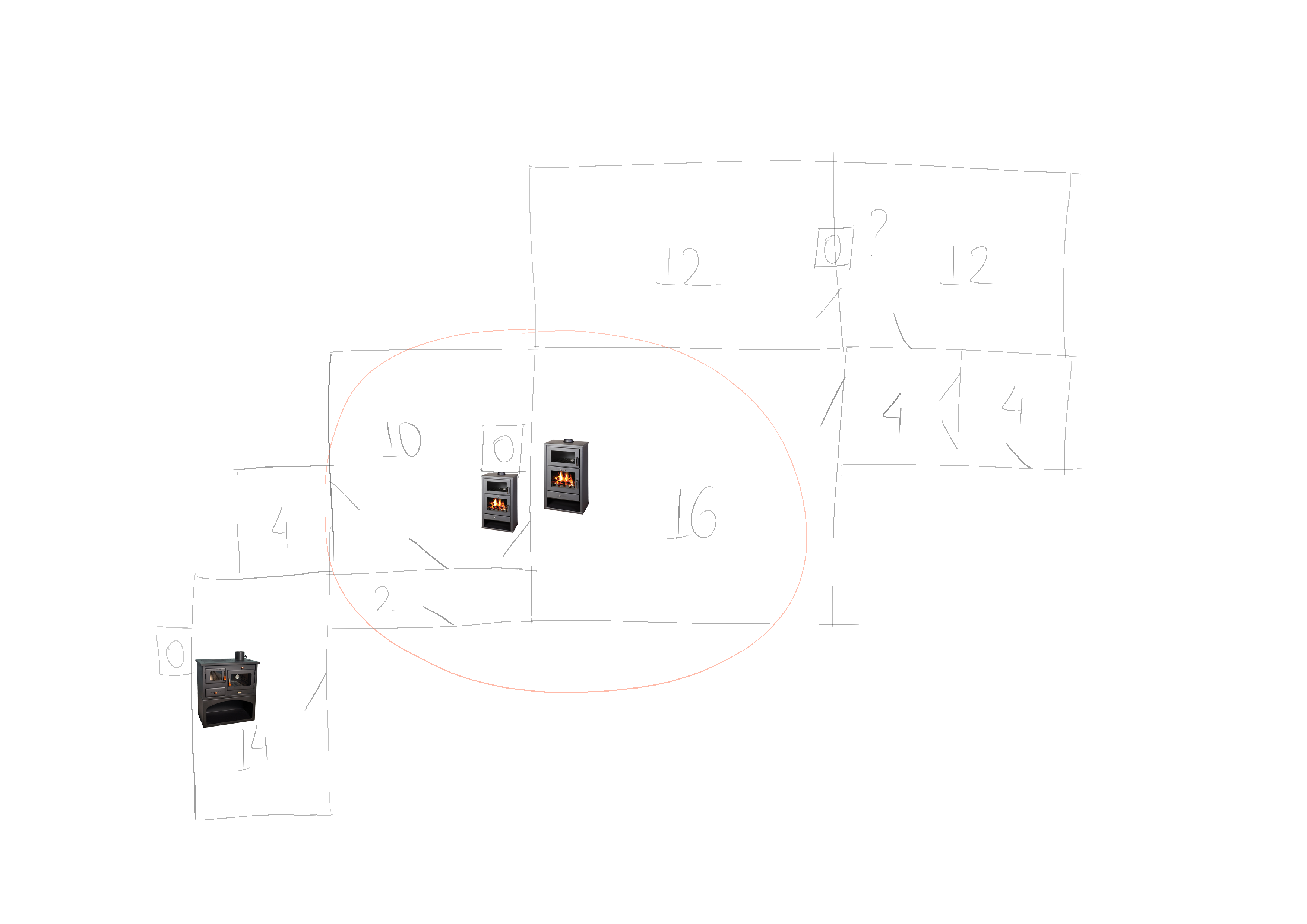
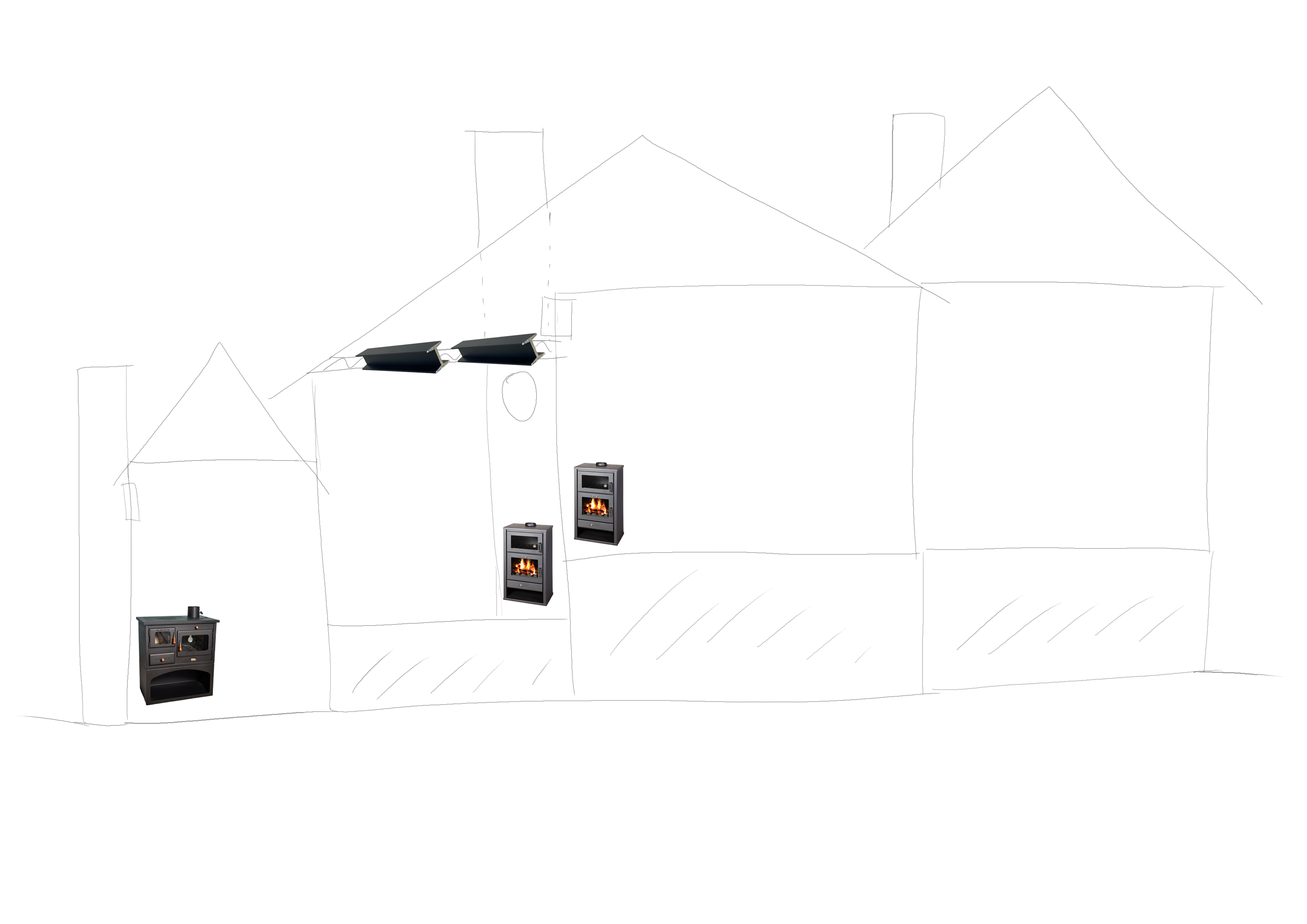
In the two drawings below (sorry for the not straight lines, I have not drawn in a while) you can see the main house, kind of strange shape. The first image is from top, second is from the side. Not all of the rooms are used at the moment. Only the circled in red two rooms and the two smaller to the left of them. The number in each room is the area in square meters. Those small rectangles with circles inside are chimneys. You can see what kind of stoves we use now for heating. I would like to replace at least the two central stoves with one rocket stove to heat both rooms and if possible more. Since I am familiar with these metal stoves, I am thinking to make a metal rocket stove that looks like them and then put bricks around it to store the heat. Probably will place it in the room 16m2, because it is in the center of the house. For heating the other room, I was reading about getting the hot air from around the stove or from the exaust with metal pipe, which goes through the wall, then inside more bricks, before it goes to the chimney. I do not want to make benches, more like something shorter and taller. Maybe building the stove and channels entirely from bricks would be better, but I think my grandmother will not like it. And it is not portable, in case we change plans. I also plan to make one with furnace for baking, maybe to replace that bottom cooking stove, but it seems a lot more complicated for now.
On the second image you can see that the rooms have different elevation. The chimney for the two main rooms is basically put on steel beam inside the roof of the left room. We recently built extension below it, inside the room, from brick chimney bodies, but they do not support it.
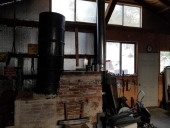
The stove on the third image is similar to what I want to make, without the bricks and will be rectangular in shape. I was thinking about J style at first, but Batch is better for using bigger wood, so it would need less chopping.

I will try to not ask too many questions, so for now this is it:
1. Do you think placement of future stove and way to heat the room next to it is okay?
2. Do you see any problem with the placement and build of the chimney and the different elevation of the rooms? Like if a pipe goes from high to low to high again?
3. Will it be okay if I oversize the stove, but not use all of its power?
4. Any way to heat the kitchen too? The left room with the cooking stove.
5. Is there any way in this case to have hot water from the stove, without electricity? Some pipes in the bricks? We have only normal electric boiler inside the left 4m2 room and do not have basement.

I can add real photos if needed and provide any other information. I just do not have any experience with these things, but I am learning fast and need to do it in the coming months. Any advice of any kind is welcome. Thanks!

p1.png
house from top
house from top
p2.png
house from side
house from side
p3.jpg
[Thumbnail for p3.jpg]
 
Posts: 805
Location: Sierra Nevada foothills, 350 m, USDA 8b, sunset zone 7
173
  • Likes 4
  • Mark post as helpful
  • send pies
    Number of slices to send:
    Optional 'thank-you' note:
  • Quote
  • Report post to moderator
Ivan,

Surrounding a metal stove with bricks will not solve your problems. The energy has to be extracted from the exhaust.
I would suggest the following:

1. Cutting opening in the wall between 10 and 16 m2 rooms and building a BBR masonry heater. I saw such solutions.
Please remember that masonry mass provides energy through radiation which would be blocked by a masonry wall. That's why masonry houses usually have separate masonry heaters in each room.
If we know your location, wall thicknes, insulation in the roof, wall openings, we could calculate the heat loss and adjust the power/size of the heater.

2. For kitchen you could build a cooking stove with a small bell to get more heat in the room.

Water will add complexity for a new builder, but it can be done. It would make sense to add it in the kitchen stove.
 
Ivan Penev
Posts: 2
  • Likes 2
  • Mark post as helpful
  • send pies
    Number of slices to send:
    Optional 'thank-you' note:
  • Quote
  • Report post to moderator
So you are saying that I should forget about metal stove? That makes it a bit more difficult to accept for the other people, but we will discuss it when I have general idea of size and shape.
My idea was that the stove itself would heat one room and the exhaust will heat the other room.

When you say opening, do you mean small opening just for the exhaust, like 150-200 mm? Because I cannot do big opening. The wall is bearing the load of the roof and the chimney. That would make my life a lot more difficult

Location is north part of Bulgaria. Walls are 30cm, except the kitchen and small bathroom 4m2 above it, they are thinner. There are windows on the south part of the house, I will measure them when I can.
Insulation is basically none. Only the left wall of the kitchen has some, but I think the wrong type. The roof has ceramic/concrete tiles, wood beams, something like clay-hay mix between them for ceiling. I plan to add insulation where I can, especially on kitchen and bathroom external walls, and if possible inside the ceiling.
If it is helpful, I can also measure the temperature difference with low resolution thermal camera. I will also measure all needed spaces, like between chimney and door, and report back.
Happy New Year!
 
Cristobal Cristo
Posts: 805
Location: Sierra Nevada foothills, 350 m, USDA 8b, sunset zone 7
173
  • Likes 2
  • Mark post as helpful
  • send pies
    Number of slices to send:
    Optional 'thank-you' note:
  • Quote
  • Report post to moderator
Ivan,

I understand it all better now.
Here is a good heat loss application for Central Europe:

https://cieplo.app/start

You can run it through a translator. Once you know the total heat loss, we can decide on the heater power.

Using the metal rocket and a bell in the larger room could work.
 
Rocket Scientist
Posts: 4716
Location: Upstate NY, zone 5
665
5
  • Likes 5
  • Mark post as helpful
  • send pies
    Number of slices to send:
    Optional 'thank-you' note:
  • Quote
  • Report post to moderator
If the wall between rooms is load-bearing, you could get by with cutting a 20cm wide x say 30cm high slot near the base for the gases to flow from one side to the other, without any problems.

As Cristobal implies, the best setup would be a combustion core (J-tube or batch box) in one room, probably the lower one, inside a masonry bell of about half the size calculated for your heating load, leading through the wall to a similar bell on the other side, and then to the chimney. You can build the bells as three sided boxes with the existing wall making the fourth common side, to minimize space required. The core will require certain minimum horizontal dimensions inside the first bell, though part of the core can stick out if necessary. The second bell can be any shape that gives the right internal surface area, such as wide and flat to the wall, possibly projecting as little as 30cm.

Given appropriate planning, you can build an easy J-tube to start with and then convert to a batch box with very little waste when you have more time and experience. J-tubes do not require all of the wood to be split small; the bulk of your fuel after starting can be sized such that 3 or 4 logs will fill the feed tube.
 
I agree. Here's the link: http://stoves2.com
reply
    Bookmark Topic Watch Topic
  • New Topic