• Post Reply Bookmark Topic Watch Topic
  • New Topic
permaculture forums growies critters building homesteading energy monies kitchen purity ungarbage community wilderness fiber arts art permaculture artisans regional education skip experiences global resources cider press projects digital market permies.com pie forums private forums all forums
this forum made possible by our volunteer staff, including ...
master stewards:
  • Carla Burke
  • Nancy Reading
  • r ransom
  • John F Dean
  • paul wheaton
  • Jay Angler
stewards:
  • Timothy Norton
  • Pearl Sutton
  • Tereza Okava
master gardeners:
  • Christopher Weeks
  • M Ljin
gardeners:
  • Jeremy VanGelder
  • Matt McSpadden
  • thomas rubino

The lost chapter—Community seed breeding.

 
author & steward
Posts: 7464
Location: Cache Valley, zone 4b, Irrigated, 9" rain in badlands.
3718
  • Likes 18
  • Mark post as helpful
  • send pies
    Number of slices to send:
    Optional 'thank-you' note:
  • Quote
  • Report post to moderator
Due to a request, I post the rough draft of a chapter that I deleted from Landrace Gardening before publication. The syntax sucks according to my current standards, but it gives a hint into my thinking at the time. I broke this chapter apart, and scattered its ideas through the rest of the book.

_______________________________________

Chapter 8. Community

This whole chapter is clunky. Rewrite from scratch!!!

My local food cooperative provides social benefits to feed my  soul: touching, singing, dancing, drumming, celebrating. One of the sweetest things in the world for me is sharing food at the annual planting celebration. Food that was grown on the farm last summer. Food that was grown from seeds that were planted during the previous planting celebration.

I grow many species and types of plant, animal, and fungal food. Much of the food that I eat is local food, that I didn’t produce myself. I feed the community vegetables, and they feed me other types of foods. I gift them bottled vegetables, they gift me prepared meals.

I don’t bake. I gift grains, spices, and squash to a local bakery. They give me bread. I gift honey to a hunter. He gifts me venison. A fisherman gives me fish.

When a relationship went haywire and I lost seeds, my local and Internet communities gave them back to me. Widespread community buy-in and participation is a vital part of landrace gardening.

When I was a young boy I gardened with my grandfather. He grew his own seed and replanted it from year to year. My father was more likely to buy commercial seed from a regional seed company. That trend towards less localized seed has continued. Today the typical method of obtaining seeds is to order them from a mega-international seed company, based only on a pretty photo and clever description.

It seems to me that the seed offered by the international seed companies is chosen by executives in far away places with little experience about what grows well in any specific garden. Their seed appears to be selected for average commercial growers using a full spectrum of synthetic fertilizers and pesticides. Casual home growers typically don’t stick to the chemical application schedule and are disappointed with the results. Additionally, there is no such thing as an average grower or an average climate. Each garden and each region has its own climate, bugs, soils, and way of doing things.

Despite the individual differences from garden to garden, there are a number of discernible eco-regions. Some online forums classify gardens by Koepen zones, which are broad climate zones. Gardens within each region share many similar traits. If I could recommend only one change to the way that home gardeners and small scale farmers obtain their seed, I recommend purchasing seed grown in the same eco-region as their garden. My neighbors are constantly complaining about seed that they purchased from the Pacific Northwest maritime eco-region. It is about as opposite of growing conditions from our desert mountain eco-region as it is possible to get. The climate, soils, and pests are radically different. If my neighbors planted seed that was grown in a desert mountain eco-region I believe that their gardens would grow much better.

My fondest dream would be for each gardener to grow their own localized seed that has been selected by survival-of-the-fittest for each specific garden. Next best would be for a few growers in each village to specialize in producing landrace seeds adapted to that town. I believe that even plain old open pollinated cultivars would do better for the casual grower if the seed was produced locally.

I am aware of two plant nurseries in my valley that carry seed that is grown in our eco-region. They also carry seed that is grown in other eco-regions. They do extensive trials and are constantly seeking feedback from growers to assure themselves that the varieties that they carry perform well in our area. I am very pleased with these two small stores. I highly recommend their offerings to local gardeners.

For those of you that live outside my valley, I recommend finding nurseries that carry seeds that have been grown in your eco-region. Ask for regional or local seed. If the seller can’t tell you where the seed grew it might be appropriate to find a different merchant.

I obtain locally-adapted seed from the farmer’s market and from local produce stands. It has typically grown very well for me. Sometimes I tell the vendor that I am buying their produce for seed, sometimes I collect the seed surreptitiously. And now for my dream: I wish that more farmers would grow their own seeds and make that seed available to the local neighbors. I regularly offer 20 to 40 varieties of local landrace garden seeds for sale at the farmer’s market. It sure would be nice if some other farmers offered their own varieties, whether landraces or cultivars. I think it would be clever if I could buy locally-adapted landrace seed from the nurseries in my valley that already carry regionally adapted seed.

When I was a small boy I often helped my grandfather harvest Scarlet Runner Beans. It is a fond memory for me. I have tried for years to find a variety that will produce a harvest in my garden. I haven’t been able to locate a supplier of locally or regionally adapted runner beans. My plantings obtained from international seed companies have failed year after year. A collaborator in California sent me a landrace of runner beans. About 80% of them failed to produce seed in my garden. Most of the plants that did set seed only produced one mature pod. There was one plant that produced eight pods. It was white flowered, and white seeded, so it’s not a “scarlet” runner. Nevertheless, I’m super pleased to be growing runner beans again.

While the landrace seeds that I received were not locally-adapted enough to thrive in my garden, there was enough genetic diversity among them that a few barely managed to reproduce. That’s better than I can say about the commercial varieties I tried. The survivors are well on their way to becoming a locally-adapted survival-of-the-fittest landrace. I may never recover my grandfather’s seed, but I might be able to come up with something substantially similar.

I hope to see more casual growers buying locally-adapted seeds from local farmers and nurseries. I’d like to see more farmers producing their own seed with enough excess to share with the community. I believe this would significantly increase the reliability of our food system. Buying localized seed is something that can be implemented by every grower and every farmer.

 
Posts: 53
13
  • Likes 6
  • Mark post as helpful
  • send pies
    Number of slices to send:
    Optional 'thank-you' note:
  • Quote
  • Report post to moderator
Joseph,

I am interested in a landrace medium red clover, have been talking with some friends about this. Our hope is to do some collection of local seed and start a plot to develop medium red clover suited specifically for western MN. In talking with a longtime organic farmer, he feels local source seed for medium red clover is vital for performance. Red clover is a workhorse in soil building and nitrogen fixation; a must have I believe for our organic farm going forward. How to proceed?
 
Joseph Lofthouse
author & steward
Posts: 7464
Location: Cache Valley, zone 4b, Irrigated, 9" rain in badlands.
3718
  • Likes 9
  • Mark post as helpful
  • send pies
    Number of slices to send:
    Optional 'thank-you' note:
  • Quote
  • Report post to moderator
As a crop that cross pollinates at close to 100%, red clover works super well in a local-adaptation project, especially if you can collect seed from populations that already live in your area. Its highly out-crossing nature pretty much assures that it will thrive for you after 2-3 generations.

I would start by growing red clover seed. Learning how the plant behaves, when the seed ripens, how to dry it, thresh it, etc... Replant that seed. Select for traits that you love. Repeat for a few years.

 
Doug McEvers
Posts: 53
13
  • Likes 7
  • Mark post as helpful
  • send pies
    Number of slices to send:
    Optional 'thank-you' note:
  • Quote
  • Report post to moderator
Joseph,

This is great information, I sure appreciate it. The red clover project makes sense for many reasons, we must grow our own fertility, mimic nature. Have been working with MN 13 OP corn for about 13 years and have been selecting for standability, ear size and formation. I can tell you the wildlife, deer, pheasants are all over it when mature. In fact, I have to plant larger areas because deer will graze the plants and eat green ears. We are seeing this generally as we have switched to biological farming, this is where the critters like to hang out. As I understand it, heirloom and OP plants uptake more minerals, generally more nutritious than modern fare.
 
Posts: 374
Location: rural West Virginia
82
  • Likes 3
  • Mark post as helpful
  • send pies
    Number of slices to send:
    Optional 'thank-you' note:
  • Quote
  • Report post to moderator
One quibble. I don't want to save my own tomato seed, or to buy seed from tomatoes grown in my area. I mostly buy from Pinetree and Fedco, both Maine-based companies, which is likely not ideal for my West Virginia garden...for them the issues are length of growing season and chill hardiness. Not issues here. In the Pacific NW, the issue is summer coolness and dryness...not issues here. The problems I have are mostly because we have plenty of summer heat and summer rain (most years)--and so fungal infections are my biggest challenge, and one I have to deal with every year in tomatoes. Some of these can be carried over on the seed, so I want seed grown somewhere that's either dry in summer, or barely warm enough. Maybe I could learn to sterilize my seed in a way that reliably kills the fungus, without killing the seed. Then I could experiment with tomato breeding...although my top goal is blight resistance, and the most resistant ones are hybrids.
Also I note that other growers in my town don't necessarily have similar conditions--I have clay soil and my nearest neighbor a mere 700 feet away has sandy soil. We are on the ridge and people in the "hollers" have significantly different challenges.
My current breeding experiment is with corn--after reading about how potent hybrid vigor is in corn, two years ago I grew two compatible varieties in alternating rows--Bloody Butcher and Blue Clarage. Last year I used my flat ground for blackeyed peas, but this year I plan to plant the crossed red and blue corn seed, hoping for a vigorous corn in shades of purple. If it works I'll probably just keep planting seed from the best ears.
 
Doug McEvers
Posts: 53
13
  • Likes 8
  • Mark post as helpful
  • send pies
    Number of slices to send:
    Optional 'thank-you' note:
  • Quote
  • Report post to moderator
This is Joseph's area, but I will say this. I have been turning my overripe WI 55 tomatoes back into the garden in the fall. Just started doing this last year but the volunteer tomatoes, although late were super hardy. Someone else here said, the volunteers far exceed transplants for vigor. By saving seed you should be able to develop a hardy variety specific to your growing area. Don't buy into the hype that you must plant the latest and greatest, there is a reason the heirlooms are still a favorite.

I may experiment a bit this spring with something I learned from an experienced organic farmer. He will lay a plate of glass in his farm field to get a couple day look ahead as when to blind cultivate. The glass helps warm that area, the weeds and roots show up sooner than the rest of the field. I have 6 single pane tempered glass from sliding doors in storage for about 35 years with the idea I would use them someday. I am thinking about laying some of them over my hoped-for volunteer tomato area to speed the emergence. I will leave an air space so it will be a ground level greenhouse as I see it. The one thing that I will do differently is to replant the volunteers at a deeper depth. This makes for easier watering and then I can bury the plant up to the first true leaves for a better root system. I like to dig a hole where I am going to plant and mix the garden soil with compost or the like. This allows for better root growth as our soil can get quite hard with frequent hand watering.
 
steward and tree herder
Posts: 12576
Location: Isle of Skye, Scotland. Nearly 70 inches rain a year
6521
6
transportation dog forest garden foraging trees books food preservation woodworking wood heat rocket stoves ungarbage
  • Likes 9
  • Mark post as helpful
  • send pies
    Number of slices to send:
    Optional 'thank-you' note:
  • Quote
  • Report post to moderator
Thank you for sharing this Joseph!

my local and Internet communities gave them back to me.


"If you want to keep a plant, give it away."
That goes for seeds too! I'm trying to encourage more people who grow locally to save their seed, and give them as many of my saved seeds as I can. If for some reason I can't plant for a while and my seeds lose viability there will hopefully be someone that still has some.
The other reason to save as a community is that not everyone needs to save the same seeds - one person could save runner beans and another tomatoes, and another drying peas, then you don't need to dedicate as much space to the plants for seed. It's probably useful also for growing plants that might cross, e.g. field and green peas, leef beet and beetroot. If you've got a good strain for one form, you don't neccessarily want it mixing up again.
 
pollinator
Posts: 224
Location: MD, USA. zone 7
84
  • Likes 7
  • Mark post as helpful
  • send pies
    Number of slices to send:
    Optional 'thank-you' note:
  • Quote
  • Report post to moderator
It's not just the genes of an individual or population being a good match for the local environment.

There are genes that are passed to offspring with the switches turned on or off.  A generation or three in a new environment will nudge those switches to be more compatible with the new environment. When your starts come from neighbors or volunteers or something that's grown locally for a couple generations, you're getting seedlings that have more of those epigenetic switches flipped to be compatible with local conditions.

If you're managing a landrace and want to add new genetics, it's worth taking in all the first generation survivors, and likely all the second year ones. It's slower, but it'll give you a larger pool of genetics to work with. And if your local environment has a multiyear pattern (occasional drought, or freezing but only some years) it'll help catch any genes in the mix that might help with that.
 
Joseph Lofthouse
author & steward
Posts: 7464
Location: Cache Valley, zone 4b, Irrigated, 9" rain in badlands.
3718
  • Likes 11
  • Mark post as helpful
  • send pies
    Number of slices to send:
    Optional 'thank-you' note:
  • Quote
  • Report post to moderator
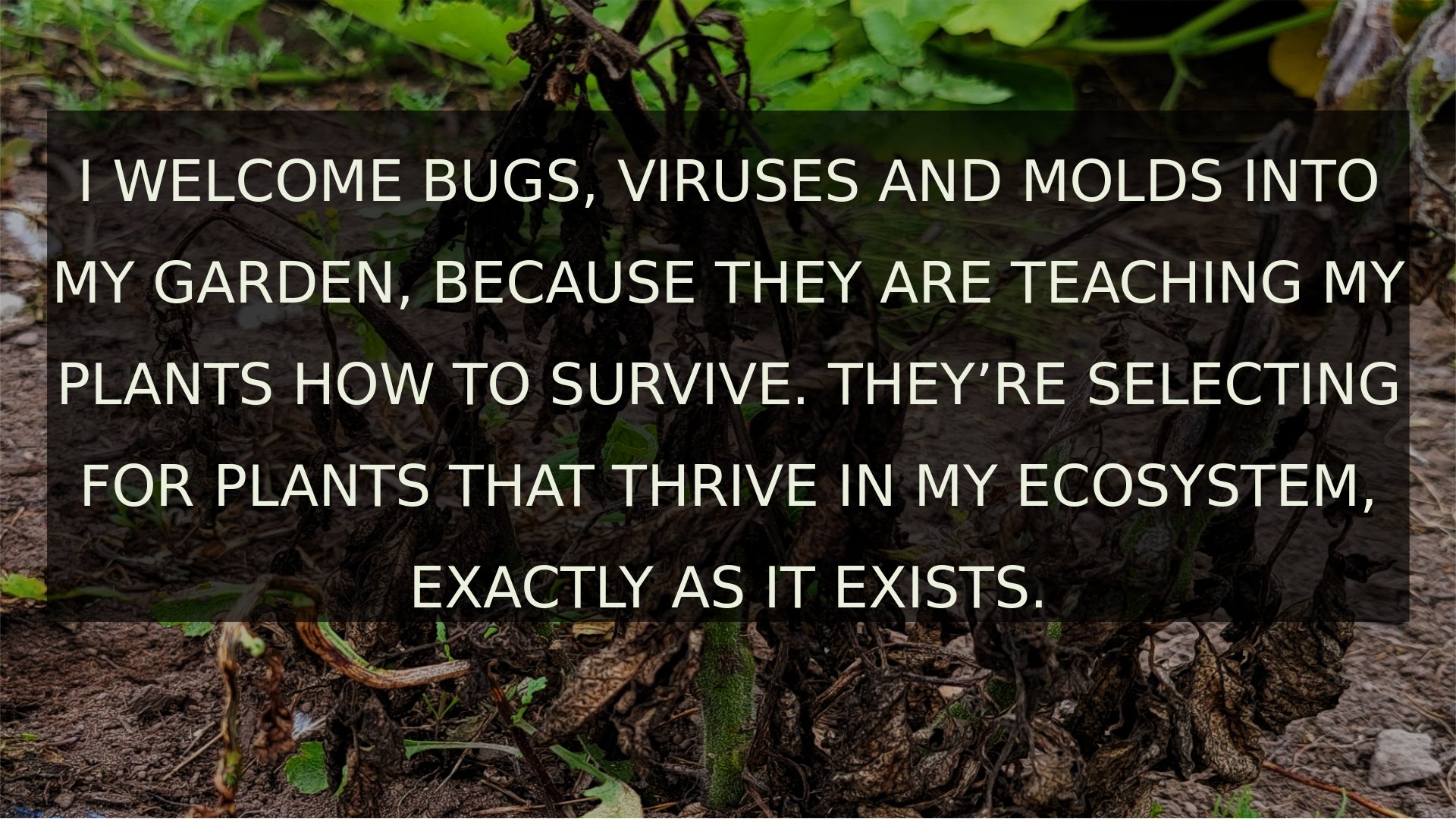
I choose to plant into the most disease infested fields available. This allows the plants to rapidly show me which have the ability to tolerate, or ignore the diseases. I don't rotate my crops for the same reason. Bring on the pests and diseases.
welcome-bugs.jpg
well met
well met
 
Nancy Reading
steward and tree herder
Posts: 12576
Location: Isle of Skye, Scotland. Nearly 70 inches rain a year
6521
6
transportation dog forest garden foraging trees books food preservation woodworking wood heat rocket stoves ungarbage
  • Likes 7
  • Mark post as helpful
  • send pies
    Number of slices to send:
    Optional 'thank-you' note:
  • Quote
  • Report post to moderator

Joseph Lofthouse wrote:I choose to plant into the most disease infested fields available.


The oats I sowed my first year were riddled with smut. I picked out the seeds from the good plants and kept those. I've never had smut since
 
Doug McEvers
Posts: 53
13
  • Likes 2
  • Mark post as helpful
  • send pies
    Number of slices to send:
    Optional 'thank-you' note:
  • Quote
  • Report post to moderator
Nancy, This is really good information, what about oat rust? Oat rust is a problem in the US so new oat varieties are always being developed to stay ahead of it. European buckthorn is thought to be a host plant for oat crown rust. Your selection method might be the answer to rust resistant oats in previously released varieties. Now I have one more thing to keep an eye on !

Oats are a fabulous cover crop and soil builder but planted here mid-season in high humidity they will develop rust. Early seedings are not generally affected.
 
Nancy Reading
steward and tree herder
Posts: 12576
Location: Isle of Skye, Scotland. Nearly 70 inches rain a year
6521
6
transportation dog forest garden foraging trees books food preservation woodworking wood heat rocket stoves ungarbage
  • Likes 2
  • Mark post as helpful
  • send pies
    Number of slices to send:
    Optional 'thank-you' note:
  • Quote
  • Report post to moderator

Doug McEvers wrote:Nancy, This is really good information, what about oat rust?


Not something I'd noticed....


source

It seems this is a hot weather problem (high temperatures (20–25°C)) - so I may be lucky in my cooler summers to avoid this one! I rarely get above 20°C here.
 
Message for you sir! I think it is a tiny ad:
11 Podcast Review of Botany in a Day by Thomas Elpel
https://permies.com/wiki/24823/Podcast-Review-Botany-Day-Thomas
reply
    Bookmark Topic Watch Topic
  • New Topic