Forums Login/signup

12,000 Liters of Freshwater per Day from Air — Offshore Buoy System | 24/7 Operation | No External E

(1 apple) 4
+Pie Number of slices to send: Send
Water scarcity in coastal regions requires infrastructure that operates continuously, not intermittently.

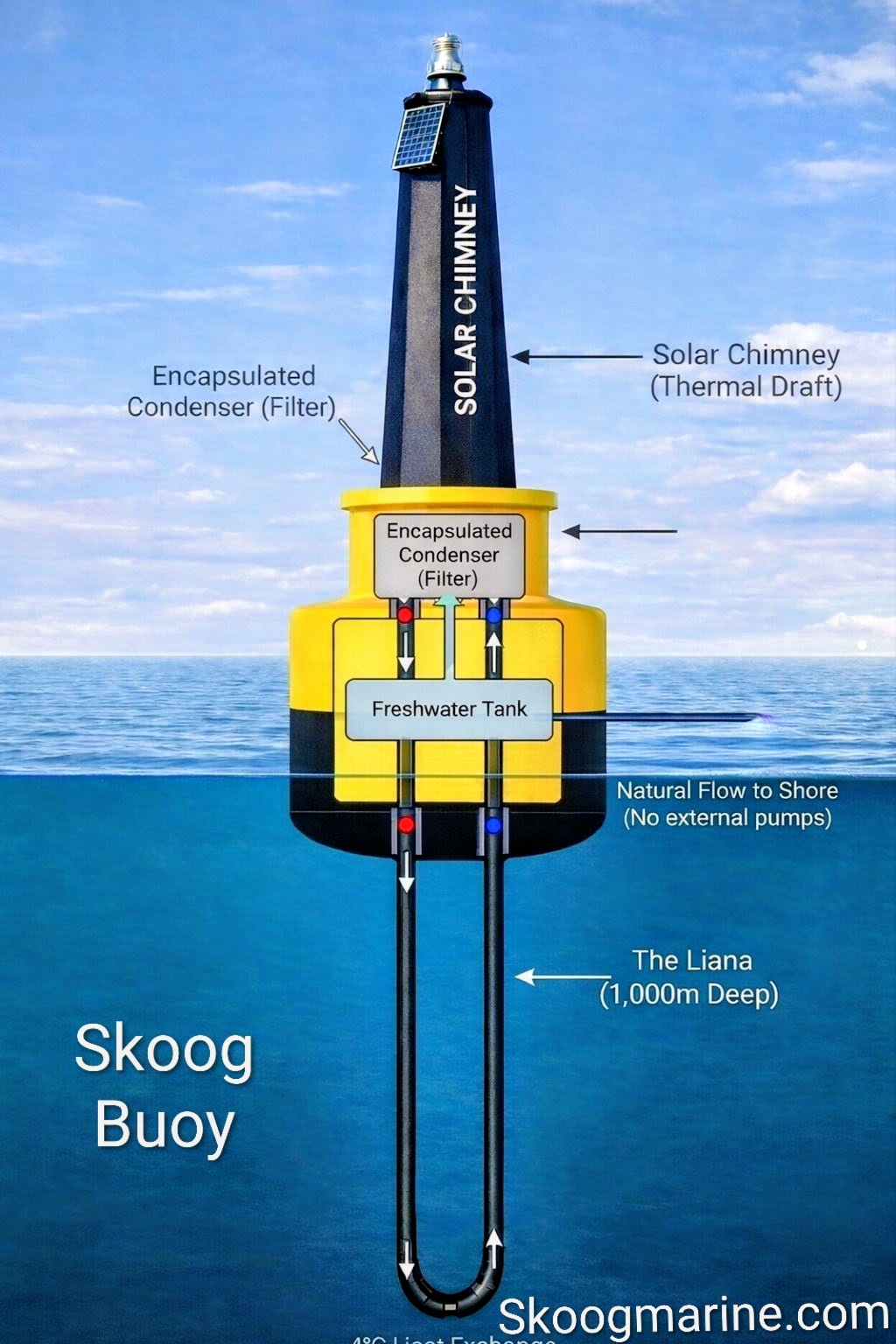
I am presenting an open technical framework for an offshore buoy-based system designed to produce approximately 12,000 liters of freshwater per day directly from atmospheric humidity — operating 24/7, without external electricity, without desalination membranes, and without high-pressure pumping.

The concept is called the Skoog Capillary Sweating Liana (SCSL).

This is not a land-based atmospheric water generator.
It is a marine spar-buoy infrastructure anchored offshore above a 1,000-meter deep-sea cooling well.

Core principle:

The system uses the ocean’s stable 4°C deep-water temperature as a permanent cooling source.
Wave motion drives continuous circulation in a closed loop.
A thermally structured chimney maintains airflow through temperature differentials inside the system — operating day and night due to sustained gradient dynamics within the structure.
Freshwater condenses continuously on a biomimetic capillary matrix.

The driving force is temperature difference, not extreme humidity.
As long as air contains moisture — which it always does — condensation occurs when cooled below dew point. Yield scales with climate conditions, but the physical principle remains valid across a wide range of coastal environments.

Full process cycle:

• A 1,000-meter closed-loop deep-sea line provides stable 4°C cooling
• Wave energy maintains constant circulation
• A thermal chimney sustains airflow 24/7
• A 500 m² capillary matrix creates continuous film condensation
• Latent heat is internally recovered
• Condensate collects in a sealed vessel
• Recovered heat and solar input raise water temperature
• A 0.43% thermal expansion generates hydrostatic discharge pressure
• Freshwater is automatically transported to shore via pipeline
• No grid electricity required for circulation or discharge

The industrial configuration is designed for approximately 500 liters per hour, totaling around 12,000 liters per day (climate dependent but thermodynamically constrained and calculated in the technical report). The system is inherently scalable: output can be increased by expanding the condensation matrix surface area and/or connecting multiple units in series offshore, enabling modular growth and thermodynamic synergy without requiring land-based expansion.

Engineering considerations often raised in offshore systems have been structurally integrated into the design:

• HDPE monolithic spar buoy architecture
• Three-point mooring with Lazy-S dynamic subsea configuration
• Wave-driven circulation (the system uses wave motion rather than resisting it)
• Open-source antifouling surface system (Iaaks framework)
• No brine discharge
• No chemical processing
• No reverse osmosis membranes
• Target structural lifespan: 30–50 years

This is not an energy-intensive desalination alternative.
It is a thermodynamic harvesting system that uses naturally occurring gradients — deep-sea cold, wave motion, and solar heat — to complete a closed freshwater cycle.

Because the framework is fully published under CC BY 4.0, detailed yield calculations, structural modeling, thermodynamic analysis, and process flow documentation are openly available.

Technical report:

https://doi.org/10.5281/zenodo.18483339

Marine architecture framework (Skoog Open Marine Technology):

https://doi.org/10.5281/zenodo.17552757

Constructive technical dialogue is welcome.

The documentation is structured for engineering-level review.

www.skoogmarine.com
Innovating for a Thirst-Free World | Wave-powered | Zero-emission (Always open source)

5
+Pie Number of slices to send: Send
some drawings would be great
5
+Pie Number of slices to send: Send
Does the system work anything like a fog harvesting net?

I've always been very impressed with those...

4
+Pie Number of slices to send: Send
No it seems to involve tubes lowered into the ocean and air is blown down to where its 4 deg. C where moisture drops out and is collected and sent to the surface. All clever.
4
+Pie Number of slices to send: Send
Thank you all for the warm welcome and for the interest in the project.
I have included  a link to a very simple video explanation below.
I recorded it at my kitchen table 🌞 to walk through the mechanics in a more hands-on way.
It is a low-budget production in Swedish, but there is an AI-generated English translation that follows my explanation exactly, I hope it helps visualize the " Skoog Capillary Sweating Liana".
The logic is straightforward: the (SCSL) uses the ocean's depths as a cooling source and the waves and sun as driving forces to let the system sweat freshwater from the air. We access the constant 4°C deep-sea temperature through a 1,000-meter closed loop of HDPE pipes to create a stable cooling source at the surface. To clarify a point mentioned in the thread, the air isn't blown down into the ocean; instead, the cold water is brought up to a process module where a solar-thermal chimney creates a natural updraft to circulate air across the cooling surfaces 24/7 without any electrical fans or external power.
The entire architecture is designed to be completely autonomous.
Instead of electrical pumps, we use an Expansion Motor where solar and recovered latent heat expand the collected water by 0.43%, generating the hydrostatic pressure needed to deliver the freshwater to land automatically. Maintenance is handled by the open-source Skoog IAKKS active ceramic coating, which uses kinetic micro-vibrations to prevent biofouling on the internal surfaces. Since everything is shared under a Creative Commons license, my goal is to provide a reliable, salt-free water source that can be built and maintained locally by the communities that need it most.


(1 apple) 4
+Pie Number of slices to send: Send
Hello,
I am posting a new link to the video as it has been redesigned and its capacity increased to 50,000 litres per day by increasing the matrix filter and dimensions

Of course, it is also possible to scale down to smaller models. For smaller off-grid groups.
The new capacity will be used in Oman. Eleven of these connected in series will provide approximately half a million litres per day. No electricity, no filter changes, no environmentally hazardous waste.
So the future looks bright for clean water for all.

So there is a solution now, Skoog Buoy, so the world's thirst is no longer an insurmountable problem.

All with open source, free for everyone to use.
This website has everything you need to get started.
https://doi.org/10.5281/zenodo.18483339

Link video;
https://youtu.be/F87YQ3tX-70?si=8WifO4okwU9WoZqS


How do they get the deer to cross at the signs? Or to read this tiny ad?
permaculture thorns, A Book About Trying to Build Permaculture Community - draft eBook
https://permies.com/wiki/123760/permaculture-thorns-Book-Build-Permaculture
Green Living Book Full online Permaculture Design course and Appropriate Technology Course video Rocket Mass Heaters permaculture chickend


reply
reply
This thread has been viewed 287 times.
Similar Threads
What would permaculture seasteading look like?
Just had a 'cell tower" go up near us
how to make charcoal
evaporative cooling fridge test
porta-cabin - love shack
permaculture bootcamp - gardening gardeners; grow the food you eat and build your own home
More...

All times above are in ranch (not your local) time.
The current ranch time is
Mar 11, 2026 10:30:46.