

|

|
|
|
|
|

|

|

|
|
 13
13


Education and outreach as a way to influence the world at-large remain a priority, exemplified through its many different interrelated projects and organizations.
Like anything created by humans, The Farm is not perfect, as its members readily admit.
Rather, it is the community’s ability to evolve and change, adapt and survive through both good times and hard times, that allow it to serve as a realistic model.The Farm continues to serve as a model for a way in which humans can live together in peace.
It continues to keep the principles of nonviolence as its core foundation.
Respect for the environment and living lightly on the earth continues to be a common thread uniting all members.Currently The Farm Community, related organizations and affiliated individuals own and control over 4000 contiguous acres.
With thousands of acres of hardwood forest surrounding the community being clear-cut in recent years, these ecosystems stand as an island for countless species and protects the watershed for future generations.
By living together in community, individuals gain greater leverage in the pursuit of their ideals.These ideals are passed from one generation to the next through example and collective participation in a variety of efforts that possess a single common purpose: to make a positive difference in the world.
Ultimately it is the ability to pass on core ideals to a future generations that defines sustainability for the community.As society’s awareness on the critical state of the planet increases, a new generation of young idealists are finding The Farm Community as a way to jump start the fulfillment of their vision to create a better world.
Put out your best love and your best good will, and most serious love all the time, because there is always someone who needs it.”
–Stephen Gaskin
"We're all just walking each other home." -Ram Dass
"Be a lamp, or a lifeboat, or a ladder."-Rumi
"It's all one song!" -Neil Young
7
Right livelihood is a Buddhist teaching which says that your work should be seamless with your ideals, a concept embraced as part of The Farm’s general philosophy.
After the Changeover, many of the community’s internal services, such as Farm Soy, were converted into businesses to generate income for the residents.Many small businesses were established to provide employment and as a way to support those remaining in the community.
A spirit of entrepreneurship developed which identified the different types of businesses that could be successful in a very rural setting.
For example, our two most successful businesses market their products through national trade shows, returning to their home in rural Tennessee to fulfill orders.
Surprisingly, the community’s most successful business is an electronic manufacturing facility.
The business was started before the Changeover by the community’s amateur radio crew, using their electronic skills to develop a line of products.
SE International was formed as a corporation with managers of the company holding the majority of stock.It produces Geiger counters and other instruments which detect radioactivity.
These devices have become widely used in hospitals, laboratories, industry and civil defense.
The first business that was established back in the 70’s was The Book Publishing Company.
Today this business is still owned by the community as a whole and employs many members.
The Book Publishing Company catalog also includes many titles by Native American authors.Some businesses are service-oriented providing a variety of technical skills to satisfy the needs of the modern world.
It is recognized as one of the largest publishers of vegetarian and vegan cookbooks, along with a number of titles on health-related topics.
Village Media Services produces videos for marketing and training, as well as documentaries and other types of multi-media. The facilities also include a digital audio recording studio.
Village Media also creates and hosts web sites and produces print materials for a variety of clients.The Farm’s yoga studio is utilized by residents and people who live outside the community.
It provides an excellent example of right livelihood, a small business which contributes to the health and well-being those who use its services.
"We're all just walking each other home." -Ram Dass
"Be a lamp, or a lifeboat, or a ladder."-Rumi
"It's all one song!" -Neil Young
7
For over 50 years, The Farm Midwifery Center has provided a very special service for mothers, babies, and their families.
Women are treated with love and respect, empowering them to fulfill their desire for natural childbirth in a sane and safe home setting.
"We're all just walking each other home." -Ram Dass
"Be a lamp, or a lifeboat, or a ladder."-Rumi
"It's all one song!" -Neil Young
10
In 1974, Stephen Gaskin and The Farm, an intentional community, started an outreach program called Plenty. In response to the devastating 1976 Guatemala earthquake, Plenty sent carpenters who built schools, houses and clinics in remote Mayan villages and a clinic for Mother Teresa. In its first ten years, Plenty established a clinic and orphanage in Bangladesh, an appropriate technology training center and reforestation program in Lesotho, and a wind-powered electric lighting system in a Carib Indian school in Dominica. It provided disaster relief in the "Developing" World and free ambulance service to the South Bronx which helped to train emergency personnel what then became New York City's EMS. It went to sea with Greenpeace and gave the Rainbow Warrior its ham radio, slo-scan TV, and radiation monitoring equipment.
Plenty put Native American FM stations on the air, and pioneered amateur-band television and radio to keep its remote outposts of volunteers connected.Plenty continues to work with Native American primary health care, midwifery, microeconomics, food and ecotourism cooperatives and alternative building programs, including the hemp house on the Pine Ridge Indian Reservation with the assistance of The Farm School.
Following the catastrophic landfall of Hurricane Katrina near New Orleans in August 2005, Plenty volunteers worked on a neighborhood-by-neighborhood basis to deliver essential supplies and re-establish civil order. Plenty worked with Veterans for Peace, Camp Casey, and others to place volunteers where they were most needed. Plenty stayed on scene for the following year and organized clean-up and repair of the damage along the coastlines of Alabama, Mississippi and Louisiana, including the cities of Mobile (Alabama), Biloxi and Gulfport (Mississippi), and Slidell (Louisiana). Plenty also brought displaced and disadvantaged children from the Gulf Coast back to The Farm to participate in its Kids To The Country summer nature school in 2006.
"We're all just walking each other home." -Ram Dass
"Be a lamp, or a lifeboat, or a ladder."-Rumi
"It's all one song!" -Neil Young
7
The First Axiom of Life: Don’t do dumb things.
8
"We're all just walking each other home." -Ram Dass
"Be a lamp, or a lifeboat, or a ladder."-Rumi
"It's all one song!" -Neil Young
9

-
“Liberty consists in the freedom to do everything which injures no one else" - M. de la Fayette
8
"We're all just walking each other home." -Ram Dass
"Be a lamp, or a lifeboat, or a ladder."-Rumi
"It's all one song!" -Neil Young
10
Bates has been a resident of The Farm since 1972.
A former attorney, he argued environmental and civil rights cases before the U.S. Supreme Court and drafted a number of legislative Acts during a 26-year legal career.
The holder of a number of design patents, Bates invented the concentrating photovoltaic arrays and solar-powered automobile displayed at the 1982 World's Fair.
He served on the steering committee of Plenty International for 18 years, focussing on relief and development work with indigenous peoples, human rights and the environment.
An emergency medical technician (EMT), he was a founding member of The Farm Ambulance Service.
He was also a licensed Amateur Radio operator.
Bates has played a major role in the ecovillage movement as one of the organizers of the Global Ecovillage Network (GEN), and served as GEN's chairman of the board (from 2002 to 2003) and president (from 2003 to 2004).
He was also the principal organizer of the Ecovillage Network of the Americas and served as its president (from 1996 to 2003).
In 1994 he founded the Ecovillage Training Center, a "whole systems immersion experience of ecovillage living."
He has taught courses in sustainable design, natural building, permaculture and technologies of the future to students from more than 50 nations.
Bates's Climate in Crisis (1990) was the first book published on web (rolled paper) press using a 100% recycled product without chemically removing clays or inks.
Since then, he has been planting a private forest to sequester carbon dioxide and related greenhouse gas emissions from travel, business and personal activities.
At 40 acres under mixed-age, mixed-species, climate-resilient management, primarily being managed for ecosystem services, that forest now annually plants itself as it expands.
"We're all just walking each other home." -Ram Dass
"Be a lamp, or a lifeboat, or a ladder."-Rumi
"It's all one song!" -Neil Young
5
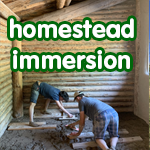
The Ecovillage Training Center is a "total immersion school" for sustainability. It is located at The Farm, an intentional community/ecovillage in Summertown, Tennessee, USA. The curricula of the center are "holistic and comprehensivist" and foster hands-on learning.
Albert Bates, a long-time resident of The Farm, founded the center in July 1994. The original farmhouse was refurbished and renamed "You're Inn at The Farm," to provide accommodation for participants. There are many permaculture design and energy conservation features at the Ecovillage Training Centre that result in a significant reduction in use of resources. These include a 5-kW solar electric system, water catchment, organic gardens, greywater treatment, ponds, wetlands, and natural buildings.
In addition to offering ecovillage apprenticeships, the Training Center's curriculum includes:
Shiitake Mushroom Growing Basics
Solar Installation
Alternative Energy Systems
Bamboo Cultivation and Construction
Ecovillage Design and Permaculture Practicum
Natural Building Basics
The center is affiliated with the Global Ecovillage Network, Gaia University and local colleges and offers college credit for several of its courses.
"We're all just walking each other home." -Ram Dass
"Be a lamp, or a lifeboat, or a ladder."-Rumi
"It's all one song!" -Neil Young
10
Creating sustainable life, beauty & food (with lots of kids and fun)
4

"We're all just walking each other home." -Ram Dass
"Be a lamp, or a lifeboat, or a ladder."-Rumi
"It's all one song!" -Neil Young
5
Creating sustainable life, beauty & food (with lots of kids and fun)
There were several communities founded in the late 60's, early 70's. Twin Oaks, in Virginia, organized during 'The Summer of Love' in 1967. Stone Garden Farm & Village, in N. Ohio, was started in about 1970. The Bear Tribe, 'headquartered' near Spokane, Wash., was founded in 1971. The Farm, in Summertown, Tenn. was founded mid-Summer of 1971. The Bear Tribe has passed into history with the death of its leader and founder Sun Bear. The other three still continue.

"We're all just walking each other home." -Ram Dass
"Be a lamp, or a lifeboat, or a ladder."-Rumi
"It's all one song!" -Neil Young
7
Creating sustainable life, beauty & food (with lots of kids and fun)

|
I promise I will be the best, most loyal friend ever! All for this tiny ad:
A book about better recipes for green living
https://greenlivingbook.com/
|


