• Post Reply Bookmark Topic Watch Topic
  • New Topic
permaculture forums growies critters building homesteading energy monies kitchen purity ungarbage community wilderness fiber arts art permaculture artisans regional education skip experiences global resources cider press projects digital market permies.com pie forums private forums all forums
this forum made possible by our volunteer staff, including ...
master stewards:
  • Carla Burke
  • Nancy Reading
  • John F Dean
  • r ransom
  • Jay Angler
  • Timothy Norton
stewards:
  • paul wheaton
  • Pearl Sutton
  • Tereza Okava
master gardeners:
  • Christopher Weeks
  • M Ljin
gardeners:
  • thomas rubino
  • Jeremy VanGelder
  • Megan Palmer

Home scale spinning frame (multiple spindles, one hand crank)

 
Posts: 7
4
  • Likes 9
  • Mark post as helpful
  • send pies
    Number of slices to send:
    Optional 'thank-you' note:
  • Quote
  • Report post to moderator
Hi! I hesitated to post here, because I don't have pictures yet, but I am working on a spinning frame. In India, this particular type is called an ambar charkha. You may have seen them as an e-charkha. I am making one out of 3D printed parts, hoping to put the whole thing out on the web so anyone can make their own spinning frame. I started with the idea of a water frame (like the ones Arkwright invented in England) but I saw they were using basically a mini ring spinning mill in India so I wanted to go whole hog on that design. I am really excited about the project! I was planning to make it a sort of flexible design, where you could use it for wool or flax or cotton, but I wonder if people on here have any commentary on what THEY would want out of a machine like that?
 
master gardener
Posts: 6161
Location: Carlton County, Minnesota, USA: 3b; Dfb; sandy loam; in the woods
3627
8
forest garden trees books chicken food preservation cooking fiber arts seed woodworking homestead ungarbage
  • Likes 5
  • Mark post as helpful
  • send pies
    Number of slices to send:
    Optional 'thank-you' note:
  • Quote
  • Report post to moderator
I look forward to seeing more when you have more to show!
 
Posts: 14
6
  • Likes 9
  • Mark post as helpful
  • send pies
    Number of slices to send:
    Optional 'thank-you' note:
  • Quote
  • Report post to moderator
There's a guy in the UK who was building a spinning jenny a few years back:
https://www.instagram.com/p/CgNIUrxo78L/

(Now going by Tottles Spinners, was Cozy Yeti)

And this is an interesting video about the Ambar Charkha if you haven't come across it: https://www.youtube.com/watch?v=dDzQ2QMc4AQ  (More historical context than mechanical - but he was talking about trying to design a 3d print version though I don't know that he's done it, he's done other 3d print fiber tools)
 
steward & author
Posts: 45774
Location: Left Coast Canada
18305
10
art trees books chicken cooking fiber arts
  • Likes 8
  • Mark post as helpful
  • send pies
    Number of slices to send:
    Optional 'thank-you' note:
  • Quote
  • Report post to moderator
I do a lot of cotton spinning on a great wheel and on a book charkha.  Love it.

I'm eager to learn more about your project.

I've seen pictures of this spinner, but haven't tried it.  https://permies.com/t/69848/Energy-generating-spinning-wheel

Is it something like that?
 
Cassie Martin
Posts: 7
4
  • Likes 9
  • Mark post as helpful
  • send pies
    Number of slices to send:
    Optional 'thank-you' note:
  • Quote
  • Report post to moderator
I hadn't seen that spinning jenny, thank you so much for the link! There are honestly so few resources about any of this, I was sorting through Indian language textile mill educational materials trying to find ANYTHING. This was one of the videos I found from a small mill
.

One thing I notice about all the cotton spinning tech is that it uses a pencil-sized puni strand, which is preprocessed in another larger spinning machine. Wool does not require this, and can be spun straight from sliver/roving (I am still not sure of the difference, coming from hand spinning myself). That sort of makes the pipeline from raw fleece to spun yarn accessible, if you just had the one machine to undo the bottleneck at spinning.

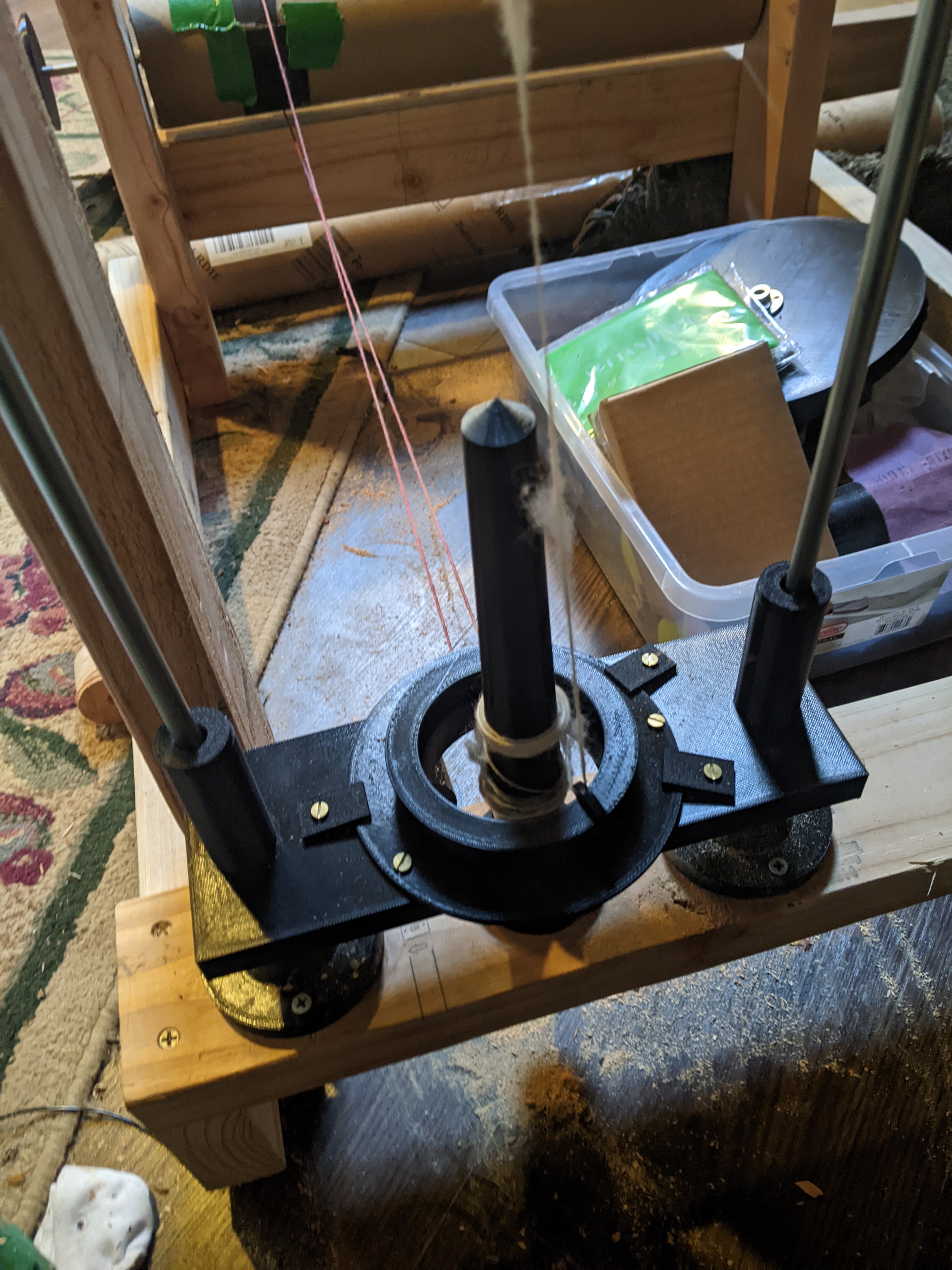
Speaking of which, the spinning part works! A fully functional, 3D printed ring spinner! Now just to get the drafting portion completely working.

PXL_20260318_154244588.jpg
The spindle and ring rail
 
Cassie Martin
Posts: 7
4
  • Likes 10
  • Mark post as helpful
  • send pies
    Number of slices to send:
    Optional 'thank-you' note:
  • Quote
  • Report post to moderator
r ranson, I had found your post just before I posted here! It is exactly like that, but instead of just two spindles, you can do 4, 8, 12, whatever you wanted! I don't know about using it to generate electricity: I am sure you could, but the vast majority of the "khadi" workers who use them daily seem to be aiming for using a solar panel to power the charkha so they don't have to sit and spin.

Edited to add: they do sell cotton spinning  ambar charkhas and I think you could get this one as a one off (not a minimum order of 100?). With shipping, I estimated it would be about a $600 purchase. Ambar Charkha Link
 
Cassie Martin
Posts: 7
4
  • Likes 3
  • Mark post as helpful
  • send pies
    Number of slices to send:
    Optional 'thank-you' note:
  • Quote
  • Report post to moderator
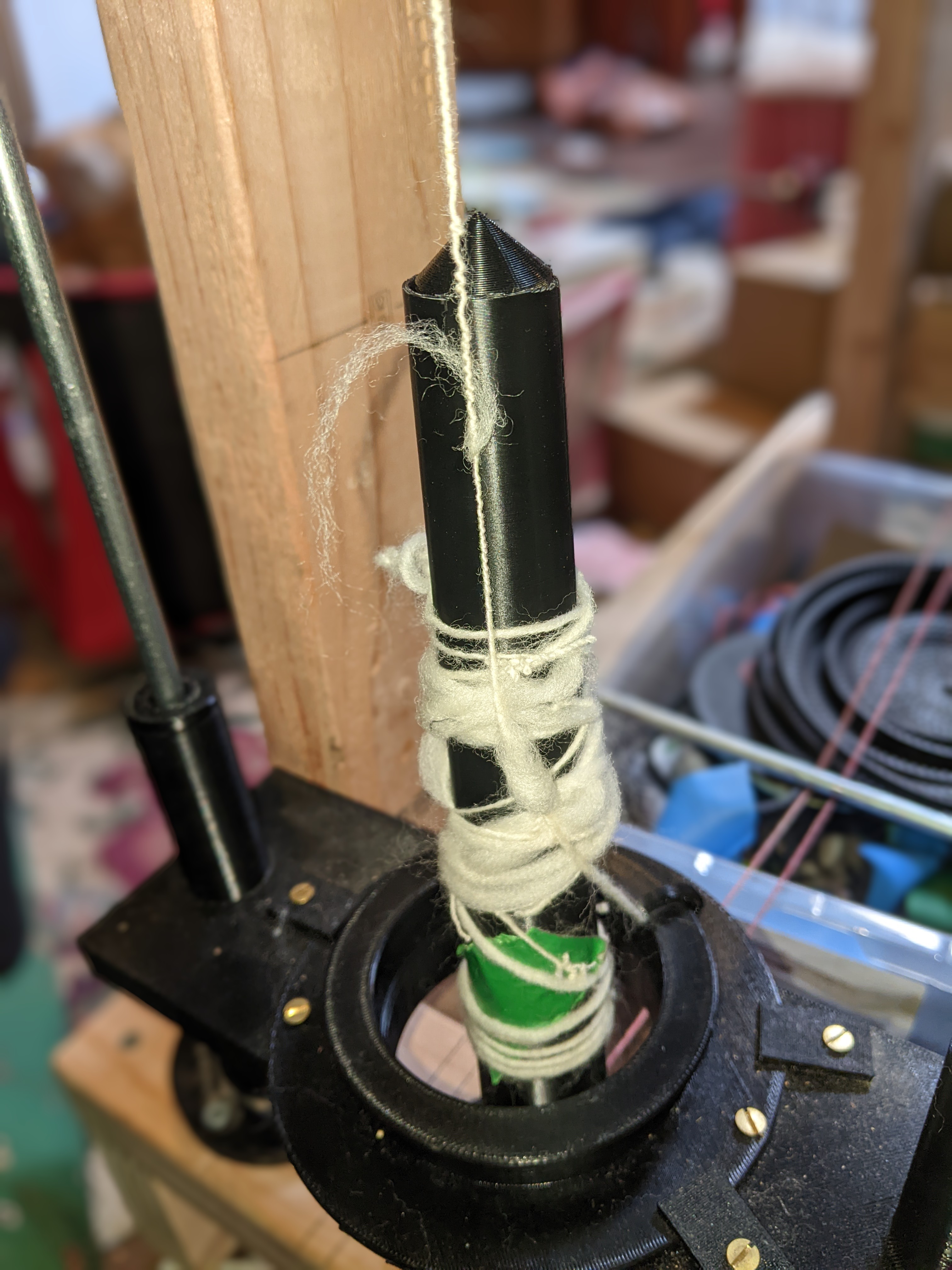
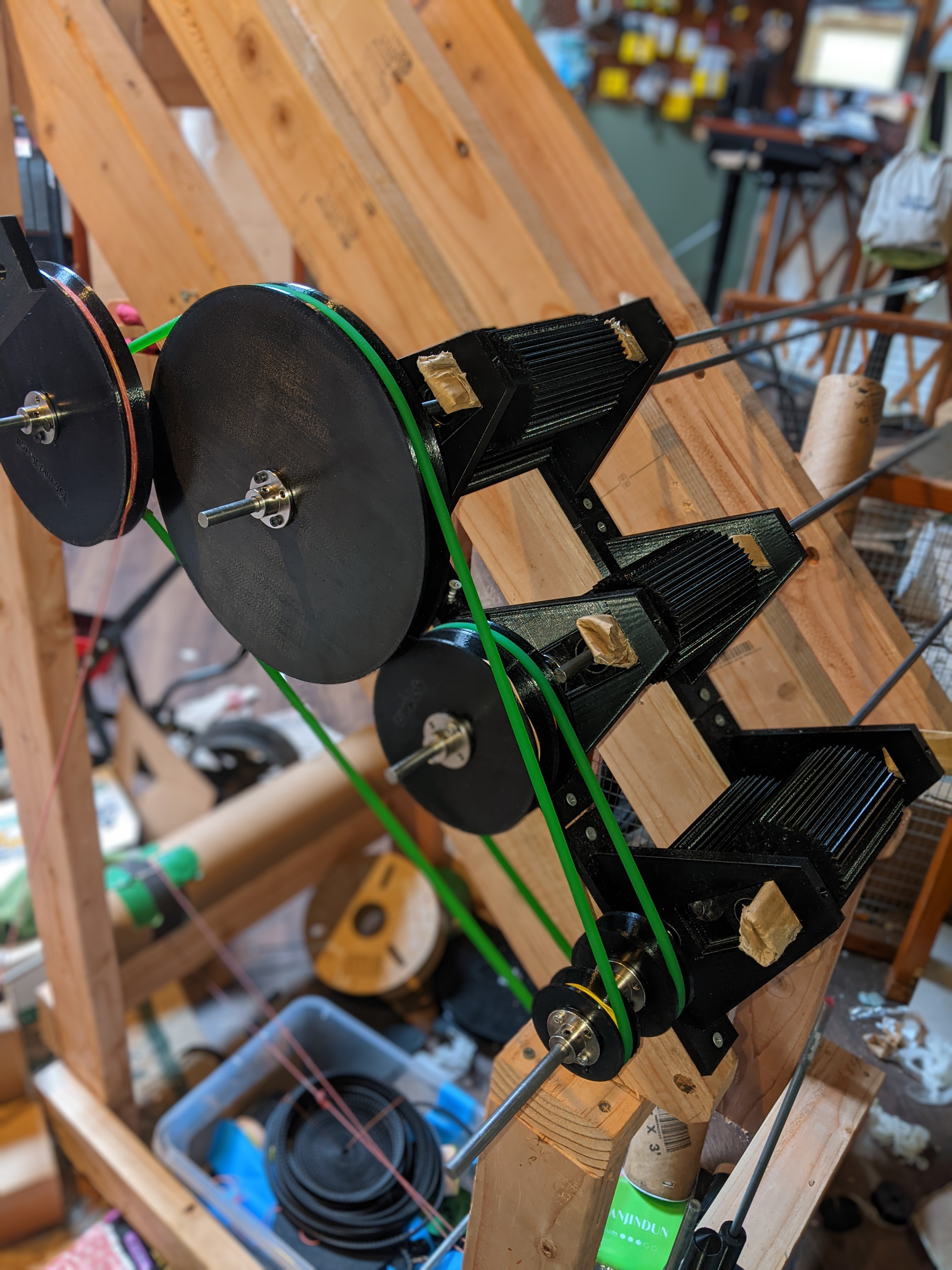
The drawing out part is working now! Attached is a new picture of yarn I made simply by turning a crank handle, and the new rollers that do the drawing out.

If you spin, you may be pained to see a lot of over twisted areas on the yarn. The problem is, a spinning frame apparently needs an insanely consistent roving. If it gets even slightly lumpy roving, the thicker parts become drastic slubs that can't get any twist and the thinner parts get over twisted. At mills they solve this by running the roving multiple times through a "draw frame", putting together multiple strands so they even out the bumps and thin spots in the other rovings. Sort of the same principle as taking two or three rough things and rubbing them together so the high spots get knocked off of both. In big mills, they take 8 rovings and run them into one, sometimes a couple times. In small mills, they take fewer (2-3) rovings, and run them together two or three times, taking the long single strand and breaking it in half to put it through each time. They seem to draw the strands out to the same thickness as the original (so to double or triple the length of the original strands), and then they do one pass to make the roving the right thickness for their spinning frame, depending on the size of yarn they want. I haven't been able to make a consistent enough roving, even running store bought roving through my rollers or carefully making one by hand. So guess what I have to make now!


PXL_20260329_211612009-2.jpg
Yarn Spun by Mechanical Drawing Out
PXL_20260329_212458178-2.jpg
Drawing out rollers. 3D printed
 
I agree. Here's the link: http://stoves2.com
reply
    Bookmark Topic Watch Topic
  • New Topic