

• Post Reply Bookmark Topic Watch Topic
  • New Topic
permaculture forums growies critters building homesteading energy monies kitchen purity ungarbage community wilderness fiber arts art permaculture artisans regional education skip experiences global resources cider press projects digital market permies.com pie forums private forums all forums
this forum made possible by our volunteer staff, including ...
master stewards:
  • Carla Burke
  • Nancy Reading
  • John F Dean
  • r ransom
  • Jay Angler
  • Timothy Norton
stewards:
  • paul wheaton
  • Tereza Okava
  • Nicole Alderman
master gardeners:
  • M Ljin
  • Christopher Weeks
gardeners:
  • Jeremy VanGelder
  • thomas rubino
  • Megan Palmer

New compost bed, what to grow?

 
gardener
Posts: 5656
Location: Cincinnati, Ohio,Price Hill 45205
1276
forest garden trees urban
  • Likes 10
  • Mark post as helpful
  • send pies
    Number of slices to send:
    Optional 'thank-you' note:
  • Quote
  • Report post to moderator
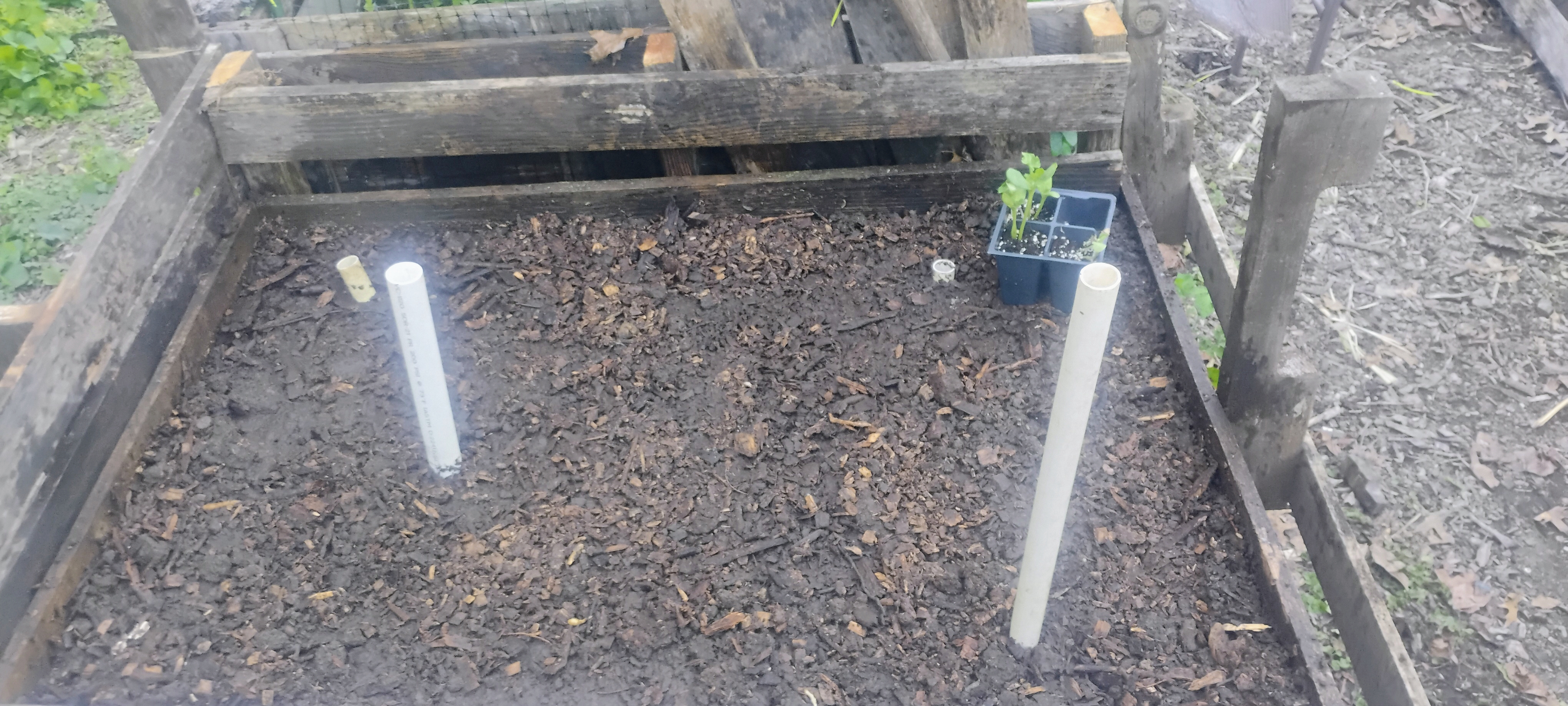
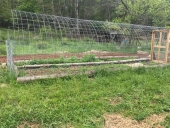
I build raised beds from pallets, fill them with leaves, and cap them with compost.
It's the first year I've used leaves at the community garden, previously I've used woodchips there, but we are low on wood chips and I had extra leaves.

Because I can't be at the  community  garden everyday, I have buried 5 gallon buckets full of woodchips in each pallet raised bed.
They act as water reservoirs, while the bed still has access to the surrounding soil, for what it's worth.
Each bucket has woodchips inside, a fill tube and holes through their sides(about half way up).
I then pack more wood chips all around buckets and top everything with compost.
This time I've packed leaves around the outside of the buckets, instead of wood chips, and I anticipate they will decay faster than the wood chips inside the buckets, but I think things will work out.

Since it's basically a compost pile, any added production an extra bonus, but it's ~16 square feet of growing space,so I don't want to waste it.
I can think of dozens of things to plant in this bed, but I'm eager to hear suggestions from my cohorts here😁
IMG_20260507_192151802_AE.jpg
The compost is decayed woodchips, not sifted, so itight be a little nitrogen hungry still
 
pollinator
Posts: 91
Location: Haarlem, The Netherlands
65
forest garden fungi trees urban writing ungarbage
  • Likes 15
  • Mark post as helpful
  • send pies
    Number of slices to send:
    Optional 'thank-you' note:
  • Quote
  • Report post to moderator
Good morning William,
For years I have planted pumpkins on my aged compost heap, with great succes, until the slugs found them and kept on eating them to the ground. This year I am trying legumes on it as well. I still have to see how it goes.
Maybe your wet woodchips are a slug paradise as well? In that case, you better plant something slug resistant, but I have no idea what that would be.
Good luck!
 
William Bronson
gardener
Posts: 5656
Location: Cincinnati, Ohio,Price Hill 45205
1276
forest garden trees urban
  • Likes 11
  • Mark post as helpful
  • send pies
    Number of slices to send:
    Optional 'thank-you' note:
  • Quote
  • Report post to moderator
Well, we do have Lazarus lizards that seem to keep the slug populations in check, but you have good point.

Legumes are a low risk crop, since I plant grocery store varieties.

I'm thinking this could be where I put the perennial garlic patch,  and plant some elderberry cuttings into that.
 
Nynke Muller
pollinator
Posts: 91
Location: Haarlem, The Netherlands
65
forest garden fungi trees urban writing ungarbage
  • Likes 10
  • Mark post as helpful
  • send pies
    Number of slices to send:
    Optional 'thank-you' note:
  • Quote
  • Report post to moderator
Good morning William,

Lizards sound great to help with the slug population. I have some froggs and salamanders as well, but most of them are smaller than the slugs. Haha.
I expect your elderberry cuttings will be happy in the new compost bed.

I am not so sure about the garlic. I have some unions (same family) planted around in my garden. The ones on a small new made bed, made from wood and compost don't do very well, while they trive in more established situations. It could be my specific situation. Somebody else maybe has experience with garlic in new beds from leaves and compost?

However, I have always understood that allium family (to which garlic belongs) is a bad companion for legumes. So, I would avoid planting them together.

Whatever you decide, please let us know how it goes.
 
pollinator
Posts: 52
Location: SW Virginia zone 7a (just moved from DFW, TX)
36
  • Likes 12
  • Mark post as helpful
  • send pies
    Number of slices to send:
    Optional 'thank-you' note:
  • Quote
  • Report post to moderator

Nynke Muller wrote:...

I am not so sure about the garlic. I have some unions (same family) planted around in my garden. The ones on a small new made bed, made from wood and compost don't do very well, while they trive in more established situations. It could be my specific situation. Somebody else maybe has experience with garlic in new beds from leaves and compost?
...


Same here in SW Virginia. I've grown garlic and elephant garlic for several years under several conditions:

A.  with plentiful compost made partly from fresh woodchips, almost no soil.
B. aged compost with wood chips, no soil.
C. in sandy loam soil heavily amended with buried kitchen waste, mulched with composted wood chips, or plain wood chips.
D. almost un-amended sandy loam soil, mulched with fresh and with aged wood chips.

In every case, older aged wood chips made better, bigger, healthier looking garlic. Fresh chips made weaker, smaller garlic, even with plentiful diluted urine to address nitrogen deficiency.

The best results are from the soil amended with kitchen waste. This area is full of worms enjoying the rich worm food. The aged compost also has good results, also full of worms. Fresher wood chips in the soil, no worms. Wood chips as surface mulch doesn't deter the worms.

So I think my experience is that worm castings are the ideal garlic substrate, and that fresh wood chips are inhospitable to worms, reducing garlic yields. I suggest trying legumes in fresher wood chip compost, but that's more of a guess, not experience.

 
William Bronson
gardener
Posts: 5656
Location: Cincinnati, Ohio,Price Hill 45205
1276
forest garden trees urban
  • Likes 8
  • Mark post as helpful
  • send pies
    Number of slices to send:
    Optional 'thank-you' note:
  • Quote
  • Report post to moderator
B, thank you for the hard earned wisdom!
These are old, old wood chips, so that's great news!
I have chicken curated household waste compost that is rife with red wrigglers, so I can add that as well!

The note on wood chips plus urine is very useful.
I might still make such a bed specifically as a perennial garlic bed.
 
gardener
Posts: 1985
Location: Longbranch, WA Mild wet winter dry climate change now hot summer
489
3
goat tiny house rabbit wofati chicken solar
  • Likes 6
  • Mark post as helpful
  • send pies
    Number of slices to send:
    Optional 'thank-you' note:
  • Quote
  • Report post to moderator
Larger seeded legumes may be able to get their roots down to your moisture reserve and then produce more nitrogen if inoculated, with the air spaces provided by the remaining wood chips.
 
Posts: 1
  • Likes 2
  • Mark post as helpful
  • send pies
    Number of slices to send:
    Optional 'thank-you' note:
  • Quote
  • Report post to moderator

Nynke Muller wrote:Good morning William,
For years I have planted pumpkins on my aged compost heap, with great succes, until the slugs found them and kept on eating them to the ground. This year I am trying legumes on it as well. I still have to see how it goes.
Maybe your wet woodchips are a slug paradise as well? In that case, you better plant something slug resistant, but I have no idea what that would be.
Good luck!

 So you just plant the pumpkins right on the chip piles? Wow! Do you add dirt or anything? Thanks.
 
Nynke Muller
pollinator
Posts: 91
Location: Haarlem, The Netherlands
65
forest garden fungi trees urban writing ungarbage
  • Likes 4
  • Mark post as helpful
  • send pies
    Number of slices to send:
    Optional 'thank-you' note:
  • Quote
  • Report post to moderator

Lin Frost wrote:So you just plant the pumpkins right on the chip piles? Wow! Do you add dirt or anything? Thanks.


Hi Lin,
I have two compost piles. One I am adding on. Try to be diverse, but dont bother to much. Just dumping stuff on that I can not or will not use elsewhere in the garden.  
The second position, I clear in fall and winter, I spread it in the garden. In spring, I put some debris, from all over the garden, like mulch that covered the beds in winter on this second position. Than I make a small pile of grassclippings, in the middle, this will cause some extra warmth. My husband turns the compost from the first position onto the second. It looks like black soil with lumps of decaying wood in it. I level the surface. Really big chunks of wood, go back to the first position. Than the pumpkin is planted. I sow some other stuff around it, with varying succes.
 
Mrs. Robinson, you're trying to seduce me. Aren't you? Give us some privacy tiny ad.
grow your own garden and build your own home in the gardening gardeners program
https://wheaton-labs.com/bootcamp
reply
    Bookmark Topic Watch Topic
  • New Topic