• Post Reply Bookmark Topic Watch Topic
  • New Topic
permaculture forums growies critters building homesteading energy monies kitchen purity ungarbage community wilderness fiber arts art permaculture artisans regional education skip experiences global resources cider press projects digital market permies.com pie forums private forums all forums
this forum made possible by our volunteer staff, including ...
master stewards:
  • Carla Burke
  • Nancy Reading
  • paul wheaton
  • John F Dean
  • r ransom
  • Jay Angler
stewards:
  • Timothy Norton
  • Tereza Okava
  • Pearl Sutton
master gardeners:
  • Christopher Weeks
  • M Ljin
gardeners:
  • Jeremy VanGelder
  • Megan Palmer
  • Thekla McDaniels

Sahara desert gardening: Zai, half-moon basins, waffle, Tulukur beds

 
pollinator
Posts: 390
Location: New Mexico USA zone 6
91
3
  • Likes 6
  • Mark post as helpful
  • send pies
    Number of slices to send:
    Optional 'thank-you' note:
  • Quote
  • Report post to moderator

The Sahara desert is turning into Africa's green wall

We are getting some rain now in my part of western New Mexico USA, but nowhere near enough to reverse the drought conditions that we've been living with for years. Rainfall is too often measured in hundredths of inches! And yet there is a project along the bottom edge of Africa's Saraha Desert called The Great Green Wall. The 8,000-kilometer (nearly 5000 miles) mega-project of theAfrican Union and backed by the United Nations is intended to stop the Sahara Desert from growing. Today, nearly 20 years later, the project has restored about 20% to 30% of its goal.

Seems to me if they can grow plants that provide food for humans and forage for livestock and wildlife, plus control the creep of the Sahara Desert, I should be able to grow 50 foot long garden in New Mexico.


Zaï (or tassa) is a farming technique of digging pits in less permeable soil to catch water and concentrate compost.

The pits are between 15 and 50 centimetres (0.5 and 2 ft) across and around 5 to 15 centimetres (2 to 6 in) deep, spaced approximately 80 centimetres (3 ft) apart. The technique is traditionally used in western Sahel (Burkina Faso, Niger, Mali) to restore degraded drylands and increase soil fertility. The technique has also been adopted by smallholder farmers in semi-arid regions of East Africa, particularly in Kenya, where farmers in counties such as Kitui use it in combination with modern agricultural practices to improve water retention and crop yields in dryland conditions.[

Zaï holes were reintroduced since the 1980s by Yacouba Sawadogo, a farmer from Burkina Faso, who introduced the innovation of filling them with manure and compost to provide plant nutrients. The manure attracts termites, whose tunnels help further break up the soil. He also slightly increased the size of the holes over the traditional models. Zaï holes help by improving the yields of trees, sorghum, and millet by up to 500 percent.

As an alternative to the zaï technique, some agricultural engineers suggest using a diking technique, especially in the case of very light soils.
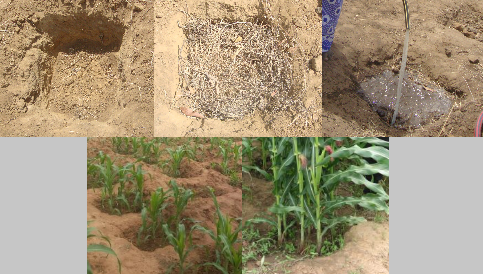
Image is of Zaï holes from Wikipedia

NEXT: Half-moon basins
Note: I am developing this post gradually as I do the research and learn how to properly embed images. Please be patient!

 
Lif Strand
pollinator
Posts: 390
Location: New Mexico USA zone 6
91
3
  • Likes 5
  • Mark post as helpful
  • send pies
    Number of slices to send:
    Optional 'thank-you' note:
  • Quote
  • Report post to moderator
HALF-MOON BASINS


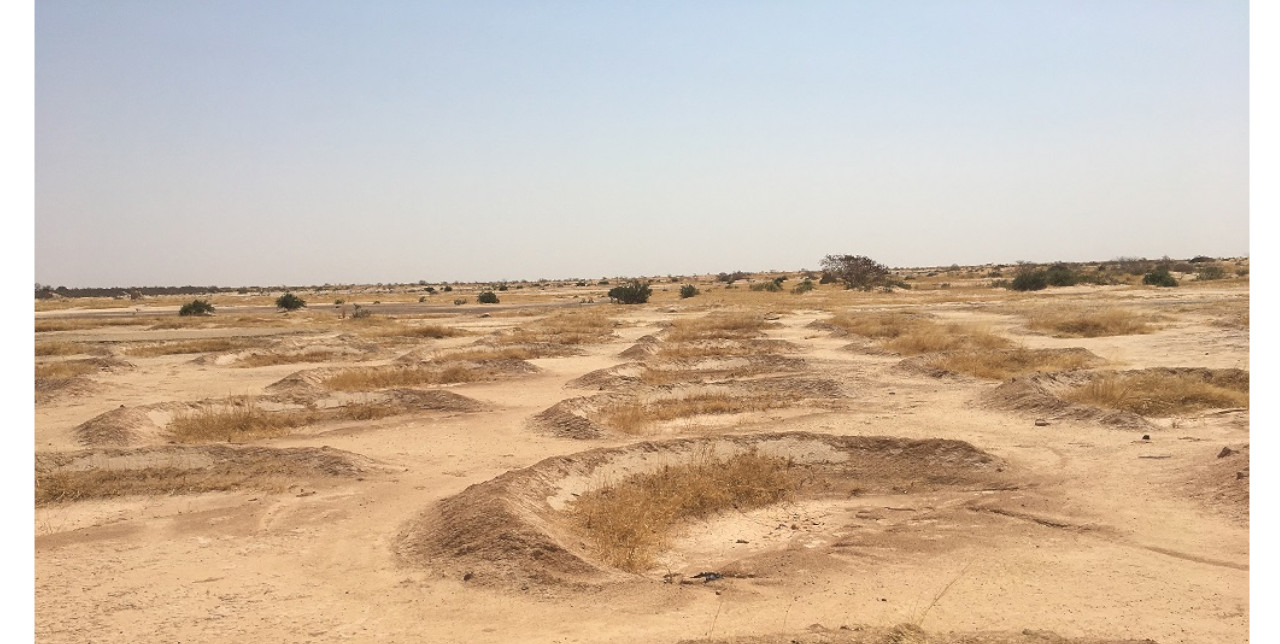
Photo: Half moon basins in Niger during dry season.

in Africa, half-moon basins (also called bunds) are used on gentle slopes. They're dug out with pickaxe and shovels and the removed soil shaping a half-moon berm about 3 m (a little over 3 yards) in diameter and about 25-50 cm (10-20 inches) deep. Soil/manure are added to the inside of the half-moon, which collects rainwater that would otherwise just have run off.  

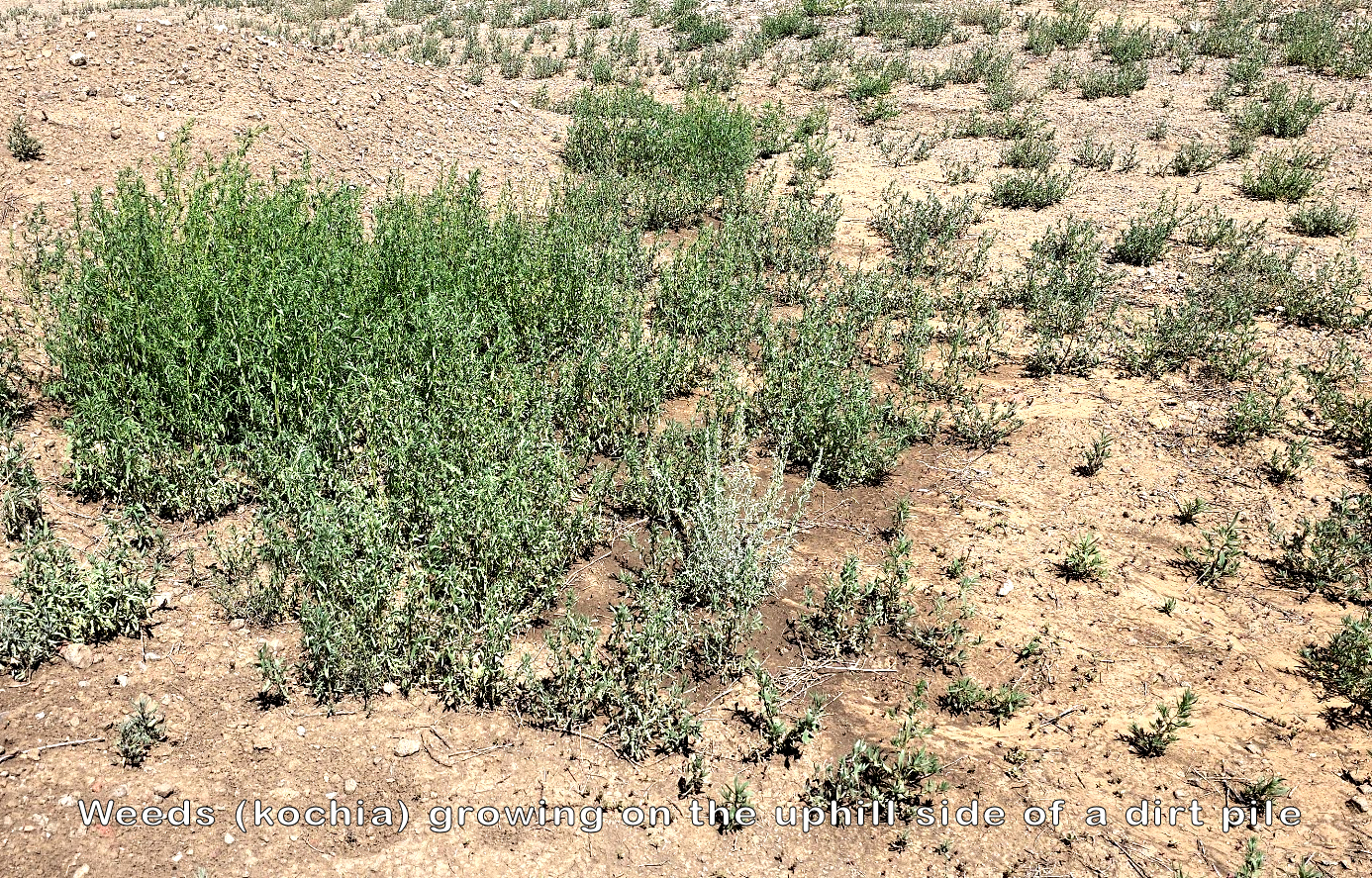
I have noticed here in my part of New Mexico that anything that even mildly blocks water runoff tends to be at least marginally greener than elsewhere. This includes hoofprints of elk and cattle, the uphill sides of rocks or downed branches, or my own efforts at slowing down the flow of water that gushes down off of mesa sides whenever it rains here.

The photo below shows the moist soil from a recent rain of less than a tenth of an inch. Surrounding soil surface has already dried. Obviously the weeds (kochia) love that spot!

I'm very fond of this kind of water retention/restoration. Check out Regreening Sub-Saharan Africa website if you're interested.

NEXT: Waffle gardens
Note: I am developing this post gradually as I do the research and learn how to properly embed images. Please be patient!
Half-moon-gardening-example.jpg
Not a purposefully made half-moon berm, but it still catches water.
 
Lif Strand
pollinator
Posts: 390
Location: New Mexico USA zone 6
91
3
  • Likes 4
  • Mark post as helpful
  • send pies
    Number of slices to send:
    Optional 'thank-you' note:
  • Quote
  • Report post to moderator
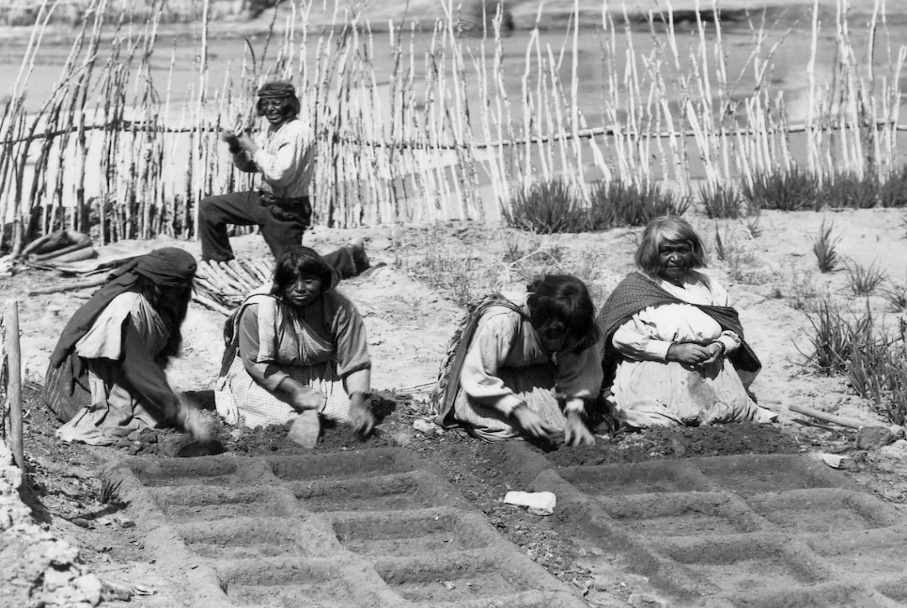
In North America, waffle gardens are a centuries-old Zuni technice for high-altitude, semi-arid desert climates.   In Zuni, these are called latdekwi:we (pronounced lah-deh-kwee-weh), and do the same thing that breakfast waffles do today: they capture liquid in indented, walled grids.


The image above is of a group of women building waffles and a man working on the stick fence surrounding the garden. Photo Credit: A:shiwi A:wan Museum Photo Archives


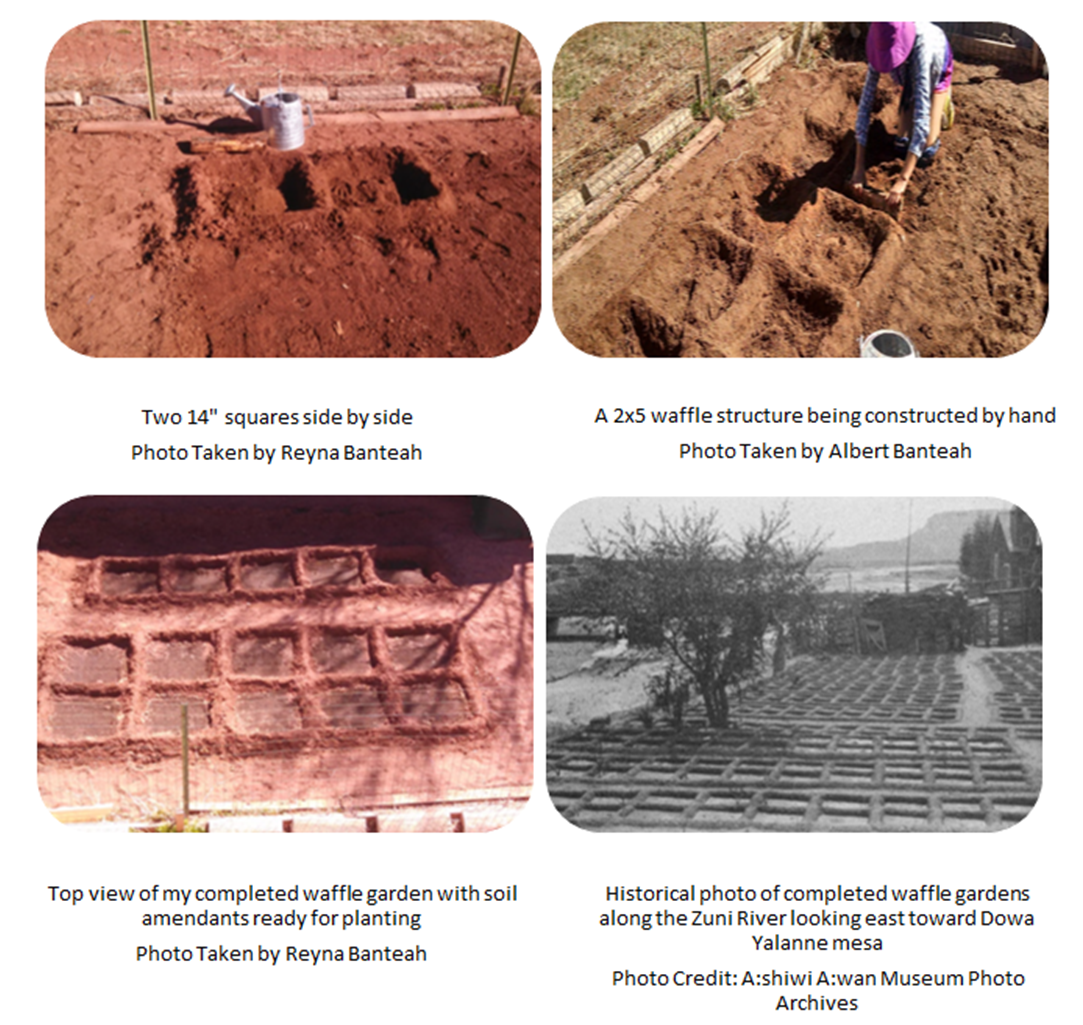
The four images above are from https://abqstew.com/2016/04/20/the-benefits-and-age-old-success-of-waffle-gardens-a-history-on-one-of-the-oldest-sustainable-farming-methods-of-the-southwest/. The webpage provides a description of the actual way to create the waffles.

Waffle gardens work best in soil with a strong clay component in order to hold the shapes of the walls.  Soil additives (compost, sand, etc) are added to the bottom.  Each square creates a microclimate for growing plants suited for higher altitudes and semi-arid climates. The waffle walls act much like those of adobe homes - retaining heat during the day to radiate at night. The walls give some protection from wind - always an issue in my part of western New Mexico, and when the waffles are filled with water, the wet clay holds the water for slow release to the plant roots and humidifies the air within the waffle.

Waffle gardens are similar to Zaï (or tassa) gardening as described in a previous post, as they both rely on plants growing from holes in the soil, but there are a few differences: Zaï technique does not use clay walls, as the water comes from downpours and subsequent surface runoff. Waffles are situated away from rain runoff, and require hand watering, since flooding would wash away the walls. Additionally, the manure and other amendments of Zaï gardening are chosen to attract termites, which break up the hardpan soil.


Next: Tulukur beds
Note: I am developing this post gradually as I do the research and learn how to properly embed images. Please be patient!
 
Brace yourself while corporate america tries to sell us its things. Some day they will chill and use tiny ads.
Experience months or even years of natural building and growing your own food
https://wheaton-labs.com/bootcamp
reply
    Bookmark Topic Watch Topic
  • New Topic