posted 2 months ago
Hi folks,
I have learned so much from y'all over the years, and now after many unfruitful attempts to root my beloved Illinois Everbearing Mulberry from cuttings, I have finally hit big success this spring/summer from air-layering, and now need the advice of you fine folks so I don’t mess things up at this stage.
My goal is to augment and expand my orchards of this cultivar of mulberry on my mountain ranch, but the source tree is growing at my house in the suburbs. The destination of these new trees is Zone 5B/A, but where the source tree and the cuttings are currently located is Zone 7A.
My question is, when should I move the cuttings from the Zone 7A bed where they are developing their roots to the Zone 5B/A mountain ranch where they will be planted for good?
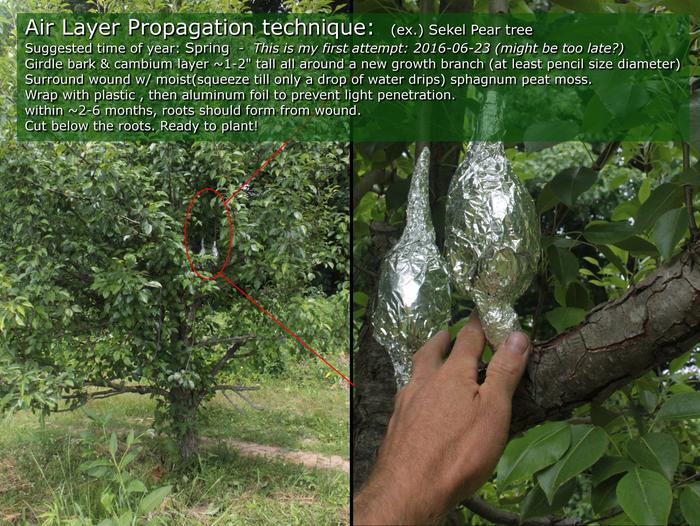
After having no success with rooting cuttings, both hardwood, softwood, and semi-softwood, using different rooting hormones and no hormones, and trying different media (sand, perlite, vermiculite, peat moss, promix, soil), I attached some air-layering pods to small branches on my tree on April 14 of this year, when the leaves were beginning to open, using rooting hormone. I maintained these branches by trimming off any developing fruit so that the branch could focus on leaves and grow the roots. All three of the layerings that had not broken off in a windstorm had some roots (not a bunch, but some) by late June, and I planted them in a partially-shaded place in my yard in promix (50-50 peat moss-perlite) before leaving town for a couple of weeks.
Given my past experience with rooting cuttings, I was not hopeful, but when I got back, I was delighted to see that all of the cuttings had grown new leaves and were thriving, as they are today. When I took the air layerings off of the tree in late June, I cut each to 6 nodes, trimmed all but two leaves off, cut those remaining leaves down to about 1/3 size, and wrapped the top and areas where I trimmed the leaves were (everywhere that I had cut) with film. New leaves are now pushing through the tape, and the cuttings are thriving.
When I took the first set of air layerings off of the tree, in late June, I attached the five pods onto new limbs that had grown completely this year and had no developing fruit, and with four still on the tree and doing well, just this morning I took one branch off that had broken in the pod during a thunderstorm last night, and it already has roots.
Both the first round and this next set of layerings are planted in an interesting area behind my house that was a rockscape when we bought the house 9 years ago, but which we have turned into, at various times, a flower garden, vegetable garden, and now a rooting patch. It is about 12 to 18 inches of very clay-heavy soil on top of what looks like a solid, flat brick surface, and for develpoing cuttings and air-layerings, I remove the soil from an area and replace it with my own blend of promix, which is peat moss with a very heavy admixture of perlite.
I have been tending to the cuttings in the rooting patch with a light dose of low-N, high-P fertilizer every two weeks to help the roots grow and encourage some leafy growth, and will likely stop the feeding of the June plantings in August, and the August plantings in September.
So that I don’t screw things up at this late stage, I am wondering when folks recommend I move the new cuttings (both the ones that went into the rooting patch in late June, the one that went in today (late July), and the ones that will go in some time between mid and late August to the mountains where they will be planted.
My options, as I see them, are (i) to move all of the new trees to the mountains this fall and hope they get established; (ii) move the ones that have been in the promix on their own and thriving since late June, and keep the ones that are coming off the tree later over the winter in my rooting bed to be moved in the spring; or (iii) let them all over-winter here in Zone 7A, and move them to the mountains in the spring.
Regardless of where they will be over the winter, I plan to mulch considerably to protect the new roots from the cold. If I move either all or a subset of the new trees in the spring, when do you recommend I do it? Should it be when it is still cold and everything is dormant, or should I wait until the chance of hard freezes in the mountains are gone? The latter would necessitate the leaves being quite advanced before moving, since deep freezes are common well into May in the mountains, at least six weeks later than they happen in 7A where the trees are now, and will potentially be until the spring.
Thanks again for your help, and I look forward to hearing what y’all think!






 3
3