
• Post Reply Bookmark Topic Watch Topic
  • New Topic
permaculture forums growies critters building homesteading energy monies kitchen purity ungarbage community wilderness fiber arts art permaculture artisans regional education skip experiences global resources cider press projects digital market permies.com pie forums private forums all forums
this forum made possible by our volunteer staff, including ...
master stewards:
  • Carla Burke
  • Nancy Reading
  • John F Dean
  • r ransom
  • paul wheaton
  • Jay Angler
  • Timothy Norton
stewards:
  • Pearl Sutton
  • Tereza Okava
  • Nicole Alderman
master gardeners:
  • Christopher Weeks
gardeners:
  • M Ljin
  • Megan Palmer
  • Pete Podurgiel

Bees In The Garden

 
Posts: 122
Location: West central Minnesota
57
  • Likes 13
  • Mark post as helpful
  • send pies
    Number of slices to send:
    Optional 'thank-you' note:
  • Quote
  • Report post to moderator
Have to report what I am seeing on my MN 13 open pollinated heirloom corn growing in the garden. The hum of bees the last few days on the tassels is something else, audible from a distance. The bees carry the pollen on their body and you can see these pollen sacs. There are also mating lady bugs on the corn leaves, my beneficial insects are having a big party on the corn. This is how it used to be, the farm crops were bug friendly and with this biodiversity was sustained. I also have this same corn planted elsewhere on the farm but have planted some in the garden because I found 2 ears last year that had large and heavy kernels, nearly 50% heavier than the average. Want to see if the garden corn will replicate to any degree ears with large and heavy kernels.

There are cucumbers and pumpkins blooming, they are loaded with bees as well.
 
steward
Posts: 19464
Location: USDA Zone 8a
4900
dog hunting food preservation cooking bee greening the desert
  • Likes 5
  • Mark post as helpful
  • send pies
    Number of slices to send:
    Optional 'thank-you' note:
  • Quote
  • Report post to moderator
How does corn taste from large and heavy kernels?
 
Doug McEvers
Posts: 122
Location: West central Minnesota
57
  • Likes 8
  • Mark post as helpful
  • send pies
    Number of slices to send:
    Optional 'thank-you' note:
  • Quote
  • Report post to moderator
This is a field corn and I do not know about using it for food. Have been working with it for about 12 years and the MN 13 I have has been selected previously for early maturity (about 87 days) for this part of the country. My quest is to see if it can produce sufficiently to replace some of the modern corn varieties. Roundup Ready and the neonicotinoid infused corns are not bug friendly. Modern farming is devastating our pollinators. I will in time send a sample to organic yellow corn milling companies for an evaluation but not this year, need more research here.

Anne Miller wrote:How does corn taste from large and heavy kernels?


If we could replace some of the 95,000,000 acres of US corn with more Earth friendly varieties, I would be happy and so would the bugs.
 
Doug McEvers
Posts: 122
Location: West central Minnesota
57
  • Likes 9
  • Mark post as helpful
  • send pies
    Number of slices to send:
    Optional 'thank-you' note:
  • Quote
  • Report post to moderator
The bees are going strong again this morning on the heirloom field corn. Watched a ladybug feeding on the pollen grains on the corn leaf, some pieces of the puzzle are starting to fit. There was also a very tiny spider working the corn leaves as well, the minutiae are so interesting. The dew this morning provides water for the bugs, we still have dew even though our rainfall has been 1/10" over the last 33 days. Fargo, ND is approaching 1/2 of the normal precipitation for the year 2026. Resilience is being tested, would not have much of a garden without supplemental watering. In 2022, what I would call a perfect growing season, did not water the garden, so it can be done.

The reason I am growing field corn in the garden is two-fold. I am interested to see how selection of specific ears might show up in this year's crop, this is how old varieties might be improved. Secondly, the deer love this heirloom corn and I better put up my fence soon, they will eat the plant along with the green ears. It is thought the older heirloom varieties take up more nutrients than do the more modern ones, the deer know. This should also equate to more nutrient dense grain but that is yet to be considered here.
 
pollinator
Posts: 799
Location: SE Indiana
471
dog fish trees writing
  • Likes 9
  • Mark post as helpful
  • send pies
    Number of slices to send:
    Optional 'thank-you' note:
  • Quote
  • Report post to moderator
Wow, your corn project sounds pretty much like mine and been at it about the same amount of time. Mine is pretty much settled on large heavy kernels and I also favored fewer rows of kernels as well as a couple other things. This year I have around thirty ears that meet all the criteria and overall, the diversity is wide enough that these ears can start a new semi-stable variety. Is yours a single heirloom that you have been preserving or is it also a mix up of heirlooms?
 
Doug McEvers
Posts: 122
Location: West central Minnesota
57
  • Likes 8
  • Mark post as helpful
  • send pies
    Number of slices to send:
    Optional 'thank-you' note:
  • Quote
  • Report post to moderator
Mark,

You have jogged my memory, thank you. The MN 13 I have is a single variety from what I have been told. As far as I understand it, the seed was selected for early maturity by a man named William Mellum (1950's) in Ulen Township, Clay County, MN. This seed was passed on to a man who grew it in Falcon Heights, MN for a number of years. He passed it on to a good friend of mine. My friend shared some of the seed with me in 2012 I think and I have been working with it since. MN 13 is available as a 100 day corn locally, what I have been growing is thought to be 87 days. I plant it no earlier than June 1 to avoid crossing with other neighboring field corn, this seems to be working. My larger plot was planted on June 5 of this year, that in the garden on June 8. It just pollinating now, far behind the neighboring corn fields. It seems to be a favorite of deer, pheasant, ducks and fox squirrels.

Your post made me look in our 1957 Clay County plat book, there it was, William Mellum, Ulen Township. This corn was known as the Mellum Strain.
 
pollinator
Posts: 1072
Location: Illinois
252
  • Likes 4
  • Mark post as helpful
  • send pies
    Number of slices to send:
    Optional 'thank-you' note:
  • Quote
  • Report post to moderator
Very interesting. I also grow OP corn. Some years I see bees on the pollen, but most years not. I have heard that corn pollen is not very attractive to bees. I suspect when I see them on the corn it is because there is a pollen dearth and they are taking whatever they can find even if it is second choice.

Do you have any pics of your corn?
 
Thom Bri
pollinator
Posts: 1072
Location: Illinois
252
  • Likes 5
  • Mark post as helpful
  • send pies
    Number of slices to send:
    Optional 'thank-you' note:
  • Quote
  • Report post to moderator

Doug McEvers wrote:Mark,
It seems to be a favorite of deer, pheasant, ducks and fox squirrels.


My corn is much preferred by the local birds. They can destroy the patch if I don't prevent it. I have walked from my corn to a nearby commercial corn field and compared. ALmost zero bird damage on the commercial corn vs heavy damage on my corn. I figure it tastes better, and they are attracted to the purple leaves.
 
Doug McEvers
Posts: 122
Location: West central Minnesota
57
  • Likes 6
  • Mark post as helpful
  • send pies
    Number of slices to send:
    Optional 'thank-you' note:
  • Quote
  • Report post to moderator

Thom Bri wrote:Very interesting. I also grow OP corn. Some years I see bees on the pollen, but most years not. I have heard that corn pollen is not very attractive to bees. I suspect when I see them on the corn it is because there is a pollen dearth and they are taking whatever they can find even if it is second choice.

Do you have any pics of your corn?


Thom,

You may be right about the bees and corn pollen. We are very dry here, there is not much blooming, so this is what's available. Normally there would be quite a bit of white sweet clover on the margins right now, I need to take a prairie walk. Have been leaving thistles in the yard, monarch butterflies are all over them. The warm season native grasses are showing dormancy, about 6 weeks early. No pictures of the OP corn, need to update my system. What is the heritage of your OP corn and what do you select for if anything? The diversity between plants is really interesting, some high ears, some low, different heights, silk color. The one thing I do select for is standability, will not take an ear from a plant that is not standing strong. This is one of the weaknesses of the OP corns, not as much lignin as the hybrids. This is why it is much more palatable and digestible for livestock.
 
Thom Bri
pollinator
Posts: 1072
Location: Illinois
252
  • Likes 8
  • Mark post as helpful
  • send pies
    Number of slices to send:
    Optional 'thank-you' note:
  • Quote
  • Report post to moderator

Doug McEvers wrote:

Thom Bri wrote:Very interesting. I also grow OP corn. Some years I see bees on the pollen, but most years not. I have heard that corn pollen is not very attractive to bees. I suspect when I see them on the corn it is because there is a pollen dearth and they are taking whatever they can find even if it is second choice.

Do you have any pics of your corn?


Thom,
What is the heritage of your OP corn and what do you select for if anything? The diversity between plants is really interesting, some high ears, some low, different heights, silk color. The one thing I do select for is standability, will not take an ear from a plant that is not standing strong. This is one of the weaknesses of the OP corns, not as much lignin as the hybrids. This is why it is much more palatable and digestible for livestock.


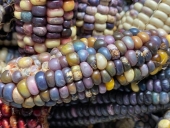
Originally it was a pound of seed I bought from a local garden store, I have no idea what variety. Some ornamental 'Indian' corn, very colorful. Since then it has crossed with quite a few different varieties. It was grown alongside sweet corn for many years and picked up whatever was in that. Also, commercial hybrid corn so certainly quite a bit of that. Presumably some GMO stuff. And I have grown several other OP varieties mixed in, so it is quite the mix. For about 20 years I have been selecting for red and purple coloration of the leaves, silks, ears and cobs so it is very purple now. For the last 5 years I have been selecting away from the visible hybrid corn traits, so I no longer see much dent corn. It is now a dark red to purple flint corn.

#1 selection is no mold. Any ear with mold gets tossed.
#2 is ear size. I select the largest, longest, fattest ears.
#3 is other ear and seed traits, purple to red color, no bird or insect damage.

I don't do stalk selection per se.
PXL_20260728_163206667.jpg
[Thumbnail for PXL_20260728_163206667.jpg]
 
Doug McEvers
Posts: 122
Location: West central Minnesota
57
  • Likes 6
  • Mark post as helpful
  • send pies
    Number of slices to send:
    Optional 'thank-you' note:
  • Quote
  • Report post to moderator
Thom,

That is quite a corn, very healthy looking plants. I need to be mindful of my seed for next year, we are so dry, might not be any on my larger planting. That in the garden has been getting water but is only seed from 2 cobs. My larger planting this spring was seed from 200 to 250 ears, want to keep a lot of diversity in the population. Had 1/2" of rain this morning, may have broken the ice.
 
Posts: 2
Location: Venezuela
  • Likes 6
  • Mark post as helpful
  • send pies
    Number of slices to send:
    Optional 'thank-you' note:
  • Quote
  • Report post to moderator
Having bees in your garden is a true blessing; they are incredible pollinators, and without them, even commercial agriculture wouldn't survive.

I've had some problems with bees in my yard because some of the ones that come seem more interested in stinging me than pollinating the flowers 😅

I live in Venezuela, and here it's common to find Africanized bees in the wild, due to what happened decades ago in Brazil. We also have another pollinator here known as the hairdresser bee. It's a type of stingless, black bee that is generally harmless, but sometimes they can get tangled in your hair. This has never happened to me, and I get along very well with them 😊

I love seeing them in my yard pollinating my amaranth plants and enjoying the flowers of my moringa tree.
 
This one time, at band camp, I had relations with a tiny ad.
grow your own garden and build your own home in the gardening gardeners program
https://wheaton-labs.com/bootcamp
reply
    Bookmark Topic Watch Topic
  • New Topic