gift
permaculture thorns eBook - DRAFT
will be released to subscribers in: soon!

Scott Perkins

+ Follow
since Nov 14, 2012
Merit badge: bb list bbv list
For More
Apples and Likes
Apples
Total received
In last 30 days
0
Forums and Threads

Recent posts by Scott Perkins

Some might consider this to be somewhat related,   I mix cheap because of wrong mis tint of custom color
latex paint from HomeDepot   and mix with portland cement  to create a flexible but tough covering over aging roofs where the shingles are degraded on  small utility sheds and other out buildings.  Before  I add enough water to make it paintable it seems a little like plastic if you wanted to trowell it on  or use it a mortar etc.
Think about the possibilities.  
1 day ago
This all leads back to my focus on admixtures in concrete that make it waterproof and impermeable to salt and other corrosive elements which then would also preserve the rebar from corroding.  I mentioned Surfside Condo as  at least a major catalyst in my awareness of the short lifespans of present day concrete.  Not only that but some admixtures massively increase the strength.  I dare say that if Surfside Condos were built with concrete modified with a few million dollars of the optimum admixtures ....  the Condos would still be standing today
and maybe for another 20 , 40, or 100 years.   Lets face it, if there is no degradation of material properties then why should it ever come down ?       I am saying that we at Permies can piggy back on this relatively new technology just as the bridge builders are doing.
1 day ago
For me, the collapse of the Surfside Condo in Miami, FL started an industry wide focus on the susceptibility and degradation in moisture rich and salt laden environments of our modern concrete.  Contrast this with some of the Roman structures that have survived hundreds of  years and there is now a big focus on concrete admixtures that increase the strength, create some self repairability, and make it completely impermeable and waterproof such that there should be zero degradation over time.   The major problem that is causing concern is the sometimes 25 to 35 year lifespan for major hi-rise and commercial buildings... same as smaller residential structures.    The government  has already studied and determined almost that any expense is worth building bridges that dont collapse with age.   I personally have been adding the "latex" admixtures that tile layers use for their portland cement when they make shower walls and floors ....  to my concrete mortar mix when I make outside steps and porches  with bricks.    I also have found  cheap mis colored Home Depot paint mixed with  Portland cement and painted on top of some old outbuilding asphalt roofs to be life extending ( so far for 14 years )    The point is that there is a big science right now in admixtures being added to cement to dramatically increase the lifespan and or strength and or water proofing etc.   Think about the shot crete walls of swimming pools?   Why cant we have that kind of waterproofing in foundations ?    I dont think a homeowner should ever be told that their house is now depreciating instead of appreciating because   cheap building components.   What do you think ?
3 days ago
I'd like to take some ques from Eskimos who also appear to build with dry stack blocks.   I've seen some molded concrete blocks that seemingly interconnect and-or overlap a bit to build retaining walls  and wonder if we couldnt produce a form for geometrical blocks to build either domes or probably better... Vaults.
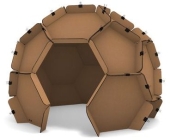
IF circular or spherical structures are not acceptable then I want to focus on the significant benefits of grooves and tongues that can be molded in concrete blocks that can significantly enhance strength and if engineered can reduce material usage because of the strength.  ( In cases where a structure is calculated to produce a certain amt of strength.... less materials would be required.)    Whenever I cur oranges or grapefruits in half I think of the sections as suitable shapes for dome components... same as when I see soccer balls.  I look at the geometry of the hexagons and pentagons.
3 days ago

William Bronson wrote:Neat idea, I love building methods that can be done incrementally.
To minimize the number of molds needed and the size of the pieces, maybe try this kind of dome:

https://www.domerama.com/calculators/trapezium/

This is like the orange slices.
To figure the dimensions of a block rather than a flat panel, calculate an inner and an outer dome and the distance between the two.

I think styrofoam blocks skinned in netting and plastered with cement could be a good option.


I really think the trapezium idea could work..  There are a total of 64 pieces and the use of four different mold shapes.    I am afraid even if the molds were made with two pieces  resulting in each piece shaped like a bowl
to hollow out the pieces and make them lighter,  I still wonder if they would be too heavy if made with pure concrete.  If Styrofoam concrete was used then would they still be strong enough ?   Wonder what it would cost to convince a styrofoam mfgr to build molds and produce pure styrofoam blocks that could be glued together.?
and then the styrofoam  dome could be covered with net and plaster of some type for weather protection.
If the eskimos can do it with ice we ought to be able to do it with something else that wont melt  
1 month ago
In the world of landscaping and building retaining walls there are a few different shaped concrete blocks which are designed for dry stacking but they are specifically designed for curved walls.  These blocks have grooves and notches that interlock at the ends and on the outside edges and in the case of the retaining wall that I built, I filled all the holes with small gravel.   Filling the holes with mortar and rebar would be incredibly strong.
Check out landscaping or retaining wall blocks to consider your options.   I should note that each extra row of blocks with the interlocking front edge results in a setback of each row of about a half to one full inch.
The big problem comes in where you would have a corner of two intersecting walls.  There is no easy way I know of to allow the corners to meet smoothly.  So if building an enclosed stand alone structure, you almost have to build a dome or a cone shape.  
1 month ago
For years I have been thinking of how to build a mold or a couple of different molds   that I could poor concrete into  where I could make one or two pieces a day  for a few months  to get enough parts to be able to stack together like an IGLOO for a dome or as a VAULT .    I have seen Igloos made from Styrofoam parts   but a concrete igloo would be much more durable.   Sometimes I think of a Soccer Ball for parts of a sphere but there must be more ways to build a dome.... Such as Orange slices  of an orange fruit that has been cut in half.
Anyone else ever think of this ?   I would like a way for the pieces to if not  lock together , at least a ledge that helps reinforce the next  row.   You would never want to be in  a concrete igloo when it collapses!   How to make it strong ?    We know how the Romans used stones to build arches and bridges etc.

2 months ago

Tereza Okava wrote:

Scott Perkins wrote:My stockpile of red and pinto beans (and rice)  is now 25 years old.  


That's awesome, Scott, thanks for sharing!!!


I forgot to add that refried bean paste makes excellent bean sandwiches.    I got the idea thinking about peanut butter.   Peanuts are not nuts actually but really more of a bean.   So think about it,  they make peanut butter out
of peanuts so why not bean butter ?    We know that peanuts ( legume I think ) and wheat bread form a complete protein just like beans and rice for the worlds most consumed food.    So since wheat in bread is a grain like rice is,  I thought I would take some bean paste ( refried beans) and make a sandwich using wheat bread.   Really not bad.   I didnt think the addition of fruit jelly worked so well  but it depends on how hungry you are   Remember the onion flavored dip with half cottage cheese and half beans was a "protein power house " !        If no-fat cottage cheese is used  .... way way lower calories from  fat-oil  as is the case with peanut butter.
3 months ago
For many years I have tried to follow and keep up with all types of materials and techniques of building sheds etc. but  I have a new ide that I have never heard of anyone trying.  That is poor concrete into a mold on the ground and when hardened , use a tractor  to tilt up what would be a concrete wall that I think would be easier and cheaper than stacking bricks with mortar or blowing  concrete onto a form to make a dome etc.    I dont have enough knowledge about concrete to design the wall such as the mix to use or if and how reinforcement should be added to the the structure when pouring into the mold etc.    I have seen contractors build large warehouses using tilt up concrete wall components but I dont have a good handle on how  to adjust the placement of the concrete tilt up wall components.   I think if you located your molds carefully the walls will tilt up right into place.
Just imagine pouring a patio slab and then grabbing one end with a tractor, or bob cat with ropes and pulleys etc
and tilting it up vertically.   What could be better ?
3 months ago