• Post Reply Bookmark Topic Watch Topic
  • New Topic
permaculture forums growies critters building homesteading energy monies kitchen purity ungarbage community wilderness fiber arts art permaculture artisans regional education skip experiences global resources cider press projects digital market permies.com pie forums private forums all forums
this forum made possible by our volunteer staff, including ...
master stewards:
  • Carla Burke
  • Nancy Reading
  • John F Dean
  • r ransom
  • Jay Angler
  • Timothy Norton
stewards:
  • paul wheaton
  • Pearl Sutton
  • Tereza Okava
master gardeners:
  • Christopher Weeks
  • M Ljin
gardeners:
  • thomas rubino
  • Jeremy VanGelder
  • Megan Palmer
  • Likes 2
  • Mark post as helpful
  • send pies
    Number of slices to send:
    Optional 'thank-you' note:
  • Quote
  • Report post to moderator
This is a badge bit (BB) that is part of the PEP curriculum.  Completing this BB is part of getting the straw badge in Homesteading.

For this BB, you will be correcting a structural defect with an outbuilding!

Here is a short related video:


There is a 4 to 16 point range for this BB depending on the complexity of the fix.  Homesteading Oddball point math would apply (1 point per hour for a talented newbie doing the job with all tools and materials ready, and the research and head scratching complete)

To document your completion of the BB, provide the photos or video (<2 min) of the following:
 - the supplies you're starting with
 - the outbuilding with a structural defect
 - part way through repairing the structural defect
 - the repaired outbuilding
COMMENTS:
 
pollinator
Posts: 341
Location: Fairfield, Idaho, USA
106
hugelkultur purity monies dog duck books chicken cooking food preservation fiber arts medical herbs
  • Likes 1
  • Mark post as helpful
  • send pies
    Number of slices to send:
    Optional 'thank-you' note:
  • Quote
  • Report post to moderator
Submission pending approval
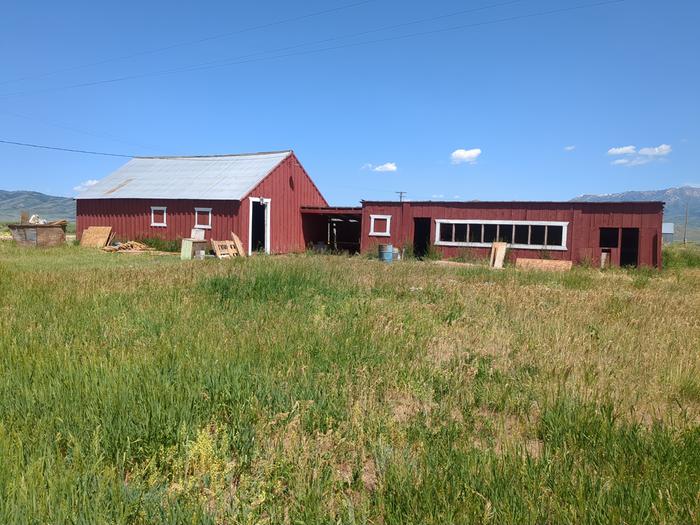
This is my attempt at this BB, I spent last summer figuring out how to keep the roof from collapsing in our barn so we could use it for chickens. There clearly used to be chickens in this section of the barn and the roof has the name of the town painted on it so it is a cool historical building that we would like to save. Not being familiar with any kind of construction, this took a lot of head-scratching and trial-and-error to figure out. If someone with more knowledge of building techniques sees anything seriously concerning please let me know so I can plan on improving this further. At the very least, I can say that I have extended the life of the roof with what I had available. As I was researching how to keep the roof from collapsing, I found diagrams of what I wanted to do but could not find the actual terminology to search on for more specific guidance for what materials to use but after putting it together I figured out what I would do differently next time so I learned a lot. I also discovered the importance of having certain tools like a chop saw in order to make angled cuts. Anyway, here is the whole saga of me trying to figure out how to save the roof with all the challenges and confusions.


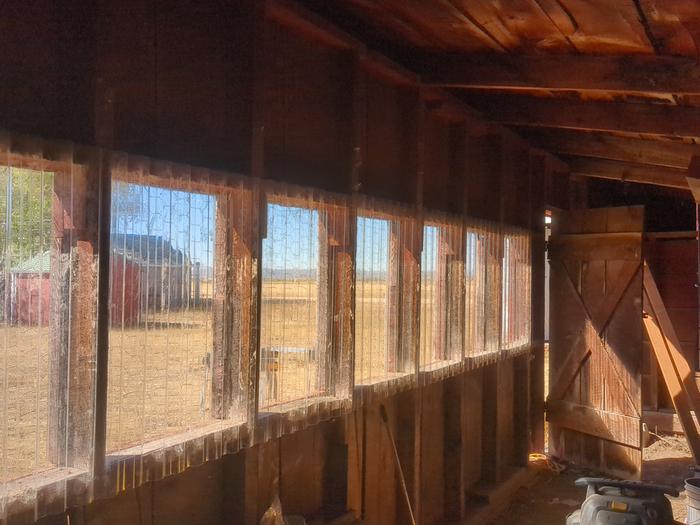
So this is the barn. The middle section with all the open windows is the section with the collapsing roof. We spent the whole summer cleaning this building out as it was full of garbage and old moldy straw.


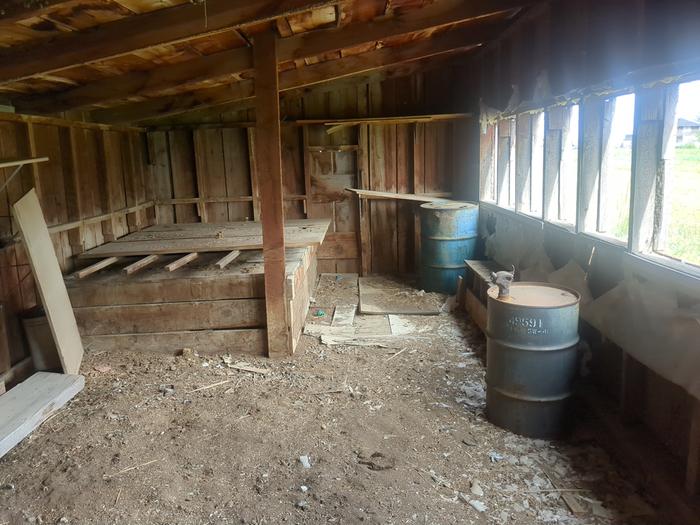
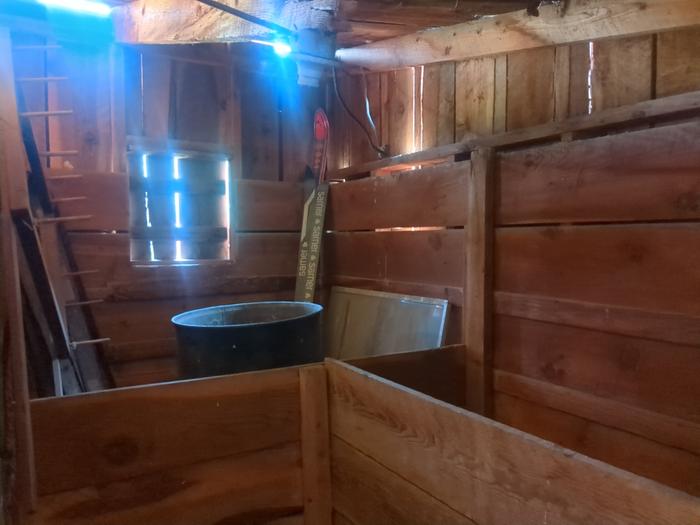
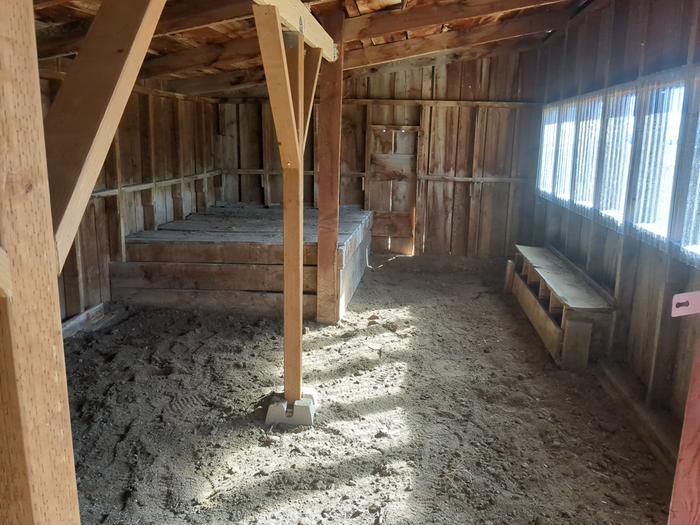
Here is the inside of the chicken area.


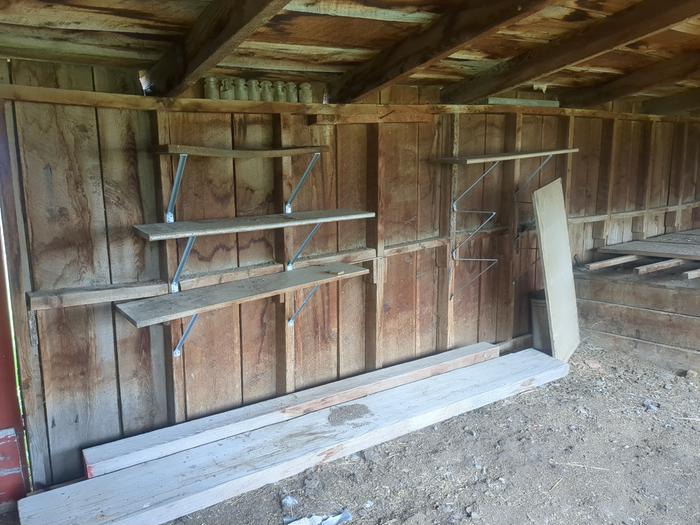
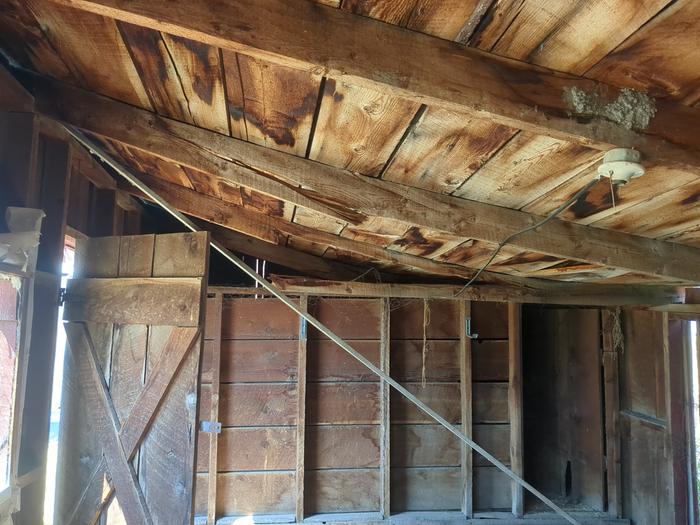
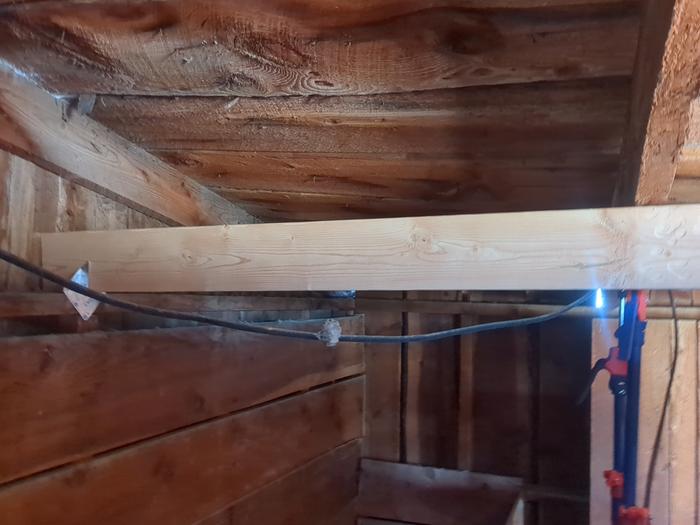
There were three split beams, this one was the worst. I'm pretty sure that wire to an old light fixture is what is holding this up.


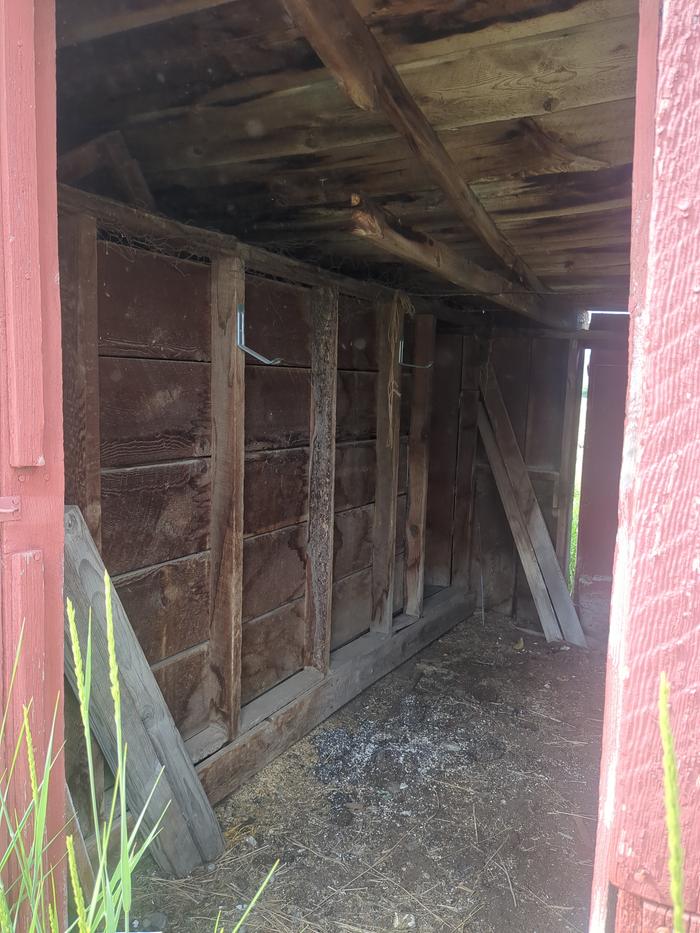
The little storage room also had a split beam.


Here is a view of the two split beams in the main area. One is completely split and the other is starting to split. The third one is the one in the little storage room.


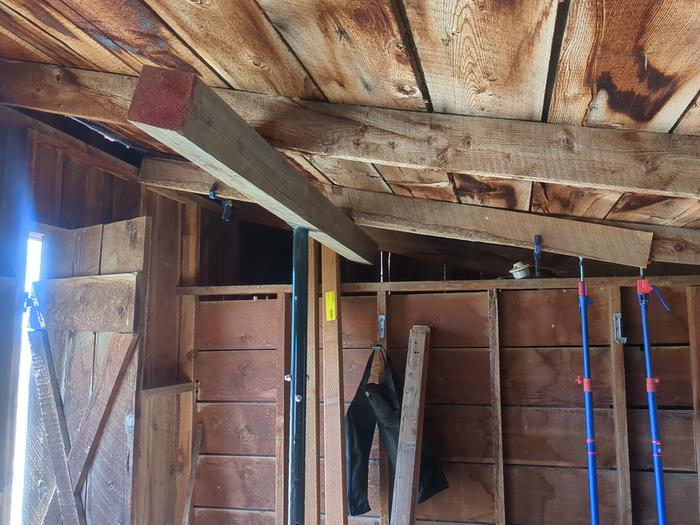
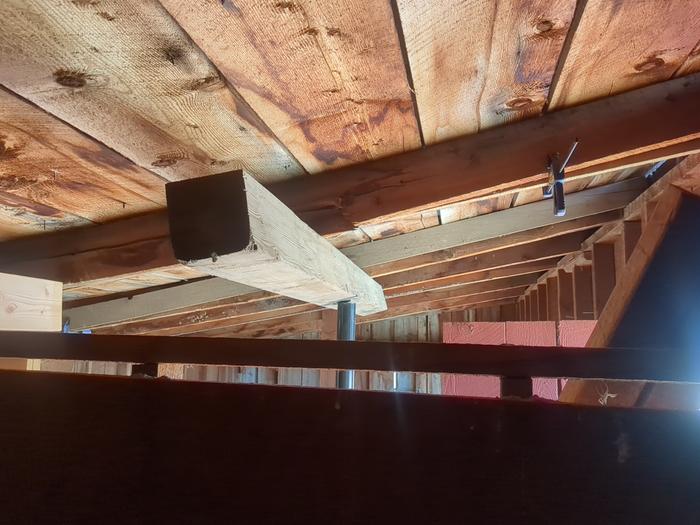
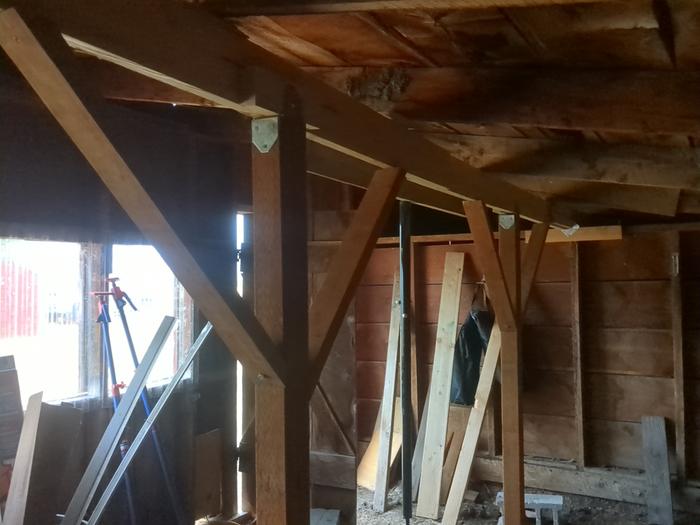
First I had to figure out how to lift up the roof. I bought some floor jacks. At first I got some cheap ones online (the blue ones) that were somewhat pressure-based so not able to hold a ton of weight. Then I got a much nicer one from Home Depot. There was a big beam in this room that I had my husband lift up above his head while I put the jack in place on a cinder block and then rotated it to lift it up so both split beams were supported by this horizontal beam that was then held up by this construction jack. I maxed out the height of this jack and didn't think we could get it to go any higher safely with what we had available.


Here is another angle of the jack and beam holding up the roof. You can see that I also found some long pieces of wood to sister against the split beams and once they were jacked up I nailed them in place to help hold them together.


I started off by supporting the third split beam in the little storage area with a 2x6 and a couple of hurricane strap brackets. Since the heavy-duty floor jack was in use, I propped this up with the two cheap jacks until I could wedge the lumber under the beam and I got it propped up on either side with existing parts of the barn structure. If I were to do this again, I would not use 2x6s as beams, I would use something more square because the angle of the roof made it difficult to put in place and I think that would distribute the weight better. I would probably want to ask someone at the lumber yard what kind of lumber to use and if there is a specific kind of "roof beam" lumber (I still have not figured out the right search term for what kind/size of lumber if used for roof beams). I ended up using 2x6s because that is what looked like would fit inside the hurricane straps and in researching what types of brackets I should use that seemed like a good option for this particular situation.


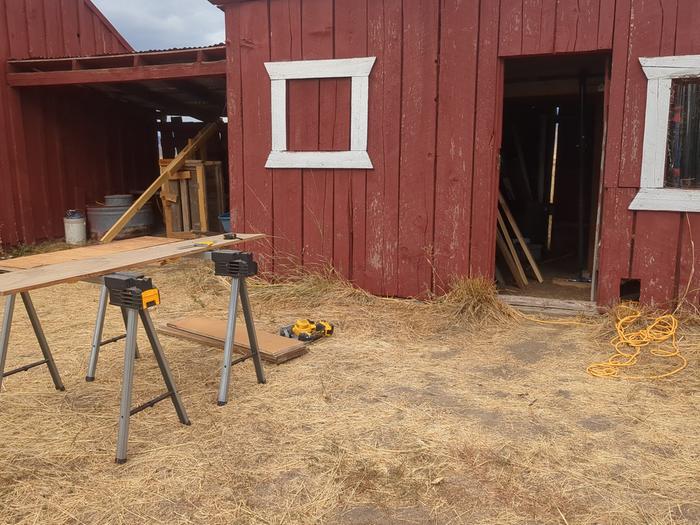
Here's my setup outside. The lumber I used for propping up the roof is just inside the door and the wood on the jackstands was for boarding up a door on the backside that wouldn't close. All I have for cutting is a circular saw.


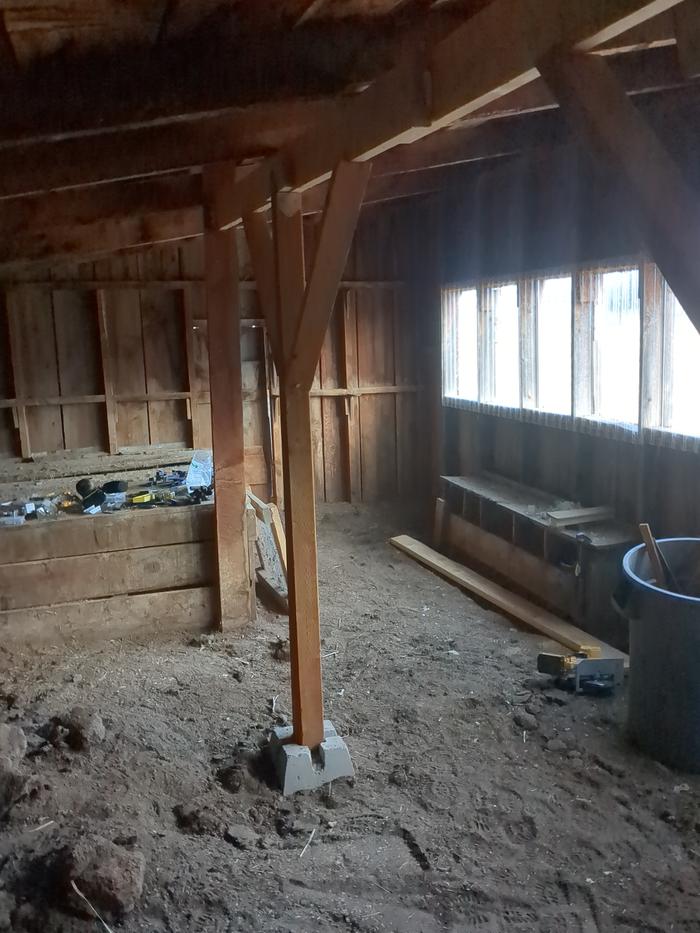
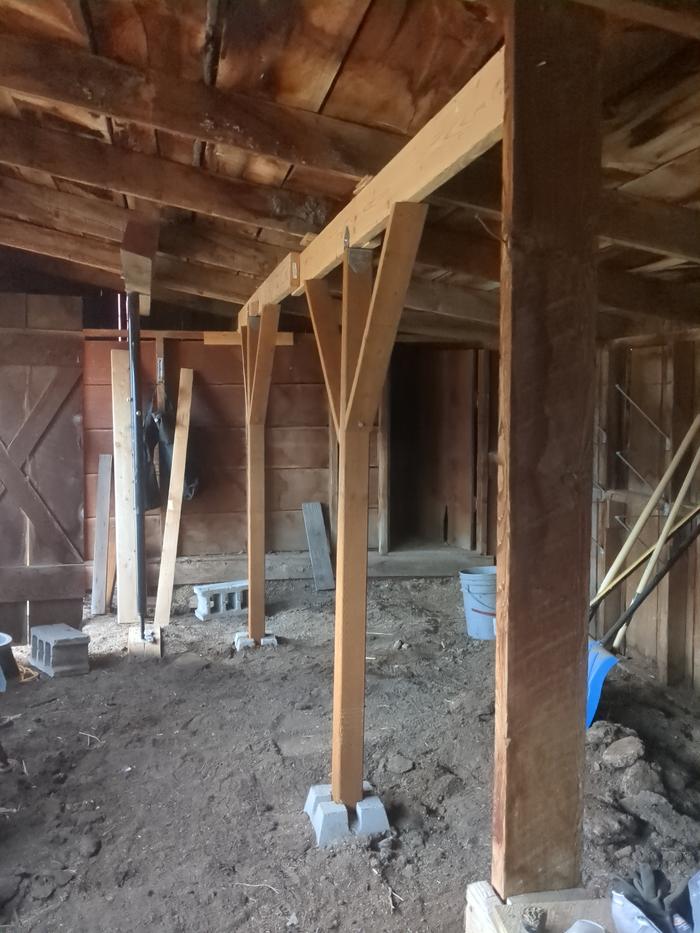
So for the main section I used two more 8-ft 2x6s as beams and held them up with pressure-treated posts that I held in place with cinderblocks (concrete footing blocks, I believe they are called). I used 4x4 posts because that was the size that fit in the blocks. I used pressure-treated 2x4s to make a "Y" shape on either side and this is where I was going off of a diagram I found online instead of knowing what this structure is called. It looked like the angled "Y" posts were smaller than the 4x4 post in the diagram I was looking at but after building this I started noticing this structure in other buildings and it looks like they usually are the same size (also a 4x4). I also learned what a lag bolt is because that is what my diagram said to use.


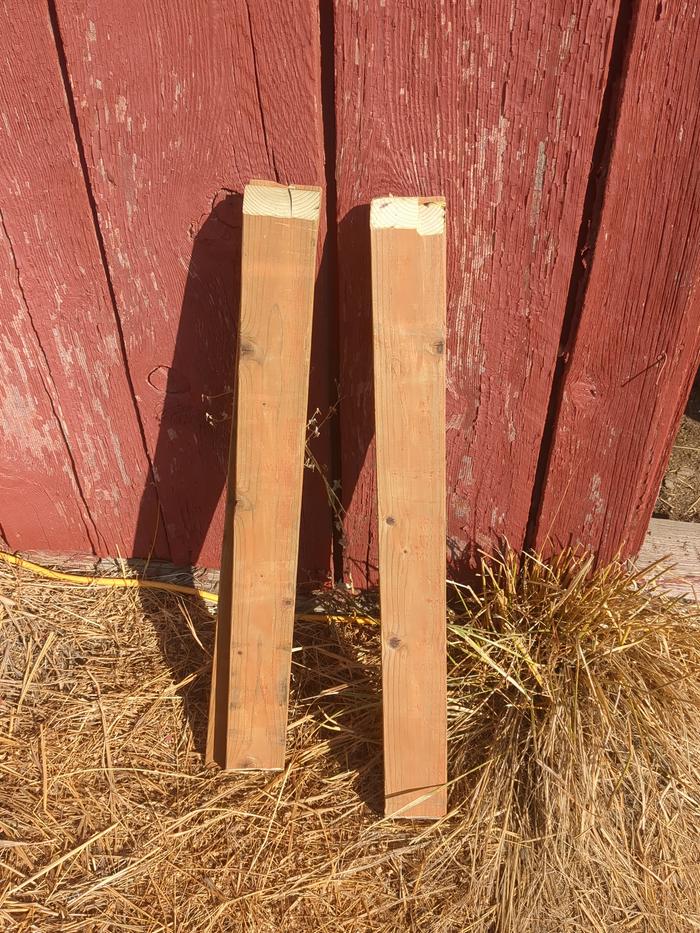
I had to cut these pieces at a 45-degree angle and I was not able to get a good cut with my circular saw so I brought them to a friend's house to use their chop saw.


On top of the posts I had a bracket to connect the post to a beam and I discovered that I had mis-interpreted the size of the bracket. I bought 2x6s to use as beams because I thought that that was the size that would fit in the bracket, but I learned that the bracket expected something thicker (so next time I will get something bigger than a 2x6). I had to stick some extra scrap pieces of wood next to the 2x6s to hold them in place. I got the biggest pieces of 2x6 I knew I could fit in my truck safely (8-ft) and I nailed them together where they meet. Each beam is held up with its own post in the middle.  I also attached the 2x6s to the existing roof beams where I could with hurricane straps.


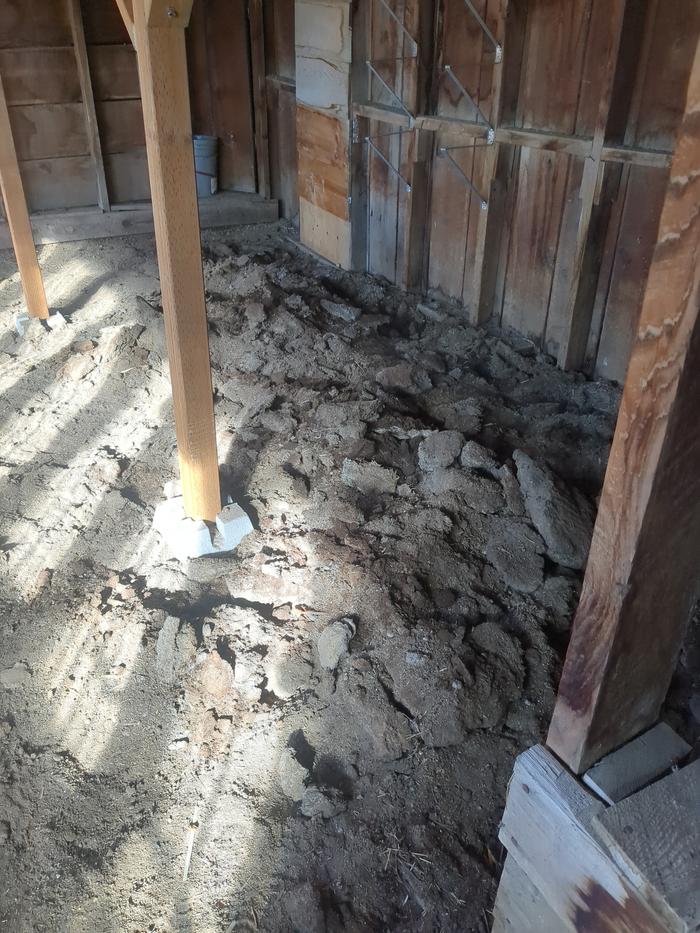
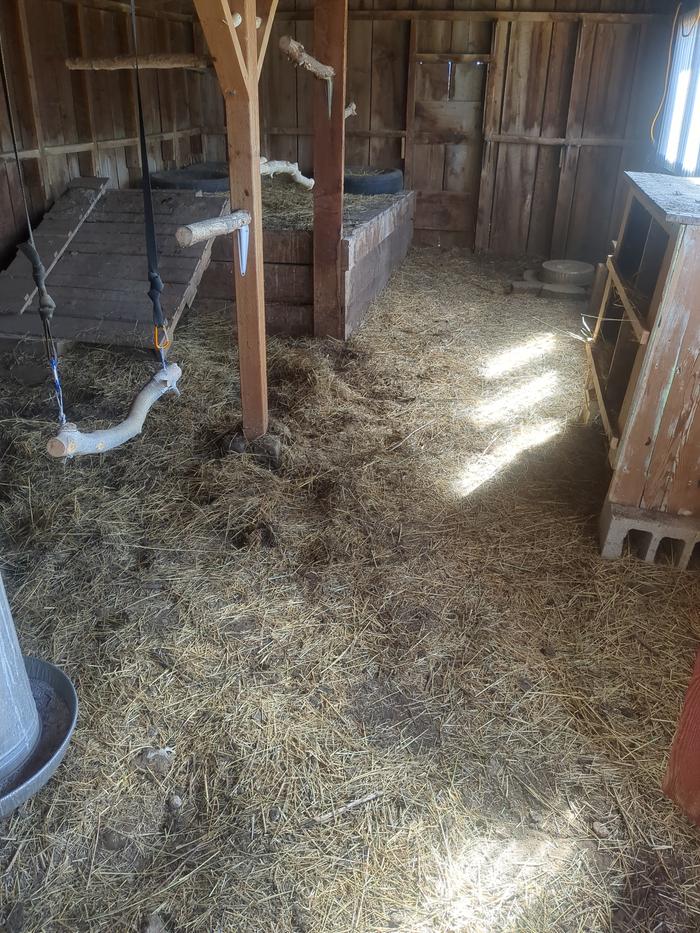
Trying to dig out the floor and get the posts to sit level and at the right height was a big challenge. The floor was covered with several inches of decades-old moldy straw that never got cleaned out so I had to dig a lot of that out and then trial-and-error my way to placing the blocks so that they would align with the one existing beam in this room.


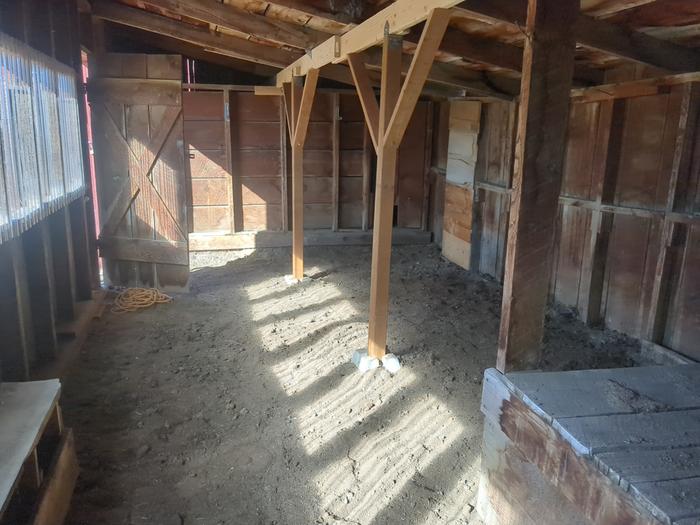
The moment of truth was when I had my husband help me take out the floor jack holding up the roof (there is no way to do that safely by myself) to see if anything would bend or shift or break. Nothing moved. Hurray!


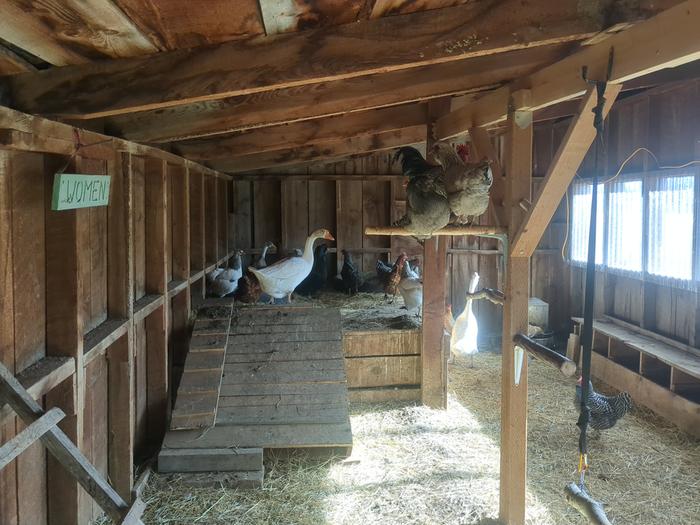
This room is looking actually usable now.


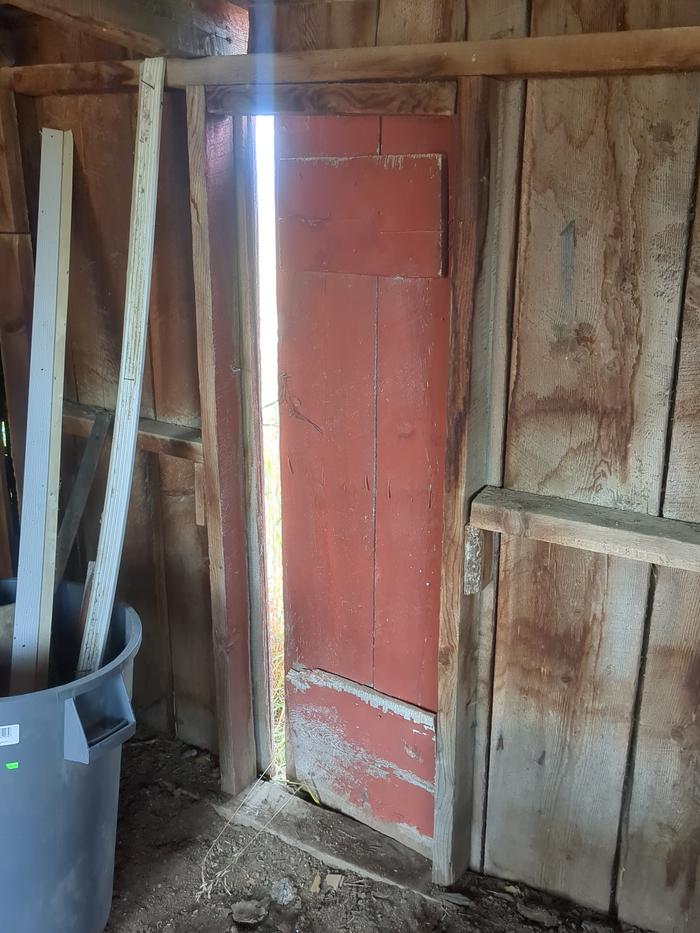
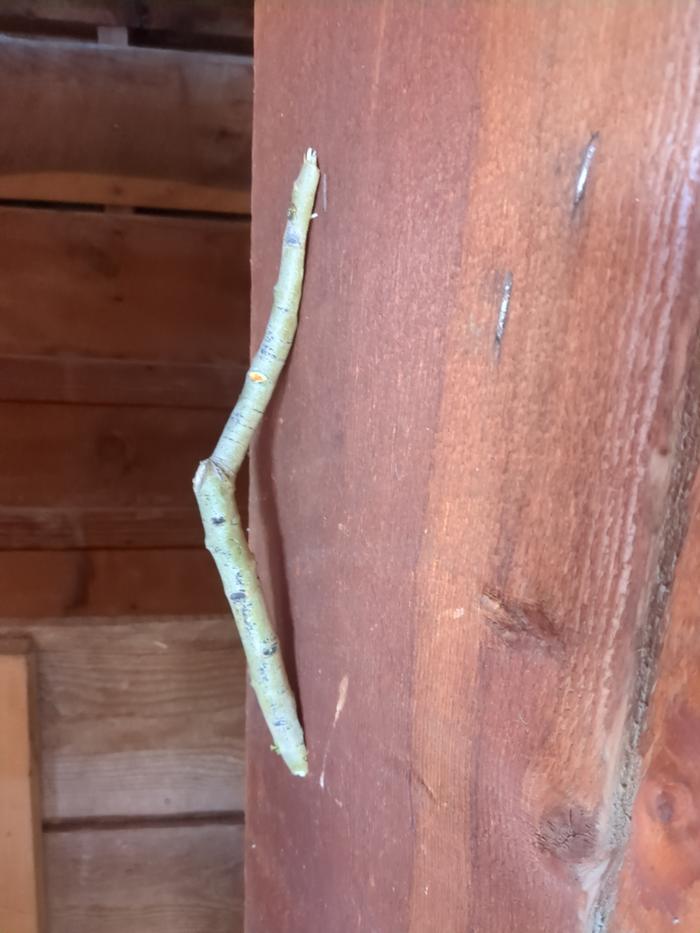
Several other things I had to do to make this space usable was board up this door on the back that wouldn't close, add some plastic to the windows that wouldn't disintegrate like whatever was on them before, and make door handles for the door and storage areas (for some reason all the door handles on our outbuildings were made out of knotted wire). I also had to tear out the light fixtures and wire that was attached to the broken beams. I'm pretty sure this wire is what was holding up the roof.


The chickens, ducks, and geese have been enjoying this space for five months now. This is a good amount of room for them and with all the straw we collected before the winter to use for deep litter, it hasn't been stinky at all. I thought I would get to test out how much the roof could hold over the winter with our usual heavy snow load, but we did not get any lasting snow for the entire winter. Nothing seems to have shifted in the last sixth months since I finished this project.


Thanks for reading and if you see anything that seriously needs to be fixed before next winter, please let me know, I would really appreciate it!
 
I'm a lumberjack and I'm okay, I sleep all night and work all day. Tiny lumberjack ad:

World Domination Gardening 3-DVD set. Gardening with an excavator.
richsoil.com/wdg


reply
    Bookmark Topic Watch Topic
  • New Topic