The idea came from Beau (although he said we should charge $1500). He says that there are people out there where this format is the best way for them to learn. Like 20 times better. Or 50 times better. When he described it to me, these folks find a book useless because the whole book just sounds crazy. Or a movie, or a collection of videos ... the content is too foreign and just sounds crazy.
So this would be you and seven others. Information would be presented, and each person can, at each moment say "that sounds crazy" and we can sort out that bit. Maybe another people will ask questions that will bring clarity to you. And then, for each person, we can explore their exact property and their exact challenges. Maybe with pics or with live video.
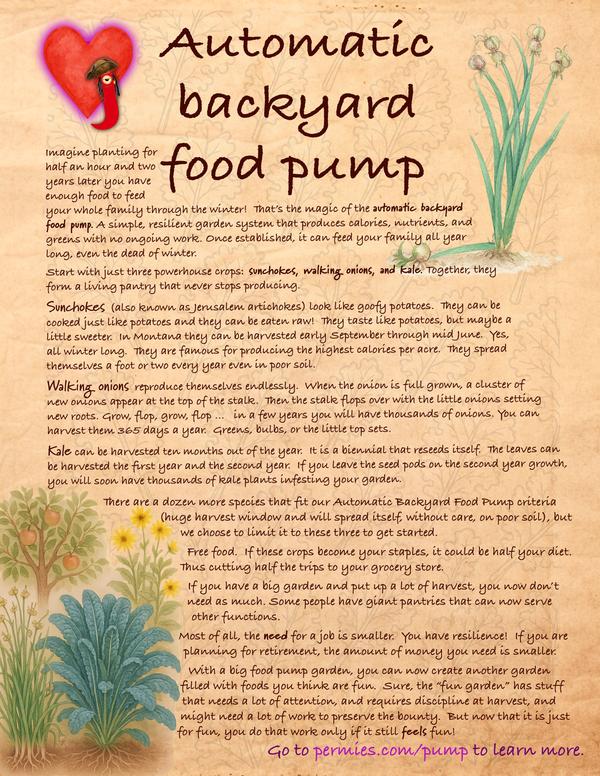
This is going to be about a style of gardening which is .... apparently ... rather unusual. Acts of gardening to produce large quantities of food two years in the future. Sure, there will be some food this season, and that's great. But the real goal is to get to a food production system that requires zero effort other than harvest. Foods become your invasive species.
My accidental food pump 20 years ago
In Seattle, I had a tiny strip of land between the sidewalk and the street where I built a garden. Lots of food. As I moved out, the new tenant ripped out my garden and planted flowers. Three years later, I happened to drive by and noticed that the flowers were all gone, but my sunchokes, potatoes and rhubarb had completely taken over. Zero care and still pumping out food.
What we will talk about
Eat what you grow, not grow what you eat. https://permies.com/wiki/372363/Podcast-Eat-Grow-grow-eat ... growing what most people eat requires a lot of work, discipline and expense - all on a tight schedule. Corn and wheat are examples of growing foods that need a lot from you, year after year. If you want to grow these, we would do it off to the side and label it a "novelty garden"
The food pump garden is going to provide a majority of your food. I think that most people will grow a large food pump garden and a small novelty garden. The food pump garden will require zero care and will be able to be harvested through the winter. A small novelty garden means a small obligation to harvest and preserve food in the fall. And a small pantry instead of a massive pantry.
Cold climate. A hard freeze in the winter. I'm in montana, and we have a really hard freeze. Maybe some folks where it stays below freezing a week (or more) each year. Maybe some folks a bit north of me too.
6 sessions. Each about 1 to 2 hours long. Each will start with 15 minutes of formal stuff, followed by some Q&A followed by people asking questions about their specific situation. Maybe with pics and stuff.
We will create a private forum for more discussion and sharing of pics.
Each of the six sessions will be recorded in case anybody cannot make a session, but these recording will never be public.
If this goes well, we might do more of this sort of thing in the future.
Are you going to organize meeting times around what works with folks who sign up? I'm guessing people will need to know if this is going to work with their schedule, probably before forking it over.
Beau M. Davidson wrote:Are you going to organize meeting times around what works with folks who sign up? I'm guessing people will need to know if this is going to work with their schedule, probably before forking it over.
That's what I was thinking: once we have our group, try to figure out a schedule for everybody.
This seems like a great opportunity, and I have learned a lot about passive food production from Paul. If demand becomes high enough, I might consider expanding to 12. 8-12 being the ideal educational group size has a lot of research behind it in the Adventure ed field, where I got my masters with a focus on Wilderness Service Learning. I found it to be the ideal group size with the hundreds of groups I have led in adventure ed, restoration, and trail crew settings. It was also the group size anthropologists found indigenous people sort themselves into for hunting and gathering parties. Generally, 8-12 helps ensure everyone has a couple people they jive with while staying manageable for the teacher. You may have your own good reasons for keeping it to 8 though.
This is all just my opinion based on a flawed memory
Anything worth doing well is worth doing poorly first. Just look at this tiny ad:





 9
9