|
|

|

|

|

|
|
|
|
|
|
|
|
|

|

|

|

|
 33
33


 33
33
 24
24
The First Axiom of Life: Don’t do dumb things.
20
24
How permies.com works
What is a Mother Tree ?


 11
11
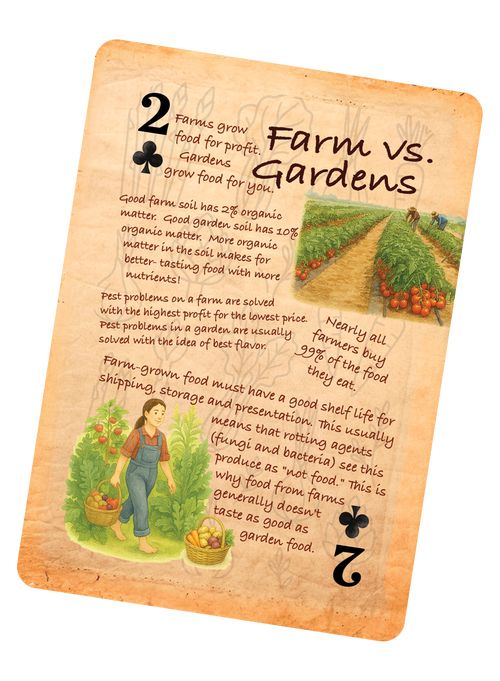
John F Dean wrote:My experiences have led me to believe there is a huge difference in perspectives between those on small farms and people living in metropolitan areas I regard to preparing for a crisis …especially one that is long term. Even more surprising to me is how similar the thinking is between the mega farmers and city dwellers. My experience has been that people operating huge farms (1000+ acres) seldom have a vegetable garden.
........... Our biggest frustration is grains. Growing, harvesting, and processing them has been difficult for us. I am trying sunflowers and corn again this year. Maybe I can be more successful.
“The most important decision we make is whether we believe we live in a friendly or hostile universe.”― Albert Einstein
15
One can never be too kind to oneself or others.
Never our fault, always our responsibility


 10
10
Invasive plants are Earth's way of insisting we notice her medicines. Stephen Herrod Buhner
Everyone learns what works by learning what doesn't work. Stephen Herrod Buhner
14
One can never be too kind to oneself or others.
Never our fault, always our responsibility
21
Creating edible biodiversity and embracing everlasting abundance.


 16
16
From under the mother plum tree.

 5
5
i do not understand where the 10 fold is coming from.
6
Anne Miller wrote:If the cost of food goes up 10x maybe my income will too.
14
Burra Maluca wrote:I'm very keen to grow a range of fruit trees/bushes/plants that will give me as close as I can get to a continuous fruit supply without the hassle of having to store it.
10
M Ljin wrote:I can guess what I’ll be doing…talking all my townspeople’s ears off about how tasty acorns and nettles and wild parsnip and dandelions are even though no one is listening.
 13
13
Visit Redhawk's soil series: https://permies.com/wiki/redhawk-soil
How permies.com works: https://permies.com/wiki/34193/permies-works-links-threads


 7
7
Jay Angler wrote:I just attended the opening presentation of our local library's new free seed library. The presenter was the coordinator of a not-for-profit local regenerative farm. I kept feeling this is not what the audience needed - they were all people with small back yards or possibly only balconies.
The library manager (I'm on first name basis with her) was wondering at the end what this could be the start of. I suggested to her that considering we are the seniors capital of Canada, that a talk on container veggie gardening might go over well. It wouldn't meet their calorie requirements, but it would boost their nutrition if the focus was on nutrient dense foods like parsley, oregano, mini-tomatoes etc. She thought that was an awesome suggestion.
9
Douglas Alpenstock wrote: I've spent time over the last 30 years on long walks through Vancouver Island (Sidney and Victoria) every spring, and have observed a fair amount of "snootiness" about vegetable gardening. Sort of the echoes of old-school British class snobbery, where only the "lower classes" grow food. The upper crust grow flowers. Personally I find it hilarious, but it appears to be a genuine thing. I don't know if that applies on the mainland.
Visit Redhawk's soil series: https://permies.com/wiki/redhawk-soil
How permies.com works: https://permies.com/wiki/34193/permies-works-links-threads
7
Jay Angler wrote: However, there is a huge permaculture trend here as well, along with publicity about how poor Vancouver Island's food security is. A lot of our more recently arrived citizens hail from the Prairies to get away from the snow. They have much more respect for farmers - or often were farmers themselves. The presentation today was *very* food focused and the seniors in the room seemed perfectly happy with that focus. They are also a great number of people on a fixed income who will be watching it erode with inflation.
 12
11
12
11
Douglas Alpenstock wrote: Excellent! Glad to see a cultural shift. We are always envious when we visit -- we can see that the amount of food that can be grown out there is simply insane. :-)
Visit Redhawk's soil series: https://permies.com/wiki/redhawk-soil
How permies.com works: https://permies.com/wiki/34193/permies-works-links-threads
13
 7
7
Jay Angler wrote:Don't be too envious - the deer and rabbits require Fort Knox to keep them out.
13
15
13
9
Douglas Alpenstock wrote:
M Ljin wrote:I can guess what I’ll be doing…talking all my townspeople’s ears off about how tasty acorns and nettles and wild parsnip and dandelions are even though no one is listening.
Hm! The townies are already massively conditioned to buy subscriptions for access to anything. They have cash but need access to country foods. This could be a business opportunity! ;-)
One can never be too kind to oneself or others.
Never our fault, always our responsibility
11
One can never be too kind to oneself or others.
Never our fault, always our responsibility
19
6
12
2
J Watt wrote:Water and fuel seems to be the most problematic for many. [quote=]
I’ve lived on rainwater 20 years; even with just 600ft2 of roof my 2 square totes in the basement fill up with a couple days of rain, then I divert to a couple of exterior totes for summer watering needs. I’m in the BC Interior with temps +/-10d of freezing, so I get water in winter although I can go without collecting Dec-Apr and still not run out.
I use a course & fine sediment filter on house water, and an additional charcoal filter for drinking water.
17
It's never too late to start! I retired to homestead on the slopes of Mauna Loa, an active volcano. I relate snippets of my endeavor on my blog : www.kaufarmer.blogspot.com
12
Never attribute to malice that which is explained by ignorance or the inability to listen
14
Douglas Alpenstock wrote:I think that a x10 "shock increase" in food cost would be the minimum for a cultural shift.
I recall the sudden rush on garden seeds during Covid. People were suddenly terrified....
Fast forward, I wonder how many of those seeds were planted? How many people kept planting in the following year? One in ten thousand? No...
 (as long as 'What you Have' is Sunchokes, Walking Onions, and Kale.


 etc..
Over-winter..)
'staples' - even from 'Store-cuts', as-per the above examples, and Kick that 'Normalcy Bias' to the curb - Right next to the Politics.
etc..
Over-winter..)
'staples' - even from 'Store-cuts', as-per the above examples, and Kick that 'Normalcy Bias' to the curb - Right next to the Politics. Every Man Dies... Not Every Man Really Lives.


 14
14
It's never too late to start! I retired to homestead on the slopes of Mauna Loa, an active volcano. I relate snippets of my endeavor on my blog : www.kaufarmer.blogspot.com
12
19
Su Ba wrote:Paul Canosa, I wouldn’t worry about that pebbled yard. Those stones would act as a mulch, helping to retain soil moisture. By carefully setting aside the pebbles, planting a veggie plant (say an eggplant for example), then returning the pebbles in place—- you’re good to go.
Never attribute to malice that which is explained by ignorance or the inability to listen

| I agree. Here's the link: https://woodheat.net |