Hugo Morvan

gardener
+ Follow
since Nov 04, 2017
Merit badge: bb list bbv list
Forum Moderator
Hugo Morvan currently moderates these forums:
Biography
I am a carpenter/mason/gardener etc, living in France, Morvan. Have small garden with about 200 different plantspecies a small natural pond, wild fish. Share a veggie plot/tree nurserie/mushroom grow operation with a local bio cattle ranger, it is being turned into a permaculture style bio diversity reserve. Seed saving and plant propagation are important factors.
Every year i learn to use more of my own produce, cooking it, potting it up. As well as medicinal herbs/balms. Try to be as self sufficient as financially possible without getting into debt. Spreading the perma culture life style and mind set, which is the only sustainable path forward on this potentially heaven of a planet we are currently ravaging with our short sighted and detached material world views which lead to depression, loneliness, illness, poverty and madness.
For More
France, Burgundy, parc naturel Morvan
Apples and Likes
Apples
Total received
In last 30 days
2
Forums and Threads

Recent posts by Hugo Morvan

Wojciech great to have you on staff. Same for Nathanael!
Hi Nathanael, i know this is an old post, maybe you're growing lots of great tasting melons by now. But if not it could be of help to try to grow a mix of diverse varieties. I used to be very bad at growing melons but this year i've had succes by growing out diverse varieites from the GoingToSeed group i'm a member of. Not many in Africa are on board the Adaptation Gardening train yet, which is a great shame, because it's such a great tool to share seeds amongst varying growers at the cost of a few poststamps surpassing the industry mostly interested in scalability and selling chemicals through the backdoor to help their weak plants.
I've had one very tough melon , very yellow, snails couldn't penetrate the skin, so i guess fruit flies couldn't either. Some genetics like that could really be the difference you need. They were very late and didn't become very sweet. I suspect somebody from Mallorca had put this variety in the mix, so i'll be trying it in the greenhouse coming summer. They might have crossed with other melons at this point... Most melons looked more like the ones in your photo though and snails got a hold of them. As well they didn't like the 40+degrees celcius heatwave we had and collapsed quite a bit. Later they bounced back and gave some lovely tasting fruit.
23 hours ago
In Holland i found a place where the dunes are invested by Eleagnus species, angustifolia as well as umbellata and multiflora i suspect. They've become all the rage because as people are looking to plant gardens that will flourish, garden centers have provided them with these plants since they're hard as nails and nitrogen fixing and don't mind growing on sand.
So in this touristy village people have been growing them in their gardens and made hedges with them, especially the evergreen ones. The birds have discovered them as well and have done a great job of infesting the dunes. I've seen this part of the dunes change rapidly. It's now infested by three types of pioneering non native plants. I don't know if i have to jump up and down in joy or weep big tears of sorrow, because i noticed the Rosa rugosa, Japanese Rose which is an invasive for 50 years seems to have created a nice soil out of where nothing but some grasses grew. Now with the Eleagnus taking it's place a bit higher on the dunes it's soil building properties are showing they make place for native shrubs and hardy oaks to take foothold whereas this previously was unthinkable. Attracting birds and so on, helping to spread the seeds while fertilizing with droppings.
It's becoming a forest slowly. Where only ever hardy grasses grew of which the function was to hold the dunes in place. I don't really see the loss for the ecosystem as the function remains similar, keep the soil from eroding away, keep the dunes in place.
It probably will push out local endangered flora and fauna, but i don't know what we should do about that as it all started out with people wanting to have gardens. And they don't want to be busy with watering so plant hardy cheap plants that need no maintenance.

Anyway, i live in a place where i try goumi for years, it takes a long while to grow and become a good chop and drop plant. Those tiny berries i can't be arsed to collect, but the birds seem happy to oblige. Maybe if they were some bigger i thought. So i ordered and exchanged goumi that were suposed to be bigger and better, but nurseries seem to lie about what the end result will be constantly. i guess they don't really know what they sell themselves, they just seem to follow trends and sell whatever is easy to propagate easily from cuttings.

So to the bewilderment of passersby i risked my life going into the overgrown prickly dunes and collect cuttings from the differing eleagnus species and i suspect that it is a wildly diverse hybrid swarm containing maybe even inter-specific crosses. How could i not, the dune protecting organizations already know about this outbreak, i looked it up and one day they'll start destroying  this genetic treasure for sure without blinking their eyes, just because they're of the opinion that everything should stay as is.

I'm going to grow these out in France, hoping i will not be unlucky and destroy the whole of Burgundy, burying it under a thicket of unstoppable Eleagnus. No i'd rather grow something worthwhile in the function of a hedge or shrub with sizeable sweet berries that like to be chopped and dropped under fruittrees profiting of it's nitrogen fixing abilities and soil building properties.
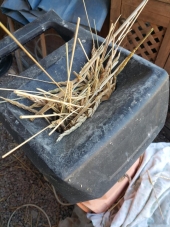
the photos are the cuttings and the situation in June and in winter.
1 day ago
I think doing this on Permies can be a good first step, a place where younger people talk amongst and older ones are not supposed to comment.
But.. I didn't mean that. I meant that this whole forum idea is a bit old. People want to just share snippets of their life. A picture on Instagram, a group on Whatsapp or Telegram they're in. I did it for GoingToSeed, we have the same problem. Old people talking amongst in very nerdy ways about nerdy subjects, in depth stuff you know for people who've been going at it for years , mostly lone wolf style. It's not attracting young people in urban settings.
It wasn't my idea to start a group, but somebody of GTS mentioned they had started a group on whatsapp and people just showed up and posted pictures lightly speaking of stuff, how great the seeds worked and how great it looked and uploaded pictures. It's about energy and low barrier and connection. People need to feel connected, that's why all these groups exist in the first place. It is difficult to find that kind of light hearted connection on this forum. It has it's advantageous, no doubt, but energetic it's not.
And that's where the young are, on the online TIk-TOks and snapchats in masses we cannot even fathom. If we want to connect we'll also have to be there and tell them about Permies, and some then will come and go in deeper. But if they do not even know we exist and are just happy to spend their life forever online with no hands on experience and often times nonsense to say it rude that's fine, but a waste of their lifes in a way, because here we have the experience, because we live or lived the life and made a zillion mistakes already. Learning is here, but the energy is not here.
1 week ago
I didn't like it at all and switched to red mountain spinach!
This is what the AI Grok says about it. Doesn't make it true, but it's an impressive amount of info they sift through. Probably next question they will find this post and use that in their answers, endlessly regurgitating info. But as you asked.

**No, Malabar seeds are not known to be poisonous to chickens.**

"Malabar seeds" most commonly refer to the **seeds of Malabar spinach** (Basella alba or Basella rubra), a heat-loving climbing vine grown as a leafy green vegetable (also called Ceylon spinach or vine spinach).

- The leaves and stems of Malabar spinach are widely considered safe and edible for chickens, similar to other greens humans eat. Chicken keepers often feed it without issues, and it's not listed in any major databases or guides of toxic plants for poultry (such as PoultryDVM or common backyard chicken resources).
- The berries (which contain the seeds) are edible for humans, and there's no evidence of toxicity to chickens. Chickens may not particularly like the taste (some reports say they ignore it), but it's not harmful.

If "Malabar seeds" instead refers to the **seeds/nuts of the Malabar chestnut** (Pachira aquatica, also called money tree or Guiana chestnut), opinions vary:
- These large nuts are eaten raw or cooked by humans in some regions (tasting like peanuts or chestnuts).
- However, some sources note potential toxicity due to compounds like cyclopropenoid fatty acids, with studies showing harm in rats. There's no specific data on chickens, so caution is advised—avoid feeding them.

In standard gardening and poultry contexts, "Malabar seeds" typically means the spinach variety, which is safe. Chickens generally avoid truly toxic plants instinctively, but always monitor your flock. If in doubt, stick to known safe treats like most leafy greens in moderation.

1 week ago
If Indian bakers are anything like French they will only change if it's economical viable to them. Somebody has to make the change, have better bread or similar, sell it cheaper than non-adapters, make more profit than regulars and open a few bakeries. Only then they might be willing to invest the time , energy and money to make a change. More to save their own jobs than to do something for a change for the public good.

Here in France long time they're using electric ovens. So long so that romantic green minded folk liked to buy bread that was cooked in a fire lid oven and forgave the baker who mostly had burned bread. And now i come to think of it, nobody of us even ever wondered why? It was just a matter of it was done this way in the past, so it must be better...

In general i would say that life works in that way, people do not like to change. Be the change. Or think of a work around. If you're worried of too many forests getting cut down, find a way to plant forests. If air polution has your interest it might be easier to change the mindset of bureaucrats around public transport, because their jobs it is to make regulation, and a change in regulation towards more air friendly ways means they find work. Maybe copy some European ways, like that old vehicles cannot come into the city centre. Which i hate by the way, because i cannot go into the city because being a poor country bum let's me live with a shitty second hand diesel van.

But in this case you'll need the people's mind to be there where they find their minds in a place where they have the luxury to thibnk asbout the environment in the first place. I would say that happens after everybody in the big cities is fed and housed. Of what i know of India that still isn't the case. Poverty is still preoblem nr1, and the industrialisation pulling people out of poverty is causing the air problem.

In my opinion poverty and housing can never be solved in a city, because megapoles attract wealth and siphon it off from the country sites, empoverishing those, which causes country bums to leave the country side for the cities, causing the very problems the cities aim to solve, but never will because of their scarcity creating nature. The solution is that people start living in harmony in the country site, which they might if they realize that real wealth is where nature is still abundant, property prices low and people friendly and not specialized in jobs narrowing their human capacities/ specializing. Nature is everlasting abundance and rocket mass heaters have their place there in making people realise we're infinite energy and solution finding nature ourselves if we chose to be in harmony with nature. Cities do not reinforce these qualities.
1 week ago
Not that i know of. I mostly did local seed swaps, because local is better, until i came across the people of going to seed who exchange landraces.
Hi Judith, no, she doesn't grow a lot of them, but she did a deep dive into growing as many varieties she could. She didn't water them at all and it has been a hot dry summer. When rain finally came they bounced back.
3 weeks ago