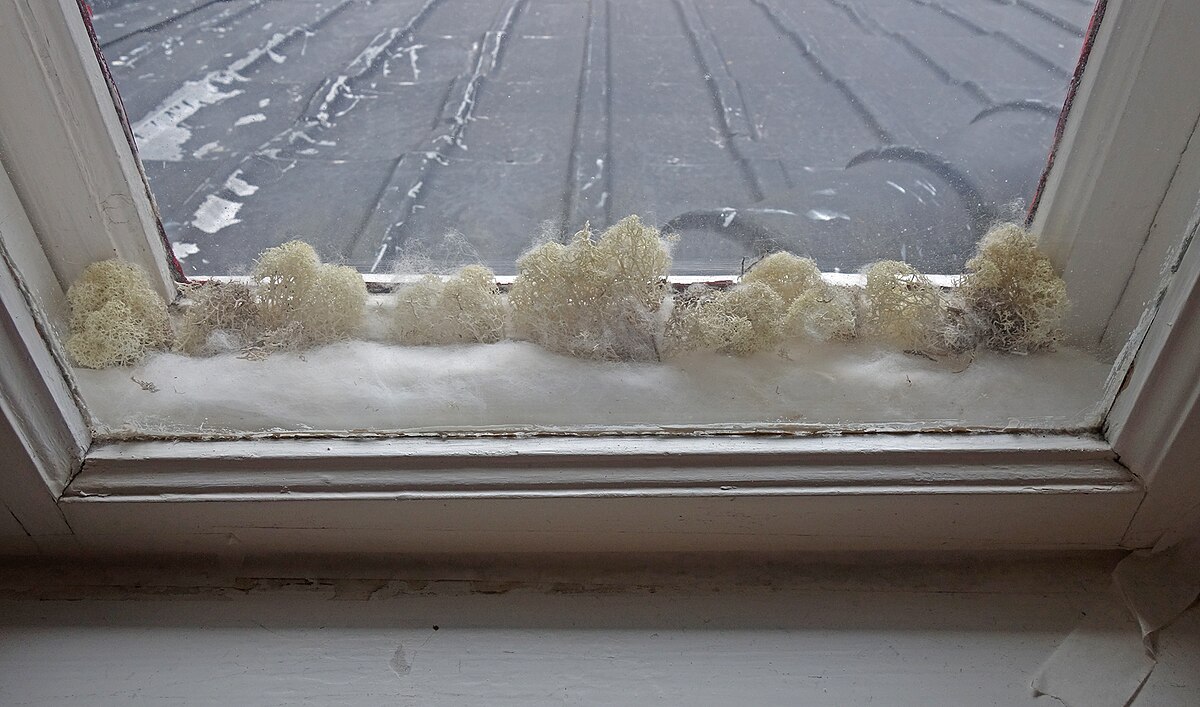
I saw a couple of different threads recently discussing how to avoid condensation between the panes in double-pane windows, and realized there's a traditional (and very permie) way to do this. In Sweden, a lichen (Cladonia stellaris, known in Swedish as fönsterlav, meaning window lichen) would traditionally be put between the panes to collect moisture. The advantage of using a living lichen, compared to using some non-living hygroscopic material, is that the lichen won't get saturated with moisture over time. Rather, it'll use the moisture to grow, locking up at least part of the hydrogen in carbohydrates.
Note that this was used in windows with wooden frames, so the frames would to some extent breathe, and the lichen's main function might have been to act as a buffer for fluctuations in air humidity. I'm not sure how it would fare in modern, non-breathing windows, but it would be worth a try.
I suspect that the reason to use Cladonia stellaris specifically is that it grows in dry, sandy habitats and can survive drying out for extended periods of time. Also, it's beautiful, giving a nice look to the lower edge of the window. However, any species of lichen that can survive dry conditions over a decent amount of time would probably work. If one could find a species that also grows reasonably fast and looks good, that would be ideal.
Cladonia_stellaris_window.jpg
Not the nicest picture, but the only one I could find online. My parents' house has one old window with lichen in it, but sadly I don't have a picture.
Those are windows that you'd open in nice weather? Like a double-hung window on the inside and a storm/weather window on the outside? That's an awesome solution. I wish I'd known to do that 20 years ago. :)
Eino Kenttä
gardener
Posts: 859
Location: Semi-nomadic, main place coastal mid-Norway, latitude 64 north
Well, you could open them in nice weather, but they're not double-hung (insofar as I understand what one is, they're not so common here) but rather the frames of the inner and outer window pane are stuck together and open together, door-style. You can separate the inner and outer frames in order to clean between the panes, but it's not typically something you do very often.
What's wrong? Where are you going? Stop! Read this tiny ad:









 1
1